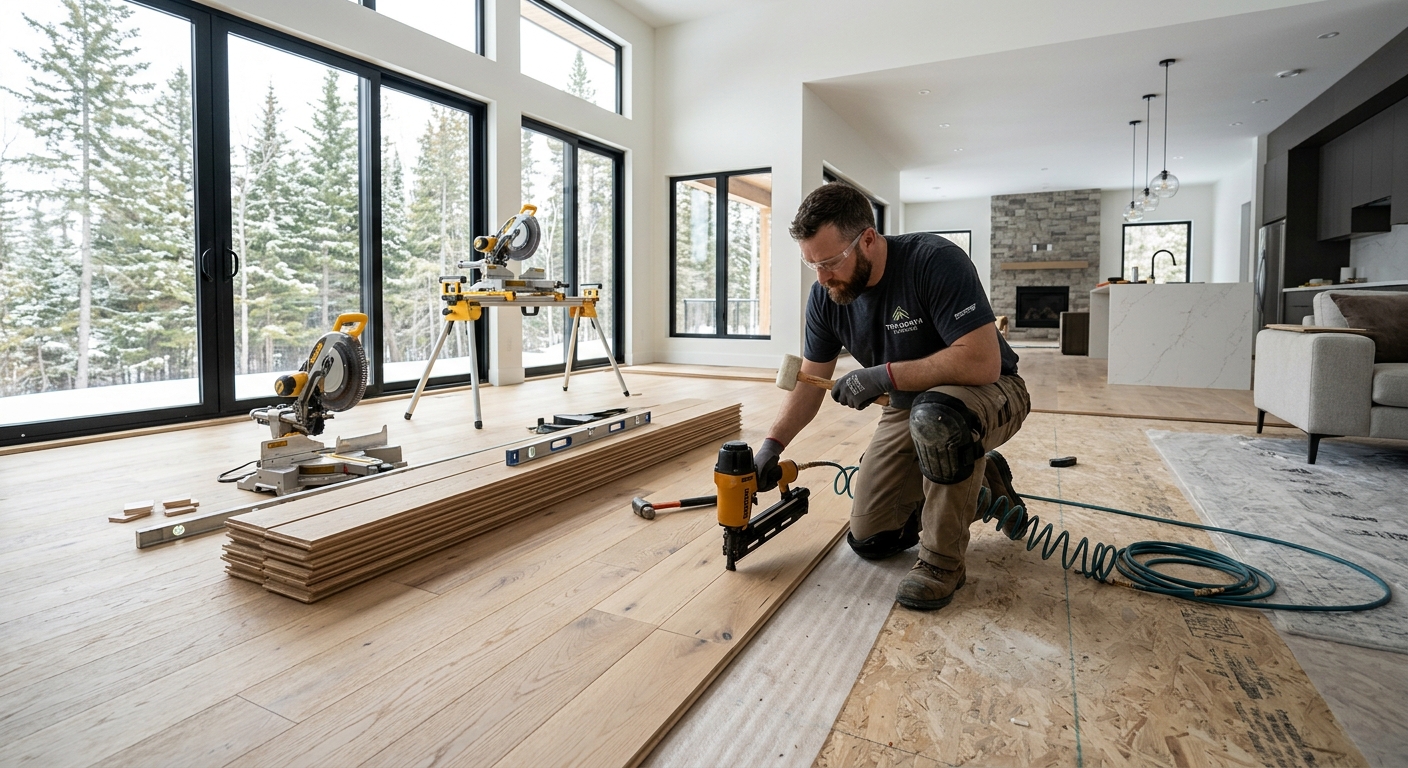
Flooring options and costs in Ganges
In Ganges, choosing flooring starts with understanding how Lower Mainland–Southwest homes handle moisture and humidity. With about 6,000 residents, the local market is smaller than Vancouver, so scheduling can be tighter when multiple trades are busy—especially in spring and early summer when renovation demand rises (Statistics Canada, 2021 Census). Costs also reflect the fact that many surrounding properties were built with older subflooring methods, and that matters: if your subfloor needs levelling or repair, homeowners in this area commonly add roughly $1–$3 per sq ft before the new floor can go down.
Because the Lower Mainland–Southwest is a wet, marine climate, indoor humidity swings can be noticeable in winter and shoulder seasons. Basements and slab-on-grade areas in the region can see moisture wicking through concrete, which is why we typically avoid solid hardwood below grade. Engineered wood and luxury vinyl plank (LVP) perform better in these conditions because their layered or PVC cores tolerate minor temperature changes and higher vapour exposure. In main living areas, solid hardwood is still popular, but it must be specified with expansion gaps and the right indoor humidity control to prevent cupping and gapping.
We see particularly strong flooring demand around the town-centre area and the older neighbourhoods closer to the waterfront, where many homes are older and subfloor prep is often the make-or-break step. Below is a practical comparison of options and realistic price ranges for Ganges, so you can align your budget before contractors measure your space.
| Type |
Best Room |
Moisture Resistance |
Lifespan |
Price per sq ft |
| Solid hardwood (nail-down, above grade only) |
Living / dining |
Low–moderate (avoid basements and slab-on-grade) |
25–60 years |
$9,00 – $18,00 |
| Engineered hardwood (float or glue, above + on-grade) |
Living, hallways, bedrooms |
Moderate (better with humidity than solid) |
20–40 years |
$9,00 – $16,00 |
| Laminate (click-lock, above-grade) |
Bedrooms, living areas (dry areas) |
Low–moderate (not for below grade flooding/moisture) |
10–25 years |
$4,00 – $10,00 |
| Luxury vinyl plank / LVP (waterproof, any level) |
Kitchen, basement (finished) |
High (waterproof core) |
15–25 years |
$5,50 – $12,00 |
| Porcelain / ceramic tile |
Bathrooms, entryways, kitchens |
Very high (surface + grout dependent) |
25–50 years |
$10,00 – $20,00 |
| Carpet (broadloom or modular tile) |
Bedrooms, stairs |
Low (needs dry subfloor) |
7–15 years |
$4,50 – $10,50 |
Prices are estimates only and vary by project scope, site access and material selection.
What affects the price of flooring in Ganges
Even for the “same” flooring, two quotes in the Lower Mainland–Southwest can differ by 30–50% because the scope details are often different: subfloor prep, moisture mitigation, demolition, waste, transitions, and whether the install method matches your home’s conditions. In Ganges and across British Columbia, labour is a major driver because it takes time to bring older floors back to flat—especially on homes with uneven plywood or concrete. That labour intensity is part of why our local price bands for laminate or vinyl plank (often $4–$10 per sq ft) can jump quickly when levelling, barriers, and stairs are included.
Technically, the Lower Mainland’s wet marine climate creates two cost drivers that surprise homeowners: indoor humidity swings and below-grade moisture. Solid hardwood expands and contracts with humidity, and it can’t be glued or floated over concrete successfully—so it’s not our go-to for basements and slab-on-grade areas. Engineered hardwood and LVP handle humidity and vapour far better for those applications. Also, when you’re in a home with radiant heating (gaining popularity in newer builds in the region), that can rule out most solid hardwood and some laminate products that aren’t rated for higher floor surface temperatures.
Concrete examples in Ganges: if your subfloor is out of flat by more than a few millimetres, levelling or an OSB overlay can add about $1–$4 per sq ft before installation. If moisture mitigation is needed—like a proper vapour barrier on slab areas—costs trend closer to the higher end of the hardwood or tile range (for example, hardwood at $9–$18 per sq ft) rather than the lower end.
| Price Factor |
Why It Matters |
Cost Impact |
| Room area in sq ft |
Material and labour scale with square footage, plus waste |
Direct cost driver; larger areas usually reduce waste per sq ft |
| Subfloor condition — levelling or repair needed |
Older floors may be uneven, spongy, or damaged |
Often adds about $1–$4 per sq ft for levelling/repair |
| Moisture / below-grade install — rules out solid hardwood |
Concrete moisture vapour affects expansion and adhesion |
Can shift you from solid hardwood to engineered/LVP; costs rise or fall based on materials |
| Material choice — solid vs. engineered vs. LVP vs. tile |
Different wear layers, cores, and warranties |
Typical band shifts: laminate/vinyl $4–$10 vs hardwood $9–$18 vs tile $10–$20 |
| Removal and disposal of existing flooring |
Time, labour, and landfill fees |
Often a significant add-on, especially for glued-down or thick underlay systems |
| Stair nosing / transitions — charged per step or per linear foot |
Edges, treads, and trim require extra labour and materials |
Can noticeably increase project total even if room area is modest |
| Radiant heat compatibility — limits material options |
Some products aren’t rated for heat cycles |
May require higher-priced, rated flooring to protect against failure |
| Installation method — float vs. glue-down vs. nail-down |
Adhesives, prep, and tolerances differ by method |
Glue-down and nail-down generally cost more than straightforward floating installs |
Permits & regulations in British Columbia
In British Columbia, installing flooring itself typically does not require a building permit. Where permits can come into play is when the flooring job includes work that affects structure, electrical systems, or regulated trade scopes. For example, if the project involves moisture remediation that requires specific subfloor repairs, structural subfloor changes (like replacing damaged joists or altering load paths), or installing/altering in-floor heating circuits, electrical permitting may be required depending on what’s being connected or modified.
In condos across British Columbia, the bigger constraint is often the building’s rules rather than municipal permits. Many condo corporations require specific underlay for sound transmission (STC/IIC), particularly for hardwood and some hard-surface installs on upper floors. Before you start, review the condo declaration and request board approval in writing for hard flooring applications, including any required underlay, underlayment thickness, and installation method.
To verify a contractor in Ganges, start with three checks: (1) Licensing/registration (where applicable) and professional standing—verify using the provincial or relevant trade registry information available online; (2) Liability insurance—ask for a certificate of insurance that lists your contractor’s business name, coverage limits, and effective dates; (3) WSIB/WCB coverage—request proof of coverage and check that it’s active for the period your job runs. Then ask for a written clearance letter if your contractor can provide one through their coverage provider.
If any of these are missing, pause and clarify before signing. Flooring failures from poor moisture control are expensive, and documentation protects you.
Best flooring for each room in your Ganges home
In Ganges, the best flooring choice comes from matching the material to that room’s moisture exposure, daily traffic, and comfort needs under a wet marine climate. For living and dining areas, homeowners typically want a warm look that still handles indoor humidity swings; engineered hardwood or high-quality laminate are common solutions because they’re more forgiving than solid wood. For bedrooms, carpet is still hard to beat for comfort and sound absorption, especially in homes where you’d rather soften footsteps.
Kitchens need durability and easy cleanup. Luxury vinyl plank (LVP) or large-format porcelain tile are excellent here because spills are common, and the floors resist water better than laminate. For basements (especially in finished basement spaces), LVP is usually the clear winner: it’s fully waterproof and performs better when there’s moisture vapour or seasonal humidity movement that can be hard to fully eliminate. Bathrooms should use porcelain or ceramic tile only, since it’s the most reliable for wet areas when installed with the correct underlayment and grouting.
If you have radiant heating—more common in newer builds in the Lower Mainland–Southwest—choose materials rated for it and avoid installing solid hardwood unless it’s specified for your exact heat system and humidity control. As a budget example: upgrading from basic laminate at about $4–$10 per sq ft to LVP around $5.50–$12 per sq ft can be worth it in a basement, because you reduce the risk of moisture-related failures that typically aren’t covered once a floor has been installed below grade incorrectly.
| Room |
Best Material |
Why |
Moisture Risk |
Price Band per sq ft |
| Living / dining room |
Engineered hardwood |
Warm look with better humidity tolerance than solid |
Low–moderate |
$9,00 – $16,00 |
| Master bedroom |
Carpet or engineered hardwood |
Comfort (carpet) or stable warmth (engineered) |
Low |
$4,50 – $16,00 |
| Secondary bedrooms |
Laminate (rated for home use) |
Cost-effective, durable surface for everyday traffic |
Low |
$4,00 – $10,00 |
| Kitchen |
Luxury vinyl plank (LVP) or porcelain tile |
Water resistance and easy maintenance for spills |
Moderate |
$5,50 – $20,00 |
| Basement (finished) |
Luxury vinyl plank (LVP) |
Best protection in case of moisture vapour and seasonal humidity swings |
High |
$5,50 – $12,00 |
| Bathroom |
Porcelain / ceramic tile |
Suitable for wet conditions with proper installation |
Very high |
$10,00 – $20,00 |
How to choose a flooring contractor in Ganges
To hire well in British Columbia, verify three things up front: (1) licensing/registration where applicable, (2) liability insurance, and (3) WSIB/WCB coverage. Ask your contractor directly for their certificate of insurance and confirm the policy is active (start/end dates) and matches the legal business name on the quote. For WSIB/WCB, request proof of coverage before work begins and confirm it covers flooring installation personnel working on your site. In Ganges, where the local pool of experienced installers can be limited, these checks matter because project timelines often depend on crews being properly assigned and insured.
Next, request 2–3 itemised written quotes—not one lump-sum. You want a line-by-line breakdown for material, underlay/padding, labour, stair labour, transitions, removal/disposal, and any moisture mitigation items (vapour barriers, primer, levelling compound). Scope clarity is where costs swing by 30–50%. Confirm whether permits are included if your job includes electrical changes (for example, radiant heating circuit work). Also confirm disposal: what’s hauled away and what’s kept.
Warranty should be clear: workmanship warranty length, manufacturer warranty for the flooring, and whether the coverage is transferable to you if you’re not the original purchaser. Payment scheduling should be conservative—never pay more than 10–15% upfront, and hold back a portion until the job is complete and you’ve received keys to any final documentation. Finally, get start date and completion estimate in writing.
- Provide a written site measure and floor plan notes (room sizes, not just “approx.”).
- Confirm the moisture plan: subfloor flatness targets, vapour barrier requirements, and acclimation time.
- Ask what underlay is included for laminate/LVP and whether it matches the product spec.
- Ensure stair pricing is itemised per step or per linear foot, not rolled into a single line.
- Confirm transitions and trims (T-mouldings, reducers, door jamb undercuts) are quoted.
- Verify removal scope: glued-down adhesive handling and disposal fees.
- Request the exact installation method (float vs. glue-down vs. nail-down) in writing.
- Check their insurance COI dates and coverage limits; keep a copy for your records.
- Confirm WSIB/WCB clearance or proof of coverage before work starts.
- Review warranty documents: workmanship, product, and who administers claims.
- Get timeline details: start date, expected milestones, and contingency for weather/humidity.
- Use a payment schedule with a holdback until completion and final walkthrough.
Red flags we commonly see in the Ganges area: contractors who won’t discuss moisture/acclimation, quotes that omit stair or disposal costs, no proof of insurance or WSIB/WCB coverage, pressure to pay the majority upfront, and vague scopes that don’t specify underlay/adhesives or installation method.
Frequently asked questions — flooring in Ganges
What flooring holds up best to pets in a Ganges home?
For most Ganges households with pets, luxury vinyl plank (LVP) is the easiest “best overall” choice because it’s waterproof and typically resists the everyday realities of accidents, paw moisture, and frequent clean-ups. In Lower Mainland–Southwest conditions, indoor humidity swings are normal, and LVP’s core is designed to tolerate those changes better than solid hardwood or many laminate floors. If you prefer the look of wood, engineered hardwood can work above grade, but you’ll still want a proper matting plan and fast wipe-ups around high-traffic areas.
Budget-wise, you’ll often see LVP land in the local band of about $5.50–$12 per sq ft, while hardwood typically sits higher (around $9–$18 per sq ft). If your pets spend time near exterior doors or in mud-tracked zones, pay extra attention to transition strips and daily maintenance—no matter the material.
How do I fix squeaky floors in my Ganges home?
Squeaks usually come from movement between subfloor layers (joists to subfloor, or subfloor to plywood/OSB), or from loose fasteners—not from the final flooring surface itself. In a Ganges home, the cause matters for cost and for whether flooring should be removed. Before you replace a finished floor, a good contractor will inspect the subfloor, check for loose screws/nails, and determine whether the squeak originates under a specific room or across a whole section.
Sometimes squeaks are solved by re-screwing or adding blocking, which can avoid replacing your floor entirely. If the squeak is widespread or your subfloor is uneven, you may need levelling or resurfacing before installing new flooring. That’s where price can change: levelling/repair commonly adds about $1–$4 per sq ft in this region, and it can bring a “simple” laminate job priced near $4–$10 per sq ft closer to the higher end once prep is included.
What is luxury vinyl plank and is it worth it in Ganges?
Luxury vinyl plank (LVP) is a layered floor product with a wear layer on top and a moisture-resistant core (often PVC-based) designed to handle real-world spills and humidity exposure. In the Lower Mainland–Southwest, where winter and shoulder seasons can bring noticeable indoor humidity swings and where basements can be affected by moisture vapour, LVP is often the most forgiving option. That’s why we frequently recommend it for kitchens and finished basements in Ganges.
Is it worth it? For many homeowners, yes—especially if you’re installing near exterior doors, in a basement, or over an imperfect subfloor. LVP’s local price band is commonly around $5.50–$12 per sq ft, and it can prevent the expensive heartbreak of moisture-related failures that are more common with solid hardwood below grade. Just make sure the installer uses the correct underlayment or moisture plan for your specific product and application.
How much does flooring cost in Ganges?
In Ganges, total flooring cost depends on both the material choice and what your home needs in prep and installation. As a starting point, local market bands for installed flooring often align with: laminate/vinyl plank around $4–$10 per sq ft, tile around $10–$20 per sq ft, and hardwood around $9–$18 per sq ft. Carpet installation is commonly in the $4–$8 per sq ft range depending on pile and underlay.
What pushes the number up is usually subfloor condition and scope: levelling or repairs frequently add roughly $1–$3 (sometimes up to $4) per sq ft in older homes, and removal/disposal plus stairs and transitions can add more. Because Ganges is part of the Lower Mainland–Southwest market with high labour demand, scheduling and installation time also affect final pricing.
Hardwood vs laminate vs vinyl plank — which is best?
There isn’t one single “best” in Ganges—each material wins in different conditions. Hardwood (solid) offers the most classic long-term look, but it’s primarily for above-grade spaces because it expands and contracts with humidity, and it performs poorly in basements or slab-on-grade applications. Engineered hardwood is a middle ground: still beautiful, but generally more stable in humidity. Laminate is a budget-friendly option for dry areas, but it’s not the same level of moisture tolerance as vinyl when you’re dealing with vapour or water exposure.
Luxury vinyl plank is often the best practical choice for Lower Mainland–Southwest homes because it’s waterproof and handles moisture vapour and humidity swings better—especially in finished basements. If you’re choosing based on cost, vinyl often lands around $5.50–$12 per sq ft, while hardwood can start around $9 per sq ft and go up significantly (often $9–$18 per sq ft). For most homeowners, the “best” option is the one that matches the room’s moisture risk.
What flooring is best for a Ganges basement?
In a Ganges basement, the best choice is usually luxury vinyl plank (LVP) or porcelain/ceramic tile, depending on how the space is finished and how much moisture risk you have. LVP is the clear go-to for most finished basements because it’s waterproof and tolerates moisture vapour better than solid hardwood and most laminate. In the Lower Mainland–Southwest, moisture can wick through concrete or show up as seasonal humidity movement, and that’s exactly where LVP performs well when installed with the right subfloor prep.
Tile is also reliable in wet-leaning areas, but it can cost more and requires solid support and proper underlayment and grout system selection. If your basement is on a slab or has known moisture issues, we typically avoid solid hardwood below grade. Budget expectations are often around $5.50–$12 per sq ft for LVP, compared with tile’s common band of $10–$20 per sq ft, with additional prep costs if levelling or moisture mitigation is required.