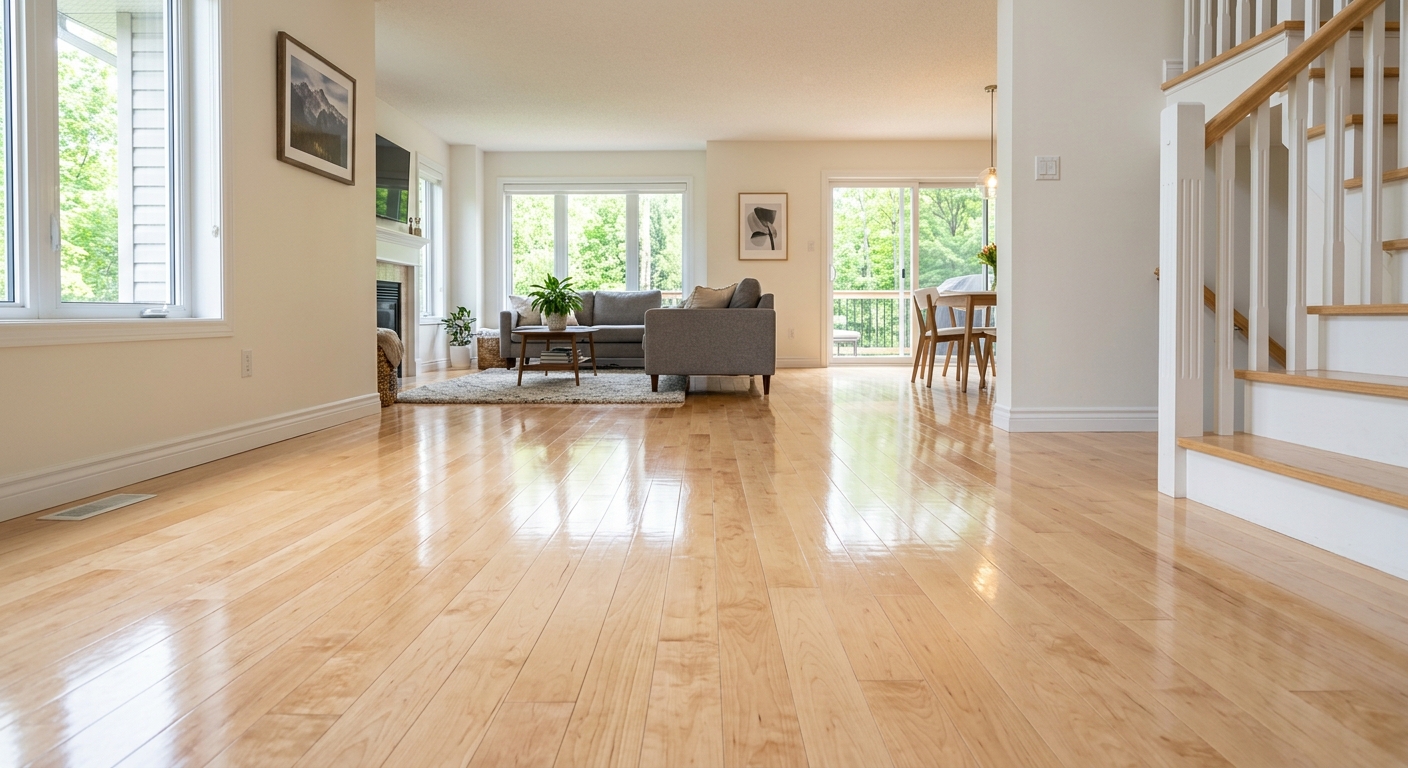
Flooring options and costs in Sechelt
Sechelt homeowners typically choose between solid hardwood, engineered wood, laminate, LVP, and tile—but the right call depends heavily on moisture behaviour and the age of the home. In Sechelt, 28.1% of dwellings were built before 1981 (Statistics Canada, 2021 Census), which matters because older plywood and concrete subfloors often need levelling, patching, or additional underlayment before any finish flooring can be installed. In other words, even when the room size is the same, your quote can change if the installer has to correct dips, seams, or moisture migration.
In the Lower Mainland–Southwest, the marine climate brings wet winters and indoor humidity swings, especially in shoulder seasons. That’s why basement and slab-on-grade areas in nearby coastal markets commonly need moisture-smart flooring. Solid hardwood can move with humidity and generally should stay above grade. Engineered hardwood and luxury vinyl plank (LVP) perform better when there’s minor temperature change and occasional vapour transmission through concrete.
Labour availability also affects pricing. Installation labour in the Lower Mainland is among the highest in Canada, so the same material can cost noticeably more if your project needs extra prep time, long carries down stairs, or detailed stair work. In Sechelt, demand is especially steady around the residential core and Chapman area, where older houses frequently get refreshed before sale or family moves.
Use the table below as a practical starting point, then we can narrow it to your exact room count and subfloor condition before anyone commits to a final number.
| Type |
Best Room |
Moisture Resistance |
Lifespan |
Price per sq ft |
| Solid hardwood (nail-down, above grade only) |
Living / dining, bedrooms (above grade) |
Low to moderate (humidity-sensitive; avoid basements) |
25–60 years |
$9–$18 |
| Engineered hardwood (float or glue, above + on-grade) |
Main floor and hallways |
Moderate to high (better for humidity and on-grade) |
15–30 years |
$9–$16 |
| Laminate (click-lock, above-grade) |
Bedrooms and living areas |
Low to moderate (water can cause swelling at seams) |
10–20 years |
$4–$10 |
| Luxury vinyl plank / LVP (waterproof, any level) |
Basements, kitchens, main floors |
High (waterproof core; handles vapour better) |
10–25 years |
$5–$12 |
| Porcelain / ceramic tile |
Bathrooms, kitchens |
Very high (tile itself is water-resistant) |
25–50 years |
$10–$20 |
| Carpet (broadloom or modular tile) |
Bedrooms, family rooms |
Low to moderate (can trap moisture if damp) |
5–15 years |
$4–$10 |
Prices are estimates only and vary by project scope, site access and material selection.
What affects the price of flooring in Sechelt
Two quotes for the same room can differ by 30–50% across the Lower Mainland–Southwest and the wider province because the biggest cost drivers aren’t just the planks—they’re the preparation, the subfloor correction, and the labour intensity. In Sechelt, indoor humidity swings and the common presence of older housing stock mean that levelling and moisture control often take longer than homeowners expect. That’s also why a “per square foot” number can feel misleading until the contractor proves how they’ll handle seams, dips, and vapour risks.
Technically, solid hardwood expands and contracts with indoor moisture and should not be glued or floated over concrete. Over basements, it performs poorly when there’s moisture migration. By contrast, engineered hardwood and LVP are layered (or PVC-core in the case of LVP) and can tolerate the minor movement that comes with coastal humidity. Colder inland pockets and radiant heating usage increasingly favour materials like engineered wood, LVP, tile, and certain laminates; most solid hardwood and some laminate products need careful temperature limits, which can add spec time to your quote.
Local examples that raise costs in Sechelt: if your home is among the 28.1% built before 1981 (Statistics Canada, 2021 Census), installers often find uneven plywood seams that require levelling or patching—commonly adding about $1–$4 per sq ft in prep. If your basement has a slab-on-grade and you’re aiming for hardwood, we typically recommend switching to LVP; otherwise, the quote can grow due to moisture remediation and replacement allowances. Conversely, if your subfloor is flat and you stay within the laminate or vinyl price bands (about $4–$10 per sq ft), labour stays more predictable—especially for click-lock layouts without extensive transitions.
| Price Factor |
Why It Matters |
Cost Impact |
| Room area in sq ft |
Larger rooms increase material quantity and labour hours |
Direct driver; expect a proportional increase |
| Subfloor condition |
Levelling, patching, or sheet replacement may be required |
Often adds about $1–$4 per sq ft for older floors |
| Moisture / below-grade install |
Concrete can wick moisture; rules out solid hardwood |
Switching to LVP can prevent costly callbacks |
| Material choice |
Solid vs engineered vs LVP vs tile changes both material and prep |
Hardwood typically sits higher (e.g., $9–$18) than LVP ($5–$12) |
| Removal and disposal of existing flooring |
Labour-heavy demo and haul-away add time and tipping fees |
Can add noticeable cost, especially with glued-down layers |
| Stair nosing / transitions |
Stairs require more cuts, nosing trim, and careful fitting |
Often charged per step or per linear foot |
| Radiant heat compatibility |
Some products have temperature limits or require specific underlay |
May force higher-spec materials; plan for extra selection time |
| Installation method |
Float, glue-down, and nail-down each demand different prep and handling |
Nail-down/precision methods usually cost more in labour |
Permits & regulations in British Columbia
In British Columbia, the act of installing new floor coverings generally does not require a building permit. However, flooring projects can include “associated work” that does require permits—most commonly when electrical systems are involved (for example, installing or modifying in-floor heating wiring, upgrading circuits, or adding thermostats). If you’re doing radiant heat over a new build or a retrofit, confirm whether the electrical scope triggers a permit and inspection.
In condominiums, regulations aren’t typically about municipal building permits—they’re about the building’s rules. Sound transmission requirements often restrict what you can install on upper floors and may require specific underlay for hard flooring to meet expected STC/IIC performance. Always review the condo declaration and ask the strata for written approval before installing hardwood or tile on above-grade, multi-unit floors. This avoids having to remove and reinstall if the installation doesn’t match the corporation’s requirements.
To verify your contractor in Sechelt, start with a paper trail: (1) licence—use the province’s online licensing directory or the contractor’s provided proof of qualification; (2) liability insurance—request a current certificate of insurance showing adequate coverage for the trade and your address/project; and (3) clearance for workers—ask whether they carry WSIB/WCB coverage for their workers (and whether proof can be provided for your project). A reputable installer will be comfortable sending documents before the contract is signed.
Best flooring for each room in your Sechelt home
Choosing flooring in Sechelt is less about trends and more about pairing each room’s moisture and traffic needs with a product that can tolerate marine humidity. For living and dining areas, engineered hardwood or high-quality laminate often hits the sweet spot: warmth underfoot, good durability, and easier humidity management than solid hardwood. In master bedrooms, carpet is still a practical choice for comfort and sound absorption, especially if you want a softer underlay feel during cool, damp winter mornings typical of the Lower Mainland–Southwest.
Kitchens are where waterproof performance pays off. LVP (luxury vinyl plank) or large-format porcelain tile handle splashes, leaks, and frequent cleaning without the edge swelling risks some laminates experience. In basements, LVP is the clear winner: a waterproof core manages moisture vapour and minor subfloor movement far better than solid wood. Bathrooms should use porcelain or ceramic tile; moisture stays under control as long as the waterproofing system and grout lines are installed correctly.
Radiant heat compatibility is increasingly common in British Columbia new construction and renovations. Engineered wood, tile, and LVP generally pair well, but solid hardwood requires careful specification and acclimation, and some laminate products have temperature limits. To justify the price difference: if tile runs near the higher band of about $10–$20 per sq ft while LVP can be about $5–$12, tile is usually worth it in bathrooms for long-term moisture performance—not just appearance. If you’d like similar comfort and easier maintenance in kitchens, LVP often gives the better value.
| Room |
Best Material |
Why |
Moisture Risk |
Price Band per sq ft |
| Living / dining room |
Engineered hardwood |
Comfortable warmth with better humidity tolerance than solid |
Low (main floor), moderate only near exterior doors |
$9–$16 |
| Master bedroom |
Carpet or engineered hardwood |
Carpet softens sound; engineered keeps a cleaner, modern look |
Low to moderate (humidity affects comfort more than water) |
$4–$10 |
| Secondary bedrooms |
Laminate (good quality) or carpet |
Laminate is cost-effective for bedrooms with normal foot traffic |
Low (avoid spills and wet mopping) |
$4–$10 |
| Kitchen |
Luxury vinyl plank (LVP) or porcelain tile |
Water resistance and easier cleanup around sinks and counters |
Moderate to high (spills, humidity from cooking) |
$5–$20 |
| Basement (finished) |
Luxury vinyl plank (LVP) |
Waterproof core supports concrete moisture conditions |
High (vapour migration and damp-season risk) |
$5–$12 |
| Bathroom |
Porcelain / ceramic tile |
Best long-term control for splash and wet-room cleaning |
Very high (direct water exposure) |
$10–$20 |
How to choose a flooring contractor in Sechelt
Picking the right contractor in Sechelt starts with verification and a clear scope. First, confirm British Columbia licensing/qualifications for the installer or trade involved, then request proof of liability insurance with coverage details that match your project. Next, ask for confirmation that workers are covered under WSIB/WCB (or equivalent clearance documents). A legitimate contractor should be able to provide certificates quickly, before any deposit is requested.
Then, get 2–3 itemised written quotes—not just a single lump sum. You want a breakdown that separates: material, underlay/moisture barrier, labour, floor levelling, removal and disposal, transitions/stair work, and any subfloor repairs. Read what’s excluded. Common exclusions that surprise homeowners include moving appliances, hauling away demolition debris, patching beyond a stated square footage, or any permit-related electrical work if radiant heat is part of the scope.
Warranty matters too. Ask for the length and terms of the workmanship warranty, and whether the manufacturer warranty is transferable if you sell the home. On payment, don’t front-load the job: keep upfront payment to about 10–15% and hold the remainder until substantial completion or key inspection points. Finally, lock in a start date and completion estimate in writing so your project doesn’t drag through Sechelt’s wetter seasons.
- Request licence/qualifications and match them to the specific work proposed.
- Ask for a current certificate of liability insurance for your address.
- Confirm WSIB/WCB coverage (or clearance proof) for workers involved.
- Get itemised quotes: material, prep/levelling, underlay/moisture barrier, labour, and disposal.
- Ensure subfloor levelling/repair is explicitly listed (and capped if there’s a limit).
- Confirm removal and disposal are included, including nail-down staples and glued remnants.
- Check transition and stair pricing (per step/per linear foot) so it isn’t “mystery cost”.
- Ask whether the contractor acclimates materials to the home and for how long.
- Verify moisture testing or moisture-plan steps are included where basements/slabs are involved.
- Require an installation schedule and completion target in writing.
- Review warranty: workmanship term, product term, and whether it’s transferable.
- Keep deposits conservative (around 10–15%) and hold back until milestones are met.
Red flags I see in Sechelt: a quote that’s not itemised, no mention of moisture barriers or subfloor flatness, refusing to provide insurance/coverage documents, vague wording like “prep included” without limits, and pushing for large upfront payments or only giving a verbal timeline.
Frequently asked questions — flooring in Sechelt
What is the best flooring for a high-traffic area in Sechelt?
For high-traffic areas in Sechelt (hallways, main living routes, and entry paths), the safest choices are engineered hardwood with a tougher wear layer, or luxury vinyl plank (LVP) with a solid waterproof core. In the Lower Mainland–Southwest’s wet, marine climate, moisture and humidity swings can be hard on edges and seams, so products that tolerate change and handle minor dampness tend to perform better. If your area is above grade and your subfloor is flat, engineered hardwood is a great balance of warmth and durability. If you’re near a basement access or you’re dealing with slab-on-grade moisture concerns, LVP usually wins on practicality. As a budgeting reference, hardwood-style products often start around $9–$18 per sq ft, while LVP is commonly closer to $5–$12 per sq ft, depending on brand and thickness.
How do I prepare my subfloor before new flooring?
Good subfloor prep is the difference between a floor that looks great for years and one that squeaks, gaps, or lifts at seams. In Sechelt homes, especially those built before 1981 (Statistics Canada, 2021 Census), installers often encounter older plywood seams, minor dips, and patch repairs. Preparation typically includes: checking flatness (not just “looks level”), fastening loose sections, removing old adhesive and nails, and repairing or levelling dips with appropriate compounds or sheet patch methods. If you’re installing over concrete or in a basement, a moisture plan is critical—solid hardwood is generally not the right choice over moisture-wicking slabs. Your contractor should explain whether they’ll add a vapour barrier, which underlay is compatible with your flooring type, and how they’ll handle transitions at doorways to avoid tripping and movement.
Is cork or bamboo flooring a good choice in Sechelt?
Cork and bamboo can work, but in Sechelt you need to be picky about construction and installation method. Cork is naturally resilient and comfortable underfoot, but it’s still vulnerable to prolonged moisture and edge swelling if water gets into seams—so it’s better for main living areas than basements. Bamboo can be a hardwood alternative, but like many “natural” wood products, it’s sensitive to indoor humidity swings; it can gap or cup if the house moisture balance isn’t managed. In the Lower Mainland–Southwest, basements and slab-on-grade areas are where I usually steer clients away from solid-style or moisture-sensitive floors. If you’re considering these materials, ask the contractor specifically about product specs: whether it’s engineered, the recommended installation method (floating vs glue-down), and moisture limitations. If you mainly want value and waterproof performance, LVP is often the lower-risk route in damp-season homes, typically in the $5–$12 per sq ft band.
What is the difference between floating and glued-down flooring?
Floating floors are installed over a foam or underlay layer and click together (or sometimes use interlocking edges) without being permanently bonded to the subfloor. Glued-down flooring is bonded directly to the subfloor with adhesive, creating a more fixed connection. In Sechelt’s humidity environment, floating installation can be advantageous when you need a little tolerance for minor movement—but it still depends on your subfloor being flat and properly prepared. Glued-down methods can improve stability on suitable subfloors and can reduce some squeaks, but they require cleaner prep and the right adhesive system. For moisture-sensitive zones, neither method should override product limitations—over basements and slabs, solid hardwood is generally not recommended. Engineered hardwood may be specified for above/on-grade applications, while LVP’s waterproof design is typically the simplest approach for high-moisture conditions, often priced around $5–$12 per sq ft depending on selection.
What flooring holds up best to pets in a Sechelt home?
For pets, I usually recommend LVP or quality engineered hardwood, with good underlayment and a finish that resists scratches. LVP is particularly popular in Sechelt because it’s waterproof and easier to clean after accidents; it also handles the coastal humidity better than many natural wood options, which helps prevent edge issues over time. If you go with engineered hardwood, choose a product with a durable wear layer and ensure proper acclimation—humidity control still matters in the Lower Mainland–Southwest. Carpet can be comfortable for pets, but it stains more easily and can hold odours if moisture gets into the fibres. Pricing-wise, LVP often lands around the $5–$12 per sq ft range, while engineered hardwood commonly sits closer to $9–$16 per sq ft depending on the line. For best results, trim nails, use felt pads, and address spills quickly—especially during damp seasons.
How do I fix squeaky floors in my Sechelt home?
Squeaks usually come from movement between layers: joists and subfloor sheets, nailed seams that loosen, or debris trapped in gaps. In older Sechelt houses (and many Lower Mainland–Southwest homes with older subfloors), squeaks can show up after temperature and humidity changes because the structure expands and contracts. Before replacing flooring, it’s smart to locate the source—walk the area and identify which spots squeak, then check for loose subfloor areas from below if access is available. The “fix” often includes re-fastening subfloor panels, adding blocking between joists where needed, and tightening nails/screws along squeaky seams. If your floor is already ready for replacement, ask your contractor to assess flatness and sound movement during prep; levelling products can help if the squeak is tied to movement, but major structural looseness may need repair. This kind of prep can affect cost, especially if levelling adds about $1–$4 per sq ft, but it usually prevents the squeak from returning under new material.