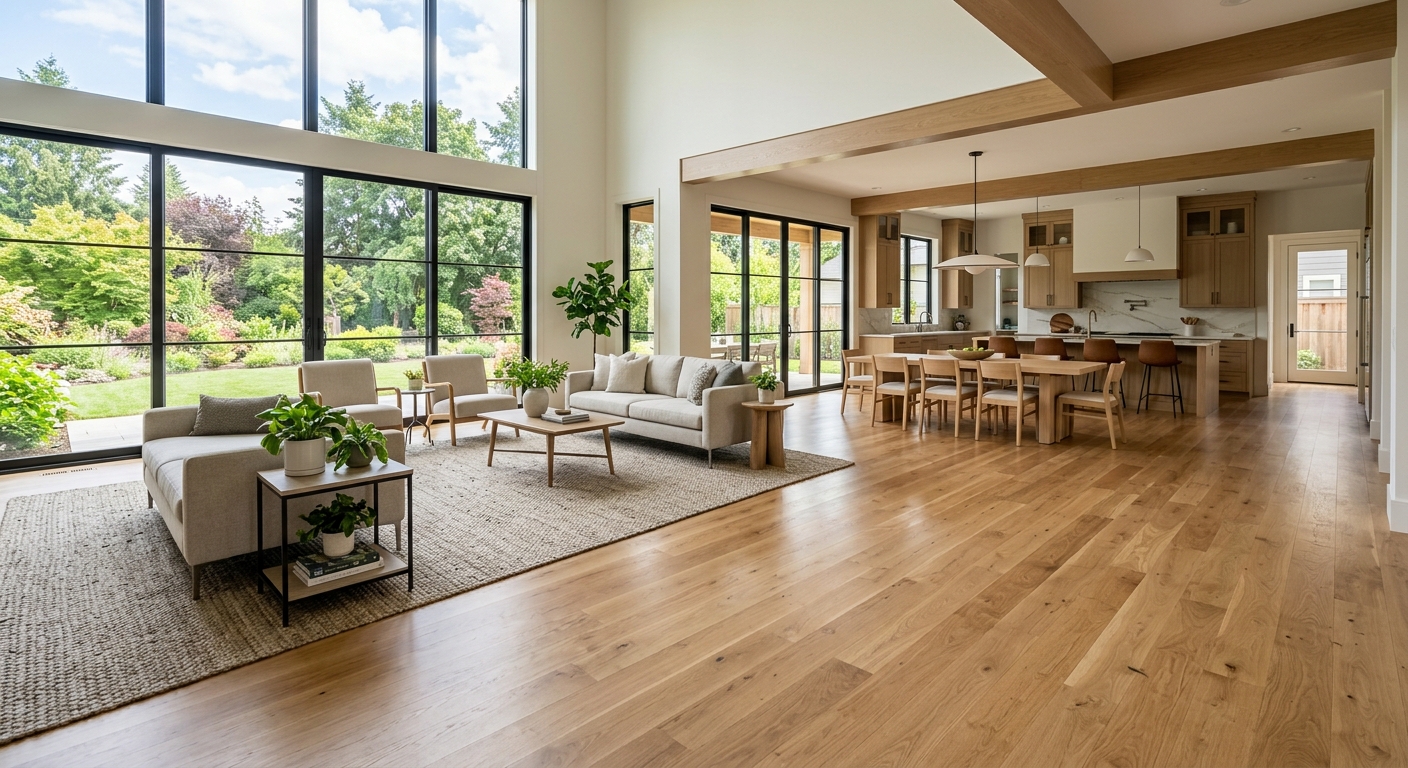
Flooring options and costs in Harrison Hot Springs
In Harrison Hot Springs, flooring decisions come down to comfort, durability and moisture control—especially when you’re dealing with the wet, marine conditions of the Lower Mainland–Southwest. With a population of 1,905 and about 720 homeowner households (Statistics Canada, 2021 Census), many upgrades are happening in occupied homes where scheduling and dust control matter. The other big cost driver is the age of the housing stock: 18.1% of homes in the area were built before 1981, and older subfloors can be uneven or prone to moisture wicking from concrete. That often means you’ll budget for levelling, repairs, and sometimes an underlay/moisture barrier system before any new finish goes down.
Because Greater Vancouver labour rates are among the highest in Canada, installation is a major portion of your total. In practice, you’ll see quotes move around with room area, subfloor condition and how your project interfaces with basements, stair transitions and any radiant heating. For below-grade or slab-on-grade areas, we typically avoid solid hardwood; it can cup or gap when indoor humidity swings. Engineered hardwood and luxury vinyl plank (LVP) perform much better in these humidity conditions because layered cores (engineered) and rigid/PVC-based construction (LVP) tolerate moisture and temperature changes more reliably. If you’re located around the lakeside and West side neighbourhoods where renovations are common, flooring crews tend to be especially busy in the shoulder season, which can affect availability and scheduling.
Here’s a practical comparison of common flooring types for Harrison Hot Springs, based on the local price bands and what homeowners usually need for a proper installation.
| Type |
Best Room |
Moisture Resistance |
Lifespan |
Price per sq ft |
| Solid hardwood (nail-down, above grade only) |
Living / dining, bedrooms |
Low to moderate (avoid basements/slabs) |
25–50 years |
$9,–$18 |
| Engineered hardwood (float or glue, above + on-grade) |
Main living areas, hallways |
Moderate to high (handles humidity swings better) |
20–35 years |
$9,–$16 |
| Laminate (click-lock, above-grade) |
Bedrooms, offices |
Low to moderate (needs dry conditions) |
10–25 years |
$4,–$8 |
| Luxury vinyl plank / LVP (waterproof, any level) |
Kitchen, finished basement, main floor |
High (good for moisture vapour and minor spills) |
15–25 years |
$6,–$10 |
| Porcelain / ceramic tile |
Kitchen, bathrooms, entryways |
Very high |
30–50 years |
$10,–$20 |
| Carpet (broadloom or modular tile) |
Bedrooms, stairs |
Low (avoid direct moisture exposure) |
8–15 years |
$4,–$8 |
Prices are estimates only and vary by project scope, site access and material selection.
What affects the price of flooring in Harrison Hot Springs
Even for the “same” flooring, quotes across the Lower Mainland–Southwest (and more broadly across British Columbia) can swing by roughly 30–50% once you factor in subfloor work, moisture prep, and how much labour is required to remove and reinstall trim, stairs and transitions. In Harrison Hot Springs, the wet marine climate increases indoor humidity swings, particularly in winter and shoulder seasons. That matters because solid hardwood expands and contracts with moisture levels, and it cannot be glued or floated over concrete. Basements and slab-on-grade areas often experience moisture wicking through the slab—so solid wood is usually ruled out, while engineered hardwood and LVP are recommended for their better tolerance of humidity and minor temperature changes.
Temperature also plays a role. Newer builds increasingly include radiant heating, and colder inland pockets in the broader region push homeowners toward products that can handle higher surface temperatures. That rules out most solid hardwood and some laminate unless the manufacturer explicitly approves radiant installations. Finally, older housing stock is common: when plywood or concrete is uneven or damaged, you may need levelling and repair—adding about $1–$4 per sq ft depending on how extensive it is. At the same time, if your subfloor is already flat and dry, you can stay closer to the lower end of the local band (for example, laminate or LVP might land closer to $4–$10 per sq ft, depending on spec), while tile and full moisture remediation often push projects toward $10–$20 per sq ft.
Concrete examples we see in Harrison Hot Springs: (1) a finished basement that needs vapour control and underlayment prep typically adds enough labour/material to move you from “basic LVP” pricing to the middle of the $6–$10 per sq ft range; (2) replacing carpet in a multi-step staircase frequently increases costs because stair nosings and transitions are priced separately per step or linear foot; (3) adding tile in a kitchen with older subfloor unevenness can mean additional self-levelling compounds and skim coating that raise the job toward the $10–$20 per sq ft tile band.
| Price Factor |
Why It Matters |
Cost Impact |
| Room area in sq ft |
Material quantity and installer time scale with square footage |
Direct: often the single largest driver for both labour and product |
| Subfloor condition — levelling or repair needed before install |
Older homes may have dips, humps, or failing underlayment |
Commonly adds about $1–$4 per sq ft depending on scope |
| Moisture / below-grade install — rules out solid hardwood |
Slabs and basements can wick moisture into the assembly |
May shift you to engineered or LVP and require vapour control prep |
| Material choice — solid vs. engineered vs. LVP vs. tile |
Different product costs, install systems, and labour intensity |
Solid hardwood and tile typically land higher than laminate/LVP |
| Removal and disposal of existing flooring |
Demo can be messy and time-consuming, especially glued-down products |
Can add a noticeable per-room surcharge on tight timelines |
| Stair nosing / transitions — charged per step or per linear foot |
Stairs require extra edging, matching height transitions and fitting |
Often adds meaningful cost beyond the floor’s square footage |
| Radiant heat compatibility — limits material options |
Not all products tolerate radiant temperatures |
May require specific engineered or approved tile/LVP specifications |
| Installation method — float vs. glue-down vs. nail-down |
Different systems require different labour and prep |
Glue-down and nail-down generally increase labour vs. basic floating |
Permits & regulations in British Columbia
In British Columbia, the flooring install itself usually does not require a building permit. Typically, if you’re only removing and replacing flooring with no structural changes, no electrical work and no modifications to plumbing, contractors can proceed under standard trade practices. However, related work can trigger permits depending on what’s being altered. For example: structural subfloor repair that affects building safety, moisture remediation that involves cutting into assemblies beyond simple surface preparation, or any work tied to in-floor heating circuits may require electrical permits. If radiant heating is being added or if existing circuits are being modified, homeowners should expect electrical permitting requirements.
For condominiums in British Columbia, the building’s corporation rules often matter as much as provincial requirements. Sound transmission rules (STC/IIC performance) can restrict hard flooring on upper levels, which may require a specific underlay and installation method to meet the building’s requirements. Always review the condo declaration and request board approval in writing before installing hardwood or tile on above-grade floors in a multi-unit building.
To verify a contractor for a Harrison Hot Springs project: (1) check their licence/registration status through the provincial registry that applies to their trade; (2) ask for a current certificate of liability insurance—ensure it lists your contractor and covers the scope of your job; (3) request proof of WSIB/WCB coverage or a clearance letter showing account status; and (4) confirm the policy dates cover the installation window. A reputable flooring contractor will provide these documents quickly and without pushback.
Best flooring for each room in your Harrison Hot Springs home
In Harrison Hot Springs, picking the right flooring by room is the most reliable way to avoid callbacks from moisture issues or premature wear. For living and dining areas, engineered hardwood or high-quality laminate can deliver a warm feel while tolerating the region’s humidity swings better than solid wood. In the master bedroom, homeowners often choose carpet for comfort and sound absorption, or engineered hardwood if they want easy cleaning and a more uniform look.
For kitchens, the Lower Mainland–Southwest climate and daily use point to luxury vinyl plank (LVP) or large-format porcelain tile. Both handle splashes, routine mopping and occasional standing water risk better than laminate. Basements are where you should be most cautious: in Harrison Hot Springs, finished basements often face moisture vapour and concrete wicking. LVP is usually the clear winner because it’s waterproof and works well with appropriate underlayment and moisture control systems. Bathrooms should be porcelain or ceramic tile only—water resistance is non-negotiable.
If your home has (or you plan to add) radiant heating, pay attention to compatibility: tile and many LVP options perform well, while solid hardwood over radiant requires careful product selection and strict acclimation. If you’re in a newer-build area where radiant heating is common, sticking with approved materials prevents expansion-related problems and helps maintain stable floor feel.
Cost-wise, the price difference is often justified by where the flooring has to “earn its keep.” For example, spending toward the tile range (often about $10–$20 per sq ft) in bathrooms is cheaper than replacing warped assemblies after moisture damage. Meanwhile, choosing LVP in a basement (commonly $6–$10 per sq ft locally) can be more cost-effective than trying solid hardwood and then dealing with cupping/gapping—especially in older homes where subfloor repair may already be needed.
| Room |
Best Material |
Why |
Moisture Risk |
Price Band per sq ft |
| Living / dining room |
Engineered hardwood |
Warm look with better humidity tolerance than solid wood |
Low to moderate (control indoor humidity) |
$9,–$16 |
| Master bedroom |
Carpet or engineered hardwood |
Carpet adds comfort; engineered keeps a cleaner, quieter feel |
Low |
$4,–$16 |
| Secondary bedrooms |
Laminate (high AC) or LVP |
Durable and family-friendly; easy maintenance |
Low to moderate |
$4,–$10 |
| Kitchen |
Luxury vinyl plank (LVP) or porcelain tile |
Handles spills and cleaning without worrying about water damage |
Moderate (spills, wet mops) |
$6,–$20 |
| Basement (finished) |
LVP (waterproof) |
Built for moisture vapour and below-grade conditions |
High |
$6,–$10 |
| Bathroom |
Porcelain / ceramic tile |
Most reliable choice for wet zones and longevity |
Very high |
$10,–$20 |
How to choose a flooring contractor in Harrison Hot Springs
Choosing the right flooring contractor in Harrison Hot Springs is mostly about proof: licences where applicable, proper insurance, and clear written scope. In British Columbia, a solid contractor can show current liability insurance (certificate of insurance listing the business) and proof of WSIB/WCB coverage (or a clearance letter showing account status). Ask them to provide these before work begins—reputable teams will have them ready. If they can’t produce documentation or dodge the question, that’s a warning sign.
Next, get 2–3 itemised written quotes. You want a breakdown that shows labour and materials separately, including underlayment/moisture barrier systems, levelling compounds (if needed), stair nosing/transitions, and disposal. Avoid lump-sum quotes that don’t explain what’s included—especially in a market with older housing stock (18.1% built before 1981), where levelling and repair are frequently required and can shift costs by $1–$4 per sq ft.
Read the scope carefully for inclusions and exclusions: is permit pulling required for related electrical work included (if radiant is being altered), is subfloor repair included, and is removal/disposal included? Confirm warranty terms: workmanship warranty length, product/manufacturer warranty coverage, and whether the warranty transfers to the homeowner if you sell the home. For payments, never pay more than 10–15% upfront; hold back a portion until the job is complete and you’ve received final sign-off. Also, insist on a written start date and completion estimate so you’re not stuck waiting during peak shoulder-season demand.
- Verify BC licensing/registration status for the trade category they work under (ask what applies to their scope).
- Request a certificate of liability insurance and confirm it covers the job dates.
- Provide WSIB/WCB clearance letter or coverage proof.
- Get 2–3 itemised quotes with labour + materials broken out.
- Confirm exactly who handles subfloor levelling/repair and what’s included.
- Ask how they test for moisture and how they prevent moisture vapour issues in basements.
- Make sure underlay, vapour barrier, and edge/expansion gap details are listed.
- Confirm stair nosings and transitions pricing (per step or per linear foot).
- Review the disposal/dump fee inclusion for old flooring and underlayment.
- Ensure the quote includes trim work, door jamb undercutting (if needed), and caulking/finishing.
- Clarify warranty: workmanship term, product warranty terms, and transferability.
- Set a payment schedule with no more than 10–15% upfront and a holdback until completion.
Red flags in Harrison Hot Springs include: quotes that don’t mention subfloor moisture/levelling at all, refusing to provide insurance/WSIB/WCB documentation, offering only vague “all-in” pricing with no disposal details, starting before you have a written scope and schedule, and blaming material failure without doing proper acclimation and expansion-gap installation for hardwood.
Frequently asked questions — flooring in Harrison Hot Springs
What flooring works with radiant heat?
In British Columbia, radiant heat compatibility depends on the flooring’s ability to tolerate temperature changes without excessive expansion or bond failure. In Harrison Hot Springs, where marine humidity swings can already stress some materials, you’ll want products that are explicitly rated for radiant heating. In general, tile (porcelain/ceramic) is the most reliable choice over radiant because it handles heat well and is dimensionally stable. Many LVP options are also approved when installed as a floating system with the manufacturer’s underlay requirements. Engineered hardwood can work if the manufacturer allows radiant installations and if the installer follows the required floor temperature limits. Solid hardwood is the most restrictive—most often it’s not recommended over radiant unless the product is specifically approved and acclimated.
Engineered vs solid hardwood — what's the difference?
Solid hardwood is one piece of wood throughout, typically installed nail-down (above grade only). Because it responds strongly to humidity changes, it can cup, gap or crown if the basement or slab assembly is affected by moisture wicking—an issue common in Lower Mainland–Southwest homes. Engineered hardwood is a layered construction: a real wood veneer on top with stable layers beneath. That layered structure gives it better dimensional stability in Harrison Hot Springs’ humidity swings, making it a more practical choice for on-grade installs and many main-floor scenarios. In basements or where moisture risk is higher, engineered (with correct underlayment and moisture control) is usually safer than solid. Pricing varies, but engineered often sits in a similar local hardwood band (commonly around $9–$16 per sq ft), while solid hardwood commonly trends toward the higher side of the hardwood range (about $9–$18 per sq ft).
Do I need to level my subfloor first?
Often, yes—especially in homes built before 1981, where older plywood or slab surfaces may be uneven. In Harrison Hot Springs, even small dips can cause click-lock flooring to separate at seams or cause tile grout lines to crack sooner. Levelling is also critical for LVP to keep the planks supported and prevent movement. Whether you need levelling depends on your flatness measurements and what’s under the current surface (old underlayment, patches, or concrete humps). If levelling is required, it’s not “extras for nothing”—it protects your investment and affects warranty outcomes. Budget realistically for subfloor condition work: older regional housing stock frequently adds roughly $1–$4 per sq ft to the overall project for levelling/repair before installation. A proper contractor will check flatness before quoting your final installation scope.
What's the most durable flooring for pets and kids?
For pets and kids in Harrison Hot Springs, the most durable choices tend to be LVP and quality laminate—because they’re easier to clean and handle everyday impacts better than carpet. Waterproof LVP is particularly helpful if you worry about moisture from mopping or humidity-related issues in basements; it’s a common solution for finished below-grade spaces in the Lower Mainland–Southwest. Look for thicker wear layers and reputable brands rather than the cheapest version. Tile is also very durable, but it can be harder on knees and more prone to chipping if small items are dropped repeatedly. Carpet is comfortable, but it stains and holds odours more readily, and it’s a weaker option if moisture risk exists. In the local price bands, many homeowners find a good balance with LVP around $6–$10 per sq ft, compared to carpet installation often landing closer to $4–$8 per sq ft—durability is usually the trade-off.
How do I choose flooring for humidity in Harrison Hot Springs?
Humidity is the deciding factor in Harrison Hot Springs. The Lower Mainland–Southwest has a wet marine climate that creates indoor humidity swings, especially in winter and shoulder seasons. Solid hardwood can move with those swings, which is why we generally keep it above grade and rely on controlled indoor humidity and correct installation gaps. For areas with higher moisture risk—basements and slab-on-grade—solid hardwood is usually the wrong direction because concrete assemblies can wick moisture. Engineered hardwood and waterproof LVP handle humidity better and tolerate minor temperature changes far more reliably. Laminate can work on dry, above-grade floors, but it’s not as forgiving if moisture vapour becomes a problem. Your best path is to choose materials that match the room’s moisture risk, use proper moisture barriers/underlay systems, and ensure acclimation and installation details are followed. If your home has older components (18.1% built before 1981), ask about levelling and moisture prep before selecting your finish.
Do condos restrict hard flooring?
Yes, often. In British Columbia, condominium corporations frequently regulate sound transmission for units above other living spaces. Even when flooring doesn’t require a building permit, your condo’s rules may restrict or require specific underlay and installation methods to meet STC/IIC performance targets. For hard flooring like hardwood, engineered hardwood, and tile, the building may require approved underlay, floating installation methods, or specific acoustic systems—especially on upper floors. Before you buy materials, review the condo declaration and ask for board approval in writing. A good flooring contractor can help you document product specifications and underlay details to make that approval process smoother. If you’re converting to hard surfaces in Harrison Hot Springs, don’t assume “standard installation” will be accepted—condo rules can be stricter than provincial requirements.