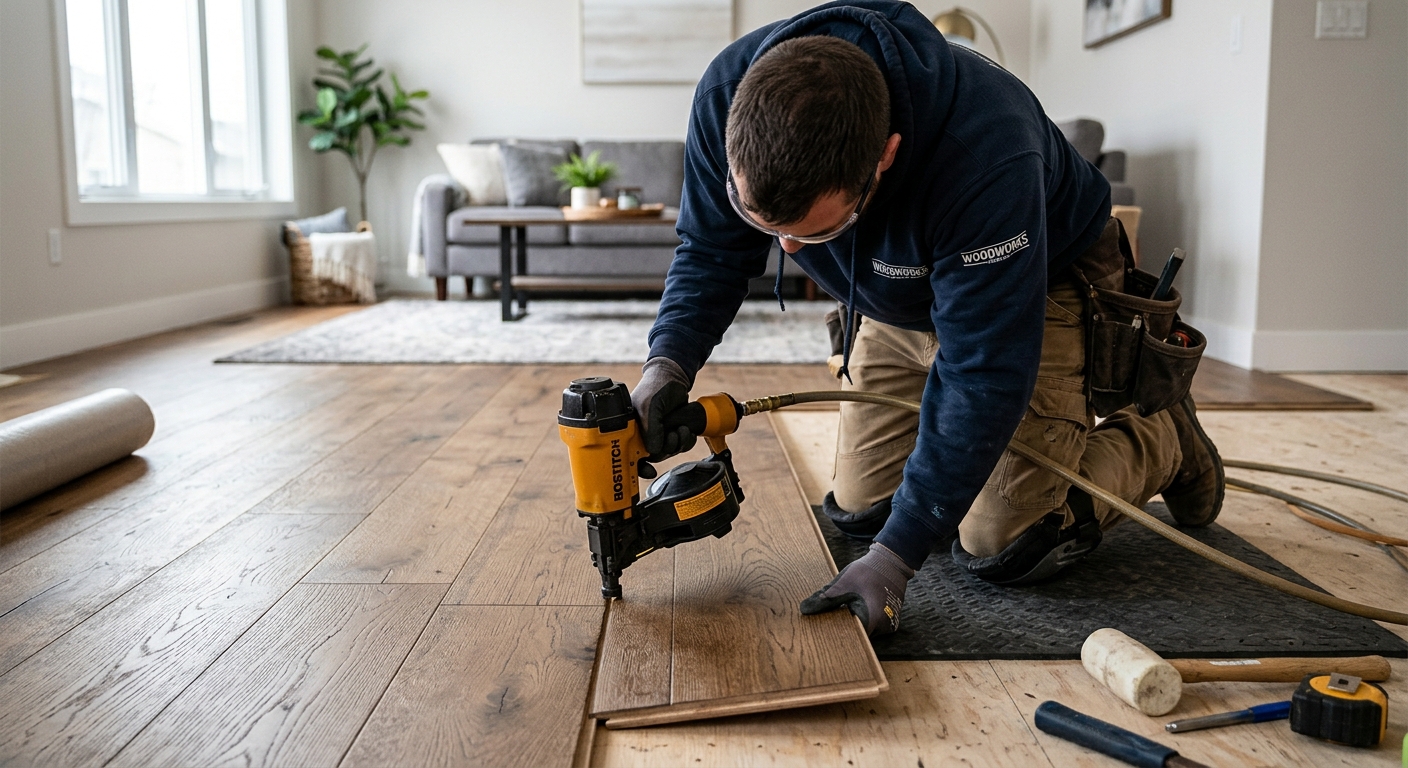
Flooring options and costs in Parkway
In Parkway, British Columbia, the flooring you choose needs to handle a wet, marine climate where indoor humidity swings can be noticeable in winter and the shoulder seasons. With a population of about 1,600 residents (Statistics Canada, 2021 Census), Parkway draws contractors from the wider Lower Mainland–Southwest market, where labour availability is good but pricing can be sensitive to project complexity. The biggest cost differences usually show up in how much prep your home needs—especially in older housing stock. Many Lower Mainland–Southwest homes have uneven plywood or older slab-on-grade conditions, and levelling, moisture barriers, and occasional resurfacing commonly add roughly $1–$3 per sq ft to the overall project.
Climate is a major driver: Lower Mainland basements and slab areas often experience moisture wicking through concrete. That’s why we typically avoid solid hardwood below grade and recommend engineered hardwood or luxury vinyl plank (LVP) instead—layered wood constructions and PVC/Vinyl cores tolerate humidity and minor temperature changes far better. For homes with radiant heating (increasing in newer builds), engineered wood, LVP, tile, and some temperature-rated laminates tend to perform well, while most solid hardwood needs careful specification and spacing.
In Parkway’s more active, renovation-friendly pockets—particularly the areas around the main commercial strip and older residential streets—flooring installs are especially in demand because moisture-safe options are top-of-mind for homeowners. Use the table below to compare typical material ranges, then we’ll break down what most affects your final quote.
| Type |
Best Room |
Moisture Resistance |
Lifespan |
Price per sq ft |
| Solid hardwood (nail-down, above grade only) |
Main living areas (above grade) |
Low—sensitive to humidity; not for basements/slabs |
25–50 years with proper humidity control |
$9,–$18,00 |
| Engineered hardwood (float or glue, above + on-grade) |
Living areas, hallways, bedrooms |
Medium to high—handles humidity better than solid |
20–40 years |
$9,–$16,00 |
| Laminate (click-lock, above-grade) |
Bedrooms, closets, some living spaces |
Medium—ok for spills with proper product rating |
10–25 years |
$4,–$10,00 |
| Luxury vinyl plank / LVP (waterproof, any level) |
Kitchen, basement (finished), utility-adjacent rooms |
High—waterproof core; tolerant of minor moisture |
15–25+ years |
$5,–$12,00 |
| Porcelain / ceramic tile |
Bathrooms, kitchens, entryways |
High—excellent resistance to water |
30–50 years |
$10,–$20,00 |
| Carpet (broadloom or modular tile) |
Bedrooms, stairs, media rooms |
Low to medium—needs dry subfloor and good ventilation |
7–15 years |
$6,–$12,00 |
Prices are estimates only and vary by project scope, site access and material selection.
What affects the price of flooring in Parkway
Even when two homeowners in the Lower Mainland–Southwest ask for the same floor “type,” quotes can swing by 30–50% across British Columbia because labour cost, subfloor condition, and prep scope vary wildly. In Parkway, that difference is usually driven by humidity performance requirements and the realities of older subfloors. Solid hardwood expands and contracts with humidity, and it generally can’t be glued or floated over concrete the way engineered or LVP can—so if your job involves a slab-on-grade or basement slab, solid wood often becomes either a poor fit or a more expensive, tightly specified install. Engineered hardwood and LVP are the practical alternatives for above-grade and on-grade areas, while tile is the “set it and forget it” option in wet rooms.
Regional temperature and installation method also matter. In colder inland pockets and some newer builds using radiant heating, most solid hardwood is either ruled out or requires a detailed spec and careful gap/conditioning—while engineered wood, LVP, and tile are more compatible. Subfloor prep is another major cost lever: older housing stock frequently needs levelling or repair, adding roughly $1–$4 per sq ft before material even goes in. That prep step can push a “laminate-looking” budget closer to higher-tier options once you include patching and underlayment.
Concrete examples from Parkway installs: (1) If an upstairs floor requires grinding and self-levelling for a click-lock laminate, the final price may land nearer the $4–$10/sq ft laminate band plus add-ons rather than staying at the low end. (2) In a basement, choosing LVP (with proper vapour control where required) is often more cost-effective than trying to force solid hardwood; avoiding moisture-driven callbacks protects your total cost. (3) If you’re moving from carpet to tile, expect transitions and stair work to rise quickly because labour is time-intensive in irregular layouts.
| Price Factor |
Why It Matters |
Cost Impact |
| Room area in sq ft |
Directly drives material quantity and labour hours |
Can move the total estimate by several thousand dollars |
| Subfloor condition |
Levelling or repair prevents gaps, squeaks, and uneven wear |
Commonly adds about $1–$4 per sq ft |
| Moisture / below-grade install |
Moisture wicking through concrete rules out most solid hardwood |
May require vapour barriers and upgraded products (often +$1–$3/sq ft) |
| Material choice |
Solid vs engineered vs LVP vs tile changes both material and prep |
Material budgets typically follow the local bands (e.g., $9–$18 hardwood; $10–$20 tile) |
| Removal and disposal of existing flooring |
Old glue, tack strips, and underlayment affect labour time |
Often adds $500–$2,000+ depending on size and debris |
| Stair nosing / transitions |
Every nosing, reducer, and custom transition takes extra measuring and cutting |
Charged per step or per linear foot; can add a noticeable premium |
| Radiant heat compatibility |
Limits material options and influences acclimation requirements |
May increase material selection costs (engineered/LVP/tile often preferred) |
| Installation method |
Float, glue-down, or nail-down changes time and subfloor tolerance |
Glue-down and nail-down usually require stricter prep and can cost more labour |
Permits & regulations in British Columbia
In British Columbia, installing flooring itself typically does not require a building permit. That said, the “associated work” around a flooring project can trigger permit requirements—especially when changes involve electrical or building structure. For example, new or altered in-floor heating circuits require appropriate electrical permitting. If you’re doing structural subfloor repair, significant joist modifications, or moisture remediation that involves sealed membranes and engineered waterproofing systems, your contractor should confirm whether any permits or inspections are required for that scope.
In multi-unit living (condominiums), regulations often come from the condominium corporation rather than the province. Sound transmission requirements (commonly expressed as STC/IIC targets) can restrict or require specific underlay systems under hard flooring on upper floors. Before installing engineered hardwood, laminate, or tile above grade in a condo, review the condo declaration and obtain board approval in writing where required. Getting this wrong can lead to costly rework and delays.
For Parkway homeowners, verify your contractor’s credentials before work starts. Check the licence/registration details through the appropriate provincial online resources, ask for a current certificate of insurance naming you (or your strata/landlord if applicable) as an additional insured, and confirm they carry WSIB/WCB coverage for their workers. If your contractor can’t provide these documents promptly, it’s usually a red flag. Lastly, request clearance letters or proof of coverage close to the start date, not months earlier.
Best flooring for each room in your Parkway home
Choosing flooring in Parkway is mostly about matching performance to moisture, traffic, and comfort—because the Lower Mainland–Southwest climate can create indoor humidity swings, and some basements or slab areas can experience moisture wicking through concrete. For living and dining areas, engineered hardwood and high-quality laminate are popular because they provide warmth and a stable feel compared with solid wood, especially when paired with good acclimation. In the master bedroom, many homeowners choose carpet for comfort and sound absorption, but engineered hardwood is also a strong option when you want easy maintenance and a cleaner feel.
In kitchens, the best “daily life” fit is luxury vinyl plank (LVP) or large-format porcelain tile—both handle splashes and frequent mopping well. In finished basements, LVP is the clear winner: it’s waterproof and far more tolerant of below-grade moisture than solid hardwood or most laminate. Bathrooms should be porcelain or ceramic tile only, with the correct subfloor prep and waterproofing practices. If your home has radiant heating, choose materials rated for higher temperatures—engineered wood, LVP, and tile are usually the safest pairings, while solid hardwood needs careful specification and spacing.
One practical cost example: if you’re deciding between engineered hardwood ($9–$16/sq ft) and LVP (often $5–$12/sq ft) for a 500 sq ft main level, the material difference alone can be roughly $2,000–$5,500. In a basement, though, spending extra on engineered wood is often not the best use of funds because moisture risk can outweigh the savings—LVP usually prevents long-term cupping/gapping concerns.
| Room |
Best Material |
Why |
Moisture Risk |
Price Band per sq ft |
| Living / dining room |
Engineered hardwood |
Warm look with better humidity tolerance than solid |
Low to medium (manage indoor humidity) |
$9,–$16,00 |
| Master bedroom |
Carpet or engineered hardwood |
Carpet adds comfort; engineered keeps maintenance simple |
Low to medium |
$6,–$12,00 |
| Secondary bedrooms |
Laminate (higher grade) or LVP |
Durable and easier to maintain for kids/pets |
Low to medium |
$4,–$10,00 |
| Kitchen |
Luxury vinyl plank (LVP) or porcelain tile |
Handles spills and frequent cleaning |
Medium (wet-to-dry transitions) |
$5,–$20,00 |
| Basement (finished) |
Luxury vinyl plank (LVP) |
Waterproof tolerance for below-grade moisture conditions |
High (vapour/moisture wicking through concrete) |
$5,–$12,00 |
| Bathroom |
Porcelain / ceramic tile |
Best long-term water resistance |
Very high |
$10,–$20,00 |
How to choose a flooring contractor in Parkway
Start by confirming British Columbia contractor accountability. Ask for their licence/registration details (where applicable), then request a certificate of insurance and verify it’s current. Also confirm WSIB/WCB coverage for their workers—get proof, not just a verbal statement. In Parkway, I recommend you ask for these documents before materials are ordered so you’re not stuck with a contractor who can’t substantiate coverage.
Next, collect 2–3 itemised written quotes with a clear labour + materials breakdown (not a single lump sum). Itemise prep work (levelling/patching), underlay/vapour barriers, moulding/transition pieces, stair nosing, and removal/disposal. Make sure the quote states what’s included in the scope: permit pull (if any related work requires it), subfloor moisture mitigation, and whether furniture moving is included. For warranties, separate workmanship from product/manufacturer warranty, and confirm whether the warranty is transferable if you sell the home.
Payment terms matter. Avoid paying more than 10–15% upfront; hold back payment until the job is complete and walkthrough corrections are done. Get a start date and a completion estimate in writing, including what happens if materials are delayed.
- Verify their British Columbia registration/licence details online and confirm the correct legal business name on the quote.
- Ask for a current certificate of insurance and ensure you’re listed if required by your strata/lease.
- Confirm WSIB/WCB coverage and request proof for subcontractors too.
- Require itemised labour and material totals (including underlayment/vapour barrier).
- Check the scope for subfloor prep: flattening, patching, and moisture mitigation.
- Confirm removal and disposal costs (and what’s being disposed of).
- Ask how they handle transitions and stair nosings (per step/linear foot).
- Request the brand/model of flooring and underlay/tape/adhesive—no vague “equivalent” language.
- Get the acclimation plan for wood products in Parkway’s humidity swings.
- Ask for workmanship warranty length and whether they return for adjustments if gaps appear.
- Review payment schedule: 10–15% max upfront; holdback until completion and punch-list.
- Ensure timeline details are written: start date, duration estimate, and material lead times.
Red flags to watch in Parkway: they won’t provide insurance/coverage documentation; quotes omit subfloor prep and moisture barriers; they refuse itemised pricing; they use “low-grade equivalent” materials without naming products; or they push for large upfront payments before any prep work is complete.
Frequently asked questions — flooring in Parkway
How do I choose flooring for humidity in Parkway?
In Parkway and the broader Lower Mainland–Southwest, the wet marine climate means indoor humidity can swing more than many homeowners expect, especially around winter heating and shoulder-season weather. Solid hardwood can expand and contract with these changes, which is why it’s generally recommended for above-grade spaces only. If you’re dealing with basements or slab-on-grade areas, moisture wicking through concrete is a common issue, so we usually steer homeowners toward engineered hardwood or luxury vinyl plank (LVP) because they tolerate humidity better. If your home uses radiant heat, you’ll also want products rated for temperature fluctuation. For budget planning, solid hardwood often sits in the $9–$18 per sq ft local band, while LVP commonly comes in around $5–$12 per sq ft—often making LVP the safer choice where moisture is a concern. (Statistics Canada, 2021 Census)
Do condos restrict hard flooring?
Yes, in British Columbia condos the restrictions are usually set by the condominium corporation, not by the flooring trade itself. Many condos require specific underlay systems and may target STC/IIC sound transmission levels, particularly for hard flooring like engineered hardwood, laminate, and tile in upper units. Before you install, review the condo declaration and any board rules, and request approval in writing when required. Practically, this affects both material selection (specific underlay) and installation technique (how seams are treated, whether floating vs. glue-down is permitted). If you install without approval, the board can require removal and reinstallation, which is far more expensive than doing it right. It’s also wise to ask your contractor to include the approved underlay and document the product so you can show compliance during any follow-up.
How do I compare flooring quotes?
To compare quotes in Parkway fairly, don’t look only at the total price—compare the scope and inclusions. Ask each contractor to provide an itemised breakdown of materials and labour, including subfloor prep (level/pour/patch), underlayment or vapour barrier, transitions, and stair nosing. Make sure they specify the exact product model and thickness, not just “equivalent” categories. Also confirm removal and disposal of old flooring is included, and clarify whether furniture moving is part of the labour. For example, tile projects often land in the $10–$20 per sq ft band locally, but the final cost can increase if levelling and underlayment are extensive. Similarly, laminate might be $4–$10 per sq ft in a simple install, but can climb if you need heavy prep. Finally, compare warranty terms: workmanship vs. manufacturer coverage, and whether the warranty is transferable.
Can I install flooring over existing tile in Parkway?
Sometimes, yes—but it depends on the condition of the tile and the new floor type. If the existing tile is solid, firmly bonded, flat enough, and not cracked/loose, contractors can often install engineered floating floors or some click-lock systems over it with the right underlayment and moisture plan. For tile-to-tile with new tile, you’d evaluate deflection, lippage, and whether it’s better to remove or armour/patch. The key is flattening and height transitions: older Lower Mainland–Southwest homes can have uneven subfloors, and adding layers can create problems at doorways and transitions. Also consider moisture—if the existing tile is part of a bathroom system or moisture-controlled assembly, you want to preserve that performance. A proper contractor will measure flatness and discuss whether grinding/patching is required. If they skip these checks, the risk is hollow spots and future grout/tile failure or click-lock joint issues.
What is the best flooring for a high-traffic area in Parkway?
For high-traffic areas in Parkway—think main hallways, entry paths, and open-concept living spaces—durability and moisture tolerance are both important. Engineered hardwood performs well when installed correctly above grade, and it’s often more stable than solid hardwood in our humidity swings. Luxury vinyl plank (LVP) is also a strong choice because it’s waterproof and handles the wet-to-dry cycles that happen near entrances and kitchens. For a lot of homeowners, the cost/value tradeoff is compelling: engineered hardwood commonly falls in the $9–$16 per sq ft range, while LVP is often closer to $5–$12 per sq ft locally. If you expect heavy traffic, pets, or frequent mopping, LVP tends to reduce worry about moisture and minor temperature changes. If you want a “best of both worlds” approach, use tile in the riskiest water-exposed spots (entries/bath zones) and LVP or engineered in the rest. (Statistics Canada, 2021 Census)
How do I prepare my subfloor before new flooring?
Subfloor prep is where good installs are won or lost in British Columbia. The contractor should start by checking flatness, firmness (no flex), and surface condition. If your home is older, expect some combination of levelling, patching, or fixing squeaks—those steps are a common reason quotes differ by 30–50%. Next, the installer evaluates moisture conditions. For below-grade areas or on-grade slabs, they may require vapour barriers or specific underlay systems; this is the main reason solid hardwood is usually avoided in basements because it can’t tolerate humidity as well. In radiant-heat homes, confirm the floor heating manufacturer’s requirements and choose products rated for temperature. Ask for the plan in writing: what prep materials they’ll use, what tolerance they’re targeting, and how they’ll protect your home during dust-prone levelling. When the prep is properly documented, it’s much easier to warranty the final result.