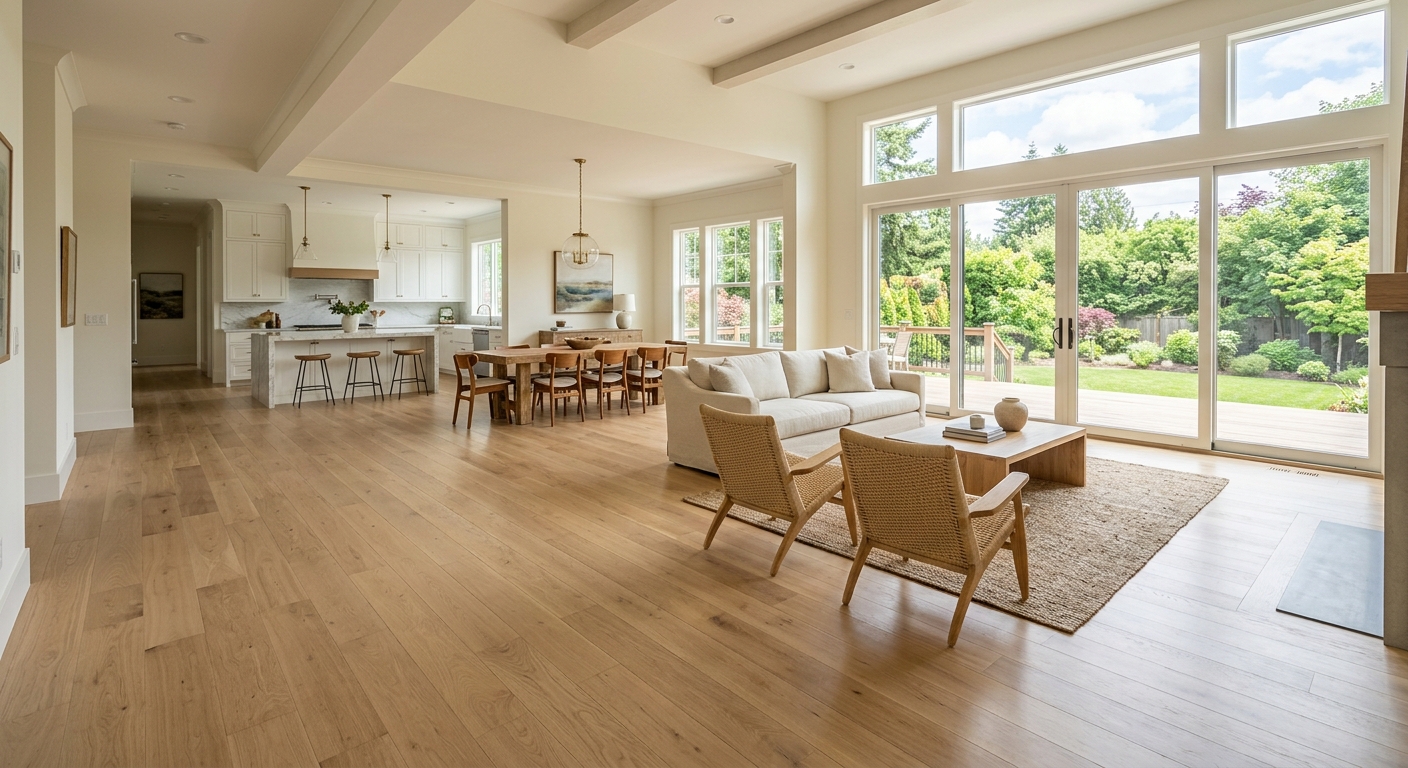
Flooring options and costs in Eagle Ridge
Eagle Ridge homeowners usually have several solid flooring choices, but the total project cost can swing meaningfully depending on the room layout and the condition of the subfloor. With 11,004 residents in town (Statistics Canada, 2021 Census), demand is steady—especially around newer pockets and family-heavy areas where people replace tired surfaces during renovations. In the Lower Mainland–Southwest, a lot of housing stock is older, and uneven plywood or patchy concrete is common. That often means levelling, adding a proper underlayment system, or sometimes a subfloor resurfacing prep step before any new finish goes down—typically adding roughly $1–$3 per sq ft to the overall budget. Because our local market rates are among the highest in Canada, installation labour is a major share of your quote, not just the flooring material.
The wet, marine climate around Eagle Ridge brings indoor humidity swings in winter and shoulder seasons. Basements and slab-on-grade areas are especially prone to moisture wicking through concrete. For that reason, solid hardwood is generally best reserved for above-grade spaces, while engineered wood and luxury vinyl plank (LVP) perform better where humidity varies and where minor temperature changes are normal. If your home uses radiant heating, it can influence what you can install over top and how the installer manages expansion. Trade demand is particularly high in and around family-renovation corridors like the West Eagle Ridge / Eagle Ridge Village area, where upgrades often include kitchen refreshes and “whole-main-floor” replacements.
Below is a practical cost comparison to help you translate quotes into apples-to-apples comparisons—then we’ll break down the key cost drivers next.
| Type |
Best Room |
Moisture Resistance |
Lifespan |
Price per sq ft |
| Solid hardwood (nail-down, above grade only) |
Main living areas above grade |
Low (humidity sensitive; avoid basements/slabs) |
25–50 years |
$9,00 – $18,00 |
| Engineered hardwood (float or glue, above + on-grade) |
Living areas, bedrooms, hallways |
Medium to high (better tolerance to humidity swings) |
20–35 years |
$9,00 – $16,00 |
| Laminate (click-lock, above-grade) |
Bedrooms, offices, hallways |
Low to medium (water-resistant varies by brand; avoid prolonged moisture) |
10–25 years |
$4,00 – $10,00 |
| Luxury vinyl plank / LVP (waterproof, any level) |
Basements, main level kitchens, entryways |
High (waterproof; handles humidity better) |
15–25 years |
$5,00 – $10,00 |
| Porcelain / ceramic tile |
Bathrooms, kitchens, entries, mudrooms |
Very high (waterproof once installed correctly) |
30–50 years |
$10,00 – $20,00 |
| Carpet (broadloom or modular tile) |
Bedrooms, stairs, rec rooms |
Medium (protect from spills; moisture can affect underpad) |
8–15 years |
$4,00 – $8,00 |
Prices are estimates only and vary by project scope, site access and material selection.
What affects the price of flooring in Eagle Ridge
In the Lower Mainland–Southwest, it’s common to see the same type of flooring quote differ by 30–50% once you compare the full scope across British Columbia jobs. The reasons are usually technical (subfloor flatness, moisture remediation, transitions, and labour complexity), not just product cost. Eagle Ridge’s wet, marine climate makes indoor humidity swings a real factor—especially in winter and during damp shoulder seasons—so installers often spend more time preparing surfaces and managing expansion gaps and vapour control. Where basements and slab-on-grade spaces are involved, moisture wicking through concrete can force changes in material choice: solid hardwood expands and contracts with humidity and generally can’t be glued or floated over concrete, while engineered hardwood and LVP handle humidity and minor temperature changes far better.
Colder pockets and newer builds increasingly add radiant heating. That usually means solid hardwood is limited or needs careful specification, and it can rule out certain laminate grades. Another common driver is older housing stock: if the subfloor is uneven or needs repair, levelling and fix-up steps add roughly $1–$4 per sq ft. For example, in a typical Eagle Ridge renovation, going from laminate at about $4,00 – $10,00 per sq ft to engineered hardwood at $9,00 – $16,00 per sq ft may be justified when the install includes a proper moisture-tolerant underlayment system and a better edge/transition package. Conversely, sometimes the “premium” isn’t worth it if your subfloor needs the same expensive levelling regardless of whether you choose LVP or engineered wood.
Two practical examples: (1) a 600 sq ft main-floor project with poor plywood flatness can add levelling labour comparable to one step up in material tier; (2) a basement conversion on slab may steer you to waterproof LVP, where you’re paying more for the right product, but avoiding higher-risk repairs that come with solid hardwood failures.
| Price Factor |
Why It Matters |
Cost Impact |
| Room area in sq ft |
Materials and labour scale directly with square footage |
Often the largest portion of your total; larger rooms benefit less from minimum labour charges |
| Subfloor condition — levelling or repair needed before install |
Uneven plywood or patchy concrete increases labour and prep materials |
Commonly adds about $1–$4 per sq ft in older homes |
| Moisture / below-grade install — rules out solid hardwood |
Humidity swings and slab moisture wicking require a safer system |
May shift you from solid hardwood to engineered or LVP; can increase material line items |
| Material choice — solid vs. engineered vs. LVP vs. tile |
Product tier changes both cost and install complexity |
Hardwood and tile are higher-ticket; LVP can be mid-range but often wins on basements |
| Removal and disposal of existing flooring |
Old flooring, underpad removal, and haul-away add time |
Can add noticeable labour cost; sometimes a significant portion of the “install” line |
| Stair nosing / transitions — charged per step or per linear foot |
Stairs and doorways require custom finishing for safe edges and clean lines |
Often under-estimated; can add hundreds to a full-project total |
| Radiant heat compatibility — limits material options |
Some products handle heat cycling better than others |
May increase cost if you need a specific engineered build or rated underlayment |
| Installation method — float vs. glue-down vs. nail-down |
Method affects labour time, subfloor prep, and product system requirements |
Glue-down and nail-down systems typically cost more than straightforward floating installs |
Permits & regulations in British Columbia
In British Columbia, flooring installation itself typically does not require a building permit. Most finish work—like installing LVP, laminate, carpet, or standard above-grade engineered hardwood—falls under normal renovation work. However, permits can come into play when flooring projects include related work that touches other building systems. For example, if your flooring scope includes structural subfloor repair (especially if joists are modified), moisture remediation measures that affect building envelopes or requires specialized remediation, or in-floor heating circuit changes (electrical work), those may trigger electrical permit requirements depending on the extent of the work.
In condominiums, the bigger constraint is usually not a permit—it’s the building and unit rules. Many corporations restrict hard flooring because of sound transmission. They may require specific underlay systems or limit the amount/thickness of floating installations on upper floors. Before you install hardwood or tile above grade in a multi-unit building in Eagle Ridge (Lower Mainland–Southwest), review the condo declaration and ask for board approval in writing when required—especially if your plan includes tile or a hard surface over living space below.
To verify your contractor in Eagle Ridge and across BC, follow three steps: (1) confirm they have the right BC licence for the work they’re doing (search their business details in the appropriate online registry); (2) request an up-to-date certificate of insurance and ensure general liability is current; and (3) ask for proof of coverage for workers (WSIB/WCB clearance or evidence that matches the province’s requirement for their workforce). A reputable flooring company will provide these documents readily before you sign a contract.
Best flooring for each room in your Eagle Ridge home
Choosing the “right” flooring in Eagle Ridge is mostly about matching material behaviour to room moisture, traffic, and comfort needs—then accounting for Lower Mainland–Southwest humidity swings. In living and dining areas, engineered hardwood is a popular sweet spot: it gives you the look and warmth of wood while better tolerating seasonal moisture changes than solid hardwood. For bedrooms, many homeowners choose carpet for comfort and sound absorption, but engineered hardwood also works well when your installer uses a moisture-appropriate underlayment system.
In kitchens and entries, water and tracking from wet weather are daily realities. That’s where luxury vinyl plank (LVP) or large-format porcelain tile tends to win. For basements (finished), LVP is typically the clear winner because it’s waterproof and handles moisture vapour and below-grade installs that can create issues for solid wood and many laminate products. Bathrooms should be porcelain or ceramic tile only, because grout and waterproofing details matter most where water exposure is frequent. If you have radiant heat (common in newer BC builds), engineered wood, LVP, tile, and some rated laminates work well—solid hardwood needs careful product specification and installation spacing to avoid cupping and gapping.
Here’s an easy budget reality: if your main floor is above grade and your subfloor is already flat, laminate in the $4,00 – $10,00 range can be cost-effective. But if you’re planning to level an older subfloor anyway, spending on engineered hardwood in the $9,00 – $16,00 range may be a better long-term value—because you’re paying for prep once and upgrading the finish that will be walked on daily.
| Room |
Best Material |
Why |
Moisture Risk |
Price Band per sq ft |
| Living / dining room |
Engineered hardwood |
Warmth and realistic wood look with better humidity tolerance than solid |
Low to medium (watch window condensation in winter) |
$9,00 – $16,00 |
| Master bedroom |
Carpet or engineered hardwood |
Carpet adds comfort and sound control; engineered offers easy maintenance |
Low (typical day-to-day humidity) |
$4,00 – $16,00 |
| Secondary bedrooms |
Laminate (click-lock) or LVP |
Durable for kids; LVP adds spill protection if you have occasional wet footwear |
Low to medium |
$4,00 – $10,00 |
| Kitchen |
Luxury vinyl plank (LVP) or porcelain tile |
Handles spills and cleaning; tile stands up to heavier water exposure |
Medium to high (spills and sink splash) |
$5,00 – $20,00 |
| Basement (finished) |
LVP (waterproof) |
Best match for slab-on-grade moisture and humidity swings |
High (vapour and wicking concerns) |
$5,00 – $10,00 |
| Bathroom |
Porcelain / ceramic tile |
Waterproof finish when installed with proper underlayment and details |
Very high |
$10,00 – $20,00 |
How to choose a flooring contractor in Eagle Ridge
When you’re hiring a flooring contractor in Eagle Ridge, I treat it like project management: verify credentials, require itemized paperwork, and confirm the install method matches the product and your subfloor. In British Columbia, start with the contractor’s licensing relevant to the work they’re proposing (some scopes may involve more than “just flooring”). Next, ask for a current certificate of insurance (general liability) and confirm it covers the premises and type of work. Finally, request evidence of WSIB/WCB coverage or a clearance letter that matches the province’s requirements for their workers—don’t accept “we have coverage” verbally.
Then get 2–3 itemised written quotes that break down labour and materials separately. Look for the prep line items: levelling/patching, vapour barrier/underlayment, removal and disposal, transitions, and stair nosing. A lump-sum quote with no scope detail is harder to compare. Read the contract carefully: is disposal included? Are stair treads and transitions priced per step or per linear foot? Will the contractor pull permits if electrical work or radiant heating circuit changes are part of the scope?
Warranty matters, too. Confirm the workmanship warranty length, the manufacturer product warranty terms (and whether it transfers to you), and the conditions for claim approvals. For payment, I recommend never paying more than 10–15% upfront and holding back funds until the job is substantially complete. Make sure you get a written timeline with a start date and completion estimate.
- Ask for BC licensing details relevant to the scope before signing.
- Request a certificate of insurance and confirm coverage is current.
- Verify WSIB/WCB clearance or proof of workers’ coverage.
- Get 2–3 quotes that separate labour, materials, and prep.
- Require a written scope: removal, underlayment/vapour barrier, levelling, transitions, and trim.
- Confirm disposal and haul-away are included (and how much).
- Ask who measures moisture/flatness and how they’ll correct subfloor issues.
- Check whether the install is nail-down, glue-down, or floating and whether it matches the product.
- Clarify stair nosing/transition pricing per step or per linear foot.
- Confirm warranty coverage: workmanship, product, and transferability.
- Agree on a payment schedule with a holdback until completion.
- Get start and finish dates in writing, with who to call if delays occur.
In Eagle Ridge, red flags include: quotes that skip subfloor levelling details for older homes, no written warranty terms, vague “all-in” pricing with no line items for removal/disposal or transitions, refusal to show insurance or WSIB/WCB clearance, and contractors who can’t explain why they’re choosing solid hardwood vs engineered/LVP for your specific moisture conditions.
Frequently asked questions — flooring in Eagle Ridge
Do I need to level my subfloor first?
In Eagle Ridge (and throughout the Lower Mainland–Southwest), levelling is one of the biggest reasons quotes differ. If your subfloor is uneven, you’ll get gaps, noisy floors, and premature wear—especially with click-lock laminate and floating engineered products. Even before we talk about material, we look at flatness and damage: older plywood can have humps or dips, and slab-on-grade can have surface irregularities. If you’re doing prep anyway, levelling typically adds about $1–$3 per sq ft (sometimes $1–$4 depending on repairs). For basements, levelling still matters, but moisture control becomes the priority—solid hardwood is generally the wrong choice over any concrete moisture risk. A reputable contractor will assess and specify the correction method in writing before you pay for product.
What's the most durable flooring for pets and kids?
For most Eagle Ridge families with pets and kids, LVP is the practical winner because it’s waterproof and handles the real-life messes that happen around wet seasons—mud tracking and occasional spills at the same time. It also performs better than solid hardwood in areas where humidity changes are more noticeable, like near exterior doors and in seasonally variable homes. If you want a softer feel, carpet can work in bedrooms, but you’ll need good underpad choices and quick spill cleanup. Laminate can be durable too, but it’s less forgiving if liquid sits at the seams. Budget-wise, many homeowners land in the $5,00 – $10,00 per sq ft range for LVP installed (depending on prep and transition complexity). For a splurge upgrade, tile is extremely tough in kitchens/entries, though it’s a harder surface for play and can be pricier.
How do I choose flooring for humidity in Eagle Ridge?
Humidity is a genuine issue in British Columbia’s Lower Mainland–Southwest because we get wet marine conditions and indoor swings in winter and shoulder seasons. Solid hardwood expands and contracts with humidity and is generally not recommended for below-grade or slab-on-grade areas in homes where moisture wicking through concrete is possible. In Eagle Ridge, that’s why we typically steer basements toward engineered wood (in the right system) or LVP (waterproof and more forgiving), while reserving solid hardwood for above-grade living areas with proper expansion gaps and controlled indoor conditions. A key decision point: if your room is near a bathroom, has a history of dampness, or is in a basement, prioritise moisture-tolerant products even if it costs a bit more. For example, engineered hardwood in the $9,00 – $16,00 range often outperforms cheaper laminate when humidity is inconsistent, but LVP can be the safest all-conditions choice around $5–$10 per sq ft.
Do condos restrict hard flooring?
Yes, in many Eagle Ridge condominiums, hard flooring is restricted—not necessarily by a provincial permit requirement, but by the condo corporation’s sound transmission rules and the building’s underlay standards. These rules often aim to meet specific sound performance expectations (often described as STC/IIC concepts) and may require a particular underlayment system. That means you should check your condo declaration and request board approval in writing when required, especially if you’re installing tile or engineered/laminate on upper floors where footsteps are heard below. Practically, this can affect both your material choice and the underlay thickness you’re allowed to use. If the board expects a certain underlay, you may need to price it into your quote from the start, otherwise you risk delays or required rework. Your contractor should be willing to coordinate this documentation before installation begins.
How do I compare flooring quotes?
To compare quotes in Eagle Ridge fairly, don’t just compare the final total—compare the scope. Ask for itemized pricing that separates product and labour, and confirm prep work is included: removal/disposal, levelling/repair, underlayment or vapour barrier, and transitions/stair nosing. Quotes can vary by 30–50% across the Lower Mainland–Southwest because one contractor may include moisture controls and subfloor correction while another offers a “surface-only” install that leads to callbacks. Also check the install method: nail-down vs glue-down vs floating should match the product system. Confirm warranty terms and what “workmanship warranty” actually covers. Payment schedule matters too: avoid paying the majority upfront. Finally, verify whether any permit-like work is included if there are radiant heat circuit changes or electrical components—those aren’t always part of standard flooring labour. Use the price bands as a guide: hardwood commonly sits around $9,00 – $18,00, while LVP often starts closer to $4,00 – $10,00.
Can I install flooring over existing tile in Eagle Ridge?
Sometimes, but it depends on the condition and the flooring system you’re installing. In Eagle Ridge, many homes have existing ceramic or porcelain tile, and homeowners ask about going over it to save time and mess. If the tile is firmly bonded, flat enough, and properly prepared (cleaned, and in some cases mechanically scuffed), some floating floors and certain underlayment systems may be workable. However, tile adds height, and uneven grout lines can telegraph through cheaper floating materials like laminate. If you’re going over tile with LVP, we focus on flatness and moisture—LVP is more forgiving, but you still need a compatible underlay plan. For hardwood, installing over tile is generally not straightforward and can conflict with system requirements. The safest approach is to have the installer assess flatness and adhesion and specify whether they recommend removing tile or using a leveling underlayment. If removal is required, that changes costs and timelines; that’s why quotes must state the exact prep method.