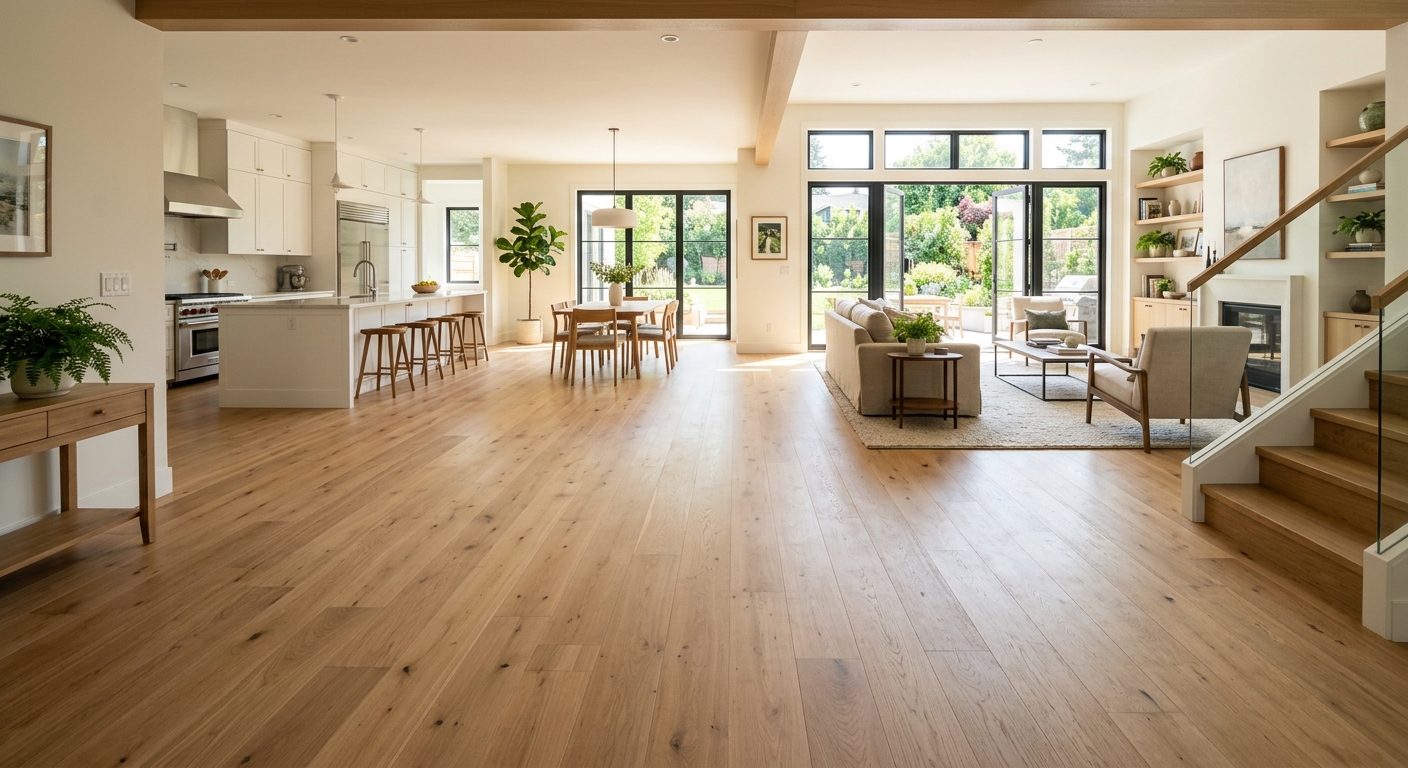
Flooring options and costs in Marlborough
Marlborough, British Columbia is a great place to update flooring, but the Lower Mainland–Southwest climate means you have to choose products that can handle indoor humidity swings. With a 2021 population of 14,169 (Statistics Canada, 2021 Census), local contractors stay busy—especially around older pocket neighbourhoods where many homes have been renovated a few times already. In this area, older housing stock is common, and when subfloors are uneven or have aged plywood, you often need levelling/repair before any new floor goes down. That typically adds roughly $1–$3 per sq ft (and sometimes more if full resurfacing is required). Because the Greater Vancouver market has among the highest labour rates in Canada, installation tends to be a large portion of your total budget, not just the flooring material.
The wet, marine climate also affects basements and slab-on-grade areas. Moisture can wick through concrete, and solid hardwood usually performs poorly below grade. For main living areas, solid hardwood is still popular, but we specify expansion gaps and help homeowners control indoor humidity to prevent cupping and gapping. Many residents in Marlborough’s more renovation-heavy pockets near the Hastings Street corridor end up booking earlier for engineered wood or luxury vinyl plank (LVP), particularly when they’re doing whole-level updates.
Use the table below as a realistic starting point, then we’ll narrow it to the right option once we know whether you’re above grade, over radiant heat, or dealing with any basement moisture concerns.
| Type |
Best Room |
Moisture Resistance |
Lifespan |
Price per sq ft |
| Solid hardwood (nail-down, above grade only) |
Living/dining, bedrooms (dry areas) |
Low (not for below grade or concrete slabs) |
25–60 years |
$9,–$18 |
| Engineered hardwood (float or glue, above + on-grade) |
Living/dining, bedrooms (including many main-floor installs) |
Medium to high (handles humidity swings better than solid) |
20–40 years |
$10,–$16 |
| Laminate (click-lock, above-grade) |
Bedrooms, hallways (dry areas) |
Low to medium (not for moisture-prone basements) |
10–25 years |
$4,–$10 |
| Luxury vinyl plank / LVP (waterproof, any level) |
Kitchen, main level, basement (finished) |
High (waterproof core for everyday spills and vapour-tolerant installs) |
15–30 years |
$6,–$12 |
| Porcelain / ceramic tile |
Kitchen, bathrooms, entryways |
Very high (true wet-area performance) |
25–50 years |
$10,–$20 |
| Carpet (broadloom or modular tile) |
Bedrooms, rec rooms |
Low to medium (avoid basements unless moisture is controlled) |
8–15 years |
$5,–$12 |
Prices are estimates only and vary by project scope, site access and material selection.
What affects the price of flooring in Marlborough
In Marlborough, two quotes for what looks like the “same” flooring can differ by 30–50% because Lower Mainland–Southwest pricing is heavily influenced by site conditions and the amount of prep work required. British Columbia projects often include higher labour costs and more frequent moisture-control steps than homeowners expect—especially where homes are older or where the install crosses different subfloor types. If your home sits over a slab-on-grade or has a basement that sees humidity swings, the technical requirements change the entire assembly, not just the top layer.
Technically, indoor humidity swings are a key driver. Solid hardwood expands and contracts with humidity, so it cannot be glued or floated over concrete and it performs poorly in basements where moisture vapour may reach the flooring. Engineered hardwood and luxury vinyl plank (LVP) handle humidity and minor temperature changes far better, making them the safer choice for many Lower Mainland homes. Colder inland pockets and newer builds with radiant heating also matter in the region: most solid hardwood is not a good match over radiant unless it’s carefully specified, while engineered wood, LVP, tile, and some higher-rated laminates are generally more compatible. Finally, older housing stock frequently needs subfloor levelling or repair, adding roughly $1–$4 per sq ft.
Concrete examples from typical Marlborough installs: (1) If we find lipped plywood seams during a walkthrough, levelling can turn a “quick” $9–$18 solid hardwood project into a higher total because we must correct flatness before fastening. (2) If the living area is fine but the basement shows moisture wicking through concrete, you may pay an extra $2–$6 per sq ft in prep and choose LVP instead of solid wood, shifting both material and installation approach. Those decisions affect cost immediately, which is why the first quote should never be a blind price.
| Price Factor |
Why It Matters |
Cost Impact |
| Room area in sq ft |
Controls how much material is needed and how long labour takes |
Direct: larger areas reduce per-sq-ft inefficiencies but increase total dollars; labour often scales with footage plus time allowances |
| Subfloor condition — levelling or repair needed before install |
Uneven plywood or deteriorated concrete requires prep before any click-lock, glue, or nail-down |
Typically adds about $1–$4 per sq ft in many older Lower Mainland homes; sometimes more if resurfacing is required |
| Moisture / below-grade install — rules out solid hardwood |
Moisture vapour through slab can ruin or warp moisture-sensitive assemblies |
Often shifts you from solid hardwood to engineered or LVP and adds moisture controls; commonly increases total by $1,000+ on larger basements |
| Material choice — solid vs. engineered vs. LVP vs. tile |
Different materials have different layers, installation methods and tolerances |
Can change the finished floor by several dollars per sq ft (for example, laminate around $4–$10 vs. LVP around $6–$12) |
| Removal and disposal of existing flooring |
Old carpet padding, underlay and glued-down materials increase demo time and disposal |
Often adds a noticeable labour line item; can be a few hundred to over a thousand dollars depending on layers |
| Stair nosing / transitions — charged per step or per linear foot |
Transitions and custom stair details require extra fabrication and materials |
Stair projects frequently add $200–$800+ depending on number of steps and change-of-floor areas |
| Radiant heat compatibility — limits material options |
Heat output and surface temperature affect dimension stability |
May rule out solid hardwood and some laminates; can add to material cost if you choose radiant-compatible engineered or tile |
| Installation method — float vs. glue-down vs. nail-down |
Different methods need different prep, products and labour time |
Glue-down and detailed transitions tend to increase labour; floating installs are usually faster when subfloors are already flat |
Permits & regulations in British Columbia
In British Columbia, the act of installing flooring itself usually does not require a building permit. Replacing an existing floor surface—such as installing LVP, laminate, carpet, engineered hardwood, or tile—typically falls under normal trade work. However, certain associated tasks may trigger permitting or additional approvals, especially where electrical or structural elements are affected. For example, if you’re adding or modifying in-floor radiant heating circuits, that can involve electrical permitting requirements. If the project includes structural subfloor repair (for example, removing and replacing compromised framing or joists), that may require permitting depending on what’s being repaired and how extensive it is. Moisture remediation can also bring extra steps, and in some cases the scope may involve controlled work that should be documented clearly in your contract.
For condominiums, sound transmission rules are often the real “permission” issue. The corporation’s requirements around STC/IIC performance can restrict underlay choices under hard flooring on upper floors. Before installing hardwood or tile above grade in a multi-unit building, review the condo declaration and request board approval in writing—especially if you’re installing engineered hardwood, tile, or LVP with a specific underlayment system.
To verify your contractor in Marlborough: (1) confirm their BC licence/registration using the province’s online listings, (2) request a current certificate of liability insurance, and (3) ask for clearance evidence for WSIB/WCB (or the applicable coverage proof they carry for workers). A reputable contractor provides these without hesitation and includes them in your proposal package.
Best flooring for each room in your Marlborough home
Choosing the right flooring in Marlborough means matching the product to moisture risk, foot traffic, and comfort needs—because the Lower Mainland–Southwest climate can swing indoor humidity, and basements may have vapour transmission through concrete. In living and dining areas, homeowners typically want warmth underfoot without overreacting to seasonal changes; engineered hardwood or high-quality laminate is often the best balance of look and stability. For master bedrooms, carpet remains a favourite for comfort and sound absorption, but engineered hardwood is also a strong option if the home is kept dry and the subfloor is flat.
In kitchens, spills happen and cleaning needs are daily. Luxury vinyl plank (LVP) or large-format porcelain tile are the most reliable choices because they’re water tolerant and forgiving on uneven minor subfloor movement. In finished basements, LVP is usually the clear winner: it’s waterproof and tolerates the kind of moisture vapour exposure that makes solid wood a risky bet. Bathrooms should be porcelain or ceramic tile only, as these materials handle real wet use and grout is designed for moisture environments.
If your home includes radiant heating (becoming more common in British Columbia new construction), prioritize materials engineered for heat cycling. Tile and many LVP systems work well, and many engineered hardwood products are rated for radiant, but solid hardwood is a much more careful specification.
For example, if you compare laminate at $4–$10 per sq ft versus LVP at $6–$12 per sq ft, the extra $2–$3 per sq ft is often justified in a basement that shows humidity. Over a 300 sq ft basement, that difference is roughly $600–$900—usually cheaper than replacing a moisture-damaged floor later.
| Room |
Best Material |
Why |
Moisture Risk |
Price Band per sq ft |
| Living / dining room |
Engineered hardwood |
Warm look with better humidity tolerance than solid; suits main-floor seasonal swings |
Low to medium (humidity changes indoors, but not usually below grade) |
$10,–$16 |
| Master bedroom |
Carpet or engineered hardwood |
Carpet adds comfort and quiet; engineered wood offers a cleaner, more durable surface |
Low to medium |
$5,–$12 |
| Secondary bedrooms |
Laminate (click-lock) or carpet |
Great for moderate traffic and budget control; choose moisture-resistant underlay if needed |
Low |
$4,–$10 |
| Kitchen |
Luxury vinyl plank (LVP) or porcelain tile |
Water and spill resistance for daily cleaning; tile also handles heat well |
Medium (frequent wet cleanup and occasional splashes) |
$6,–$20 |
| Basement (finished) |
Luxury vinyl plank (LVP) |
Waterproof core and vapour-tolerant install approach for slab-on-grade and humid spaces |
High (Lower Mainland concrete moisture wicking risk) |
$6,–$12 |
| Bathroom |
Porcelain / ceramic tile |
True wet-area performance; durable with correct underlayment and grout system |
Very high |
$10,–$20 |
How to choose a flooring contractor in Marlborough
Choosing a contractor in Marlborough is mostly about verifying proof, not trusting promises. Start with licensing in British Columbia: ask the contractor for their licence/registration details and confirm them using the BC online registry. Next, request a certificate of liability insurance; it should list the correct business name and show the policy is active. For worker coverage, ask how they handle WSIB/WCB clearance for their crews—then request clearance documentation (or the appropriate proof they carry) before work begins. If they can’t provide these documents quickly, or they only provide them “after you pay,” treat that as a serious warning sign.
Get 2–3 written, itemised quotes—not lump sums. A good quote separates labour and materials and breaks out key items like removal and disposal, subfloor prep/levelling, underlay/moisture barrier requirements, trim, transitions, and stair work. Read the scope carefully: confirm what’s excluded (like moving furniture, floor patching beyond a certain depth, or custom stair nosing), whether permits are included if required for radiant or electrical-related work, and whether debris hauling is part of the job.
Warranty is another make-or-break point. Ask for the workmanship warranty length and what it covers, plus the manufacturer warranty terms for the specific product you’re buying. Also confirm whether the warranty is transferable if you sell your home. For payment, never pay more than 10–15% upfront; keep a holdback until the job is complete and walkthrough items are fixed. Finally, require a start date and a completion estimate in writing so you can plan around work schedules and access.
- Provide BC licence/registration details and confirm them before signing
- Show current liability insurance certificate (active coverage, correct business)
- Provide WSIB/WCB clearance proof for workers (or applicable coverage evidence)
- Include an itemised breakdown: labour, materials, prep, underlay/moisture barrier, transitions
- State exactly who removes and disposes of existing flooring
- List all inclusions/exclusions in writing (furniture moving, patching, levelling scope)
- Confirm subfloor requirements: flatness standard and how they’ll correct it if needed
- Detail transition and stair nosing pricing per step or per linear foot
- Provide product model numbers and thickness/specs (especially for engineered/LVP)
- Give clear warranty terms: workmanship duration and manufacturer warranty conditions
- Set payment schedule with only 10–15% upfront and a holdback until final walkthrough
- Schedule a written timeline with start date and completion estimate
Red flags we see in Marlborough: (1) a contractor who won’t provide licence/insurance/clearance evidence; (2) quotes that ignore subfloor flatness or moisture testing when basements/slabs are involved; (3) “too good to be true” pricing that lumps everything together without prep and disposal details; (4) no written scope for transitions/stairs or unclear underlayment/moisture barrier; and (5) pushing for large upfront payments beyond 10–15%.
Frequently asked questions — flooring in Marlborough
Hardwood vs laminate vs vinyl plank — which is best?
For Marlborough and the Lower Mainland–Southwest climate, “best” depends mostly on moisture risk. Solid hardwood looks fantastic above grade, but it’s sensitive to indoor humidity swings and is a poor choice over concrete or in basements. Laminate is usually the budget-friendly option (often in the $4–$10 per sq ft range), but it’s not the best fit for below-grade humidity exposure and it doesn’t like standing moisture. Luxury vinyl plank (LVP) is the practical winner for many homeowners because it’s waterproof and tolerates humidity better at $6–$12 per sq ft. If you’re doing main-floor living areas, engineered hardwood often splits the difference: a more stable wood look that performs better than solid. If you tell me which rooms are above grade and whether there’s radiant heating, I can point you to the safest choice for that layout.
What flooring is best for a Marlborough basement?
In Marlborough, basement performance is mainly about vapour and moisture movement through concrete and older subfloors. Because the region has a wet, marine climate and indoor humidity can swing in winter and shoulder seasons, we generally avoid solid hardwood in basements. Many families choose LVP because it’s waterproof and designed to handle moisture exposure better than wood and most laminate systems. If your basement is only “partially finished,” LVP is still usually the better long-term option because it’s forgiving if conditions change. Carpet can work if the space is properly dried and controlled, but it’s more vulnerable to odours and lingering dampness. If you’re comparing costs, LVP often lands around $6–$12 per sq ft, while carpet pricing varies widely with fibre and installation approach. The extra upfront cost for LVP is commonly cheaper than replacing a floor after humidity issues show up.
Can I install hardwood over concrete?
In most Marlborough situations, solid hardwood over concrete is not recommended. Solid boards need consistent humidity and should not be glued or floated over concrete slabs; below-grade moisture and slab vapour can cause cupping, gapping, and failure of the adhesive if someone attempts it. Engineered hardwood is the better option because it’s dimensionally more stable and can be installed appropriately for on-grade conditions (installation method matters—some systems are float, others are glue-down with the correct substrate prep). If your slab is on-grade and dry, engineered may be a fit. If the area is below grade or shows moisture wicking, we usually steer homeowners toward LVP or tile instead. In all cases, the correct flatness prep and moisture management plan should be written into your quote before you commit—especially in Lower Mainland homes where concrete behaviour can be unpredictable.
How long does flooring installation take?
Timelines in Marlborough depend on prep work, access, and the flooring type. A straightforward, above-grade job on a flat subfloor can sometimes be completed in a few days for a single level, while jobs that require levelling, subfloor repair, moisture barriers, or detailed transitions typically take longer. Removal and disposal also add time, particularly with older multi-layer flooring. Tile is usually slower due to layout, set time, and curing requirements, while LVP and laminate tend to be faster when the subfloor is properly prepped. Radiant heat or specialty installations can extend schedules because we must confirm compatibility and follow product instructions carefully. The key is to get a written start date and completion estimate from the contractor, and make sure your quote lists what’s included (prep scope, stair work, transitions). That way, you can plan around furniture moves and other trades.
What flooring works with radiant heat?
For British Columbia homes with radiant heating, the best matches are materials rated for heat cycling. In practical Lower Mainland installs, tile is a top performer because it conducts heat well and handles temperature changes. Many engineered hardwood products are also suitable when they’re specifically rated for radiant heat and installed with the recommended methods and underlay. LVP can work too, provided the product is radiant-compatible and the installation follows the manufacturer’s temperature guidance. Laminate can work only with products that are rated for radiant heat—otherwise it may warp or separate over time. Solid hardwood is the most difficult category; it can be used in carefully specified cases, but it’s not our default choice for radiant without confirming the exact product rating, acclimation requirements, and humidity control plan. If you share the brand/model of your radiant system and the intended flooring type, I can help you narrow to products that make sense for Marlborough conditions.
Engineered vs solid hardwood — what's the difference?
Solid hardwood is a single piece of real wood throughout the board and it’s most stable when installed above grade over a well-prepared, moisture-controlled subfloor. In Marlborough, solid wood is very sensitive to indoor humidity swings; it can cup or gap if the home is too dry or too humid, and it’s generally a poor choice for basements or slab-on-grade where moisture vapour can be present. Engineered hardwood is made with a real wood veneer on top with layered construction underneath, which makes it more dimensionally stable across humidity and temperature changes. That’s why engineered is a common recommendation for Lower Mainland main floors and many on-grade situations. In pricing terms, solid and engineered are both often in the higher hardwood bands, while LVP can be a more forgiving alternative. If you’re comparing options, tell me which rooms you’re flooring and whether you’re working over concrete or near a moisture-prone area.