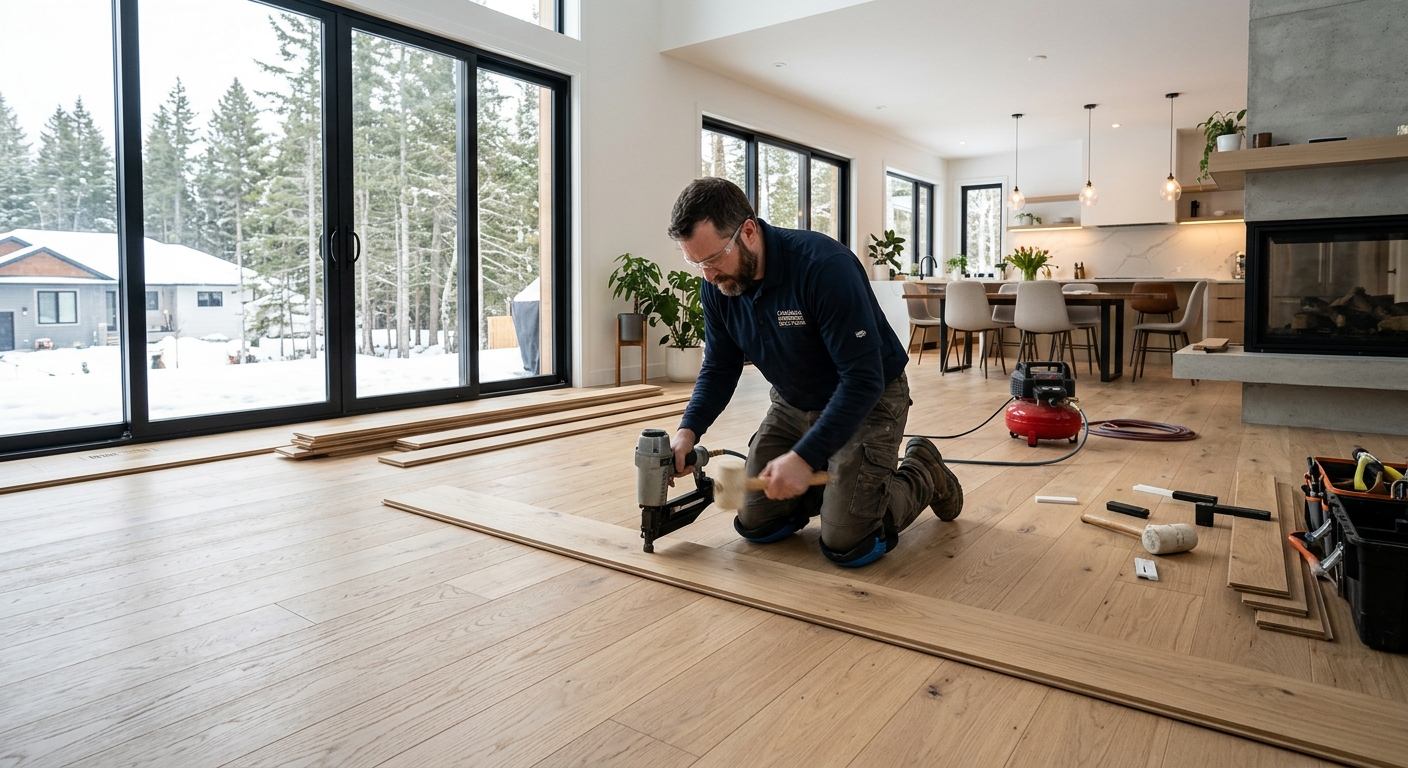
Flooring options and costs in South Surrey
South Surrey homeowners typically choose from a tight set of options—solid hardwood remains a favourite in main living areas, while moisture-tough choices dominate in basements and slab-on-grade spaces. With South Surrey’s population at 77,170 (Statistics Canada, 2021 Census), the market is busy enough that you’ll see real competition from installers, but prices still reflect Greater Vancouver’s high labour costs and the area’s wet, marine climate. In Lower Mainland–Southwest homes, indoor humidity swings are common in winter and shoulder seasons, and they can show up as gapping or cupping if the wrong flooring is installed. Also, older housing stock is a frequent reality in and around neighbourhoods like Crescent Park and Ocean Park—more uneven plywood and concrete subfloors mean levelling, repairs, and moisture prep before any finish goes down, which often adds roughly $1–$4 per sq ft to the total project.
That same climate also shapes contractor availability: builders and renovators in Surrey/Burnaby/Richmond often request engineered wood or luxury vinyl plank (LVP) for on-grade and below-grade work, so installers tend to stock those more reliably than specialty hardwood products meant for controlled indoor conditions. If your home includes radiant heat, your options can narrow further, because some solid hardwood and certain laminates won’t tolerate higher slab temperatures. The table below gives practical, South Surrey–realistic pricing ranges and where each option performs best so you can compare quotes confidently.
| Type |
Best Room |
Moisture Resistance |
Lifespan |
Price per sq ft |
| Solid hardwood (nail-down, above grade only) |
Main living areas (above grade) |
Low to moderate (humidity sensitive) |
30–60 years |
$10 – $18 |
| Engineered hardwood (float or glue, above + on-grade) |
Living areas, bedrooms |
Moderate to high (layered construction) |
20–40 years |
$9 – $16 |
| Laminate (click-lock, above-grade) |
Bedrooms, halls, living spaces (not wet basements) |
Low to moderate (water can damage core) |
10–25 years |
$4 – $10 |
| Luxury vinyl plank / LVP (waterproof, any level) |
Kitchen, entry, basement (finished) |
High to waterproof (PVC core systems) |
15–25 years |
$6 – $12 |
| Porcelain / ceramic tile |
Kitchen, bathrooms, foyers |
Very high (surface + grout need care) |
25–50+ years |
$12 – $20 |
| Carpet (broadloom or modular tile) |
Bedrooms, stairs (comfort-focused) |
Moderate (needs good underlay/handling) |
8–15 years |
$6 – $12 |
Prices are estimates only and vary by project scope, site access and material selection.
What affects the price of flooring in South Surrey
In South Surrey, two quotes for the “same” flooring can diverge by 30–50% because the real variable isn’t the finish—it’s the prep, the subfloor, and the fit-and-finish details. Across the Lower Mainland–Southwest region (and even across British Columbia), labour and jobsite conditions are consistently high-cost compared with more inland markets, so removal, levelling, and installation method matter a lot. The wet marine climate adds another technical driver: moisture vapour can wick through concrete slabs, and indoor humidity swings make solid hardwood expand and contract. Solid hardwood can’t be glued or floated over concrete, and it typically performs poorly in basements where moisture risk is higher. Engineered wood and luxury vinyl plank (LVP) handle humidity far better because they’re built as stable layered systems, and LVP’s PVC construction is designed for waterproof performance.
Cold-inland areas often see more radiant heating, and even in the Lower Mainland more new homes are pairing heat with flooring. That reality can rule out most solid hardwood and some laminate products that aren’t rated for higher temperatures, pushing buyers toward engineered wood, tile, or LVP. Older South Surrey housing also commonly needs subfloor levelling or repair before install, often adding about $1–$4 per sq ft—on a 600 sq ft project that’s real money. For example, if laminate is quoted at the low band near $4 – $10 per sq ft, but your subfloor needs repair and moisture mitigation, the “effective” installed cost can creep toward the higher end. Conversely, a straightforward engineered wood job at roughly $9 – $16 per sq ft can come out competitive if you’re already getting good flatness and a proper vapour plan.
In practical terms, a home in Ocean Park with a slab-on-grade main level often needs a vapour/underlay strategy and may cost more than a similar-sized job on a properly vented crawl space. Meanwhile, Crescent Park basements frequently push homeowners toward LVP because it’s the best fit for moisture-prone below-grade rooms and won’t swell the way many laminate cores can.
| Price Factor |
Why It Matters |
Cost Impact |
| Room area in sq ft |
Materials scale with coverage; labour includes time per room |
Higher square footage typically reduces per-sq-ft overhead |
| Subfloor condition — levelling or repair needed |
Uneven plywood/concrete requires grinding, patching, or overlays |
Often adds roughly $1–$4 per sq ft depending on extent |
| Moisture / below-grade install — rules out solid hardwood |
Moisture vapour through slab can damage solid/most laminate cores |
May switch you to engineered wood or LVP and add prep |
| Material choice — solid vs. engineered vs. LVP vs. tile |
Hardwoods, tile, and premium LVP include higher material and system costs |
Tile and premium LVP land at the upper bands more often |
| Removal and disposal of existing flooring |
Demo time varies wildly (glue-down, underlay type, subfloor attached debris) |
Can be a major portion of labour on older installs |
| Stair nosing / transitions — charged per step or per linear foot |
Custom nosing, reducers, and matching edges affect labour and trim |
Often underquoted unless clearly itemised |
| Radiant heat compatibility — limits material options |
Some products can’t handle higher temperature swings without gapping/warping |
May increase cost by requiring engineered wood or tile-rated systems |
| Installation method — float vs. glue-down vs. nail-down |
Glue-down and nail-down increase labour and subfloor flatness requirements |
Can shift pricing by several dollars per sq ft |
Permits & regulations in British Columbia
In British Columbia, flooring installation itself usually does not trigger a building permit. That means replacing carpet, laminate, LVP, engineered hardwood, or installing tile on a typical floor area is typically “trade work” without a permit requirement. Where permits can come into the picture is when the job scope crosses into electrical or structural-related work. For example, if you’re modifying or installing in-floor heating circuits, that work is commonly handled under electrical permitting requirements. Similarly, substantial structural subfloor repair—like major framing changes or load-bearing adjustments—may require permits depending on the extent and what’s being altered.
Condominiums add another layer: even if a permit isn’t required, condo bylaws often govern noise and impact sound. Many corporations require specific underlay choices and may restrict hard flooring on upper floors unless you meet sound transmission targets (commonly discussed via STC/IIC-style performance). Always review the condo declaration and ask for written board approval—especially before installing hardwood or tile above another unit, because the underlay system and installation details can affect compliance.
To verify a contractor in South Surrey, start by confirming their British Columbia licence status (where applicable for the trade) and then request proof of liability insurance and workers’ compensation coverage (WCB/WSIB coverage equivalents). You should be able to see the clearance letter or confirmation of coverage. For insurance, ask for a current certificate of insurance naming you (or the project address) where required by your strata/lease, and ensure it’s valid for the work period. A reputable flooring contractor should also provide a written scope and warranty details before any payment is taken.
Best flooring for each room in your South Surrey home
Choosing the right flooring in South Surrey is mostly about matching each room’s moisture exposure, traffic, and comfort needs to a product that can handle the Lower Mainland’s humid winters and wetter shoulder seasons. Living and dining rooms are where engineered hardwood or high-quality laminate often hits the best balance: they deliver warmth and a real “wood look” without the same humidity sensitivity as solid hardwood. For the master bedroom, comfort matters—carpet can be a great choice for sound absorption and underfoot feel, while engineered hardwood is an excellent option if allergies or maintenance are priorities.
The kitchen is one of the most practical decision points. LVP is popular because it’s waterproof, tolerates daily spills, and stands up well to mop-based cleaning. If you want the longest service life and strong water resistance, large-format porcelain tile is also an excellent fit—just note it can be costlier and feels colder unless you use area rugs or radiant-compatible setups. Basements in this region often see moisture vapour through concrete, so LVP is usually the clear winner for finished basements. Solid wood and many laminates are more likely to swell or fail when the subfloor stays cool or damp. Bathrooms should be porcelain or ceramic tile only, because repeated splashes and humidity demand a truly moisture-tolerant system.
If you have in-floor radiant heat, consider that it can rule out some solid hardwood and certain laminate products not rated for those temperature profiles. As a concrete example, if you’re deciding between laminate and LVP for a 300 sq ft main-floor area, laminate might start in the $4 – $10 band but can rise quickly once you include moisture mitigation and more labour for prep; a reliable LVP install at roughly $6 – $12 per sq ft can be worth it where you expect spills, damp footwear, or humidity fluctuations near exterior doors.
| Room |
Best Material |
Why |
Moisture Risk |
Price Band per sq ft |
| Living / dining room |
Engineered hardwood |
Warm look with better humidity stability than solid |
Low to moderate |
$9 – $16 |
| Master bedroom |
Carpet or engineered hardwood |
Comfort and quiet; engineered option suits humidity swings better |
Low |
$6 – $16 |
| Secondary bedrooms |
Laminate or carpet |
Laminate is cost-efficient; carpet adds sound comfort for kids/guests |
Low |
$4 – $12 |
| Kitchen |
Luxury vinyl plank (LVP) or porcelain tile |
Handles spills and frequent cleaning; tile offers maximum longevity |
Moderate to high (spills) |
$10 – $20 |
| Basement (finished) |
Luxury vinyl plank (LVP) |
Best match for below-grade moisture concerns; waterproof performance |
High |
$6 – $12 |
| Bathroom |
Porcelain / ceramic tile |
Moisture-tolerant surface; long-term value if installed correctly |
Very high |
$12 – $20 |
How to choose a flooring contractor in South Surrey
When you hire a flooring contractor in South Surrey, don’t rely on word-of-mouth alone—verify credentials and insist on itemised documentation. First, confirm British Columbia licensing where the trade applies, and always request proof of liability insurance (valid for the job dates) plus workers’ compensation coverage. Ask for the certificate of insurance and a clearance letter or proof of coverage—so you’re not left holding the risk if something goes wrong on site. A contractor who can’t provide current paperwork is a risk, especially with demo work, dust containment, and noise-sensitive condominium schedules.
Next, get 2–3 itemised written quotes. The best quotes break down labour and materials separately (flooring, underlay/vapour barrier, levelling compounds, transitions, stair nosing, and removal/disposal). Avoid “lump sum” only proposals—without line items, it’s hard to compare apples to apples. Read the scope carefully: what’s excluded (moulding/trim replacement, floor level tolerances, subfloor repair, moving appliances), whether disposal is included, and whether permits (if needed for electrical/in-floor heating work) are handled by the contractor. Warranty should be clear on two fronts: workmanship warranty length and what the manufacturer covers, plus whether warranties are transferable if you sell the home.
For payment scheduling, never pay more than 10–15% upfront, and use a holdback until the job is complete and cleaned. Get a start date and completion estimate in writing, because scheduling is a major factor during rainy-season lead times. If you’re in a condo, request coordination for move-in/move-out windows and sound mitigation requirements.
- Provide a written scope that includes underlay/vapour barrier details for your subfloor type.
- Confirm liability insurance and request a certificate showing the project address/jobsite.
- Ask for proof of workers’ compensation coverage (clearance letter or equivalent).
- Get 2–3 itemised quotes with separate labour and material line items.
- Clarify removal and disposal: what gets hauled away, and what’s your responsibility.
- Request subfloor prep specifics: levelling target, patching method, and moisture plan.
- Confirm transitions and stair nosing pricing (per step or per linear foot).
- Make sure your quote states whether door trimming/undercuts are included.
- Ask about acclimation time for hardwood/engineered products before install.
- Verify radiant heat compatibility requirements in writing if your home has it.
- Review warranty terms: workmanship length, product warranty, and transferability.
- Use staged payments: small deposit (10–15%), holdback until final walkthrough.
Red flags I see around South Surrey: contractors who won’t provide proof of insurance or coverage, quotes that don’t include subfloor levelling/moisture remediation when it’s needed, “free upgrade” claims without line items, unusually low pricing that skips transitions or underlay, and schedules that keep moving with no written start/completion dates.
Frequently asked questions — flooring in South Surrey
How do I fix squeaky floors in my South Surrey home?
Squeaks are usually caused by loose subfloor fasteners, contact points rubbing between joists and subfloor, or nail/ screw movement over time. In South Surrey’s wet, marine climate, wood can expand/contract seasonally, which sometimes makes squeaks more noticeable during humid winter stretches. The right fix depends on what you can access: if it’s a floor above a crawl space, contractors may be able to add blocking or re-fasten from below; if it’s on a slab, you typically can’t access joists and may need to remove localized flooring to secure subfloor layers. Get a contractor to locate squeak points first—often you can treat a few high spots rather than pulling entire rooms. If you’re already planning a flooring replacement, it’s best to address squeaks before installing engineered wood, LVP, or tile so the new surface doesn’t flex over unstable sections.
What is luxury vinyl plank and is it worth it in South Surrey?
Luxury vinyl plank (LVP) is a PVC-based flooring system built to be highly water-resistant and more tolerant of the humidity swings common in the Lower Mainland–Southwest. In South Surrey, LVP is especially worth it for kitchens, entries, and finished basements where moisture vapour from slabs can be a concern. Unlike laminate, which can swell when water reaches the core, good LVP is designed to handle spills and minor dampness better. Pricing varies by quality and wear layer, but many installed projects land in the $6 – $12 per sq ft range for typical homeowners’ choices. It’s also easier to match to radiant heat or existing transitions than some rigid products, provided the installer follows the manufacturer’s flatness and underlay instructions.
How much does flooring cost in South Surrey?
Installed flooring in South Surrey typically depends on room size, subfloor condition, and the prep required. As a realistic baseline, laminate and vinyl plank projects often start around the $4 – $10 and $6 – $12 bands respectively, while tile and higher-end materials commonly sit closer to $12 – $20 per sq ft. The biggest surprise cost is usually subfloor levelling or repair—common in older homes—plus removal/disposal of existing flooring. In the Lower Mainland, labour rates are among the highest in Canada, so installation method and trim/transitions (stair nosing, reducers, door undercuts) can meaningfully change your total even when the material looks similar on paper. Get line-item quotes and insist on clear moisture-prep steps if your home has basements or slab-on-grade areas.
Hardwood vs laminate vs vinyl plank — which is best?
“Best” depends on your room and your tolerance for climate risk. Solid hardwood is beautiful, but in British Columbia—especially with basement slabs or frequent indoor humidity swings—it’s a higher-maintenance choice; it’s also typically limited to above-grade installations. Engineered hardwood is often the best middle ground for living areas, offering a more stable build than solid when humidity fluctuates. Laminate is cost-efficient and works well above grade in low-moisture rooms, but it’s not the top pick for damp areas because the core can be damaged if water gets underneath. Luxury vinyl plank is usually the most forgiving option in South Surrey: it’s waterproof or water-resistant by design and fits well for kitchens and finished basements. If you want a quick rule, prioritize LVP for any room with potential moisture exposure, laminate for dry bedrooms, and engineered hardwood for main living spaces.
What flooring is best for a South Surrey basement?
A South Surrey basement needs to be chosen with moisture vapour and temperature changes in mind. Because many basements are on slab-on-grade or have slab proximity, moisture can wick through concrete and create conditions that defeat solid hardwood and many laminates. For that reason, luxury vinyl plank is usually the best overall choice: it’s designed for waterproof performance and can handle minor humidity swings far better than wood-based products. Tile is also durable, but it can be colder and more costly once you factor in labour and underlayment/subfloor prep. If you do choose LVP, the key is proper subfloor flatness and correct installation details (vapour barrier only where required, proper acclimation, and attention to transitions). A good installer can prevent future issues by levelling or patching problem spots before laying the planks.
Can I install hardwood over concrete?
In most South Surrey situations, solid hardwood over concrete is not the right approach. Solid hardwood is generally intended for nail-down installations above grade, because it’s humidity-sensitive and cannot be glued or floated directly over concrete in the way engineered products are. Engineered hardwood can be installed over concrete in many cases, but only if the slab is properly assessed (moisture conditions, flatness, and the correct system layers). If your concrete has moisture vapour concerns, an LVP or tile solution is often the safer path in this Lower Mainland–Southwest climate. If you’re set on hardwood, ask your contractor to specify the installation method and moisture plan in writing and ensure the product is rated for your concrete conditions. Proper preparation is what protects your investment—especially in winter humidity swings common across British Columbia.