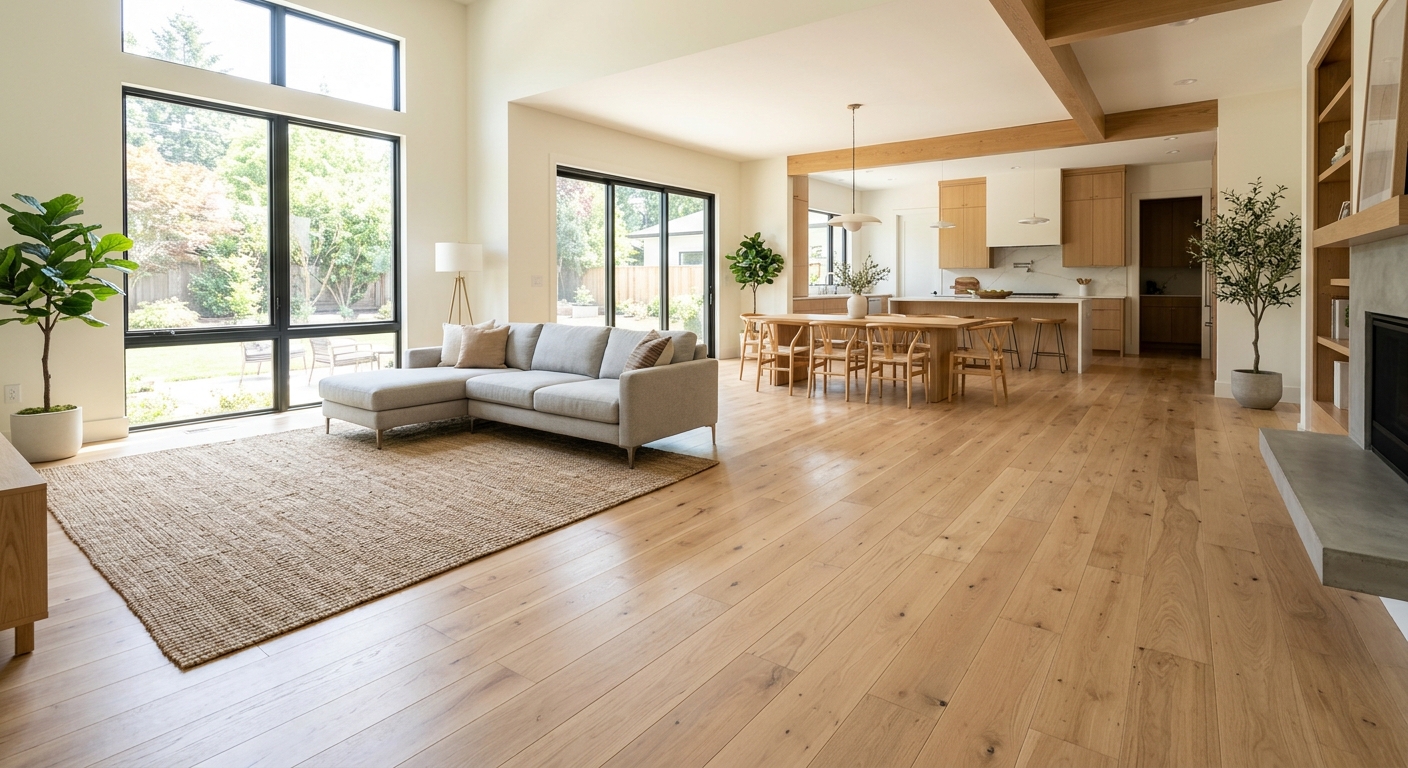
Flooring options and costs in Cowichan Bay
Cowichan Bay homeowners usually start with a simple question—“what will it cost?”—but the real answer depends on your home’s setup and the marine weather that drives indoor humidity swings. With a population of 2,799 (Statistics Canada, 2021 Census), the town has a smaller contractor pool than big centres, so scheduling and site visits can affect labour availability and pricing. Cowichan Bay’s housing stock includes plenty of older homes; that often means patchy plywood or concrete, which typically requires levelling and prep before you can install new flooring—commonly adding about $1–$3 per sq ft depending on how uneven the surface is.
In the Lower Mainland–Southwest, moisture can wick up through concrete and crawl into seams during damp stretches, especially in winter and shoulder seasons. That’s why we treat basements and slab-on-grade areas differently: solid hardwood is usually limited to above-grade rooms, while engineered hardwood and luxury vinyl plank (LVP) are better suited for humidity exposure and minor temperature movement. If your home has radiant heat in a newer build area, the material choices narrow further, with tile, LVP, and many engineered floors performing best when specified correctly.
For many residents near the harbour and the core residential blocks closer to the shoreline, upgrades are in high demand because people want comfortable, easy-to-clean floors that handle damp shoes and coastal air—especially in main living areas and kitchens. Use the table below as your quick comparison baseline before you ask for itemised quotes.
| Type |
Best Room |
Moisture Resistance |
Lifespan |
Price per sq ft |
| Solid hardwood (nail-down, above grade only) |
Living / dining |
Low to moderate (avoid below grade and concrete slabs) |
25–60 years |
$9–$18 |
| Engineered hardwood (float or glue, above + on-grade) |
Main living / bedrooms |
Moderate to high (layered construction helps with humidity) |
20–40 years |
$9–$16 |
| Laminate (click-lock, above-grade) |
Bedrooms / low-risk rooms |
Moderate (water spills must be cleaned fast) |
10–25 years |
$4–$10 |
| Luxury vinyl plank / LVP (waterproof, any level) |
Kitchen / basement / main floor |
High to waterproof (handles vapour and minor moisture) |
15–30 years |
$5–$12 |
| Porcelain / ceramic tile |
Kitchen / bathroom |
High (grout must be maintained) |
30+ years |
$10–$20 |
| Carpet (broadloom or modular tile) |
Bedrooms / stairs |
Low to moderate (humidity can affect underlay) |
8–15 years |
$4–$9 |
Prices are estimates only and vary by project scope, site access and material selection.
What affects the price of flooring in Cowichan Bay
In Cowichan Bay and across the Lower Mainland–Southwest, the same “average” flooring job can come in 30–50% apart from quote to quote, even when the product name sounds identical. That difference is usually not the showroom material—it’s the unseen parts: subfloor prep, moisture control, removal/disposal, and the crew’s time to get the surface flat enough for a quality installation.
First, indoor humidity swings are a technical driver. Solid hardwood expands and contracts with moisture; it also can’t be installed properly on concrete slab or below grade where moisture vapour is present. In humid months, that’s when homeowners feel the cost impact—extra acclimation time, tighter gaps, and sometimes a required vapour barrier system. Engineered hardwood and LVP handle humidity far better, especially when the underlayment and seam details are chosen for our marine climate. Second, colder inland pockets and radiant heating installations increasingly shape specifications: radiant-compatible products can cost more up front, while many solid hardwood and some laminates need tighter temperature limits.
Third, older regional housing stock frequently needs levelling or repair. A common prep scenario—patching low spots and flattening uneven plywood—adds roughly $1–$4 per sq ft. Example: a living room with moderate dips might keep engineered hardwood in the $9–$16/sq ft range, while a basement slab with moisture concerns can push the same square footage higher when levelling and moisture remediation are required, but LVP often remains the more predictable solution. On the other side, if your floor is already flat and dry, laminate at $4–$10/sq ft can look very attractive—provided you’re not running it where spills or vapour exposure will persist.
| Price Factor |
Why It Matters |
Cost Impact |
| Room area in sq ft — direct driver of material and labour cost |
More square footage increases product, cutting time, and labour hours |
Moderate; scales linearly with square footage |
| Subfloor condition — levelling or repair needed before install |
Uneven floors cause gaps, squeaks, and premature wear in clicks and planks |
Commonly adds $1–$4 per sq ft depending on severity |
| Moisture / below-grade install — rules out solid hardwood |
Concrete moisture vapour can warp solid wood and some underlay systems |
Can shift material choice; often adds prep and barrier cost |
| Material choice — solid vs. engineered vs. LVP vs. tile |
Different materials have different per-sq-ft pricing and installation requirements |
Large; solids and tile typically cost more per sq ft |
| Removal and disposal of existing flooring |
Old flooring removal, haul-away, and damage repair add time |
Moderate to high for multi-layer floors |
| Stair nosing / transitions — charged per step or per linear foot |
Transitions and stair trim are labour-intensive and can require special mouldings |
Moderate; not reflected in simple square footage estimates |
| Radiant heat compatibility — limits material options |
Not all floors handle heat cycles safely without cupping or joint failure |
Can increase cost through upgraded product and spec |
| Installation method — float vs. glue-down vs. nail-down |
Prep requirements, adhesives, and technique vary by method |
Moderate; glue-down and nail-down can add labour and materials |
Permits & regulations in British Columbia
In British Columbia, the act of installing flooring itself generally does not require a building permit. That said, related work can trigger permit and inspection requirements depending on what else is being altered. For example, if the project includes electrical work—such as adding or modifying in-floor heating wiring, thermostats, or circuits—an electrical permit may be required. If your scope includes structural subfloor repair that affects load paths (not just patching loose edges), approvals may be needed.
In condominiums, regulations are often enforced through building rules rather than city permits. Many corporations restrict hard surface flooring on upper floors due to sound transmission. That means you may need to use specific underlay systems and meet sound ratings (commonly discussed as STC/IIC). Always review the condo declaration and request board approval in writing before installing hardwood or tile above grade in a multi-unit building, even if your installer tells you it’s “standard.”
Step-by-step verification for Cowichan Bay homeowners: (1) Ask for the contractor’s BC licence number (and verify it using the appropriate online registry available through the province’s public listings). (2) Request a certificate of liability insurance with effective dates; confirm it covers flooring installation and general liability. (3) Confirm coverage for workers: WSBC/WCB coverage where applicable—ask for proof of account/clearance documentation. (4) Make sure the quote references who will handle moisture testing/assessment, subfloor prep, and any required remediation steps so the installation method matches the conditions.
Best flooring for each room in your Cowichan Bay home
Choosing flooring in Cowichan Bay is about matching the material to moisture exposure, foot traffic, and everyday comfort in a wet, marine climate. In the Lower Mainland–Southwest, the biggest mistake is selecting “looks good in the showroom” flooring for areas where concrete vapour or winter humidity swings will challenge the installation. For living and dining rooms, engineered hardwood or a high-quality laminate is a strong balance: you get warmth underfoot while keeping flexibility for minor seasonal movement. For master bedrooms, carpet remains popular for comfort and quiet, but make sure the underlay and layout avoid trapping moisture at the perimeter.
In kitchens, go for luxury vinyl plank (LVP) or large-format porcelain tile. LVP handles splashes and cleanup better than laminate, and tile resists water permanently (grout needs routine maintenance). Basements deserve special care: LVP is the clear winner in finished basements because it’s waterproof and can handle moisture vapour that would quickly damage solid wood or most laminate. Bathrooms should be porcelain or ceramic tile only.
Radiant heat compatibility matters, too. If you have in-floor heating (more common in newer BC builds), tile, LVP, and many engineered wood products are usually the safest paths. Solid hardwood over radiant heat needs very careful specification and acclimation—often not worth the risk for below-grade or high-variance layouts.
Price-wise, the choice usually pencils out when you compare “cheap now” versus “right material for the conditions.” If you’re deciding between laminate at $4–$10/sq ft and engineered hardwood at roughly $9–$16/sq ft, the extra cost is often justified in main living areas where you want a more stable feel and longer service life in humid winters—especially when levelling prep is already needed.
| Room |
Best Material |
Why |
Moisture Risk |
Price Band per sq ft |
| Living / dining room |
Engineered hardwood |
Warm look with better humidity stability than solid wood |
Low to moderate (control indoor humidity) |
$9–$16 |
| Master bedroom |
Carpet or engineered hardwood |
Carpet improves comfort and sound; engineered stays stable |
Low (avoid damp underlay in shoulder-season) |
$4–$14 |
| Secondary bedrooms |
High-quality laminate |
Cost-effective and easy to maintain in typical dry bedrooms |
Low |
$4–$10 |
| Kitchen |
Luxury vinyl plank (LVP) or porcelain tile |
Water resistance for spills; robust performance under daily use |
Moderate (spills and cleaning frequency) |
$5–$20 |
| Basement (finished) |
Luxury vinyl plank (waterproof) |
Handles moisture vapour and protects against below-grade challenges |
High (vapour and damp seasons) |
$5–$12 |
| Bathroom |
Porcelain / ceramic tile |
Best long-term water resistance and durability |
Very high |
$10–$20 |
How to choose a flooring contractor in Cowichan Bay
Hiring a contractor in Cowichan Bay should start with proof—not promises. In British Columbia, confirm the installer’s licensing status (ask for their BC licence number and verify it using the province’s public online registry). Next, request a certificate of liability insurance with the correct business name and coverage limits; the policy should be active for your project dates. For worker coverage, ask for evidence of WSBC/WCB coverage (and clearance status if applicable). A credible flooring contractor should provide these without hesitation, along with their warranty terms.
When you get quotes, insist on 2–3 itemised, written estimates with a labour + materials breakdown instead of a single lump sum. You want line items for subfloor prep (levelling/patching), moisture barrier materials where required, underlay, mouldings/transitions, removal and disposal, and stair work if applicable. Carefully read what’s excluded—common gaps include disposal fees, unanticipated subfloor repairs, or replacing damaged plywood after moisture comes up in testing. Also ask whether permit-related work (such as electrical for radiant heating changes) is handled or coordinated.
Warranty matters in two layers: workmanship (how long the installer covers installation problems) and the product manufacturer warranty (what’s covered and what conditions can void it). Make sure the warranty is transferable to a new owner if you sell.
For payment, avoid large up-front deposits; typically keep it to no more than 10–15% upfront, and use a holdback until the job is fully complete. Lock in a start date and completion estimate in writing, and ask how changes will be documented if your subfloor condition surprises the crew.
- Ask for their BC licence number and verify it in the provincial online registry.
- Request a current certificate of liability insurance before signing.
- Confirm WSBC/WCB coverage evidence for their workers.
- Use itemised quotes: labour, underlay/moisture barrier, transitions, removal, and disposal.
- Ask how they’ll handle subfloor levelling and who pays if extra prep is required.
- Verify product claims: waterproof LVP means the system (planks + underlay + seals), not just the plank.
- Get the flooring moisture/acclimation plan in writing.
- Confirm installation method: nail-down, glue-down, or float, and why it fits your slab/room.
- Ask for expected lead time for materials and a contingency plan if a product is backordered.
- Clarify warranty length for workmanship and confirm manufacturer warranty terms.
- Agree on a payment schedule with a holdback until completion and punch list sign-off.
- Ensure the quote states disposal responsibility and whether disposal fees are included.
Red flags we see in Cowichan Bay: they won’t provide licence/insurance proof; they quote only a “per sq ft” number without line items for levelling, underlay, or transitions; they dismiss moisture concerns in basements; they ask for 50%+ up front; or they avoid written timelines and change-order procedures.
Frequently asked questions — flooring in Cowichan Bay
Do I need to level my subfloor first?
Often, yes—especially in older Cowichan Bay homes where plywood or concrete can be uneven. Even small dips can telegraph through laminate, cause click joints to separate, and lead to squeaks. With hardwood, levelling is critical to avoid rocking and to keep the installation flat enough for proper expansion gaps. In the Lower Mainland–Southwest, we also see older subfloors that are uneven and sometimes affected by humidity. That can mean additional prep beyond levelling, such as patching loose material or addressing minor moisture pathways before you lay engineered wood or LVP. If your installer finds the floor needs flattening, that prep is typically built into the quote as a separate line item and can add roughly $1–$4 per sq ft depending on scope.
What's the most durable flooring for pets and kids?
For most families in British Columbia, waterproof luxury vinyl plank (LVP) is the practical winner because it handles accidents and messy cleanup better than laminate or carpet. In a wet, marine climate like Cowichan Bay, spills and tracking damp shoes are constant, and LVP’s layered construction and water resistance make it forgiving for everyday life. Carpet is comfortable and quiet, but it can struggle if moisture gets trapped under the underlay or at baseboards during shoulder-season humidity swings. If you want the “natural look” with durability, engineered hardwood can work well in above-grade living areas when installed over a properly prepared, dry, and level subfloor. As a reference point, LVP commonly lands in the $5–$12 per sq ft band, while engineered hardwood is often closer to $9–$16 per sq ft—worth it when you want a longer-lasting, warmer feel.
How do I choose flooring for humidity in Cowichan Bay?
Start with the location: below grade and slab-on-grade areas are where humidity problems show up first. In Cowichan Bay, moisture vapour can wick through concrete in damp seasons, so we generally avoid solid hardwood in basements and on concrete slabs. Solid hardwood expands and contracts with indoor humidity; it can cup or gap if moisture conditions aren’t stable. Engineered hardwood and LVP are better suited because they tolerate minor changes and can be installed with appropriate vapour control. If you’re using engineered wood above grade, you still need a good acclimation process and the correct expansion spacing. For radiant heat rooms, check product compatibility so the floor isn’t exposed to heat swings outside its rated range. If you’re comparing quotes, make sure the installer explains moisture barriers and the intended installation method—because two “similar” materials can perform very differently when the prep isn’t matched to the climate.
Do condos restrict hard flooring?
Yes, in many British Columbia condominiums. Even when flooring installation itself doesn’t require a permit, the condominium corporation’s rules can restrict or require specific sound-control underlay for hard flooring on upper floors. Those rules are commonly tied to sound transmission targets (often discussed using STC/IIC concepts). In practice, that means you should review your condo declaration, check what underlay is approved, and request board approval in writing before installing hardwood or tile. Some buildings also restrict the type of installation method (for example, floating systems versus rigid glue-down) because of vibration transmission. If you’re in Cowichan Bay and you’re working in a multi-unit building, treat sound compliance as part of the scope—otherwise you can end up paying for upgrades later. A reputable contractor will ask for your condo requirements up front and quote the correct underlay system.
How do I compare flooring quotes?
Compare quotes the way an installer would: line-by-line. Start by ensuring each quote includes the same scope—removal and disposal, subfloor levelling/repairs, underlay and moisture barrier (where needed), transitions/stair nosing, and protection for doors and trim. If one quote is much lower than the others, it may be missing moisture prep or using a cheaper subfloor prep approach that affects performance in our Lower Mainland–Southwest humidity. Also verify the installation method: a nail-down solid hardwood system will have different prep and timeline than an engineered float-down system or waterproof LVP. Ask whether disposal fees are included, what’s excluded (like unexpected subfloor damage), and how changes are priced. Finally, check the warranty: workmanship coverage length and what voids the manufacturer warranty. A transparent quote usually narrows the “30–50%” variation homeowners see across BC.
Can I install flooring over existing tile in Cowichan Bay?
Sometimes, but not as a blanket rule. Installing over existing porcelain or ceramic tile can create height issues and can be risky if the tile surface is uneven or poorly bonded. For many projects in Cowichan Bay, the more reliable approach is removal and proper subfloor prep—especially if you’re moving from tile to hardwood or laminate and need a stable, flat base. If your tile is well-adhered and flat, a contractor may be able to install over it using the correct underlayment system and height transitions, but it must be evaluated in person. Also consider moisture: in areas with below-grade influence, the existing tile doesn’t automatically solve vapour issues if moisture is coming up through the slab or subfloor assembly. When comparing quotes, ask what prep is included to confirm tile flatness (and whether they’ll level or use a specific underlayment). If your quote seems unusually low without mentioning this step, that’s a common hidden cost.