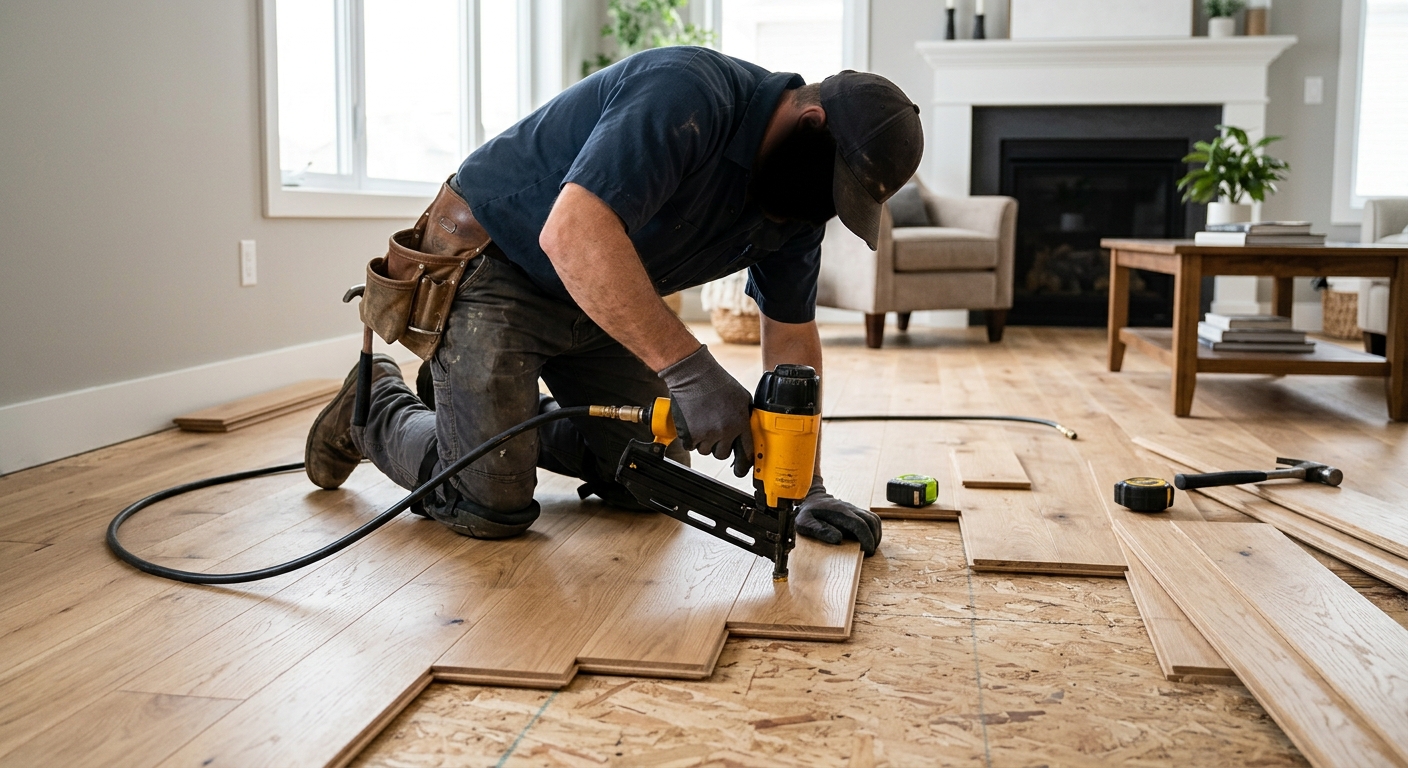
Flooring options and costs in Univercity
In Univercity, British Columbia, choosing new flooring is as much about managing moisture as it is about look and feel. With a small population base of 5,000 people (Statistics Canada, 2021 Census), the trades market is tight, so reputable installers can book out quickly—especially during the busier spring shoulder season when indoor humidity swings tend to be more noticeable. Unusually, older housing stock around the Lower Mainland–Southwest still drives many project costs: if your home needs subfloor levelling or patching before new finishes go in, homeowners often see an add-on of roughly $1–$3 per sq ft due to uneven plywood or concrete and the extra labour for resurfacing preparation. That preparation step is one of the main reasons two quotes can look very different for the same square footage.
Because Univercity sits in a wet, marine climate, basements and slab-on-grade areas can experience moisture wicking through concrete. For that reason, we typically avoid solid hardwood below grade and recommend engineered wood or luxury vinyl plank (LVP), which handle humidity better. In main living areas, solid hardwood remains popular, but we specify expansion gaps and we push for indoor humidity control to reduce cupping and gapping. If you’re near the Univercity town centre area where renovation demand is concentrated, you’ll also notice installers prioritize solid and engineered systems that dry correctly and lay flat over older subfloors.
Below is a practical comparison of the most common materials installers recommend for local homes, along with typical price ranges. Use it as a starting point before you request itemised quotes.
| Type |
Best Room |
Moisture Resistance |
Lifespan |
Price per sq ft |
| Solid hardwood (nail-down, above grade only) |
Main living areas |
Low to moderate (humidity-sensitive) |
25–60 years |
$9–$18 |
| Engineered hardwood (float or glue, above + on-grade) |
Living, dining, bedrooms |
Moderate to good (layered construction) |
20–40 years |
$9–$15 |
| Laminate (click-lock, above-grade) |
Secondary rooms |
Moderate (avoid standing water) |
10–25 years |
$4–$10 |
| Luxury vinyl plank / LVP (waterproof, any level) |
Kitchen, basement (finished) |
High (PVC or core-based waterproof) |
15–25 years |
$4–$10 |
| Porcelain / ceramic tile |
Kitchen, bathrooms, entries |
Very high (with correct grout and membrane) |
30–60 years |
$10–$20 |
| Carpet (broadloom or modular tile) |
Bedrooms and stairs (as applicable) |
Low to moderate (needs good drying) |
7–15 years |
$4–$8 |
Prices are estimates only and vary by project scope, site access and material selection.
What affects the price of flooring in Univercity
In the Lower Mainland–Southwest, the same flooring project can land 30% to 50% apart across British Columbia because the quote is heavily driven by preparation and installation complexity, not just the material. Two homes with identical square footage may still differ because one has flat, dry subfloors while the other has moisture wicking through concrete, dips in plywood, or old underlay that must be removed and disposed of. In Univercity, the wet marine climate amplifies those variables: indoor humidity swings are common in winter and shoulder seasons, and basements can show moisture migration through slab-on-grade assemblies. That moisture risk changes what’s allowed—solid hardwood expands and contracts with humidity and can’t be safely installed over concrete in basement environments, while engineered wood and LVP are far more forgiving in layered or PVC core systems.
Radiant heating also plays a role. In colder inland pockets and newer builds, radiant heat is increasingly used; that typically favours engineered wood, LVP, tile and some higher-temperature laminates, while it rules out most solid hardwood installs or requires very careful specification. Older housing stock is another cost driver locally: subfloor levelling or repair frequently adds around $1–$4 per sq ft. For example, a basement finishing job may shift from laminate pricing at roughly $4–$10 per sq ft to LVP because LVP’s waterproof build is worth the difference when moisture is present. Similarly, if your main floor needs levelling before solid hardwood at $9–$18 per sq ft can be nailed down cleanly, the preparation work can become the biggest portion of the budget.
In practice, Univercity homeowners often see cost rise when there’s: (1) uneven subfloor requiring patching/skim work, and (2) more transition pieces for doorways and stair edges. Costs can drop when rooms are open-plan, subfloors are already flat, and the job can be installed quickly with minimal demolition.
| Price Factor |
Why It Matters |
Cost Impact |
| Room area in sq ft |
Direct driver of material quantities and labour hours |
Major (baseline of the entire project) |
| Subfloor condition — levelling or repair needed |
Uneven plywood or concrete must be corrected before installation |
Often adds roughly $1–$4 per sq ft |
| Moisture / below-grade install |
Rules out solid hardwood and affects underlay/membrane choices |
Can move you to engineered wood or LVP |
| Material choice — solid vs. engineered vs. LVP vs. tile |
Each system has different tolerances, prep needs, and install time |
Ranges broadly (e.g., $4–$10 vs. $10–$20 per sq ft) |
| Removal and disposal of existing flooring |
Demolition affects time, disposal fees, and dust control |
Can be substantial on older builds |
| Stair nosing / transitions |
Transitions are labour-intensive and sometimes require custom cuts |
Charged per step or per linear foot |
| Radiant heat compatibility |
Limits product selections and can require specific installation methods |
May increase material costs or require special underlay |
| Installation method — float vs. glue-down vs. nail-down |
Different methods require different labour, adhesives, and prep |
Labour mix changes the total price |
Permits & regulations in British Columbia
In British Columbia, installing flooring itself typically does not require a building permit. That means a normal nail-down solid hardwood install, a floating engineered wood job, LVP over an approved underlayment, or a typical carpet installation is generally permit-free. However, associated work may require permits depending on what you’re altering. For example, if your project involves electrical work for in-floor heating circuits, upgrading wiring, or modifications to an existing system, it may trigger electrical permit requirements. Similarly, if you’re doing structural subfloor repair—like replacing subfloor framing, correcting rot that impacts structural members, or making changes that go beyond “finishing” work—permits can be required depending on scope and how the work is documented.
Condominiums add another layer: the corporation’s rules on sound transmission (often expressed through STC/IIC requirements) can restrict underlay thickness and what hard flooring systems are allowed on upper floors. Before you start, review your condo declaration and request board approval in writing—especially for hardwood or tile, which typically demand specific underlay and installation details to meet noise rules.
To verify a contractor in Univercity or anywhere in BC, you’ll want to confirm:
- British Columbia licensing status (where applicable for their business/role), by checking online registries.
- Liability insurance certificate of insurance, matching the address and specifying coverage limits.
- WSIB/WCB coverage (clearance letter or confirmation), for the right current status.
Do these checks before signing—good contractors provide paperwork quickly and consistently.
Best flooring for each room in your Univercity home
For Univercity homes, the “best” flooring is the one that matches the room’s moisture exposure, traffic level, and comfort needs—without fighting the Lower Mainland–Southwest humidity. Living and dining areas typically do well with engineered hardwood or high-quality laminate because they keep a warmer feel than tile and can be installed to handle normal indoor humidity swings when properly acclimated. In the master bedroom, many homeowners choose carpet for comfort and sound absorption, or engineered hardwood if they prefer easier cleaning and a consistent look throughout the main level. For the kitchen, luxury vinyl plank (LVP) or large-format porcelain tile is the practical win: both tolerate splashes, quick mopping, and the day-to-day spills that happen in a busy household.
Basements are where climate reality matters most. In finished basements, LVP is usually the clear winner because it’s waterproof and tolerates minor moisture vapour better than solid wood and most laminates. For bathrooms, porcelain or ceramic tile is the best match due to splash and ongoing wet conditions, provided the installation includes correct setting materials and appropriate waterproofing/membrane where required.
If your home has radiant heating (increasingly common in newer BC builds), pair it with engineered wood, LVP, tile, or a laminate product specifically rated for radiant heat. Solid hardwood over radiant heating needs very careful specification and humidity control—often not worth the risk in a wet marine climate. As a cost example, if the basement is $4–$10 per sq ft for laminate on paper but moisture concerns push you toward LVP, the move is often justified because you’re buying durability and reduced call-backs instead of paying to replace a failed floor later.
| Room |
Best Material |
Why |
Moisture Risk |
Price Band per sq ft |
| Living / dining room |
Engineered hardwood |
Warm look with better humidity tolerance than solid |
Low to moderate (manage indoor humidity) |
$9–$15 |
| Master bedroom |
Carpet or engineered hardwood |
Comfort and quiet underfoot; option for easier cleaning |
Low (avoid damp edges and keep ventilation good) |
$4–$15 |
| Secondary bedrooms |
Laminate or carpet |
Budget-friendly and typically stable above grade |
Low to moderate (standing water is the enemy) |
$4–$10 |
| Kitchen |
Luxury vinyl plank (LVP) or porcelain tile |
Easy clean-up, splash tolerance, and strong wear layer |
Moderate (spills and wet traffic patterns) |
$4–$20 |
| Basement (finished) |
LVP |
Waterproof build suits slab-on-grade moisture conditions |
Higher (moisture vapour and wicking can occur) |
$4–$10 |
| Bathroom |
Porcelain / ceramic tile |
Best long-term performance in wet areas |
High (standing water and humidity) |
$10–$20 |
How to choose a flooring contractor in Univercity
Choosing a flooring contractor in Univercity is mostly about proof—of coverage, of experience with your specific floor type, and of a quote that’s detailed enough to execute correctly. Start by verifying British Columbia licensing status (where relevant to their business/role), then request their liability insurance certificate of insurance showing current coverage. Next, confirm WSIB/WCB coverage: ask for a clearance letter or written confirmation and check that it’s active as of your contract date.
For pricing, get 2–3 itemised written quotes. “Itemised” should mean you can see labour and materials separately, including underlayment (if applicable), adhesives or levelling compound line items, and any floor transition pieces. Avoid lump sums that don’t explain preparation; in Lower Mainland–Southwest homes, subfloor levelling can be a significant cost driver and is often missed in vague estimates. Read the scope carefully: what’s excluded (baseboards? demolition? moving appliances?), whether disposal is included, and whether any permits are included for associated electrical/in-floor heating work. If your quote mentions moisture-related prep (vapour barrier, patching, or self-levelling), it should specify the materials and the coverage area.
Warranty matters too. Ask for the workmanship warranty length, whether the manufacturer warranty is product-specific, and whether coverage is transferable to you if you sell the home. Payment schedules should be conservative: never pay more than 10% to 15% upfront, and hold back a portion until the job is complete and cleaned. Finally, request a start date and realistic completion timeline in writing.
- Ask for at least one floor-type reference match (basement LVP, radiant heat, tile, or hardwood nail-down).
- Confirm liability insurance limits and effective dates before scheduling.
- Verify WSIB/WCB status with a clearance letter or written proof.
- Get an itemised quote: materials, labour, underlayment, adhesives, levelling, and transitions.
- Confirm disposal and dust-control expectations in the scope.
- Ask how they handle moisture testing or subfloor readings (especially for basements).
- Clarify acclimation timelines for hardwood/engineered and how they maintain indoor conditions.
- Request an explicit start date and completion estimate in writing.
- Check warranty terms: workmanship duration and manufacturer coverage details.
- Ensure transitions/stair nosing are priced per step or per linear foot when applicable.
- Confirm how they protect doorways, vents, and existing trim during install.
- Keep a signed change-order process for any add-ons discovered during demo.
Concrete red flags to watch for in Univercity: (1) a quote that offers a low price but doesn’t mention subfloor levelling or moisture prep; (2) no proof of liability insurance or WSIB/WCB coverage; (3) refusing to provide itemised labour/material breakdown; (4) asking for large upfront payments beyond 10%–15%; (5) vague warranty language (no workmanship duration or product details).
Frequently asked questions — flooring in Univercity
What flooring is best for a Univercity basement?
In Univercity, basements usually see the most moisture risk due to the Lower Mainland–Southwest wet, marine climate and occasional moisture wicking through concrete slabs. Because of that, LVP is typically the best choice: it’s waterproof, tolerates minor moisture vapour better than solid wood, and it can be installed with the right underlayment for a stable feel. Engineered hardwood can work on-grade or in well-controlled basement conditions, but it’s not our first pick when moisture is an ongoing concern. If you’re comparing costs, remember LVP generally tracks the $4–$10 per sq ft band, while tile and premium options can climb to $10–$20 per sq ft—yet LVP often wins on risk reduction and fewer call-backs in damp-prone basements (Statistics Canada, 2021 Census).
Can I install hardwood over concrete?
You can install hardwood over concrete, but the type matters. Solid hardwood is typically installed nail-down over an above-grade wood subfloor; solid boards don’t perform well in many basement-on-concrete situations because they expand and contract with humidity. For concrete slabs, engineered hardwood is usually the better option since it’s more dimensionally stable and can be specified for on-grade installs. Even then, the slab must be properly prepared: it may require moisture mitigation and a flat surface so the planks don’t telegraph dips. If your quote is for solid hardwood directly over slab in a basement, pause and ask about moisture testing, vapour control, and the exact install method—those details are what protect your floor.
How long does flooring installation take?
Timing depends on product type, room layout, and how much prep is required. In Univercity, the wet season can also affect drying and acclimation steps, especially with engineered wood or any self-levelling prep. As a rule of thumb, a straightforward main-floor install (flat subfloor, limited removals) can move faster, while older homes with uneven plywood or concrete often add time for patching and levelling. Removal and disposal of existing flooring can also add a day or two depending on what’s there. If your total project includes transitions, stair nosing, and careful moisture prep for a basement, expect longer scheduling. For budgeting purposes, use the quote timeline in writing, and ensure the contractor accounts for acclimation and cure times where needed.
What flooring works with radiant heat?
Radiant heat compatibility is about controlling temperature effects on the flooring system. In British Columbia, radiant heat is increasingly common in newer builds, but it changes which materials are safe to install. Generally, engineered hardwood, luxury vinyl plank (LVP), and porcelain/ceramic tile are the most reliable pairings, because they handle controlled temperature changes better than many solid wood setups. Some laminates are also rated for higher temperatures, but not all click-lock products are suitable—so you need the manufacturer’s radiant heat specification. If you’re considering solid hardwood over radiant, it often requires a very careful engineered-style approach (thickness, installation details, and indoor humidity control). Ask for written product suitability for radiant heat before you commit—this is one of the most common failure points.
Engineered vs solid hardwood — what's the difference?
Solid hardwood is one thickness of real wood; it’s typically nailed down and is more sensitive to humidity and moisture movement. In Univercity’s marine climate, that means solid hardwood is best for above-grade installations, with correct expansion gaps and a stable indoor humidity range. Engineered hardwood is made from multiple layered plies topped with a hardwood wear layer. That layered construction is more stable, so engineered floors tolerate normal humidity swings better and can be installed in more scenarios—often above-grade and sometimes on-grade systems, depending on the concrete moisture conditions. Price-wise, both sit commonly within the local hardwood bands (for example, hardwood can fall around $9–$18 per sq ft), but engineered may offer better performance where moisture is a factor. The “right” choice is really about your room and substrate, not just the look.
Do I need to level my subfloor first?
Often, yes—especially in Univercity homes with older housing stock and uneven subfloors. When floors feel “bouncy,” show dips, or have uneven plywood/underlayment, you can end up with weak locking joints (laminate), movement noise, gaps at seams (wood products), or tile cracks if the substrate isn’t properly prepared. Levelling doesn’t always mean a full resurfacing; it can involve patching high/low spots or installing a proper compound plan so the floor comes out flat and smooth. Locally, that preparation is a recurring cost driver and commonly adds roughly $1–$4 per sq ft to the overall project depending on the extent of repair. Ask your contractor to describe the plan for levelling and moisture protection in writing before installation starts.