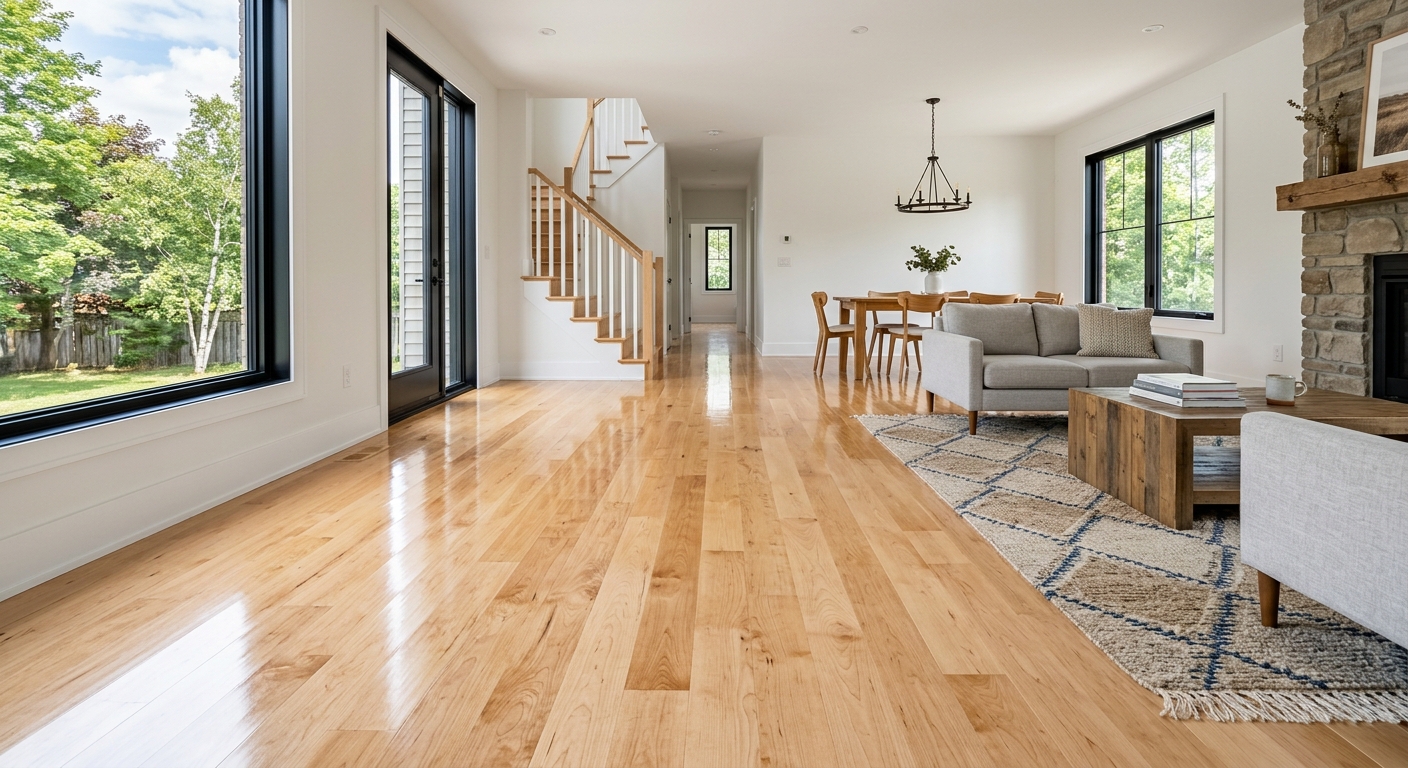
Flooring options and costs in Brighouse-City Centre
In Brighouse-City Centre, your flooring choice usually comes down to how you want to balance comfort, durability, and moisture risk—especially given the Lower Mainland–Southwest’s wet, marine climate. With a population of 62,855 (Statistics Canada, 2021 Census), the area has a steady mix of older homes and newer builds, and that matters for your subfloor preparation. Many houses in and around the downtown Richmond/Brighouse corridor are from earlier eras when plywood or concrete surfaces can be uneven or unevenly sealed; that often means levelling or repairs before any new flooring goes down, typically adding roughly $1–$3 per sq ft to project costs.
Coastal humidity also creates indoor moisture swings in winter and shoulder seasons. For this reason, we avoid solid hardwood below grade and rarely recommend it over slab-on-grade in areas where moisture wicking through concrete is common. In main living areas, solid hardwood is still popular, but we specify correct expansion gaps and manage indoor humidity to prevent cupping and gapping. When a home is heated with radiant systems, engineered wood, LVP, tile, and some higher-rated laminates tend to pair more safely than traditional solid hardwood.
Because of the region’s high demand and limited installer availability in peak season, labour can be a major portion of your final number—particularly in older neighbourhood pockets like the Brighouse core where renovations are frequent. Next, compare the typical options and realistic price ranges per square foot in your local market.
| Type |
Best Room |
Moisture Resistance |
Lifespan |
Price per sq ft |
Price Range |
| Solid hardwood (nail-down, above grade only) |
Living rooms, hallways, dining |
Low to moderate (humidity-sensitive) |
25–60 years |
$9–$18 |
$9,XXX – $18,XXX |
| Engineered hardwood (float or glue, above + on-grade) |
Main floor, bedrooms |
Moderate to high (better humidity tolerance) |
20–50 years |
$10–$16 |
$10,XXX – $16,XXX |
| Laminate (click-lock, above-grade) |
Bedrooms, living areas (dry zones) |
Moderate (seam swelling if water sits) |
10–25 years |
$4–$10 |
$4,XXX – $10,XXX |
| Luxury vinyl plank / LVP (waterproof, any level) |
Kitchen, entry, basement (finished) |
High (waterproof core) |
15–30 years |
$5–$10 |
$5,XXX – $10,XXX |
| Porcelain / ceramic tile |
Bathrooms, kitchens, entry |
Very high (waterproof surface) |
25–50+ years |
$10–$20 |
$10,XXX – $20,XXX |
| Carpet (broadloom or modular tile) |
Bedrooms, rec rooms |
Low (needs prompt drying) |
8–15 years |
$4–$8 |
$4,XXX – $8,XXX |
Prices are estimates only and vary by project scope, site access and material selection.
What affects the price of flooring in Brighouse-City Centre
In Brighouse-City Centre, two quotes for the “same” flooring can differ by 30–50% across the Lower Mainland–Southwest and the rest of British Columbia because the hidden drivers are almost never the product—it’s the site conditions and how the subfloor must be prepared. Moisture is the biggest technical reason. In this wet, marine climate, humidity swings can move through spaces quickly, and below-grade areas in many older homes can experience moisture vapour migration through concrete. Solid hardwood expands and contracts with indoor humidity, and it cannot be safely glued or floated over concrete; it performs poorly in basements. Engineered hardwood and luxury vinyl plank (LVP) handle humidity and minor temperature changes far better, so they’re often the practical choice.
Price also shifts with radiant heating compatibility. In colder inland pockets and newer builds that use radiant systems, solid hardwood is typically ruled out unless it’s specified very carefully; that pushes homeowners toward engineered wood, LVP, tile, or higher temperature-rated laminate. Older regional housing stock frequently needs subfloor levelling or repair—commonly another $1–$4 per sq ft—before installation can proceed.
Concrete examples from local projects: (1) If the subfloor is out of plane in a Brighouse core reno, we may add levelling compound and floor-priming, which nudges a lower-cost option upward toward the middle of the band (for example, laminate at the $4–$10 range becomes closer to $7–$10 after prep). (2) If you move an LVP install into a finished basement, the waterproof system can reduce risk and rework compared with trying to “save money” with laminate—especially when moisture is present—so the higher material price is often justified. Depending on product and prep, you’ll typically see hardwood and tile projects naturally land in the higher local $9–$18 or $10–$20 bands.
| Price Factor |
Why It Matters |
Cost Impact |
| Room area in sq ft |
Material quantity and labour hours scale with square footage. |
Direct; larger areas can lower per-sq-ft labour efficiency by 5–15%. |
| Subfloor condition |
Levelling or repair is often required to prevent squeaks and joint failure. |
Commonly adds about $1–$4 per sq ft in older homes. |
| Moisture / below-grade install |
Moisture vapour rules out solid hardwood and can swell laminate seams. |
May add moisture barrier systems; can change material choice. |
| Material choice |
Solid vs. engineered vs. LVP vs. tile changes both material cost and install method. |
Usually the biggest swing: hardwood and tile in higher $/sq-ft tiers. |
| Removal and disposal of existing flooring |
Demo time, haul-out fees, and subfloor cleaning affect labour. |
Often adds 5–20% to the total, depending on layers. |
| Stair nosing / transitions |
Stairs and custom transitions require extra materials and workmanship time. |
Charged per step or per linear foot; can add noticeable cost fast. |
| Radiant heat compatibility |
Only specific products are rated for radiant temperature cycling. |
Can add cost if you must upgrade to compatible engineered/LVP/tile. |
| Installation method |
Float, glue-down, and nail-down each have different prep and labour intensity. |
Glue-down often costs more in labour due to bonding and prep requirements. |
Permits & regulations in British Columbia
In British Columbia, flooring installation itself typically does not require a building permit. That said, associated work can trigger permits—so it’s important to separate “floor covering” from anything structural or electrical. What usually does NOT require a permit includes: removing and installing broadloom carpet, floating laminate, installing LVP over approved underlay (where applicable), and installing tile over an appropriate underlayment system when you are not changing building structure.
What may DO require a permit includes: structural subfloor repair that alters load-bearing framing, major moisture remediation that involves significant building envelope work, and any in-floor heating electrical circuits (or modifications to existing wiring and controls). If you’re adding radiant heat, expect electrical permitting involvement, even if the flooring surface finish is the only visible change.
In condominiums in British Columbia, the bigger constraint is usually the corporation’s rules for sound transmission (often referenced through STC/IIC requirements). Hard flooring on upper floors may require specific underlay or a board-approved approach, especially with hardwood and tile.
Step-by-step for Brighouse-City Centre homeowners: ask your contractor for (1) their BC licence details and check the business record/registry information online, (2) a current certificate of insurance naming you/your strata where applicable, and (3) proof of coverage for workers (WSIB/WCB clearance letter or equivalent documentation). You should also request the quote in writing with the scope clearly separated from any permit-triggering work, so there are no surprises.
Best flooring for each room in your Brighouse-City Centre home
Choosing the right flooring by room is how Brighouse-City Centre homeowners protect their investment in a wet marine climate. In living and dining areas, engineered hardwood or high-quality laminate often gives you the look and warmth while handling indoor humidity swings better than solid wood above concrete. For bedrooms, you can go either way: carpet is excellent for comfort and sound absorption, while engineered hardwood keeps a consistent feel throughout the main level.
In kitchens, where spills and frequent damp mopping are part of daily life, luxury vinyl plank (LVP) or large-format porcelain tile is usually the smartest move. LVP is forgiving with minor water exposure and tends to perform well when homes experience indoor humidity changes. Porcelain tile remains a top choice for easy cleaning and long-term durability. For basements (finished), LVP is typically the clear winner: it’s fully waterproof and better suited for below-grade installs where moisture vapour can affect traditional materials; solid hardwood and most laminate struggle in those conditions.
Bathrooms should use porcelain or ceramic tile only for reliable water management. If you have radiant heat, we match the flooring to the system: engineered wood, tile, and rated LVP are common best-sellers, while solid hardwood may be limited by specifications.
Cost-wise, the price difference can be justified. For example, laminate might sit in the $4–$10 per sq ft band, but if a kitchen has a lot of moisture exposure, upgrading to LVP (often $5–$10 per sq ft) can prevent seam swelling and edge damage—saving you the expense and disruption of an early replacement.
| Room |
Best Material |
Why |
Moisture Risk |
Price Band per sq ft |
| Living / dining room |
Engineered hardwood |
Warm look with better humidity tolerance than solid wood. |
Medium (humidity swings; keep indoor levels stable) |
$10–$16 |
| Master bedroom |
Carpet or engineered hardwood |
Carpet improves comfort and sound; engineered keeps a clean, consistent feel. |
Low to medium |
$4–$16 |
| Secondary bedrooms |
Laminate or carpet |
Laminate is durable for dry rooms; carpet helps with comfort and noise control. |
Low |
$4–$10 |
| Kitchen |
Luxury vinyl plank (LVP) or porcelain tile |
Handles spills and cleaning; tile offers the longest waterproof performance. |
High |
$5–$20 |
| Basement (finished) |
Luxury vinyl plank (LVP) |
Waterproof core and better tolerance for below-grade moisture vapour. |
High |
$5–$10 |
| Bathroom |
Porcelain / ceramic tile |
Best-in-class water resistance; durable surface for wet zones. |
Very high |
$10–$20 |
How to choose a flooring contractor in Brighouse-City Centre
Choosing the right flooring contractor in Brighouse-City Centre starts with verifying credentials and protecting yourself with clear documentation. In British Columbia, ask for (1) their current BC business/contractor licence information, (2) liability insurance—get a certificate of insurance, and confirm the coverage is current for the job dates, and (3) WSIB/WCB clearance documentation for workers. Don’t accept “we’re insured” as a verbal answer; you want the certificate details and clearance letter/proof provided before work begins.
Next, request 2–3 itemised written quotes. You want a labour-and-materials breakdown, not one lump sum. Itemisation should show: removal and disposal, subfloor prep/levelling, underlayment or membranes, transitions and stair nosing, and the specific product (brand, grade, thickness, wear layer for LVP/laminate). Carefully check what’s excluded: does the quote include furniture moving, floor leveling requirements if the slab is uneven, permit work where radiant heat is involved, and haul-away fees? For warranties, confirm workmanship warranty length, product/manufacturer warranty coverage, and whether warranties are transferable if you sell your home.
Payment scheduling matters. Plan to never pay more than 10–15% upfront; hold back the remainder until completion and cleanup are verified. Get your start date and completion estimate in writing, plus a realistic schedule that accounts for subfloor moisture testing or levelling.
- Provide a written scope of work with surface prep requirements stated clearly.
- List exact products (model/grade) and thickness/wear layer for LVP/laminate.
- Confirm underlay and moisture barrier specifications for your room levels.
- Show how transitions and stair nosing will be handled and priced.
- Include removal and disposal line items (how many dumps, what’s hauled).
- Answer moisture questions specifically for concrete slabs/basements.
- Provide insurance certificate details and coverage limits.
- Provide WSIB/WCB clearance or equivalent proof upon request.
- Do a site visit and measure subfloor flatness before quoting (not just photos).
- Give a workmanship warranty in writing (and what it covers).
- Use a sensible payment schedule: small deposit, completion holdback.
- Communicate timeline milestones (demo, prep, install, final inspection).
Red flags in Brighouse-City Centre: contractors who avoid a site measurement, quote without discussing moisture/subfloor prep for concrete or basements, won’t provide insurance/WSIB/WCB clearance, give only lump-sum pricing with no itemisation, or push a large upfront payment (beyond 10–15%) before any work starts.
Frequently asked questions — flooring in Brighouse-City Centre
What is the difference between floating and glued-down flooring?
In Brighouse-City Centre, “floating” usually means the planks or boards connect to each other via a click-lock system and sit over an approved underlay, without being mechanically fastened to the subfloor. “Glued-down” means adhesive bonds the flooring to the subfloor, which can improve stability on some surfaces but requires more precise subfloor prep and correct moisture testing/primers—especially over concrete. Solid hardwood is generally nail-down above grade only; it’s not designed to be glued or floated over slab. For humidity swings in the Lower Mainland–Southwest, floating engineered wood and many LVP products handle better than solid wood in damp-prone areas. If you’re comparing costs, note that base material bands locally place laminate and vinyl in the mid lower range (often $4–$10 per sq ft), while engineered and tile typically start higher (often $9–$18 or $10–$20 per sq ft depending on product).
What flooring holds up best to pets in a Brighouse-City Centre home?
For pets in British Columbia’s Lower Mainland–Southwest climate, LVP is usually the most resilient choice because it’s waterproof and forgiving with accidents or paw-morning moisture. If you have a basement or on-grade areas where concrete moisture vapour is a concern, LVP still tends to perform better than laminate; laminate can swell at seams if water sits long enough. For main living rooms, engineered hardwood can also work well if you choose a durable finish and maintain indoor humidity—this helps reduce cupping and gapping that can happen with solid wood. Carpet offers comfort but can be harder to keep looking clean if pets have frequent accidents; moisture and humidity can slow drying. Price-wise, you’ll often see LVP align with the $4–$10 per sq ft style band locally, while hardwood options commonly land in the higher $9–$18 range. For pet-heavy homes, we prioritise scratch resistance, wear layer thickness (for LVP/laminate), and an easy-to-clean surface.
How do I fix squeaky floors in my Brighouse-City Centre home?
Squeaks almost always come from movement between components—subfloor sheets rubbing on joists, loose fasteners, or a gap that shifts when you step. In Brighouse-City Centre, older housing stock can have uneven subfloors and inconsistent fastening, which may only become obvious once finish flooring is removed. The best “fix” depends on what you uncover: sometimes it’s re-fastening subfloor to joists, sometimes it’s correcting flatness or adding bracing. If you’re planning new floors, don’t install over squeaks; you should address the cause first. After you lift existing material, check for loose boards and fastener spacing, then repair/secure before installing engineered wood, laminate, or LVP. If you’re keeping your current flooring, a contractor may pinpoint high-traffic squeak zones and add shims or fasteners. In a full reno, squeak correction may be bundled under subfloor prep, often a cost add similar to the typical $1–$3 per sq ft levelling/repair budget we see in older homes.
What is luxury vinyl plank and is it worth it in Brighouse-City Centre?
Luxury vinyl plank (LVP) is a layered floor covering with a wear layer on top and a stable core underneath. In British Columbia’s wet marine climate, LVP is often worth it because it resists water and handles humidity better than laminate and far better than solid hardwood when moisture vapour is present. That makes it a strong fit for basements and on-grade areas in the Lower Mainland–Southwest, where concrete moisture wicking is common. LVP is also easier to maintain after spills in kitchens and entries—important when indoor humidity swings are part of the season. Cost varies by brand and thickness, but locally you’ll commonly see LVP in the $4–$10 per sq ft style band, depending on quality and install complexity. For a finished basement, that “worth it” factor usually comes from avoiding early replacement and reducing moisture-related callbacks. If you want a warmer feel in main living areas, you can also pair LVP with good underlayment options where appropriate.
How much does flooring cost in Brighouse-City Centre?
In Brighouse-City Centre, total flooring cost depends heavily on site prep and moisture conditions, not just the product. As a practical guide for the Lower Mainland–Southwest tier: hardwood flooring is commonly budgeted around $9–$18 per sq ft, laminate or vinyl plank around $4–$10 per sq ft, and tile around $10–$20 per sq ft. Carpet installation often falls into the $4–$8 per sq ft band depending on material and pile type. Older homes frequently require subfloor levelling or repair, which adds roughly $1–$3 per sq ft (sometimes a bit more when the base is significantly uneven). Labour is also a major driver because Greater Vancouver rates are among the highest in Canada. For best accuracy, request itemised quotes showing removal, prep, underlayment/membranes, installation method, and transitions. That way you can compare like-for-like rather than just comparing the product line.
Hardwood vs laminate vs vinyl plank — which is best?
In British Columbia’s Lower Mainland–Southwest, there isn’t one “best” for every room, but there is a best-match pattern. Solid hardwood is beautiful, yet it’s best kept above grade where you can control indoor humidity; it’s not a good fit for basements or slab-on-grade areas where moisture vapour can impact the wood. Engineered hardwood often bridges the gap for main living spaces, offering better humidity tolerance than solid. Laminate is cost-effective and can look great, but it’s more sensitive to standing water; seams can swell if moisture sits. Luxury vinyl plank (LVP) is usually the safest all-around choice for kitchens and finished basements because it’s waterproof and more tolerant of humidity swings. In Brighouse-City Centre pricing, laminate and LVP commonly land in the $4–$10 per sq ft range, while hardwood typically sits higher in the $9–$18 band. If you tell me your rooms (especially basement vs. main floor) and whether you have radiant heat, I can recommend the safest value option for your specific setup.