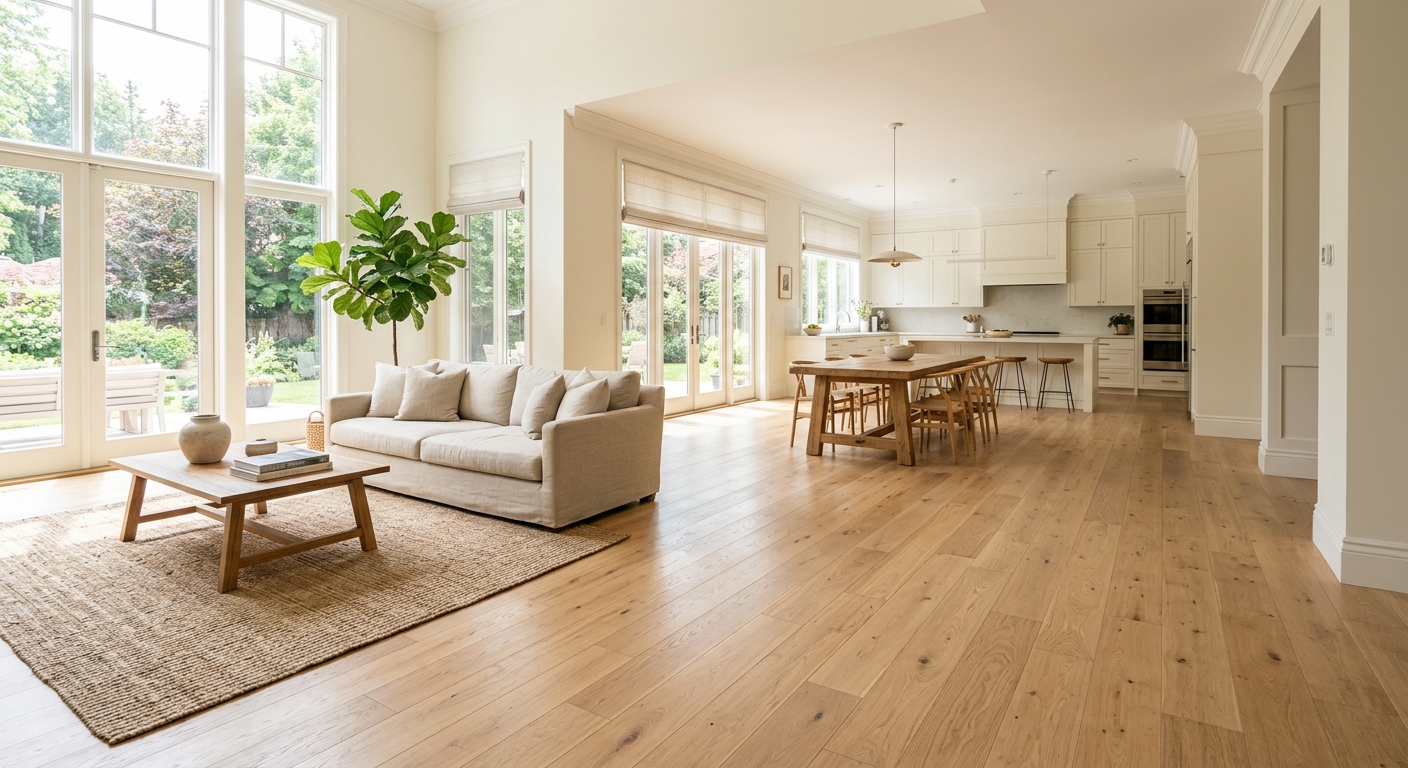
Flooring options and costs in Ladysmith
Ladysmith homeowners usually have plenty of choice, but the right flooring depends on the age and moisture conditions typical of the area. With 44.7% of homes in the region built before 1981 (Statistics Canada, 2021 Census), many projects start with a reality check: older plywood subfloors can be wavy or uneven, and correcting them often adds cost before any new surface goes down. On Vancouver Island and the Coast, that matters because indoor relative humidity can swing outside the ideal 35–55% window, especially around coastal moisture events and seasonal temperature changes.
In practice, those humidity swings and common below-grade concerns (including damp basements) shape what we recommend and what installers can price confidently. Solid hardwood still performs beautifully on main floors, but it’s a poor fit for concrete slabs and basements where moisture risk is higher. Engineered hardwood and luxury vinyl plank (LVP) are usually the safer choices because their layered construction and dimensional stability help reduce gapping, cupping, and callback problems. If you’re considering radiant heat—common as electrically heated homes expand on the Island—radiant-compatible options like many engineered hardwoods, LVP, tile, and many laminates tend to be the easiest way to stay comfortable without stressing the product.
In Ladysmith, demand is especially steady around the North Oyster / downtown corridor where older single-detached homes and renovations frequently overlap, bringing subfloor repair and transition work into the scope. From there, the table below shows realistic all-in installed ranges you’ll typically see for materials and labour in this tier—then we’ll break down what drives the numbers.
| Type |
Best Room |
Moisture Resistance |
Lifespan |
Price per sq ft |
| Solid hardwood (nail-down, above grade only) |
Main floors (dry living areas) |
Low to moderate (needs stable indoor humidity) |
25–50 years |
$9 – $18 |
| Engineered hardwood (float or glue, above + on-grade) |
Living, dining, hallways |
Moderate to high with proper prep |
20–35 years |
$10 – $16 |
| Laminate (click-lock, above-grade) |
Living rooms, bedrooms |
Moderate (protect edges; not for chronic damp) |
10–25 years |
$5 – $10 |
| Luxury vinyl plank / LVP (waterproof, any level) |
Kitchen, basement (finished) |
High (best tolerance of humidity swings) |
15–25 years |
$7 – $14 |
| Porcelain / ceramic tile |
Kitchen, bathrooms, entries |
High (requires good subfloor support) |
25–50 years |
$12 – $25 |
| Carpet (broadloom or modular tile) |
Bedrooms, family rooms |
Low (sensitive to moisture exposure) |
7–15 years |
$4 – $9 |
Prices are estimates only and vary by project scope, site access and material selection.
What affects the price of flooring in Ladysmith
In Ladysmith and across Vancouver Island and the Coast, it’s common to see the same “type” of flooring quote land 30–50% apart. The reason isn’t just brand—it’s subfloor condition, moisture management requirements, and how much labour time your installer has to spend on preparation, transitions and protection. British Columbia pricing also varies by neighbourhood access, seasonal scheduling, and whether the contractor needs to bring crews in for underlayment, levelling compound, floor repairs or additional finishing details.
Technically, indoor humidity swings are a key driver in this region. Solid hardwood expands and contracts with moisture; it cannot be installed over concrete and performs poorly when there’s a chronic damp condition, such as an unfinished or moisture-prone basement. Engineered hardwood and LVP handle humidity far better because their construction is more dimensionally stable. In the colder pockets of the Island where radiant heat is more popular, many solid hardwood options (and some laminate lines) are restricted or require very specific product specs, pushing many homeowners into engineered, tile or LVP.
Older regional housing stock is another cost lever. With 44.7% of homes built before 1981 (Statistics Canada, 2021 Census), it’s not unusual to uncover wavy plywood or small concrete issues that add real dollars. Subfloor levelling or repair commonly adds roughly $1–$4 per sq ft before install—on a 500 sq ft job, that’s the difference between staying near the lower end of a band and moving into the mid-range.
To make it practical: if you choose laminate at the $5–$10 per sq ft band but your subfloor needs significant levelling, you may end up paying labour close to what engineered hardwood typically costs. Conversely, selecting waterproof LVP for a basement can cost more than carpet upfront, but it avoids moisture-related failures and often reduces the “redo” risk on below-grade projects.
| Price Factor |
Why It Matters |
Cost Impact |
| Room area in sq ft |
Directly affects material quantity, cutting waste and labour time |
Can shift total by hundreds to thousands, depending on layout |
| Subfloor condition — levelling or repair needed before install |
Uneven floors require prep or partial replacement for a smooth finish |
Often adds about $1–$4 per sq ft on older homes |
| Moisture / below-grade install — rules out solid hardwood |
Humidity swings and damp basements demand moisture-tolerant systems |
May move you from $9–$18 to engineered/LVP/tile pricing |
| Material choice — solid vs. engineered vs. LVP vs. tile |
Different products carry different material and underlayment costs |
Typical range shifts according to local bands ($4–$25 per sq ft) |
| Removal and disposal of existing flooring |
Old flooring may include glue residue, staples or underlay |
Adds labour and dump fees; can be significant in basements |
| Stair nosing / transitions — charged per step or per linear foot |
Trim details take time and require matching pieces |
Usually increases cost noticeably on multi-level homes |
| Radiant heat compatibility — limits material options |
Temperature tolerances affect wood movement and laminate performance |
May require upgrading to radiant-compatible engineered, LVP or tile |
| Installation method — float vs. glue-down vs. nail-down |
Method determines prep demands, subfloor requirements and labour steps |
Glue-down and certain tile methods can be higher labour costs |
Permits & regulations in British Columbia
In British Columbia, the flooring install itself typically does not require a building permit—so replacing flooring finishes usually proceeds without municipal permit paperwork. However, permits can be triggered by associated work. For example, if your project includes electrical changes for in-floor heating circuits, that work may require an electrical permit. If there are structural subfloor repairs that go beyond cosmetic patching—especially where support systems are modified—that’s when you should confirm requirements with the trades involved.
In condominiums, the bigger practical constraint is usually building rules rather than permits. Many condo corporations regulate hard-surface flooring impacts and may require specific underlay for sound transmission (STC/IIC performance), and they often require board approval before installing hardwood or tile on upper floors. For a homeowner in Ladysmith, the best step is to request written approval before work starts, especially if you’re planning engineered hardwood, tile, or thick rigid flooring.
To verify your contractor in BC, follow a simple checklist. First, confirm the contractor is registered and appropriately licensed for the work they’re doing by checking the relevant online registry. Next, ask for a current certificate of insurance and ensure general liability coverage is active for the project dates. If the company uses workers, also confirm Workers’ Compensation coverage via WCB/WSIB status documentation they should provide. Finally, request a clearance letter if required by your strata/landlord, and keep copies of everything before payment milestones.
Best flooring for each room in your Ladysmith home
Choosing flooring in Ladysmith is about matching the material to the room’s moisture behaviour, traffic patterns and comfort needs—then accounting for Vancouver Island’s humidity swings. For living and dining areas, engineered hardwood or a high-quality laminate is often the best balance: it gives a warmer feel than tile and holds up well to daily foot traffic, provided the subfloor is flat. In the master bedroom, many homeowners choose carpet for comfort and sound absorption, but engineered hardwood can also work well if humidity is controlled and the installation is done to spec.
In kitchens, we commonly steer clients toward luxury vinyl plank (LVP) or large-format porcelain tile. Spills are realistic, and LVP’s waterproof construction handles splashes and occasional flooding without swelling. Porcelain tile is also excellent for easy cleaning, but it depends on a well-prepared, stable substrate to avoid cracked grout. Basements are where local practice diverges most: LVP is the clear winner for finished below-grade spaces because it tolerates moisture vapour and humidity better than solid wood and most laminates. Bathrooms are tile territory—porcelain or ceramic—because they’re designed for wet conditions.
Radiant heat compatibility is increasingly relevant here, especially in newer builds across the Island region. Many LVPs, most porcelain tile, and many engineered woods are radiant-friendly when the system is used within manufacturer temperature guidelines.
Cost-wise, it’s normal to see carpet at roughly the $4–$9 per sq ft band, while a tile bathroom can land around the $12–$25 per sq ft band. That difference is justified when the room is exposed to steam and wet mopping—carpet won’t last long there in this climate profile.
| Room |
Best Material |
Why |
Moisture Risk |
Price Band per sq ft |
| Living / dining room |
Engineered hardwood |
Warm look, good dimensional stability, handles seasonal humidity better than solid |
Low to moderate (main-floor, controlled humidity) |
$10 – $16 |
| Master bedroom |
Carpet |
Comfort and quieter rooms; good under bare feet |
Low (avoid if humidity is consistently high) |
$4 – $9 |
| Secondary bedrooms |
Laminate |
Budget-friendly durability with easy maintenance |
Low to moderate (protect from spills) |
$5 – $10 |
| Kitchen |
Luxury vinyl plank (LVP) or porcelain tile |
Spill tolerance, easy cleaning, strong day-to-day performance |
Moderate (routine water exposure) |
$7 – $14 |
| Basement (finished) |
LVP (waterproof) |
Best tolerance of humidity swings; works with moisture-management approaches |
High (below-grade vapour and moisture risk) |
$7 – $14 |
| Bathroom |
Porcelain / ceramic tile |
Wet-rated performance and long-term durability |
High (steam, splash, wet mopping) |
$12 – $25 |
How to choose a flooring contractor in Ladysmith
Picking the right flooring contractor in Ladysmith starts with verification, not promises. In British Columbia, ask for their current certificate of general liability insurance (to protect you on-site), confirm their workers’ compensation coverage (WCB/WSIB documentation), and ensure they’re properly registered for the scope they’re selling. How to check: request documents up front, then verify dates and coverage amounts on the certificate; for licensing/registry items, use the BC online registry relevant to the contractor type and match the company name exactly as written on your quote.
Next, get 2–3 itemised written quotes. You want line items that separate labour from materials, plus specific allowances for underlayment, levelling compound or floor repair, transitions, and disposal. Avoid lump-sum quotes that don’t state what’s included. Read the scope carefully: is subfloor levelling included or “if required”? Is permit/inspection support included where it’s applicable? Is removal and disposal included, and what happens with old flooring (dumping vs. reuse/haul-away)?
Warranty matters too. Ask for the workmanship warranty length, the product manufacturer warranty, and whether any warranties are transferable to future homeowners. Payment schedule should be conservative: never pay more than 10–15% upfront, and use a holdback until the job is complete and the final cleanup is done. Finally, request a written start date and realistic completion estimate—Vancouver Island scheduling can shift, but a good contractor will still commit to a timeframe in writing.
- Ask for examples of similar Ladysmith basements or older-home subfloor repairs.
- Confirm general liability insurance is active for the exact job dates.
- Verify WCB/WSIB coverage status and obtain clearance documentation if required.
- Get a detailed written quote with labour and material line items.
- Ensure underlayment type and moisture barrier details are specified.
- Confirm whether levelling/patching is included, and the method used.
- Ask how they handle high spots, wavy plywood, and squeaks before install.
- Require a written transition and stair nosing plan (pricing per step or linear foot).
- Confirm removal, haul-away, and disposal fees are included or clearly excluded.
- Ask about acclimation time for hardwood/engineered products in coastal humidity.
- Confirm warranty terms in writing (workmanship and manufacturer; transferability).
- Use a payment schedule with 10–15% upfront max and a holdback at completion.
Red flags I commonly see around Ladysmith include contractors who won’t provide insurance documents, quotes that ignore subfloor levelling when the home is built before 1981, vague scope language like “prep as needed” without unit costs, pushing large upfront payments, and refusing to put start dates and warranty details in writing.
Frequently asked questions — flooring in Ladysmith
How long does flooring installation take?
In Ladysmith, timing depends mostly on prep and how many rooms you’re finishing. A straightforward main-floor laminate or click-LVP install over an already-flat subfloor can be completed in a few days, while engineered hardwood or tile usually takes longer because acclimation, careful fastening/glue-down work, grout or mortar considerations, and more transitions add steps. If your home is older—44.7% of homes in the region were built before 1981 (Statistics Canada, 2021 Census)—subfloor levelling or repair can extend the schedule. As a ballpark, homeowners often plan roughly 1–2 weeks for multiple rooms with prep, and 2–4 weeks for tile plus significant subfloor correction. Your contractor should provide a written start date and completion estimate after measuring and inspecting the subfloor.
What flooring works with radiant heat?
British Columbia homes increasingly use radiant heat, and on Vancouver Island the safest approach is to follow the floor manufacturer’s radiant compatibility statement and temperature limits. In general, many LVP products are radiant-compatible when installed with the correct underlayment (and without trapping excess heat). Porcelain/ceramic tile is also a common radiant choice because it’s stable and transfers heat well. Many engineered hardwoods can work over radiant systems too, but only specific products and thicknesses; solid hardwood is more restricted due to movement from temperature and humidity. If a contractor is vague about “radiant-compatible” products, ask for the exact product spec sheet before you commit. The right choice also affects cost—LVP often fits in the $7–$14 per sq ft band, while tile commonly lands around $12–$25 per sq ft.
Engineered vs solid hardwood — what's the difference?
Solid hardwood is a single piece of wood installed nail-down and it performs best when installed only above grade with stable indoor humidity. In this coastal region, humidity swings can cause movement; solid hardwood can cup, gap, or shrink if the environment varies or if it’s installed where moisture risk exists (like on concrete slabs or in damp basements). Engineered hardwood uses layered construction (a real wood top with plywood or composite layers underneath), which makes it more dimensionally stable for Ladysmith homes. That’s why engineered hardwood is usually a better option than solid when there are moderate moisture concerns or when you want more flexibility for on-grade applications. Price-wise, solid often sits in the $9–$18 per sq ft band, while engineered commonly lands slightly higher to similar in practice depending on the grade and installation method.
Do I need to level my subfloor first?
Usually, yes—at least to the point of meeting the installer’s flatness requirements. Even small dips, ridges, or wavy plywood can cause click joints to separate, tile to crack, or LVP to telegraph imperfections. In Ladysmith and across Vancouver Island, older homes frequently need some prep because subfloors can shift over time and may not be perfectly flat. If you need levelling or repair, expect an additional cost often around $1–$4 per sq ft before flooring goes down, depending on how much material and labour are required. Whether you “need” it depends on measurement results, but good contractors test for flatness before pricing a final installation. The safest path is to request that your quote includes levelling/repair scope or a clear allowance with unit pricing.
What's the most durable flooring for pets and kids?
For pets and kids in Ladysmith, the most durable option is often LVP—especially waterproof LVP—because it stands up to everyday messes, minor spills, and the occasional accident without swelling like wood-based products. It’s also easier to replace boards in some systems than to repair damaged solid wood planks. Carpet can be comfortable and quiet for kids, but it’s more vulnerable to moisture and lingering odours if spills aren’t cleaned quickly—an issue to consider with below-grade humidity risks. Laminate is durable for impact, but edges can suffer if water gets underneath. For the best balance, many families choose LVP in high-traffic areas and consider tile in entryways if they’re already comfortable with the higher cost (tile commonly runs about $12–$25 per sq ft). If you want maximum value, plan a waterproof solution where spills are likely.
How do I choose flooring for humidity in Ladysmith?
Start with what your home actually experiences: humidity swings and the moisture risk of each level. In Ladysmith, humidity can move outside the ideal indoor range, and older housing (with 44.7% built before 1981) often has subfloor conditions that need attention. For main floors with stable conditions, engineered hardwood and high-quality laminate are usually reliable if the installer uses correct underlayment and proper acclimation. For basements or any area with vapour concerns, choose waterproof LVP; it tolerates moisture better and is designed for “any level” installs when paired with the right moisture management. Solid hardwood is best limited to above-grade rooms where indoor humidity stays consistent, since it can expand and contract noticeably. If you’re unsure, ask your contractor to discuss moisture testing and specify a system that matches your room risk—not just a style you like.