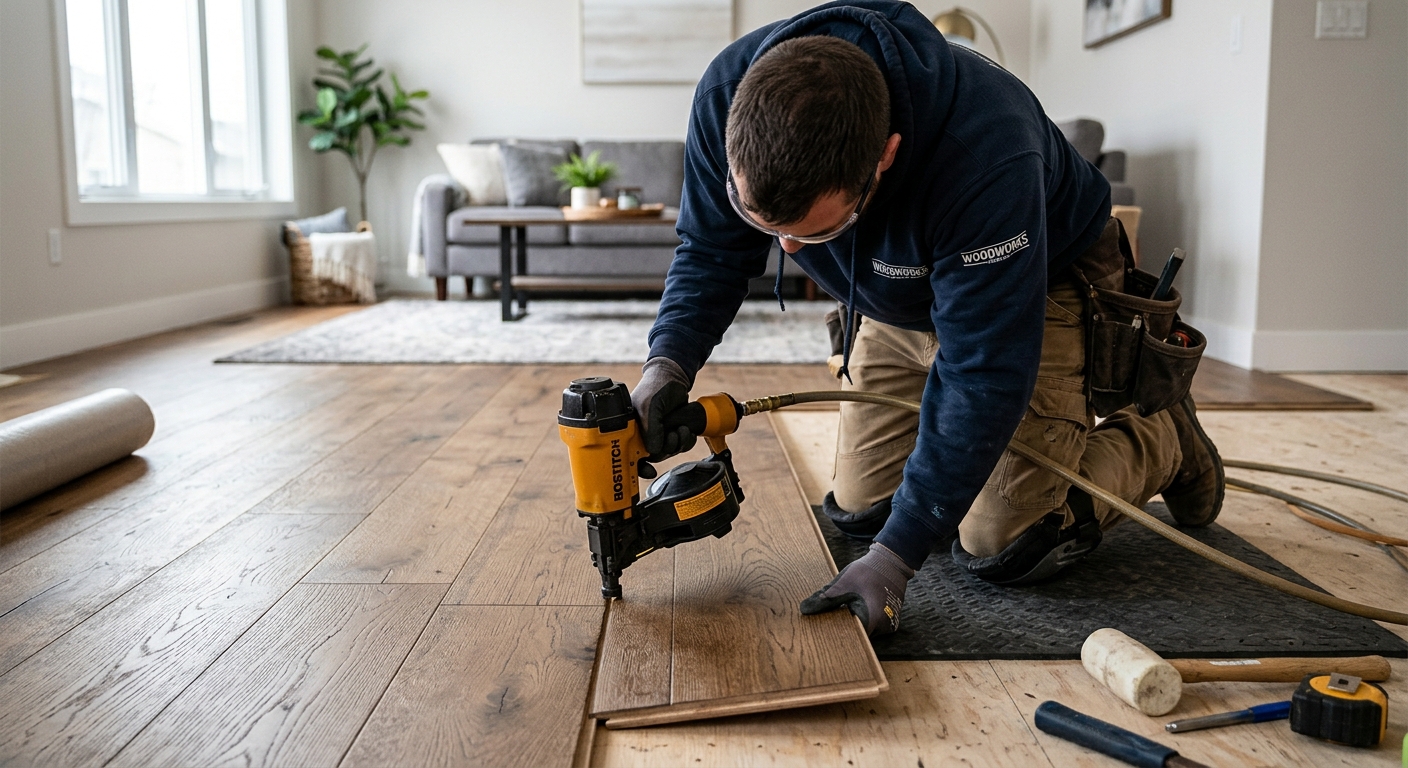
Flooring options and costs in Douglas-Gilpin
In Douglas-Gilpin, the right flooring choice depends a lot on how Lower Mainland–Southwest homes deal with moisture and humidity. With a population of 10,234 (Statistics Canada, 2021 Census), the area has steady demand from established neighbourhoods and ongoing renovation cycles, which keeps installer availability competitive—but not always immediate. A big cost swing comes from housing age and subfloor conditions: many older homes in the region have uneven plywood, aged OSB, or patchy slab conditions, so levelling, underlayment, or repairs commonly add roughly $1–$3 per sq ft before a new finish can go down. Even when the “room looks flat,” it can hide dips that show up once planks or tiles lock together.
The Lower Mainland–Southwest’s wet, marine climate also drives seasonal indoor humidity changes, especially in winter and shoulder seasons. Basements and slab-on-grade areas can experience moisture wicking through concrete, so solid hardwood is typically limited to above-grade rooms only. For those below-grade spaces, engineered wood or luxury vinyl plank (LVP) is usually a better match because layered wood or PVC cores handle humidity and minor temperature movement far more reliably. If your home has radiant heating (increasing in newer builds inland pockets around the region), that further narrows what performs best.
In Douglas-Gilpin and the broader Lower Mainland market, projects are especially common in older residential pockets where basement renovations and main-floor refreshes go hand-in-hand—so moisture testing and subfloor preparation are often where quotes diverge. Below is a practical cost comparison to help you map “what you want” to “what it typically costs,” then we’ll break down the drivers behind the numbers.
| Type |
Best Room |
Moisture Resistance |
Lifespan |
Price per sq ft |
| Solid hardwood (nail-down, above grade only) |
Main living areas (above grade) |
Low to moderate; avoid basements/slabs |
30+ years with proper humidity |
$9, $–$18 |
| Engineered hardwood (float or glue, above + on-grade) |
Living areas, hallways, bedrooms |
Moderate to good; better with humidity swings |
20–35 years depending on wear layer |
$10, $–$16 |
| Laminate (click-lock, above-grade) |
Bedrooms, living rooms (not wet zones) |
Moderate; can fail if water reaches core edges |
10–20 years |
$4, $–$10 |
| Luxury vinyl plank / LVP (waterproof, any level) |
Kitchen, finished basement, main floor |
High; waterproof cores handle moisture better |
15–25 years for quality lines |
$5, $–$12 |
| Porcelain / ceramic tile |
Bathrooms, kitchens, entryways |
Very high; tolerant of wet cleaning and spills |
25+ years |
$10, $–$20 |
| Carpet (broadloom or modular tile) |
Bedrooms and rec rooms |
Low to moderate; moisture can linger in pads |
8–15 years |
$3, $–$9 |
Prices are estimates only and vary by project scope, site access and material selection.
What affects the price of flooring in Douglas-Gilpin
If you get three quotes for what sounds like the same flooring job in Douglas-Gilpin, it’s not unusual to see 30–50% variation across the Lower Mainland–Southwest and the wider British Columbia market. The reason usually isn’t “who’s cheaper,” it’s what’s actually included: site prep, moisture management, subfloor levelling, transitions, and whether the installer is pricing the real installation method your subfloor requires. In our local market, where labour demand can be high and older housing stock is common, installation scope becomes the biggest driver—often more than the difference between two product lines.
Technically, indoor humidity swings and below-grade moisture are the key reasons solid hardwood costs can jump. Solid hardwood expands and contracts with humidity and should not be glued or floated over concrete; it also performs poorly in basements where moisture vapour can wick upward. Engineered wood and luxury vinyl plank (LVP) handle humidity and below-grade applications far better, so you can keep a more consistent build-up and reduce the chance of call-backs. Where radiant heating is present, some solid hardwood specs and many laminate products become a poor fit, which can shift you into the $10, $–$16 engineered or $5, $–$12 LVP/compatible tile price ranges.
Concrete examples in Douglas-Gilpin: (1) If a crew finds dips or bowing in the plywood and recommends levelling (instead of “installing over it”), you may see an additional $1–$4 per sq ft before materials go down. (2) If moisture testing indicates slab-on-grade vapour issues, a moisture barrier system and careful adhesive/underlayment choice can add both materials and labour. (3) On homes with lots of transitions—hallways, landings, and multiple stair runs—stair nosing and finishing can add meaningful cost even if the main square footage looks modest. Those are the moments where a laminate quote in the $4, $–$10 band can rise quickly if subfloor work and exclusions aren’t clear.
| Price Factor |
Why It Matters |
Cost Impact |
| Room area in sq ft |
Controls material quantities, wastage, and labour time |
Higher area usually lowers $/sq ft slightly, but total project rises |
| Subfloor condition — levelling or repair needed before install |
Uneven plywood, damaged OSB, or patchy concrete must be corrected |
Commonly adds about $1–$4 per sq ft depending on severity |
| Moisture / below-grade install — rules out solid hardwood |
Moisture vapour affects nail-down and can warp or gap solid boards |
May require moisture testing and barrier systems; can increase costs $500–$2,000+ per project |
| Material choice — solid vs. engineered vs. LVP vs. tile |
Product construction dictates performance in this climate |
Shifts budget by band: LVP/laminate typically cheaper than tile; engineered sits mid-range |
| Removal and disposal of existing flooring |
Old flooring, underlay, nails, and staples add time and hauling |
Often adds hundreds to over a thousand dollars depending on layers and access |
| Stair nosing / transitions — charged per step or per linear foot |
Detailed finishing is labour-intensive and hard to compare between quotes |
Can add $200–$1,000+ depending on steps and specialty transition trims |
| Radiant heat compatibility — limits material options |
Some products react poorly to heat cycles |
May require switching products and thicker/approved underlay; can add $1–$3 per sq ft |
| Installation method — float vs. glue-down vs. nail-down |
Choice depends on subfloor and product system |
Nail-down and glue-down usually take more preparation; glue-down can add labour cost |
Permits & regulations in British Columbia
In British Columbia, flooring installation itself typically does not require a building permit—most hardwood, engineered wood, laminate, LVP, and tile replacements are handled as interior finishes. However, associated work can trigger permit requirements. For example, if you’re doing structural subfloor repair, major framing changes, or addressing significant moisture remediation that involves more than surface treatment, permits may come into play depending on what’s being altered. If the project involves in-floor heating circuit work (electrical connections, thermostat wiring, or modifications to existing circuits), electrical permitting requirements can apply.
In condominiums in the Lower Mainland–Southwest, the bigger “rule layer” is usually the building’s sound transmission requirements. Corporations often require specific underlay or approved flooring assemblies to meet STC/IIC targets, and some units restrict hard flooring on upper floors unless the correct acoustic underlay and installation method are used. Always review the condo declaration and request board approval in writing before installing hardwood or tile on upper levels.
To verify a contractor in Douglas-Gilpin: first check their British Columbia licence (and the correct trade category for their scope). Next, request a certificate of liability insurance showing active coverage for your project type and dates. Confirm they have proper work coverage for their workers (commonly referred to as WSIB/WCB coverage). Then ask for a clearance letter or documentation number if they can provide it—your goal is to ensure their paperwork matches the work they’re doing on your site before money changes hands.
Best flooring for each room in your Douglas-Gilpin home
In Douglas-Gilpin’s marine climate, the “best” flooring is the one that matches room moisture exposure, foot traffic, and how your home handles humidity swings. For living and dining areas, engineered hardwood or high-quality laminate is a common sweet spot: it gives warmth underfoot while tolerating seasonal movement better than solid wood. For master bedrooms, carpet (for comfort and sound absorption) is still a strong choice, especially if you want a quieter feel on stairs and hallways leading into sleeping rooms.
Kitchen areas are where we often steer homeowners toward luxury vinyl plank (LVP) or large-format porcelain tile. These options are more forgiving when spills happen and they handle repeated wet cleaning without the edges swelling the way less moisture-tolerant materials can. In basements, especially slab-on-grade or any space showing humidity or dampness, LVP is usually the clear winner: it’s waterproof and better suited to moisture vapour conditions where solid hardwood and most laminate aren’t reliable. Bathrooms should be porcelain or ceramic tile for the same reason—water resistance and long-term cleanability.
Radiant heating compatibility matters in rooms tied to in-floor systems. Engineered wood and many LVP assemblies can be a good match when installed with the manufacturer’s approved underlay and acclimation steps. Solid hardwood over radiant heating is possible only with careful specification and operating conditions, so most homeowners choose engineered or tile instead to avoid warranty hassles.
Where prices make sense: if you’re deciding between laminate at roughly $4, $–$10 and LVP at roughly $5, $–$12, the extra $1–$2 per sq ft is often justified in a finished basement because it reduces moisture-related callbacks. Conversely, if you’re only doing an above-grade bedroom, laminate can be a more cost-effective match.
| Room |
Best Material |
Why |
Moisture Risk |
Price Band per sq ft |
| Living / dining room |
Engineered hardwood |
Warm look with better humidity tolerance than solid |
Low to moderate (main floor) |
$10, $–$16 |
| Master bedroom |
Carpet or engineered hardwood |
Comfort and sound reduction; engineered if you want easy maintenance |
Low (if no dampness) |
$3, $–$9 |
| Secondary bedrooms |
Laminate |
Good value and durable for family traffic |
Low |
$4, $–$10 |
| Kitchen |
Luxury vinyl plank (LVP) or porcelain tile |
Easy clean-up, spill tolerance, and consistent performance |
Moderate (daily moisture exposure) |
$5, $–$12 |
| Basement (finished) |
Luxury vinyl plank (LVP) |
Waterproof core handles moisture vapour and below-grade conditions |
Higher (moisture wicking through concrete possible) |
$5, $–$12 |
| Bathroom |
Porcelain / ceramic tile |
Designed for wet environments and long service life |
High (direct water and humidity) |
$10, $–$20 |
How to choose a flooring contractor in Douglas-Gilpin
Choosing a flooring contractor in Douglas-Gilpin comes down to proof and precision. Start by verifying their British Columbia licence for the scope they’ll perform, and ask for a current certificate of liability insurance. You should also confirm they carry worker coverage (WSIB/WCB coverage depending on their setup) and can provide documentation such as a clearance letter. If a contractor can’t clearly provide these items upfront, that’s a serious warning—especially when subfloor levelling, moisture remediation, or tile work is involved.
Next, get 2–3 written, itemised quotes that separate labour and materials. Look for line items for removal and disposal, subfloor prep (levelling/patching), underlayment/moisture barriers, transition pieces, and stair nosing. Avoid lump-sum pricing unless the scope is extremely detailed. Make sure the quote states what’s excluded (for example, unexpected subfloor replacement beyond a specified threshold, or extra trips for stair finishing).
Warranty is another area where contractors can differ. Ask for the workmanship warranty length and what conditions void it, plus the manufacturer warranty details for the flooring product. Also confirm whether warranties are transferable if you sell your home.
Payment schedule should protect you: never agree to pay more than about 10–15% upfront. Request a holdback until the job is complete and materials are inspected. Finally, ask for a start date and estimated completion timeline in writing—Lower Mainland scheduling can be tight, but you shouldn’t be guessing.
- Licence number and trade scope match the work you’re buying
- Certificate of liability insurance with dates and your address/project details
- Proof of worker coverage (WSIB/WCB) and ability to provide clearance documentation
- Itemised quote: labour, materials, underlay/moisture barrier, transitions, stairs, disposal
- Clear scope for subfloor prep (levelling/repairs) and how moisture issues are handled
- Specified underlay/moisture barrier brands and thicknesses for the exact product
- Acclimation plan for solid/engineered products in Douglas-Gilpin’s humidity swings
- Written start date and completion estimate (not just “sometime this month”)
- Workmanship warranty in writing, including exclusions and trigger dates
- Payment schedule: holdback until punch list is complete
- Site protection plan (plastic, dust containment where needed)
- References or recent local project photos relevant to your basement/main-floor situation
Red flags in Douglas-Gilpin: contractors who won’t provide insurance/coverage paperwork, vague quotes that omit moisture barriers or subfloor prep, pressure to pay large deposits upfront, no written installation method (nail-down vs glue-down vs float), and no clear warranty terms for workmanship and transitions.
Frequently asked questions — flooring in Douglas-Gilpin
Hardwood vs laminate vs vinyl plank — which is best?
In British Columbia (including Douglas-Gilpin), “best” depends on moisture exposure and your subfloor. If you’re above grade and can maintain indoor humidity, hardwood is the most natural look. But solid hardwood should be kept to above-grade rooms because Lower Mainland–Southwest humidity swings and any below-grade moisture can cause cupping or gapping over time. Engineered hardwood is often the safer hardwood choice in this region. Laminate can be a budget-friendly option in bedrooms and living rooms, usually within the $4, $–$10 band, but it’s less forgiving if water reaches the edges or underlayment. Luxury vinyl plank (LVP) is typically the best “all-rounder” for kitchens and finished basements because it’s waterproof and stands up better to moisture vapour conditions that can wick through concrete.
What flooring is best for a Douglas-Gilpin basement?
For a Douglas-Gilpin basement, we usually recommend LVP as the first choice, especially if it’s slab-on-grade or you’ve noticed seasonal dampness. The Lower Mainland–Southwest climate often means moisture wicking through concrete in winter and shoulder months, and solid hardwood plus most laminate systems are not designed for those conditions. With LVP, you get a waterproof surface and a construction that handles humidity far more reliably, reducing the risk of warping or failure at seams. If you prefer a natural wood look, engineered hardwood can work on an appropriate subfloor with proper moisture management, but we still treat moisture testing and underlayment selection as non-negotiable. Budget-wise, many LVP projects land in the $5, $–$12 per sq ft range depending on the brand and prep scope.
Can I install hardwood over concrete?
Yes, but it depends on the type of hardwood and the concrete conditions. Solid hardwood is generally not recommended over concrete because it’s intended for nail-down installation over suitable subfloors, and it doesn’t tolerate concrete moisture vapour well. Engineered hardwood is the more common solution for concrete slabs: it can be installed using approved methods (often glue-down or floating depending on the product system) and is designed to better handle dimensional changes. Before any hardwood goes down, a qualified contractor should address slab moisture with proper testing and use the manufacturer’s required moisture barrier and adhesive/underlayment system. If your concrete has known moisture issues, it can be cheaper in the long run to choose LVP (often $5, $–$12) rather than trying to force solid hardwood where it’s prone to movement and warranty disputes.
How long does flooring installation take?
Timelines vary with square footage, subfloor prep, and whether you’re removing old flooring. As a practical guide for Douglas-Gilpin projects: a straightforward above-grade install (no major levelling and no tile) can be completed in a few working days for a typical room, while multiple rooms can take about a week depending on crew size and transition complexity. If levelling is required or moisture remediation is needed, add time because prep is where failures are prevented—especially in this wet coastal climate. Stair work and custom transitions also extend the schedule. Your contractor should provide a written start date and completion estimate after measuring and assessing your subfloor. In Lower Mainland–Southwest conditions, crews may also schedule work around material acclimation requirements, so factor that into your planning.
What flooring works with radiant heat?
For radiant heat, the safest approach in British Columbia is to choose flooring products explicitly approved for in-floor heating. Engineered hardwood and many LVP products can work well when installed with the manufacturer’s recommended underlay and temperature/installation settings. Tile and porcelain are also commonly compatible because they handle heat cycling effectively. The caution is that solid hardwood and some laminate products can be sensitive to heat-driven expansion and contraction; in practice, they often require tighter specification and operating conditions. If you have radiant heat in Douglas-Gilpin, ask your contractor to confirm product compatibility in writing and to follow temperature-ramp procedures (turning heat on gradually before and after installation). That documentation matters because it protects your warranty if conditions aren’t met.
Engineered vs solid hardwood — what's the difference?
Solid hardwood is a single piece of wood thickness designed to be installed with a nail-down method over an appropriate subfloor, generally above grade. Engineered hardwood is made of multiple layers (a stable core topped with a hardwood wear layer). That layered structure helps it tolerate humidity and minor temperature changes better—an important consideration in the Lower Mainland–Southwest where indoor humidity swings can be significant. In Douglas-Gilpin, solid hardwood is still popular for main floors, but it’s typically avoided in basements where moisture vapour can travel through concrete. Engineered hardwood is often the better choice when you want the hardwood look with more resilience. Price-wise, hardwood choices commonly fall around $9, $–$18 for solid and $10, $–$16 for engineered depending on grade, wear layer, and installation method.