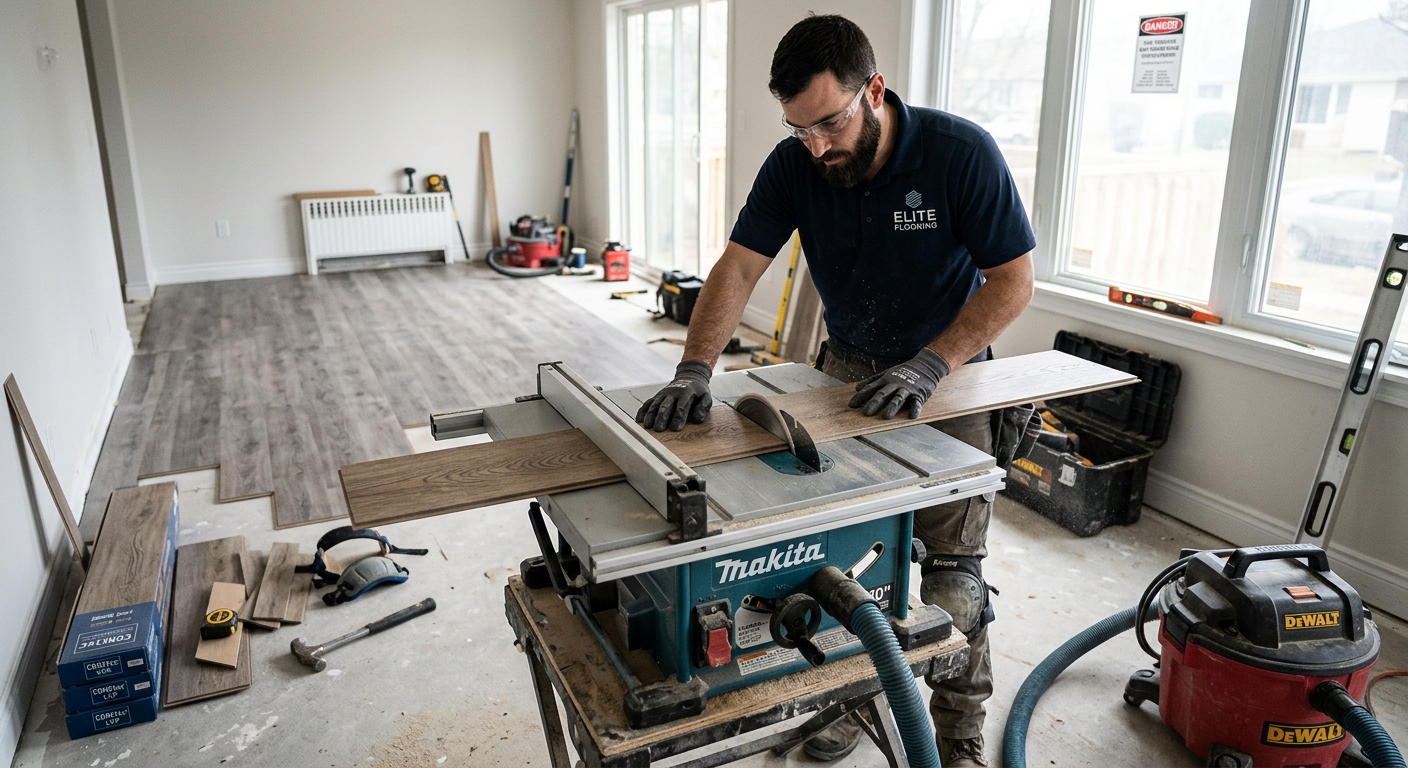
Flooring options and costs in Surrey City Centre
Surrey City Centre is a practical place to renovate, but flooring pricing changes quickly depending on where moisture is coming from and how your subfloor is built. With a 2021 population of 33,520 in the area (Statistics Canada, 2021 Census), there’s steady demand for installers, especially around multi-unit buildings and older neighbourhood pockets. In the Lower Mainland–Southwest, the bigger cost driver often isn’t the surface material—it’s what’s under it. Many homes in Surrey were built with older, uneven plywood or concrete slabs that need levelling, patching, or even a moisture barrier layer before flooring can go down. That prep work commonly adds roughly $1–$3 per sq ft (and more if the floor needs resurfacing).
Because the climate is wet and marine, indoor humidity can swing meaningfully in winter and shoulder seasons. Those swings matter for solid hardwood: it expands and contracts with humidity, so it’s best limited to above-grade installs with appropriate gaps and stable indoor conditions. For basements and on-grade concrete, we typically avoid solid hardwood and recommend engineered wood or luxury vinyl plank (LVP), because layered or PVC cores handle humidity and minor temperature movement far better. If your home uses radiant heating, engineered wood, LVP, tile, and some rated laminates are typically the safest match; solid hardwood needs a careful spec and isn’t our default.
In Surrey City Centre, the trade is especially busy in the downtown core near Civic Plaza and along the transit corridors, where turnover and condo renovations keep crews booked. With that context, here’s how the main flooring types compare on cost, performance, and where they work best—then you can decide which line items should show up in your quote.
| Type |
Best Room |
Moisture Resistance |
Lifespan |
Price per sq ft |
| Solid hardwood (nail-down, above grade only) |
Main living areas above grade |
Low (needs stable indoor humidity; not for basements) |
30–60 years |
$9–$18 |
| Engineered hardwood (float or glue, above + on-grade) |
Living rooms, bedrooms, some main-floor on-grade |
Medium to high (layered core manages humidity better) |
20–35 years |
$8–$16 |
| Laminate (click-lock, above-grade) |
Bedrooms, living rooms (rated products only) |
Medium (not ideal for standing moisture) |
10–25 years |
$4–$10 |
| Luxury vinyl plank / LVP (waterproof, any level) |
Kitchen, entry, finished basements |
High to very high (waterproof with correct underlayment) |
15–25 years |
$4–$10 |
| Porcelain / ceramic tile |
Bathrooms and kitchens (and foyers) |
Very high (water-ready) |
25–50 years |
$10–$20 |
| Carpet (broadloom or modular tile) |
Bedrooms and comfort zones |
Medium (sensitive to dampness; requires dryness) |
7–15 years |
$4–$10 |
Prices are estimates only and vary by project scope, site access and material selection.
What affects the price of flooring in Surrey City Centre
In Surrey City Centre and across the Lower Mainland–Southwest, the same “rooms and square footage” can still land in very different totals—often by 30–50%—because the quote has to account for local conditions and how crews work. Wet, marine weather drives indoor humidity swings, and the region’s older housing stock frequently includes uneven plywood or moisture-prone concrete. In a basement, moisture can wick through slabs-on-grade, which affects what’s allowed and what prep is required. That’s why solid hardwood tends to be more limited in BC: it expands and contracts with humidity and shouldn’t be installed over concrete or in damp below-grade spaces. Engineered hardwood and LVP are usually a better fit, and they’re priced differently because their construction is more tolerant of humidity and minor temperature changes.
Cold inland pockets and newer builds with radiant heating also affect labour and material selection. If you have radiant heat, most solid hardwood and some laminate products are ruled out or must be specifically rated for temperature swings. Subfloor prep adds another cost layer: levelling, patching, and moisture barriers commonly add about $1–$4 per sq ft depending on how far the existing surface is out of level.
Here are a few concrete Surrey City Centre examples of where the cost goes up or down:
- A main-floor install where the plywood is flat may keep you closer to the laminate/vinyl plank band (roughly $4–$10 per sq ft); the same job on a badly uneven subfloor often pushes totals toward the higher end due to levelling and underlayment.
- A finished basement that needs a moisture barrier and careful acclimation usually makes LVP the value play; it avoids the “high risk” scenario that can come with solid hardwood.
- Tile in a kitchen can be economical if your substrate is already square and stable; if the slab needs resurfacing, tile labour and prep can quickly approach the upper tile band (roughly $10–$20 per sq ft).
Bottom line: in Lower Mainland–Southwest, moisture management and subfloor readiness are often the difference between a straightforward quote and one that climbs into a higher budget bracket.
| Price Factor |
Why It Matters |
Cost Impact |
| Room area in sq ft |
Directly drives material quantity, underlayment, waste factor, and labour hours |
Major driver; larger areas usually reduce cost per sq ft slightly |
| Subfloor condition — levelling or repair needed |
Uneven plywood or damaged concrete can require patching, self-levelling, or resurfacing |
Often adds about $1–$4 per sq ft depending on how far out-of-level it is |
| Moisture / below-grade install — rules out solid hardwood |
Moisture wicking through slab requires barrier planning; solid wood performs poorly below grade |
Can change material choice and add prep; typically increases total quote |
| Material choice — solid vs. engineered vs. LVP vs. tile |
Different products have different tolerances to humidity, plus different installation systems |
Solid hardwood can sit around $9–$18 per sq ft; LVP often around $4–$10 per sq ft |
| Removal and disposal of existing flooring |
Tearing out old materials, hauling, and cleaning affects labour time and disposal costs |
Can add a noticeable fixed cost plus hours; varies by what’s being removed |
| Stair nosing / transitions — charged per step or per linear foot |
Transitions and nosings are time-intensive and often require matching trim pieces |
Frequent quote “surprises” on multi-level homes |
| Radiant heat compatibility |
Limits material options and can require approved underlay/installation specs |
May shift you into engineered, LVP, tile; can add product-specific costs |
| Installation method — float vs. glue-down vs. nail-down |
Different methods require different labour steps, adhesives, and curing time |
Glue-down and tile work typically increase labour time vs basic click-lock |
Permits & regulations in British Columbia
In British Columbia, installing flooring itself usually does not require a building permit. That said, associated work can trigger permit or compliance steps. Common examples include electrical work related to in-floor heating circuitry or any modifications to existing electrical components, which typically require an electrical permit through the proper channels. If you’re doing structural subfloor repair that meaningfully changes structural elements (for example, replacing load-bearing components), permits or engineered sign-off can become relevant depending on scope—so it’s important not to assume “it’s just flooring.” For moisture remediation, the work is often done without a permit, but the contractor should still document what they found and what they’re correcting.
In condominiums, the bigger practical restriction is usually the building’s sound transmission requirements (STC/IIC expectations). Some buildings require specific underlay systems under hard flooring, and boards often limit floating installs or require board approval before hard surface upgrades above certain areas.
Step-by-step, Surrey City Centre homeowners can verify a contractor’s standing: (1) confirm they’re properly licensed for the type of work they’re doing via the appropriate BC registry search; (2) ask for a current certificate of liability insurance and ensure it names you as the certificate holder when appropriate; (3) for covered labour, request confirmation for workers’ coverage (WSIB/WCB coverage) and keep it on file; (4) if you’re in a condo, request the installation plan and underlay/product specs and obtain board approval in writing before any work starts. This protects you if there’s a sound complaint or if something needs to be removed and redone due to building rules.
Best flooring for each room in your Surrey City Centre home
Choosing the right flooring in Surrey City Centre comes down to matching moisture exposure, foot traffic, and comfort needs to Lower Mainland–Southwest realities. Living and dining areas are best with engineered hardwood or a high-quality laminate: they bring warmth underfoot, handle day-to-day humidity swings better than solid wood, and still look like classic hardwood. For master bedrooms, many homeowners choose carpet for softness and sound control, but engineered hardwood is also a strong choice if your indoor humidity is well-managed and the subfloor is flat. In a kitchen, go with LVP or large-format porcelain tile—both handle spills and frequent cleaning without worrying about swelling.
Basements (especially finished ones) are where the region’s moisture pattern matters most. LVP is the clear winner: it’s waterproof and performs far better when there’s minor vapour exposure from concrete slabs-on-grade. Bathrooms are straightforward: porcelain or ceramic tile only. And if you’re planning or already have radiant heating, favour tile, LVP, and properly rated engineered wood; most solid hardwood installs need very careful specification.
Price-wise, it’s common to find that LVP sits around the $4–$10 per sq ft band, while engineered hardwood can push higher (often within the $8–$16 range). A practical example: if you’d otherwise spend in the solid hardwood range ($9–$18 per sq ft), choosing engineered in your main living spaces can cost less than solid while still giving you a hardwood look—then using LVP in the basement avoids moisture-driven failures that are expensive to correct.
| Room |
Best Material |
Why |
Moisture Risk |
Price Band per sq ft |
| Living / dining room |
Engineered hardwood |
Warmth and realistic wood look with better humidity tolerance than solid |
Low to medium (manageable with indoor humidity control) |
$8–$16 |
| Master bedroom |
Carpet or engineered hardwood |
Carpet boosts comfort and sound; engineered gives easier maintenance |
Low (unless there are moisture issues from below-grade walls/slab) |
$4–$10 |
| Secondary bedrooms |
Laminate (rated) or engineered hardwood |
Durable for everyday traffic; laminate can be cost-effective with correct underlayment |
Low to medium |
$4–$10 |
| Kitchen |
Luxury vinyl plank (LVP) or porcelain tile |
Spill resistance, easy cleaning, and strong performance in wet-wipe environments |
Medium (daily spills/splashes) |
$4–$20 |
| Basement (finished) |
LVP (waterproof) |
Handles slab moisture and vapour movement far better than solid wood and typical laminate |
High (Lower Mainland–Southwest moisture exposure through concrete is common) |
$4–$10 |
| Bathroom |
Porcelain / ceramic tile |
Best wet-area track record; works with proper waterproofing practices |
Very high |
$10–$20 |
How to choose a flooring contractor in Surrey City Centre
Start by verifying contractor legitimacy the way you’d verify a major purchase—piece by piece. In British Columbia, ask for a current certificate of liability insurance and confirm coverage dates and scope. For workers’ coverage, request proof of WSIB/WCB coverage (or the applicable equivalent documentation they carry for their workforce) before the first day on site. Then, check their licensing status for the type of work being quoted and whether they are using a subcontractor model or taking responsibility directly. Surrey City Centre projects often involve condos and older homes, so you want a contractor who can show they’ve done similar moisture-aware installs.
Next, get 2–3 written quotes that are itemised—labour and materials separated, with clear lines for underlayment/moisture barrier, removal and disposal, transitions, and stair work. Avoid “lump sum only” quotes because they hide the true cost drivers, especially subfloor levelling. Read the exclusions carefully: what’s not included (for example, self-levelling compound, additional patching, or removing stubborn adhesive)? Confirm disposal is included if it’s a tear-out. Warranty matters too: ask about workmanship warranty length, whether it covers labour and materials for failures caused by installation, and whether product warranties are transferable to you as the homeowner.
Finally, align payment with progress. Never pay more than 10–15% upfront; request a holdback until the job is complete and you’ve reviewed the finished surfaces. Ask for a start date and a completion estimate in writing so you can plan around Surrey’s schedules and condo access windows.
- Ask for itemised labour and material breakdowns (no “all-in” only line).
- Confirm moisture testing/assessment steps for on-grade and basements.
- Get exact underlayment and barrier product names in writing.
- Verify levelling approach and whether self-levelling is included or extra.
- Confirm stair nosing and transition pricing per step or linear foot.
- Check what transitions are included at doorways and between rooms.
- Ask whether removal and disposal of existing flooring is included.
- Request a clear waste factor allowance for planks/tiles.
- Confirm radiant heat compatibility (if applicable) and product ratings.
- Review warranty terms: workmanship duration and what it covers.
- Set a payment schedule with a holdback until punch-list completion.
- Get start date, material lead time assumptions, and completion estimate in writing.
Red flags in Surrey City Centre: contractors who won’t provide proof of liability insurance, who give only verbal scope (no written exclusions), who dismiss basement moisture concerns with “it’ll be fine,” who require large upfront payments beyond 10–15%, or who can’t explain the installation method (float vs glue-down vs nail-down) and what that means for warranty coverage.
Frequently asked questions — flooring in Surrey City Centre
Can I install flooring over existing tile in Surrey City Centre?
Often, yes—but it depends on the tile’s surface condition and your underlayment plan in Surrey City Centre. If the tile is firmly bonded (no loose edges), level enough, and not excessively high/uneven, some contractors will install click-lock laminate or certain engineered wood systems over it using the right underlay. For LVP, it can work in many cases as well, but the key is whether the tile grout ridges and lippage are within the tolerance required by the product manufacturer. If there’s cracking, movement, or significant unevenness, the safest route may be flattening/skim-coating or removing the tile.
Because Lower Mainland–Southwest homes can see humidity swings, the contractor should also verify moisture conditions before installing. If you’re comparing options, many homeowners choose LVP (often in the $4–$10 per sq ft band) when they want a forgiving surface system, while tile remains the most moisture-proof but may add thickness and height transitions.
What is the best flooring for a high-traffic area in Surrey City Centre?
For high-traffic areas in Surrey City Centre—entries, hallways, and open living spaces—the “best” option is usually the one that’s durable and humidity-tolerant. If you want a wood look, engineered hardwood is a strong choice in main living zones because it handles seasonal moisture changes better than solid hardwood. If you want maximum resilience against everyday spills and tracking from wet weather, luxury vinyl plank (LVP) is typically the most forgiving. In our Lower Mainland–Southwest climate, LVP’s waterproof core helps when moisture makes its way in during winter or shoulder seasons.
Carpet can work too, but it needs good maintenance and fast drying if damp occurs—otherwise it’s not ideal. Price-wise, homeowners often stay around the laminate/LVP band (roughly $4–$10 per sq ft) for corridors to manage cost, while tile (commonly $10–$20 per sq ft) can be worth it for areas that see heavy wet mopping.
How do I prepare my subfloor before new flooring?
Subfloor prep is where Surrey City Centre projects can make or break the finished floor. First, the contractor should check flatness (not just “it looks fine”), then assess whether the surface is sound and dry. For on-grade concrete or slab-on-grade areas, the focus is moisture: below-grade or slab areas can wick moisture, especially in winter, so a moisture barrier may be required. For uneven plywood, levelling may be needed—this is common in older regional housing stock and can add roughly $1–$4 per sq ft to your overall budget depending on how much repair is required.
Next, choose the correct installation method for the product. Solid hardwood needs a stable above-grade setup and doesn’t belong over concrete where moisture vapour is present. Engineered hardwood and LVP are generally more tolerant, but they still require correct underlayment and proper expansion/clearance where applicable. If you’re installing over tile or remnants of adhesive, prep must include cleaning and addressing surface height differences.
Is cork or bamboo flooring a good choice in Surrey City Centre?
Cork and bamboo can be good looking options, but they’re not always the best match for the Lower Mainland–Southwest moisture profile in Surrey City Centre—especially in basements and on-grade concrete areas. Cork is more dimensionally stable than many natural floors, and it’s comfortable underfoot, but it can still be vulnerable to prolonged humidity and standing water if the installation isn’t moisture-appropriate. Bamboo flooring has similar sensitivity concerns, particularly with humidity-driven expansion and contraction; it also needs the right underlay and a stable subfloor to prevent gapping.
Where these materials usually make sense: above-grade rooms with stable indoor humidity—living spaces and bedrooms where you can control moisture. Where they often don’t: finished basements and areas with concrete moisture vapour. In those spaces, many homeowners pivot to waterproof LVP (often $4–$10 per sq ft) for peace of mind, or to tile if they want the most moisture-proof approach.
What is the difference between floating and glued-down flooring?
Floating flooring means the planks or panels “float” on top of an underlayment and lock together, without being mechanically fastened to the subfloor (typical with click-lock laminate and many engineered hardwood systems). Glued-down flooring is installed with adhesive directly to the subfloor, which can help reduce movement but requires strict subfloor preparation and correct adhesive selection. In Surrey City Centre, floating installations are common because they’re faster and can be forgiving over minor surface imperfections—when paired with the right underlayment.
Where this matters: humidity swings and subfloor condition. Over concrete or in spaces with moisture vapour risk, both methods require careful moisture management. Solid hardwood is generally nail-down above grade only; it’s not a glued-down solution over damp concrete. If you’re pricing, floating systems often land nearer the $4–$10 band for laminate/LVP, while tile or glue-intensive assemblies can push toward higher totals depending on prep and labour.
What flooring holds up best to pets in a Surrey City Centre home?
For pets in Surrey City Centre, the best-performing choices usually balance scratch resistance, clean-up ease, and moisture tolerance. LVP is a top contender because it’s waterproof (helpful for accidents) and its surface is generally easier to clean than carpet. Engineered hardwood can also work if you pick a thicker wear layer and use proper mats and routine maintenance, but it’s not the first pick for homes with basement access issues where moisture vapour can be present.
Carpet can still be chosen for comfort, but it often takes more care—pet incidents need fast drying to prevent odours and trapped moisture. Tile is durable and easy to disinfect, but it’s harder underfoot and can be colder without radiant heating. If you’re deciding based on budget, many pet owners start around the LVP or laminate range (roughly $4–$10 per sq ft) for hallways and living areas, then use tile in bathrooms or kitchens for the easiest cleanup.