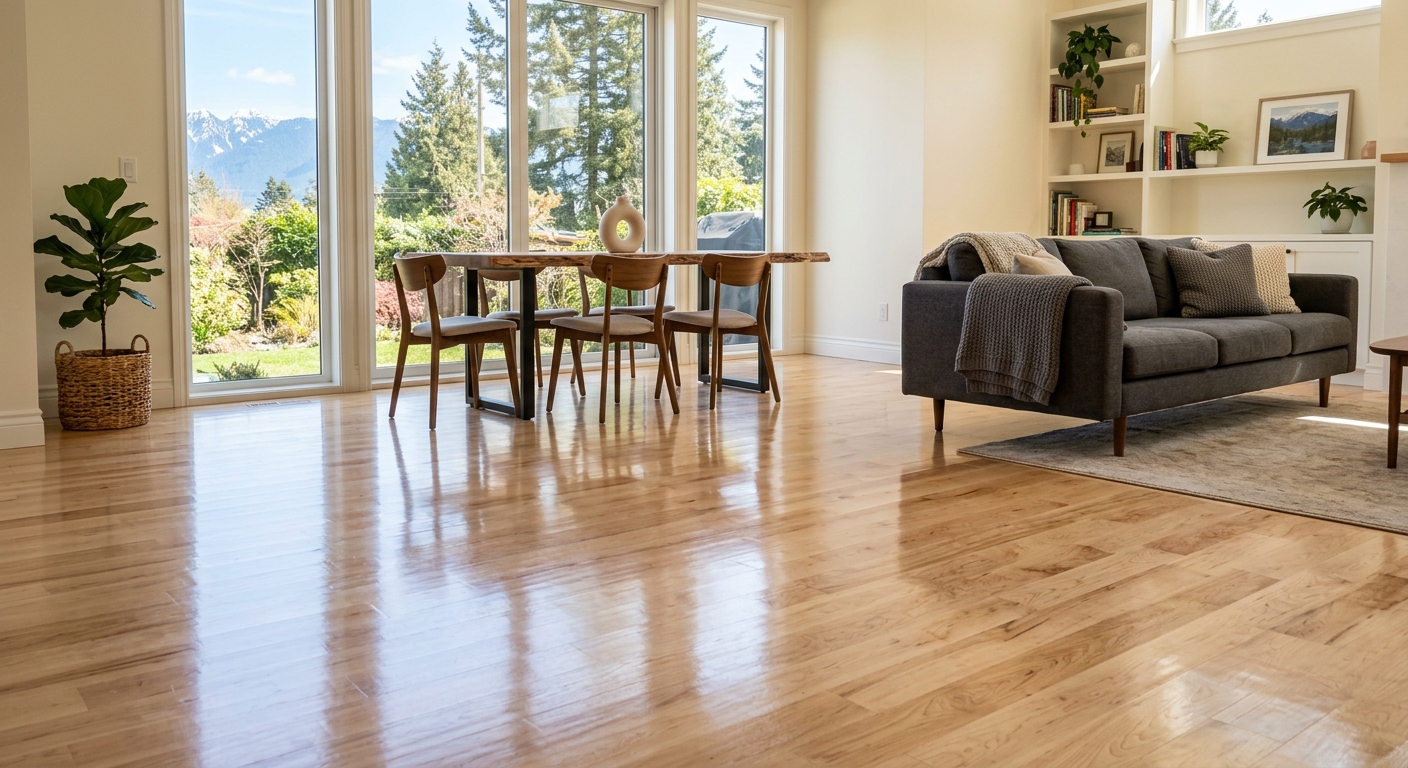
Flooring options and costs in Clearwater
Flooring in Clearwater is all about finding the right balance between comfort and moisture stability. With a population of 2,388 and about 800 homeowner households (Statistics Canada, 2021 Census), many projects involve updating older housing stock: roughly 50.5% of local homes were built before 1981, and those renovations often uncover uneven subfloors, patchy plywood, or older underlayment that needs repair or levelling before any new finish goes down. In most Clearwater basements and below-grade areas, that extra prep isn’t optional—mechanical fastening, moisture control primers, and self-levelling underlayments are frequently part of the scope. Plan for added labour and materials, commonly in the $1–$4 per sq ft range depending on how far out-of-level the surface is.
The Thompson–Okanagan’s dry winters and hot, sometimes smoky summers create noticeable indoor humidity swings. That cycling affects wood dimensionally, and it also intensifies the need for proper vapour control where there’s crawlspace or basement moisture. It’s why local installers often steer homeowners toward engineered hardwood or luxury vinyl plank (LVP) below grade, while tile and quality LVP also perform well in the day-to-day reality of lakeside properties and busy family homes. You’ll also notice strong trade demand around Clearwater’s core residential areas and busy service zones where updates often coincide with kitchen and living-room refreshes, especially when in-floor heating is present in newer builds. With that in mind, here’s a practical side-by-side of flooring types and what they typically cost per square foot when installed in Clearwater.
| Type |
Best Room |
Moisture Resistance |
Lifespan |
Price per sq ft |
| Solid hardwood (nail-down, above grade only) |
Living / dining |
Low (must stay above grade and dry) |
25–60 years |
$12,00 – $25,00 |
| Engineered hardwood (float or glue, above + on-grade) |
Main floor bedrooms & hallways |
Medium to high (stable with humidity swings) |
20–50 years |
$14,00 – $28,00 |
| Laminate (click-lock, above-grade) |
Secondary bedrooms |
Low to medium (spills must be cleaned fast) |
10–25 years |
$6,00 – $12,00 |
| Luxury vinyl plank / LVP (waterproof, any level) |
Kitchen & finished basements |
High (waterproof surface) |
15–30 years |
$8,00 – $18,00 |
| Porcelain / ceramic tile |
Bathrooms & entryways |
Very high (impervious tile) |
25+ years |
$16,00 – $32,00 |
| Carpet (broadloom or modular tile) |
Master & stairs |
Low (needs protection from below-grade moisture) |
8–15 years |
$7,00 – $14,00 |
Prices are estimates only and vary by project scope, site access and material selection.
What affects the price of flooring in Clearwater
Even when you’re comparing the “same” flooring type, quotes across the Thompson–Okanagan can vary by 30–50% in British Columbia once moisture conditions, subfloor prep, and demolition/disposal are factored in. In Clearwater, the indoor humidity swings caused by dry winters and hot, sometimes smoky summers can lead to seasonal expansion issues if the install method and underlayment aren’t matched to the product. That’s one reason solid hardwood is priced higher and limited to above-grade applications—solid planks expand and contract with humidity, and they perform poorly in basements. By contrast, engineered hardwood and LVP handle humidity and occasional spills far better, so they’re often selected for on-grade and below-grade work.
Cold pockets and in-floor heating are also common considerations in the region. Radiant heating typically nudges homeowners away from most solid hardwood and some laminate lines that aren’t rated for it; engineered wood, quality LVP, and tile are more frequently compatible. Older Clearwater homes—about 50.5% built before 1981—often need subfloor levelling or repair before any planks or underlayments will sit properly, and that’s where costs can rise quickly. For example, levelling a rough plywood floor can add several dollars per square foot, while fixing a damaged subfloor section can jump the quote even for a smaller area.
Two concrete examples you’ll see locally: upgrading a main-floor living space from click-lock laminate (often in the $4–$10 materials band) to engineered hardwood usually costs more, but it can be justified when you’re also addressing inconsistent humidity and want longer lifespan. In basements, installing LVP that tolerates below-grade moisture often costs less overall than trying to “make solid wood work,” because you avoid failed installs and extra moisture mitigation cycles. Those practical differences are why installers in Clearwater tend to treat moisture management as a core part of the price—not a surprise add-on.
| Price Factor |
Why It Matters |
Cost Impact |
| Room area in sq ft |
Material quantity and labour hours scale directly with size. |
Direct driver; larger areas often get slightly better unit pricing. |
| Subfloor condition |
Levelling, grinding, or repair must meet flatness needs for planks and tile. |
Commonly +$1–$4 per sq ft for levelling/repair in older homes. |
| Moisture / below-grade install |
Solid hardwood is sensitive to vapour and humidity; basements typically need engineered or LVP. |
Moisture mitigation can add several dollars per sq ft. |
| Material choice |
Solid vs engineered vs LVP vs tile changes installation method and underlayment requirements. |
Broadly shifts the installed budget to different bands. |
| Removal and disposal of existing flooring |
Labour and dump fees vary based on thickness, glue-down residue and subfloor damage. |
Can materially increase cost on older glued surfaces. |
| Stair nosing / transitions |
Steps and thresholds require extra trim, templating and precision cuts. |
Often charged per step or per linear foot; can add noticeable totals. |
| Radiant heat compatibility |
Not all products tolerate heat cycling; compatible materials may cost more but prevent failure. |
May require a specific product line and approved underlayment. |
| Installation method |
Float, glue-down, and nail-down methods require different labour and prep. |
Nail-down and glue-down typically cost more than simple floating. |
Permits & regulations in British Columbia
In British Columbia, a flooring installation itself usually does not require a building permit. What can trigger permitting is the associated work around the flooring. For example, subfloor structural repairs (such as replacing significant framing members), major moisture remediation that involves building-envelope changes, or any in-floor heating work connected to electrical circuits may require electrical permits depending on how the work is performed and who is doing it. If your project involves removing old heating mats, modifying wiring, or adding new thermostat components, expect permit requirements to fall under the electrical scope rather than the flooring scope.
For condos in Clearwater or elsewhere in BC, the bigger issue is typically not a municipal permit—it’s the strata’s rules. Condo corporations often restrict hard flooring due to sound transmission. They may require specific underlay, restrict installation hours, or require proof of compliance with sound ratings (often discussed as STC/IIC performance). Before you start, review your unit’s condo declaration/bylaws and request written board approval if required—especially for engineered hardwood, tile, and LVP with hard backing on upper floors.
To verify your contractor in Clearwater, ask for (1) their business licence details/registration as applicable, (2) liability insurance certificate, and (3) proof of workers’ coverage (WSIB/WCB coverage). You should also request a “clearance” letter where their provider issues one. If they cannot provide documentation, treat it as a serious red flag.
Best flooring for each room in your Clearwater home
Choosing the best flooring in Clearwater means matching the material to moisture exposure, daily wear, and comfort—because the Thompson–Okanagan climate swings humidity more than many homeowners expect. Living and dining rooms are usually the best place for warm, attractive surfaces: engineered hardwood or high-quality laminate offer a balance of look and durability, with engineered products generally performing better during seasonal changes. In bedrooms, many homeowners prefer carpet for softness and sound control, but engineered hardwood is also a strong option if you’re aiming for easy cleaning and a more consistent look throughout the main floor.
In kitchens, where water spills happen and traffic is constant, luxury vinyl plank (LVP) is a practical choice, or large-format porcelain tile if you prefer a truly waterproof, easy-scrub surface. In Clearwater basements (especially finished spaces above any crawlspace or with seasonal humidity), LVP is typically the clear winner: its waterproof core and surface reduce the risk from moisture vapour and incidental seepage—problems that can spell trouble for solid wood and many laminate installs. Bathrooms should be porcelain or ceramic tile only, because tile systems are built for wet environments and long-term cleaning. Where radiant heat is installed (increasingly common in BC new construction), choose radiant-compatible engineered wood, quality LVP, or tile; most solid hardwood and some laminate lines aren’t rated for heat cycling.
As a dollar example: if a homeowner compares laminate around the $4–$10 per sq ft band versus engineered hardwood closer to the $12–$25 hardwood band (plus any levelling costs), the higher budget often makes sense when the subfloor is older and you want a material that handles humidity better over time—especially in a home built before 1981.
| Room |
Best Material |
Why |
Moisture Risk |
Price Band per sq ft |
| Living / dining room |
Engineered hardwood |
Warm underfoot, more stable than solid with local humidity swings. |
Low on grade; moderate if near exterior doors with drafts. |
$14,00 – $28,00 |
| Master bedroom |
Carpet or engineered hardwood |
Carpet adds comfort and sound absorption; engineered keeps a cleaner look. |
Low (avoid only if basement-like humidity issues exist). |
$7,00 – $22,00 |
| Secondary bedrooms |
Laminate (click-lock) |
Good value for daily wear if cleaned promptly after spills. |
Low to medium; sensitive at seams if moisture sits. |
$6,00 – $12,00 |
| Kitchen |
Luxury vinyl plank (LVP) or porcelain tile |
Easy cleanup and strong spill tolerance; tile adds long-term durability. |
Medium (spills and occasional standing water risk). |
$8,00 – $32,00 |
| Basement (finished) |
LVP (waterproof) |
Handles moisture vapour and minor subfloor irregularities better than wood. |
High (below-grade environment variability). |
$8,00 – $18,00 |
| Bathroom |
Porcelain / ceramic tile |
Built for wet areas; durable grout and surface cleaning. |
Very high (routine wet zones). |
$16,00 – $32,00 |
How to choose a flooring contractor in Clearwater
Start by verifying British Columbia coverage and paperwork. Ask the contractor for: (1) proof of liability insurance (certificate of insurance showing your project address if available), (2) proof of workers’ coverage (WSIB/WCB coverage), and (3) a clear business contact and licensing details as applicable for their trade role. You can often cross-check business registration information via provincial and business listings, but your best evidence is the certificate of insurance and any clearance letter from their workers’ coverage provider. If they can’t produce current documents, don’t proceed—especially in older Clearwater homes where there’s a higher chance of hidden subfloor issues.
Next, get 2–3 itemised written quotes. You want a breakdown for labour, materials (underlayments, membranes/primers if needed, transitions, stair work), and disposal/removal. Avoid “lump sum” quotes that don’t describe prep steps. Read the scope line-by-line: confirm whether levelling/patching is included, whether disposal is included, and whether any permits or inspections for electrical work (if radiant heating is being modified) are part of the contractor’s scope.
Warranty matters too. Ask for the workmanship warranty length, what it covers (subfloor prep and installation issues), and whether the manufacturer warranty is transferable if you sell the home. Payment schedules should protect you: never pay more than 10–15% upfront, and hold back a portion until the job is complete and cleaned up.
Finally, insist on a written timeline with a start date and estimated completion date. Flooring work is sequential—materials and subfloor prep can shift—so clarity prevents disputes later.
- Request liability insurance certificate and verify the coverage is active.
- Ask for WSIB/WCB proof (and a clearance letter if their provider issues one).
- Get an itemised quote: labour + materials + underlay/membranes + transitions.
- Confirm what’s included in subfloor prep (levelling, grinding, patching).
- Ask if moisture testing or vapour mitigation is included where needed.
- Clarify disposal: removal of old flooring and dump fees included or extra?
- Confirm stair nosing and transitions pricing (per step or per linear foot).
- Check warranty: workmanship length, product warranty, and transferability.
- Require a written schedule with start and completion targets.
- Verify radiant heat compatibility requirements in writing for your specific product.
- Use a payment schedule capped at 10–15% deposit; hold back near completion.
- Ask for photos/examples of similar Clearwater basements or on-grade installs.
Red flags in Clearwater include: a contractor who won’t provide insurance/coverage documentation, quotes that skip subfloor prep details, vague “all-in” pricing with no disposal or transition scope, refusal to put the timeline in writing, and no clear warranty terms for workmanship.
Frequently asked questions — flooring in Clearwater
What flooring works with radiant heat?
In Clearwater and across British Columbia, radiant heat compatibility depends on the product’s installation rating and thickness—not just the general “type” of flooring. In most cases, engineered hardwood, high-quality LVP, and porcelain tile are the safest choices because they’re designed to tolerate heat cycling and expansion more predictably than many solid hardwood and click laminate lines. For example, if you’re upgrading a main floor with in-floor heating and you’re choosing between laminate and engineered wood, engineered typically holds up better under temperature swings in addition to meeting more radiant requirements. Always ask the installer to confirm the specific product’s radiant compatibility in writing and confirm the approved underlayment (some underlays can trap heat). Also, ensure the subfloor is flat—radiant systems don’t fix unevenness, and that matters for both tile setting and plank performance.
Engineered vs solid hardwood — what's the difference?
Solid hardwood is one single piece of wood throughout its thickness and is typically nailed down or stapled. It performs best when installed above grade where indoor humidity stays relatively stable; in basements, it can be vulnerable to expansion, contraction and moisture-driven movement. Engineered hardwood uses multiple layers (a stable core with a real hardwood wear layer). That construction makes it more dimensionally stable through the Clearwater humidity swings—dry winters followed by hot, sometimes smoky summers—so it’s commonly recommended on and above grade, and often in homes where moisture management is a recurring cost driver. If you’re comparing budgets, solid hardwood installs often land in the $12–$25 per sq ft range for many projects, while engineered hardwood frequently comes higher but may prevent issues and rework when your subfloor is older (many Clearwater homes were built before 1981, per Statistics Canada, 2021 Census).
Do I need to level my subfloor first?
Often, yes—especially in Clearwater’s older homes. When boards are out of level or the subfloor has dips, humps, or damaged patches, you’ll see it quickly: click-lock joints may separate, LVP can flex and show gaps, and tile can crack or have lippage. Whether you need levelling depends on the flooring type and the flatness requirements of the manufacturer, but as a practical rule, many installs require grinding, patching, or self-levelling compound. Levelling and prep are also where older housing stock raises costs because you can’t “hide” an uneven substrate under wood or tile. As an example, if levelling adds $1–$4 per sq ft, that may be the difference between choosing LVP within an $8–$18 per sq ft installed band versus spending more trying to make an unsuitable material work on an uneven floor. Ask for the flatness plan and what prep steps your quote includes.
What's the most durable flooring for pets and kids?
For durability in a Clearwater home with pets and kids, luxury vinyl plank (LVP) is usually the front-runner because it’s designed to be waterproof on the surface and stands up well to routine accidents and quick cleanups. It also tends to tolerate minor subfloor imperfections better than some rigid wood products. In kitchens and finished basements, LVP’s water tolerance can prevent small spills from becoming a long-term problem. If you want a “strongest for wet zones” option, porcelain/ceramic tile is excellent in bathrooms and kitchens, but it’s harder underfoot and can be harder to manage if you drop toys or use it across the whole home. Carpets can be comfortable, but they stain and trap odours if spills aren’t handled quickly—especially in areas affected by below-grade humidity. Budget-wise, many Clearwater installs for LVP land around the $8–$18 per sq ft range, which often feels sensible compared with the added risk of choosing moisture-sensitive flooring in a home that experiences humidity swings.
How do I choose flooring for humidity in Clearwater?
Start with the “where” question: what floor is above grade, on grade, or below grade. Clearwater experiences dry winters and hot, sometimes smoky summers, which creates indoor humidity swings. That makes solid hardwood risky below grade because it expands and contracts with humidity and cannot be installed over concrete in the same way as more stable products. Engineered hardwood and LVP are typically better because their construction tolerates seasonal movement more effectively. For basements, contractors commonly recommend engineered wood or LVP rather than solid wood, and they plan moisture mitigation (primers, membranes, and proper underlay systems) as part of the job. If your home is one of the many built before 1981, subfloor conditions can also contribute to moisture problems, which is why levelling and repair costs are frequently part of the estimate (Statistics Canada, 2021 Census). Choose materials and underlayments that match the room’s moisture level, not just the look you like.
Do condos restrict hard flooring?
Yes, often. In British Columbia, condo flooring restrictions are typically handled through the strata’s bylaws and sound-transmission requirements rather than by a standard building permit for the flooring itself. Many corporations restrict hard surface flooring on upper floors because footsteps and furniture movement can transmit noise. You may be required to use specific underlay products, achieve certain sound ratings (commonly referenced in discussions around STC/IIC performance), and provide documentation or board approval before installation. In Clearwater, if you’re in a multi-unit building, plan for paperwork and proof of underlay compliance before you order materials. The other practical factor: condo floors may have limited ability to do heavy subfloor grinding or moisture remediation. If your plan includes engineered hardwood, tile, or LVP, confirm allowed systems and underlay thickness early—before your contractor locks in the layout. A good contractor will help you compile the install details the board usually asks for.