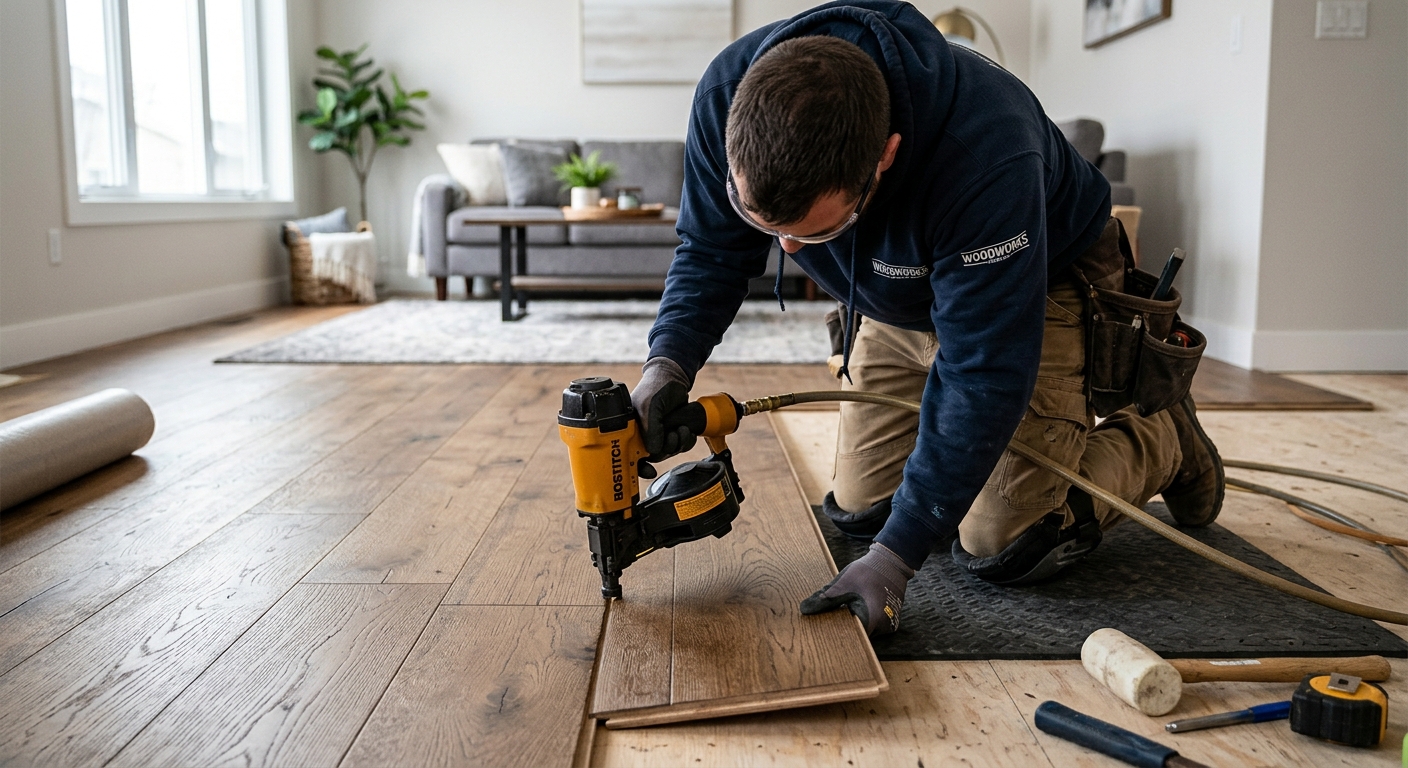
Flooring options and costs in Morley-Buckingham
Flooring choices in Morley-Buckingham feel personal, but the pricing is very practical. For a community of 4,828 residents (Statistics Canada, 2021 Census), most jobs here are smaller in scale, so site access, subfloor prep, and detailed labour scheduling can noticeably affect your total bill. One reason quotes can swing is older housing stock: when subfloors need levelling or repair before installation, homeowners often see roughly $1–$3 per sq ft added to the project cost. In Lower Mainland–Southwest, we also budget for a wet, marine climate—winter and shoulder-season humidity can fluctuate indoors, and moisture can wick through concrete in slab-on-grade areas. That’s why we’re cautious about solid hardwood below grade, and we favour engineered wood or luxury vinyl plank (LVP) where there’s any basement risk.
In established pockets such as Buckingham Heights, turn-over and renovations keep installers busy—especially for main-floor refreshes where speed matters and clients want warm, quiet floors without long downtime. In that market, availability and labour rates are high enough that a “cheaper” material can still end up similar in total cost if it requires more labour-intensive subfloor work or special underlay. With that in mind, the table below compares typical material price ranges per square foot and what each option is best at in a Lower Mainland–Southwest home.
| Type |
Best Room |
Moisture Resistance |
Lifespan |
Price per sq ft |
| Solid hardwood (nail-down, above grade only) |
Main living areas (above grade) |
Low to moderate (humidity sensitive) |
25–50 years |
$9–$18 |
| Engineered hardwood (float or glue, above + on-grade) |
Living areas, bedrooms |
Moderate to good (layered construction) |
20–35 years |
$10–$17 |
| Laminate (click-lock, above-grade) |
Secondary bedrooms, hallways |
Moderate (water must be cleaned fast) |
15–25 years |
$4–$10 |
| Luxury vinyl plank / LVP (waterproof, any level) |
Kitchen, basement (finished) |
High (PVC core and waterproof wear layer) |
15–25 years |
$5–$12 |
| Porcelain / ceramic tile |
Bathrooms, kitchens (and entries) |
Very high (if installed to spec) |
30+ years |
$10–$20 |
| Carpet (broadloom or modular tile) |
Bedrooms, stairs |
Low to moderate (moisture can linger) |
8–15 years |
$4–$9 |
Prices are estimates only and vary by project scope, site access and material selection.
What affects the price of flooring in Morley-Buckingham
In the Lower Mainland–Southwest, it’s common to see the same “square-foot” flooring scope come in 30–50% apart across British Columbia. The material may be similar on paper, but the real differences show up in moisture testing, subfloor levelling, labour time to address uneven plywood or concrete, and the extra steps needed for a stable install under humidity swings. In Morley-Buckingham specifically, winter and shoulder-season indoor humidity changes can make solid hardwood expand and contract; because solid wood is not designed to handle moisture and movement from concrete, it generally can’t be glued or floated over slab and it performs poorly in basements. Engineered hardwood and luxury vinyl plank handle humidity and minor temperature changes far better, so they’re often the more cost-predictable choices when the home has crawlspace risk or moisture migration.
Regional pricing also reflects how older housing stock is built. Many homes need levelling or subfloor repair before install, which typically adds about $1–$4 per sq ft to the total. For example: choosing LVP at roughly $4–$10/sq ft can still cost more if we’re removing carpet padding, grinding high spots, and building a smooth plane—yet it usually stays more efficient than solid hardwood when there’s below-grade concern. Conversely, tile may pencil out near $10–$20/sq ft, but labour rises when tile requires extra substrate prep or if you need many transitions to match existing flooring heights.
Two concrete Morley-Buckingham scenarios we see often: (1) slab-on-grade rooms with signs of dampness—where we add a moisture barrier/appropriate system and shift you away from solid hardwood; and (2) older subfloors with uneven joists—where levelling compounds or sistering can add material and time. These are exactly the parts that make quotes vary, even when the top-line material price looks close.
| Price Factor |
Why It Matters |
Cost Impact |
| Room area in sq ft |
More square footage drives both material quantity and labour hours. |
Directly proportional to total cost |
| Subfloor condition — levelling or repair needed |
Uneven plywood or cracked concrete adds prep time and sometimes patching/level compound. |
Often adds about $1–$4/sq ft in older homes |
| Moisture / below-grade install — rules out solid hardwood |
Humidity and slab moisture change acceptable materials and underlay systems. |
Can shift choice to engineered wood or LVP |
| Material choice — solid vs. engineered vs. LVP vs. tile |
Each has different price points and installation complexity. |
Usually the biggest swing in material cost |
| Removal and disposal of existing flooring |
Pulling old carpet, underlay, staples, or tile mortar can add significant time. |
Commonly a noticeable add-on |
| Stair nosing / transitions — charged per step or per linear foot |
Transitions and stair work require precision and extra components. |
Can raise the overall project cost even if floor area is modest |
| Radiant heat compatibility — limits material options |
Not all materials tolerate heat cycling the same way. |
May require specific engineered/LVP/tile systems |
| Installation method — float vs. glue-down vs. nail-down |
Preparation and labour intensity differ by method. |
Glue-down generally costs more than floating |
Permits & regulations in British Columbia
In British Columbia, a typical flooring swap usually does not require a building permit by itself. Flooring installation is generally treated as a finish upgrade. However, associated work can trigger permits—especially when you’re altering the structure, addressing moisture with remediation systems, or working near electrical components. If your project involves in-floor heating circuit modifications, wiring changes, or electrical upgrades, that’s the kind of work that commonly requires permits through the electrical pathway. If you’re replacing or substantially repairing subfloor framing for structural reasons, that can also move the project into “permit-worthy” territory.
For condominiums, the bigger restriction is often the building’s sound transmission requirements. Multi-unit buildings frequently set requirements related to impact sound (commonly discussed in terms of STC/IIC) and may restrict hard flooring without specific underlay. Before you install hardwood or tile above grade in a condo, review the declaration/bylaws and request board approval in writing—especially if you’re installing on upper floors.
For homeowners in Morley-Buckingham, verifying a contractor should be step-by-step:
- Check the contractor’s licence status (where applicable) via the Government of British Columbia consumer/licensing listings or the relevant trade registry.
- Request an insurance certificate (general liability) naming you and/or confirming coverage for flooring installation.
- Confirm workers’ compensation coverage (WSIB/WCB) for the crew doing the work.
- Ask for a clearance letter/letter of good standing or proof of coverage directly from the insurer/workers’ compensation portal.
- Keep copies of everything with your contract and scope.
Best flooring for each room in your Morley-Buckingham home
Picking the right flooring in Morley-Buckingham is about matching the material to the room’s moisture exposure, day-to-day traffic, and comfort needs in a wet, marine climate. Living and dining areas usually suit engineered hardwood or high-quality laminate: both give you a warmer feel underfoot than tile and are practical for humidity-managed homes when we leave the proper expansion space and use appropriate underlay. For the master bedroom, carpet is a strong comfort choice—sound absorption and softness matter in colder months, and it helps reduce footstep noise. That said, keep in mind that carpet is more sensitive to prolonged moisture; in areas with any dampness risk, engineered wood is often the safer alternative.
In kitchens, LVP or large-format porcelain tile typically wins. LVP handles splashes and quick clean-ups while resisting moisture vapour issues better than laminate, and tile offers the most reliable water resistance when installed correctly. For basements (finished), the clear winner in Lower Mainland–Southwest is waterproof LVP: it’s designed for “any level” installs and tolerates the humidity profile that comes with slab-on-grade and older homes where moisture can wick through concrete. Bathrooms should be porcelain or ceramic tile only.
If your home has radiant heating (increasing in newer builds), we prioritize tile, LVP, and engineered wood systems that are explicitly rated for radiant heat. Solid hardwood is usually more restricted because heat cycling and humidity changes can lead to gapping or cupping. As a realistic example, you might pay closer to $10–$20/sq ft for tile, but it’s justified in a bathroom where durability and water resistance prevent costly replacements; meanwhile LVP at roughly $5–$12/sq ft can deliver a similar “finished look” in a basement for less money and with fewer humidity-related headaches.
| Room |
Best Material |
Why |
Moisture Risk |
Price Band per sq ft |
| Living / dining room |
Engineered hardwood |
Warmth and stability with layered construction under humidity swings. |
Low to moderate (humidity-driven movement) |
$10–$17 |
| Master bedroom |
Carpet or engineered hardwood |
Comfort and quiet; engineered options still look premium if you want lower maintenance. |
Low (keep relative humidity controlled) |
$4–$15 |
| Secondary bedrooms |
Laminate or carpet |
Good value; easy to clean for family traffic when installed above grade properly. |
Low to moderate |
$4–$10 |
| Kitchen |
Luxury vinyl plank (LVP) or porcelain tile |
Handles spills and frequent cleaning; strong performance under daily wetting. |
Moderate (wet events from cooking and sink) |
$5–$20 |
| Basement (finished) |
Luxury vinyl plank (LVP) |
Waterproof design tolerates moisture vapour and subfloor variability. |
High (humidity and concrete moisture migration risk) |
$5–$12 |
| Bathroom |
Porcelain / ceramic tile |
Best water resistance when installed to spec with proper prep and grouting. |
Very high (standing water potential) |
$10–$20 |
How to choose a flooring contractor in Morley-Buckingham
Choosing the right flooring contractor in Morley-Buckingham is mostly about verification and clarity. Start with licensing/eligibility: in British Columbia, flooring work may not always require the same permitting as electrical or structural work, but reputable contractors still operate with the proper trade credentials for their scope. Ask for their general liability insurance certificate and confirm they carry workers’ compensation coverage (WSIB/WCB, depending on the employer and coverage framework). You should be able to view the certificate and coverage details before work begins—don’t rely on “we have insurance” without paperwork. For a clean record, request a clearance letter or proof of coverage that matches the crew doing the installation.
Next, get 2–3 itemised written quotes. The quote should break down labour and materials (including underlay, moisture barrier where needed, transitions, stair nosing, and disposal). Avoid lump sums that hide what’s included. Read the scope: what is excluded (subfloor grinding/levelling, plywood replacement, mould remediation, electrical changes, permit pulls)? If disposal is not included, expect extra hauling time and fees.
Warranty matters, too. Make sure you understand the workmanship warranty length, whether the manufacturer warranty applies to the exact product and installation method, and if it’s transferable if you sell your home. For payment scheduling, never pay more than about 10–15% upfront; hold back a portion until the job is complete and clean-up is done. Finally, insist on a written timeline with a start date and completion estimate.
- Ask for proof of insurance and workers’ compensation before signing.
- Confirm who will be on site (company name and crew).
- Get itemised labour + materials, not a single blended number.
- Ensure moisture testing/assessment is described for slab-on-grade areas.
- Ask who handles subfloor levelling and whether it’s included.
- Confirm underlayment/moisture barrier requirements by product type.
- Verify stair and transition pricing (per step or per linear foot).
- Ask about subfloor flatness targets and how they’ll achieve them.
- Check disposal/haul-away is included in the scope.
- Review warranty coverage for workmanship and product (and transferability).
- Agree on a payment schedule with a small upfront deposit and holdback.
- Get the start date and completion estimate in writing.
Concrete red flags to watch for: a contractor who won’t show insurance/coverage documents, quotes that only state “labour included” without itemising prep work, promises of solid hardwood installation in basements without a humidity/moisture plan, refusing to outline underlay/moisture barrier specifications for laminate/LVP, or asking for large upfront payments before materials are ordered and the schedule is confirmed.
Frequently asked questions — flooring in Morley-Buckingham
How do I prepare my subfloor before new flooring?
In Morley-Buckingham and across the Lower Mainland–Southwest, subfloor prep is where successful installs are won. First, the subfloor must be clean, dry, and flat enough for the product system you’re installing. For slab-on-grade areas, we typically assess moisture risk because marine humidity and concrete moisture migration can cause failures—especially with solid hardwood. That’s why solid wood is generally limited to above-grade. For engineered hardwood and LVP, we still require good flatness and appropriate underlay/moisture barrier per manufacturer. If you have dips or high spots, levelling compounds or grinding may be necessary; many older homes see about $1–$3 per sq ft added for levelling/repair. For your quote, ask the contractor to specify flatness targets and what prep is included.
Is cork or bamboo flooring a good choice in Morley-Buckingham?
Cork and bamboo can be great for comfort, but in British Columbia—especially with Lower Mainland humidity—your choice should be about installation method and moisture tolerances. Cork is often sold as floating floors, which helps with minor movement, but prolonged dampness can still be an issue in basements. Bamboo products also vary: some are solid or engineered, and not all are rated for above-grade only. In Morley-Buckingham, if the subfloor is on-grade or you have any moisture wicking concerns, we usually steer homeowners toward engineered wood or LVP rather than relying on bamboo/cork to “tolerate” humidity. If you love the look of bamboo, ask for the manufacturer’s warranty wording on humidity/moisture and radiant heat compatibility (if applicable). In terms of cost, cork and bamboo can land within or above typical hardwood pricing—so be sure the performance specs match your home’s moisture profile.
What is the difference between floating and glued-down flooring?
Floating floors “lock” together (often click-lock) and rest over an underlayment without being mechanically fastened to the subfloor. Glued-down floors are bonded directly to the subfloor with an adhesive, which can improve feel and stability in some situations, but it demands excellent surface prep and moisture control. In Morley-Buckingham, moisture management matters because concrete and indoor humidity swings can affect dimensional stability. Floating installations can be more forgiving when subfloors are slightly variable, but they still need flatness and the correct underlay. Glued-down engineered systems typically provide a different performance envelope, and the adhesive and moisture barrier requirements must match the manufacturer’s instructions. If you’re planning radiant heat, choose products that explicitly support it; not all floating laminate and all-glued solids are compatible. When comparing quotes, ask which method you’re getting and whether any moisture barrier is included.
What flooring holds up best to pets in a Morley-Buckingham home?
For pets in Morley-Buckingham homes, the top performers usually balance scratch resistance, easy cleaning, and moisture tolerance from occasional accidents. Waterproof LVP is often the best practical choice because it can handle spills and messes without the damage patterns you’d see in carpet or most laminate. Look for thicker wear layers and a good underlayment system that reduces noise and helps with stability. Engineered hardwood can also work if you choose a durable finish and keep nails trimmed, but you must manage indoor humidity and keep the installation above grade—solid hardwood in basements is usually not the right call. If you want the most forgiving option for cleanup, LVP typically lands in the laminate/vinyl style price band (for example, around $5–$12/sq ft for many LVP ranges). Carpet is comfortable but tends to trap odours and can be expensive to fully remediate after repeated moisture events.
How do I fix squeaky floors in my Morley-Buckingham home?
Squeaks usually come from movement between subfloor layers or from fasteners loosening in the joists system—so “fixing” the top layer alone doesn’t always solve the problem. In Morley-Buckingham, older homes with uneven framing are common, and humidity changes can also contribute to wood movement over time. The right fix depends on where the squeak is coming from: sometimes adding screws through the subfloor into joists works; in other cases, you need to address gaps between subfloor sheets or underlayment. If you’re planning new flooring, it’s best to correct squeaks during subfloor prep rather than after install. When you get a quote, ask if the scope includes identifying squeak points, tightening subfloor fasteners, and levelling/repair work before the flooring goes down. That prep step can be a key cost driver—commonly reflected in the $1–$3 per sq ft range for older-home levelling/repair—rather than adding expensive call-backs later.
What is luxury vinyl plank and is it worth it in Morley-Buckingham?
Luxury vinyl plank (LVP) is a waterproof flooring system with a vinyl wear layer on top and a core that resists moisture effects better than laminate or most wood products. In Morley-Buckingham and the Lower Mainland–Southwest, it’s often “worth it” because humidity swings and potential moisture migration through concrete can make basements and on-grade areas tricky for solid hardwood. LVP is also easier to live with: it’s spill-friendly, comfortable underfoot compared to tile, and many products tolerate everyday wear well. Cost-wise, LVP commonly sits in the vinyl/plank band—about $5–$12/sq ft—while tile runs higher (often $10–$20/sq ft) depending on product and install complexity. The value is highest when your home needs moisture-tolerant flooring without extensive substrate changes. To be safe, ensure the contractor follows product-specific underlayment and flatness requirements; the best LVP still fails if the subfloor preparation is skipped.