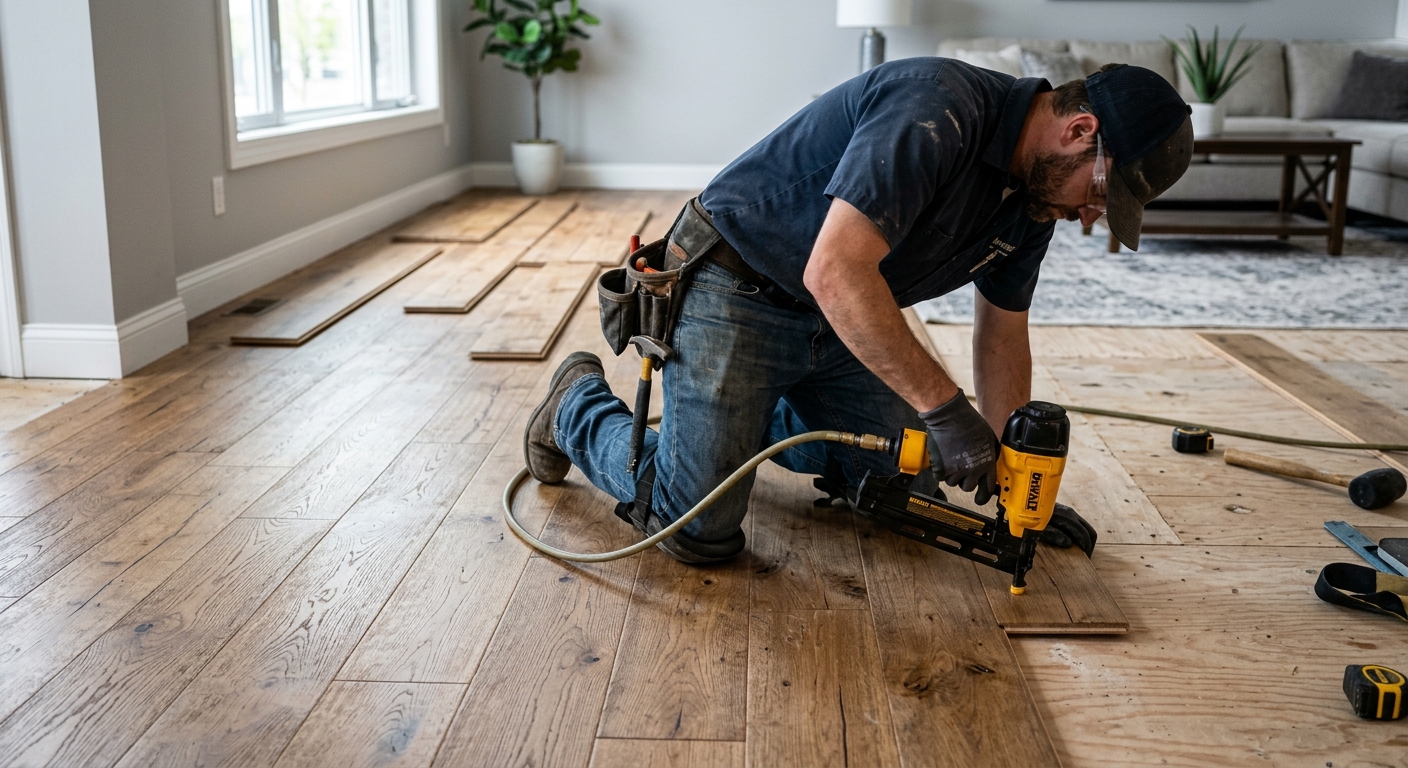
Flooring options and costs in Fort St. James
Fort St. James has a unique flooring market shaped by its small housing stock and big climate swings. With only 1,386 people recorded in the community in the 2021 Census (Statistics Canada, 2021 Census), you’ll notice trades availability can be tighter than larger centres, which can affect lead times and scheduling—especially during peak spring and early summer installs. At the same time, many local homes were built before 1981 (60.2% of dwellings, Statistics Canada, 2021 Census). That matters because older subfloors often need levelling and surface repair before you can lay new planks or tile, and that extra prep is one of the most common reasons a “similar” flooring quote ends up different by thousands.
Nechako humidity swings—dry winters followed by moister shoulder seasons—push homeowners toward products that tolerate movement. Solid hardwood is workable only for above-grade installs with stable indoor conditions; in basements and on slab-on-grade, it’s much riskier due to moisture and vapour. That’s why many Fort St. James homeowners choose engineered wood or luxury vinyl plank (LVP), both of which handle day-to-day moisture variation far better. In colder stretches, radiant heat is also common in retrofits and new builds, which favours radiant-compatible flooring such as engineered wood, LVP, or tile over thick, moisture-sensitive solid hardwood. In practice, demand is especially noticeable in and around town-centre pockets where renovations are frequent and access for material delivery is easier.
Below is a clear comparison of typical material-level price ranges for Fort St. James, before any project-specific subfloor work and transitions are added.
| Type |
Best Room |
Moisture Resistance |
Lifespan |
Price per sq ft |
| Solid hardwood (nail-down, above grade only) |
Living / dining, hallways (stable indoor humidity) |
Low to moderate (not for basements or slab) |
25–60 years |
$12–$25 |
| Engineered hardwood (float or glue, above + on-grade) |
Living / dining, bedrooms |
Moderate to high (better with humidity swings) |
20–40 years |
$10–$22 |
| Laminate (click-lock, above-grade) |
Bedrooms, secondary rooms |
Moderate (avoid chronic dampness) |
10–25 years |
$4–$8 |
| Luxury vinyl plank / LVP (waterproof, any level) |
Kitchen, living, finished basements |
High to waterproof (tolerates vapour better) |
15–25 years |
$6–$14 |
| Porcelain / ceramic tile |
Kitchen, bathrooms, entries |
High (with proper membrane/adhesive) |
25–50 years |
$12–$25 |
| Carpet (broadloom or modular tile) |
Master bedroom, stairs |
Low to moderate (needs good moisture control) |
8–15 years |
$6–$12 |
Prices are estimates only and vary by project scope, site access and material selection.
What affects the price of flooring in Fort St. James
In Fort St. James and the wider Nechako region, two quotes for the “same” floor can easily diverge by 30–50% because the hidden scope is where costs hide: subfloor condition, moisture mitigation, transitions, and the labour method that fits your slab or framing. Humidity swings are the technical driver—solid hardwood expands and contracts with indoor moisture and temperature, and it cannot be glued or floated over concrete in the way engineered products can. It also performs poorly in basements where vapour pressure is more difficult to manage. For cold-region homes that use radiant heat, contractors often steer you away from thick solid hardwood and some laminate systems, because compatibility and underlay choices affect performance.
Below-grade and older-stock prep are major cost levers in this market. Many local homes were built before 1981 (60.2% of dwellings, Statistics Canada, 2021 Census), and that age correlates with mixed subfloor materials, uneven lath/joists, or worn OSB. It’s common to see subfloor levelling and repair add roughly $1–$4 per sq ft depending on how much floor is out of plane. If you’re comparing options, that’s also where budget bands matter: a laminate project at $4–$8 per sq ft can become much closer to engineered wood (often $10–$22) once levelling, underlay upgrades, and transitions are included.
Concrete examples from Fort St. James: (1) a finished basement often pushes homeowners to waterproof LVP (typically $6–$14) instead of solid hardwood (often $12–$25) because of moisture tolerance; (2) a kitchen install with sinks and occasional wet traffic may justify porcelain tile (commonly $12–$25) or high-end LVP to reduce future warping and rework. In colder conditions, labour availability can also shift schedules, and that can change crew time and travel charges.
| Price Factor |
Why It Matters |
Cost Impact |
| Room area in sq ft |
More square footage increases material volume and labour hours for prep, layout and cutting |
Direct driver (small rooms can cost more per sq ft) |
| Subfloor condition |
Uneven floors require levelling/repair before you can install plank or tile successfully |
Often adds roughly $1–$4 per sq ft |
| Moisture / below-grade install |
Basements and slab areas rule out solid hardwood and limit laminate choices |
May shift you from $12–$25 solid to engineered/LVP; can add mitigation steps |
| Material choice |
Solid hardwood, engineered, LVP and tile have different installation systems and tolerances |
Wide swing across $4–$8 laminate vs $12–$25 tile/hardwood |
| Removal and disposal of existing flooring |
Tear-out, hauling and sometimes damaged subfloor repair add time |
Can materially increase total cost on older homes |
| Stair nosing / transitions |
Steps, doorways and height changes require trims and special labour |
Charged per step or per linear foot; easy “hidden” add-on |
| Radiant heat compatibility |
Some products need approved underlay and specific installation methods |
May require upgraded products and testing/conditioning steps |
| Installation method |
Float, glue-down and nail-down each involve different prep, adhesives, acclimation and labour |
Labour differences can change total by thousands on larger areas |
Permits & regulations in British Columbia
In British Columbia, installing flooring itself typically does not require a building permit. However, certain connected scopes can trigger permitting—especially if you’re changing anything structural or electrical. In practice, the most common “permit-relevant” work includes: electrical permits for modifications to in-floor heating circuits, and any electrical work associated with thermostats or wiring changes; and permitting or inspections when structural changes are needed, such as major subfloor rebuilds to correct rot, failing joists, or load issues. If your project involves moisture remediation that includes repairs to assemblies beyond the finish layer, treat it as “inspectable scope” until the contractor clarifies what’s actually being done.
In condominiums, the process is different. Even when permits are not required for the flooring installation, the corporation’s rules on sound transmission often matter. You may be restricted on hard surface flooring, required to use specific underlay, or needed to meet STC/IIC performance expectations on upper floors. Before starting in a multi-unit building in Fort St. James’s broader BC context, review your condo declaration and request board approval in writing where required—especially for hardwood or tile.
Step-by-step verification in Fort St. James: ask your contractor for (1) their British Columbia business/contractor registration and any required trade certifications for the work they’re doing; (2) a certificate of insurance showing liability coverage with proper limits; and (3) proof of workers’ compensation coverage (WSIB/WCB equivalent coverage as applicable). Then confirm with the documentation you receive: check the insurer’s certificate details match the company name and address, and request a clearance letter where the provider supplies one. For electricians or radiant-heat circuit changes, make sure any electrical permit path is handled by a licensed electrician—not your flooring crew.
Best flooring for each room in your Fort St. James home
Choosing the right flooring in Fort St. James is mostly about matching the product to moisture behaviour, traffic and comfort under real Nechako conditions. Living and dining areas benefit from warmth and cleanability without frequent spills; engineered hardwood or high-quality laminate gives you a comfortable feel while handling humidity swings better than solid hardwood. For bedrooms—especially the master—carpet is often the best comfort choice because it dampens sound and stays warmer underfoot during colder mornings. When you want durability with softness, engineered hardwood in the master can still work, as long as the home’s indoor climate is reasonably stable.
In kitchens, the rule is simple: water and grit win. Luxury vinyl plank (LVP) is a practical top pick because many waterproof options tolerate everyday splashes and easier cleaning, while large-format porcelain or ceramic tile is ideal where spills happen frequently. Basements are where Fort St. James homeowners most often avoid solid hardwood; fully waterproof LVP is the clear winner for finished basements because it tolerates moisture vapour and below-grade installation constraints far better than solid wood and most laminate. For bathrooms, porcelain or ceramic tile only is the most reliable approach. If you have radiant heat (increasing in BC new builds and retrofits), choose radiant-compatible flooring and approved underlay systems—this is one reason many people end up with engineered wood, quality LVP, or tile rather than thick solid hardwood.
A quick price reality check: if laminate is around $4–$8 per sq ft but your subfloor needs more levelling and transitions, the cost gap can shrink. Meanwhile, spending at the higher band—like engineered wood often $10–$22—can be justified when it reduces risk in humidity swings and protects you from premature callbacks.
| Room |
Best Material |
Why |
Moisture Risk |
Price Band per sq ft |
| Living / dining room |
Engineered hardwood |
Warm feel, better dimensional stability than solid wood during humidity swings |
Low to moderate (managed indoor humidity) |
$10–$22 |
| Master bedroom |
Carpet or engineered hardwood |
Carpet adds comfort and sound control; engineered maintains a cleaner, hard-surface look |
Low (typical bedrooms) |
$6–$12 |
| Secondary bedrooms |
Laminate (click-lock) or LVP |
Good value and durability for everyday traffic; LVP adds moisture tolerance for busy households |
Low to moderate |
$4–$14 |
| Kitchen |
Luxury vinyl plank (waterproof) or porcelain tile |
Handles wet traffic and frequent cleaning; tile resists staining with correct sealing approach where needed |
Moderate to high (spills) |
$6–$25 |
| Basement (finished) |
Luxury vinyl plank (waterproof) |
Works with below-grade moisture conditions better than solid hardwood; easier to protect with correct underlayment |
High (vapour risk and seasonality) |
$6–$14 |
| Bathroom |
Porcelain / ceramic tile |
Best long-term performance in wet zones when installed over proper prep and waterproofing practices |
Very high |
$12–$25 |
How to choose a flooring contractor in Fort St. James
Start with verification, not promises. In British Columbia, confirm your contractor is set up to legally operate for the type of work they’re performing, and ask for a certificate of liability insurance (so you’re protected if something is damaged on site). For workers on the job, verify workers’ compensation coverage documentation (WSIB/WCB equivalent), because flooring crews should be covered when they’re installing, lifting materials and doing removal. If your project includes electrical work for radiant heat circuits, the electrical scope should be handled by a licensed electrician and permit-ready where required.
Next, require 2–3 itemised written quotes. Insist the quote breaks down labour and materials separately (not a single lump sum), and that it clearly lists allowance pricing for underlay, adhesives, levelling compounds, transitions and stair work. Read the scope carefully: does it include subfloor prep, moisture mitigation, demolition and disposal, and the specific trim/transition pieces needed at doors and height changes? Also clarify timing and protection: when will the contractor acclimate materials, and what protection will they put down to prevent dirt tracking through the house?
Warranty matters, too. Ask for the workmanship warranty period and whether it’s transferable if you sell, and confirm what the manufacturer warranty covers for product defects versus installation errors. For payment scheduling, never pay more than 10–15% upfront; use a holdback until completion and punch-list items are signed off. Finally, get the start date and completion estimate in writing, including what happens if materials are delayed during the Northern BC season.
- Ask for a detailed labour/material breakdown with line items and allowances
- Confirm liability insurance (active, correct company name, right contact info)
- Verify workers’ compensation coverage documentation
- Check who’s responsible for subfloor assessment and levelling scope
- Confirm acclimation timelines for wood products (and where they’ll be stored)
- Require a written scope for removal and disposal
- Make sure transitions, stair nosing and door-jamb undercutting are included
- Ask how they handle moisture mitigation for basements (vapour strategy, underlayment)
- Clarify radiant heat compatibility: product approvals and underlay rules
- Get warranty terms in writing (workmanship and product) and who you contact for claims
- Confirm payment schedule: keep 10–15% holdback until wrap-up
- Insist on a start date and completion estimate with weather/material contingencies
Red flags I see with flooring contractors in Fort St. James: vague “we’ll figure it out” subfloor language, no written moisture or acclimation process, quotes that omit stair/transition details, inability to provide insurance/coverage paperwork on request, and warranties that are offered verbally but not documented in the contract.
Frequently asked questions — flooring in Fort St. James
How do I choose flooring for humidity in Fort St. James?
In Fort St. James, indoor humidity swings are what separate a “pretty” install from a long-lasting one. If you’re considering solid hardwood, remember it’s best for above-grade areas where your home’s humidity stays fairly stable; it shouldn’t go in basements or on slab where moisture vapour is harder to manage. For Nechako conditions, engineered hardwood and luxury vinyl plank (LVP) are often the safer choices because they tolerate movement better and can be installed on-grade or in finished basements (with the right underlayment and prep). If you’re buying into budget, laminate at $4–$8 per sq ft can work in bedrooms and living rooms, but avoid relying on it for below-grade moisture conditions. Use a consistent indoor climate and don’t skip subfloor levelling in older homes (60.2% built before 1981, Statistics Canada, 2021 Census).
Do condos restrict hard flooring?
In British Columbia, many condo corporations restrict or regulate hard flooring on upper floors due to sound transmission. Even if a permit isn’t required for the flooring installation itself, your building may require approved underlay, specific thickness, or proof of STC/IIC performance. In practice, that can mean you’ll need written board approval—especially for hardwood/engineered wood or tile where impact noise is more noticeable. Before you choose a product, check your condo declaration and ask the corporation what underlay system they require and whether any installation method is prohibited. If your plan includes tile, also confirm whether any waterproofing membrane requirements or subfloor conditions must be met to protect the unit below. Doing this up front prevents expensive tear-outs after the fact.
How do I compare flooring quotes?
When comparing quotes in Fort St. James, start by lining up the full scope—not just the final number. Ask each contractor to itemise labour and materials: include underlay/adhesives, levelling compounds, transition pieces, stair nosing, and removal/disposal. Then compare installation method and what’s excluded. For example, a laminate quote may look attractive at $4–$8 per sq ft, but if one contractor includes subfloor levelling and the other treats it as “extras,” the real difference can disappear. Also confirm they’ve addressed moisture risk: whether they recommend LVP for basements, how they handle vapour management, and how they accommodate radiant heat if you have it. Finally, check warranty length and whether workmanship coverage is documented, not just mentioned.
Can I install flooring over existing tile in Fort St. James?
Sometimes, but it depends on the condition of the tile and the thickness/build-up allowed in your space. In Fort St. James, older homes can have uneven subfloor conditions, and tile may be sound yet out of level, which causes problems for click-lock laminate and can complicate transitions. Many installers will remove tile if it’s loose, cracked, or creating significant height variation; otherwise, they may only proceed if the surface is properly cleaned, levelled, and compatible with the new flooring system. For LVP, waterproof product options can sometimes tolerate installation over certain hard surfaces, but you still need an appropriate underlayment strategy and flatness requirements. For tile-to-tile, the tile substrate must meet manufacturer flatness and bond expectations; otherwise, you’ll risk hollow spots and premature failure.
What is the best flooring for a high-traffic area in Fort St. James?
For high-traffic areas (entries, main hallways, kitchens), the best choice is usually the most moisture-tolerant durable surface you can maintain easily. In Nechako homes, LVP is commonly the practical “best overall” because it’s waterproof and holds up well to everyday wet boots, snow melt, and seasonal humidity. If you prefer a natural look, engineered hardwood can also work in main traffic zones—provided it’s installed above grade with proper expansion allowances and subfloor readiness. Solid hardwood at $12–$25 per sq ft can be excellent, but it’s not the right call for basements or slab areas. For the toughest wet/dirty zones, porcelain or ceramic tile (also often $12–$25 per sq ft) is very reliable when installed correctly over a properly prepared substrate.
How do I prepare my subfloor before new flooring?
Subfloor prep is where most long-term performance is won or lost in Fort St. James. The process starts with assessment: contractors check for flatness, secure fastening (no squeaks), and signs of moisture or damaged areas—especially in homes built before 1981 (60.2% of dwellings, Statistics Canada, 2021 Census). If levelling is needed, it’s done before you install planks or underlayment; this is why you’ll often hear about levelling adds (commonly around $1–$4 per sq ft). For basements and below-grade installs, focus on moisture vapour management and appropriate underlayment for LVP, while solid hardwood should generally be avoided. Finally, protect the install: allow materials to acclimate, maintain clean conditions during cutting, and don’t bury moisture issues behind new flooring.