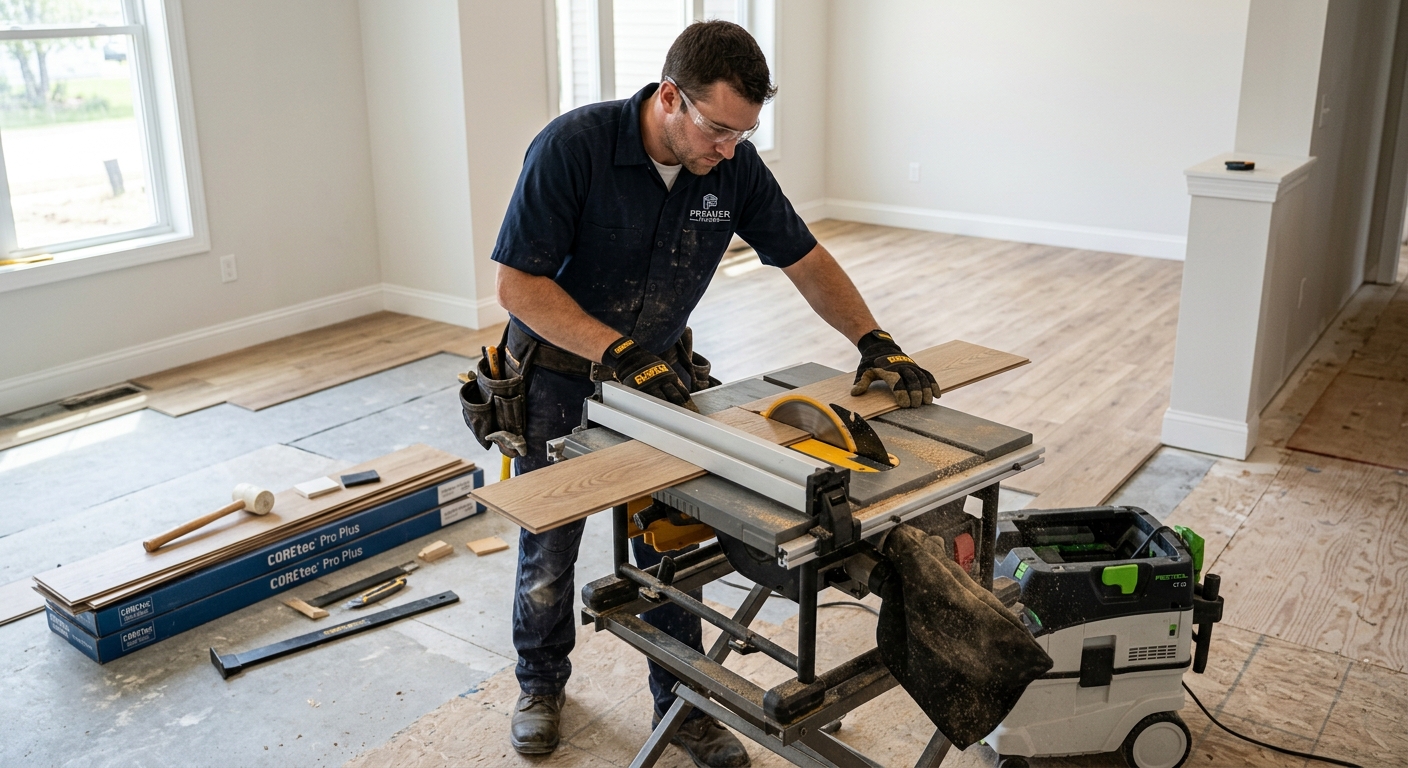
Flooring options and costs in Maillardville
Maillardville homeowners typically start their flooring search with a simple question: “What will look great, handle the day-to-day life here, and fit the budget?” Maillardville’s population is 15,837 (Statistics Canada, 2021 Census), and the Lower Mainland–Southwest market is active year-round—so good installers do book up, especially for weekday starts. A big reason quotes can look very different is the area’s older housing stock: many homes built decades ago often have uneven plywood or slab conditions that require levelling, moisture barriers, and sometimes resurfacing, which commonly adds about $1 to $3 per sq ft to the project.
Cost and product selection also reflect the wet, marine climate. In winter and shoulder seasons, indoor humidity swings can cause solid hardwood to cup or gap if it’s not installed with the right acclimation and service-level control. Basements and slab-on-grade areas in nearby Burnaby, Surrey, and Richmond-style homes often see moisture wicking through concrete, so we generally avoid solid hardwood below grade and steer customers toward engineered wood or luxury vinyl plank (LVP). For many Maillardville families, demand is especially high around the older commercial strips and denser residential pockets near Lougheed Highway, where renovation cycles align with moving schedules and resale timelines.
Below is a practical comparison of common materials you’ll see on Maillardville quote sheets, including typical price ranges and what each option can realistically handle in our coastal humidity.
| Type |
Best Room |
Moisture Resistance |
Lifespan |
Price per sq ft |
Price Range |
| Solid hardwood (nail-down, above grade only) |
Main living areas (above grade) |
Low to moderate; sensitive to humidity swings |
25–50 years with good indoor humidity control |
— |
$9,000–$18,000 |
| Engineered hardwood (float or glue, above + on-grade) |
Living rooms, halls, bedrooms (above or on-grade) |
Moderate to good; better tolerance than solid |
20–40 years depending on wear layer |
— |
$10,000–$17,000 |
| Laminate (click-lock, above-grade) |
Bedrooms, hallways, living areas (no flooding) |
Moderate; fails if it stays wet |
10–25 years |
— |
$4,000–$10,000 |
| Luxury vinyl plank / LVP (waterproof, any level) |
Kitchens, basements, main floors |
High; handles spills and below-grade conditions |
15–25 years for quality products |
— |
$4,500–$11,500 |
| Porcelain / ceramic tile |
Bathrooms, kitchens, entryways |
High; very water resistant |
25–50+ years |
— |
$10,000–$20,000 |
| Carpet (broadloom or modular tile) |
Bedrooms, stairs (comfort-first) |
Low; avoid basements unless specifically designed for moisture |
7–15 years (varies with traffic) |
— |
$5,000–$9,000 |
Prices are estimates only and vary by project scope, site access and material selection.
What affects the price of flooring in Maillardville
In Maillardville and the wider Lower Mainland–Southwest region, two quotes for “the same” floor can differ by 30% to 50% because the scope behind the scenes is rarely identical. One contractor might be installing over a fairly flat subfloor, while another is planning levelling, patching, or moisture mitigation first. That’s a common reality in British Columbia because older homes often have uneven plywood, older underlay, or slab issues that reveal themselves once we remove existing flooring. On top of that, Greater Vancouver labour costs are among the highest in Canada, so installation details—prep time, transition work, and the method used—carry real weight in the final number.
Technically, indoor humidity swings are a key driver here. Solid hardwood expands and contracts with humidity, so it can’t be glued or floated over concrete and it performs poorly below grade in moisture-prone areas; it also tends to be a poor fit for basements where moisture vapour migrates through slab. Engineered hardwood and luxury vinyl plank handle humidity far better and are the usual recommendations for on-grade and below-grade work. Colder inland pockets and newer homes with radiant heating also affect options: most solid hardwood needs very careful specification, while engineered wood, LVP and tile generally pair with radiant systems more reliably.
Concrete Maillardville examples: (1) If we find an old subfloor with dips and squeaks in an upstairs room, levelling can add about $1 to $4 per sq ft before the new material goes down. (2) If the job includes cutting and installing multiple stair transitions, the stair work can add several hundred dollars even when the floor material is mid-range. (3) Choosing tile in a kitchen can raise the price toward the $10 to $20 per sq ft band once you factor in labour-intensive prep, while LVP in the $4 to $10 per sq ft band can be a better value when moisture risk is part of the equation.
| Price Factor |
Why It Matters |
Cost Impact |
| Room area in sq ft |
Materials are priced per sq ft and labour scales with square footage |
Direct driver; small rooms can cost proportionally more due to minimum labour |
| Subfloor condition |
Uneven plywood, damaged OSB, or slab flatness issues require levelling/repair |
Often adds about $1 to $4 per sq ft in older Lower Mainland homes |
| Moisture / below-grade install |
Moisture vapour through concrete affects product performance and underlayment choice |
Can rule out solid hardwood; may add membrane and remediation steps |
| Material choice |
Solid vs engineered vs LVP vs tile have different install systems and base costs |
Moves you between roughly $4 to $10 (vinyl/laminate) and $10 to $20 (tile) bands |
| Removal and disposal of existing flooring |
Demo time varies by adhesive type and how many layers are present |
Typically adds several hundred dollars for extra layers and hauling |
| Stair nosing / transitions |
Stairs require extra cutting, matching, and secure fastening details |
Often charged per step or per linear foot; can materially change the total |
| Radiant heat compatibility |
Not all products are designed for higher subfloor temperature cycles |
May require an approved engineered product or specific underlay, adding cost |
| Installation method |
Float vs glue-down vs nail-down affects labour time and subfloor requirements |
Glue-down and nail-down usually add labour and stricter prep requirements |
Permits & regulations in British Columbia
In British Columbia, the act of installing flooring itself typically does not require a building permit. That said, related scope can trigger permitting depending on what else you’re changing. Flooring projects often stay permit-free when the work is limited to removing flooring, installing underlayment, laying LVP/laminate/engineered flooring, or setting ceramic/porcelain tile on existing surfaces. Where permits can come into play is when you’re doing structural subfloor repair beyond simple patching, moisture remediation that involves more than surface-level treatment, or in-floor heating circuit work (electrical changes). If there are electrical adjustments for radiant heat controls or any wiring modifications, an electrical permit and qualified electrical work are typically required.
For condominiums, there’s a separate practical rule: sound transmission requirements. Many condo corporations restrict what you can install above other units and may require specific underlay to meet STC/IIC performance. Before you order materials, review the condo declaration and request approval in writing—especially for hardwood or tile on upper floors where impact sound is a frequent concern.
To verify a Maillardville contractor, homeowners should: (1) check licensing/registration information online through the province’s contractor/trade listing tools (as applicable to the contractor’s category), (2) ask for a certificate of liability insurance showing the contractor name and active policy dates, (3) confirm WCB coverage (or the equivalent clearance letter/coverage confirmation provided by the contractor), and (4) request proof those cover the dates of your project. Then match those documents to the invoice/contract and keep copies for your records.
Best flooring for each room in your Maillardville home
In Maillardville, “best” depends less on trends and more on moisture exposure, foot traffic, and comfort—because our wet, marine climate can create humidity swings that stress some materials more than others. For living and dining areas, homeowners usually want warmth and a clean look; engineered hardwood or high-quality laminate are the common balance of comfort and durability. If you have radiant heating, engineered wood can be a strong fit when installed with the right product specification, while solid hardwood needs much tighter control of humidity and temperature cycles.
For master bedrooms, carpet often wins for comfort and sound absorption, especially in multi-unit buildings or homes where bedrooms are above living spaces. In the kitchen, we typically recommend luxury vinyl plank (LVP) or large-format porcelain tile because spills and occasional wet mopping are part of real life. For basements (finished), LVP is usually the clear winner: it’s fully waterproof, tolerates minor moisture vapour movement better than solid wood, and is designed for below-grade and on-grade installations.
Bathrooms should be porcelain or ceramic tile only for best long-term performance. If you’ve got older subfloor conditions, factoring in levelling can narrow the price gap between options—tile can look expensive up front, but it often lasts longer in wet rooms. For example, moving from mid-range laminate in the $4 to $10 per sq ft band to LVP in the $4 to $10 per sq ft band can be justified when basement moisture risk exists, because you avoid product failures that cost more to fix later.
| Room |
Best Material |
Why |
Moisture Risk |
Price Band per sq ft |
| Living / dining room |
Engineered hardwood |
Warm look, more humidity-tolerant than solid, stable over typical above-grade conditions |
Low to moderate (manage indoor humidity in winter) |
$9–$18 |
| Master bedroom |
Carpet or engineered hardwood |
Carpet adds comfort and sound control; engineered wood keeps a cleaner feel with better stability |
Low |
$4–$10 |
| Secondary bedrooms |
High-quality laminate |
Good value, durable wear layer, easier maintenance than carpet |
Low |
$4–$10 |
| Kitchen |
Luxury vinyl plank (LVP) or porcelain tile |
LVP handles spills and daily cleaning; tile is ideal if you want maximum water resistance |
Moderate (spills, wet mopping) |
$10–$20 |
| Basement (finished) |
Luxury vinyl plank (LVP) |
Waterproof core and better tolerance for moisture vapour from slab; avoids solid wood failures below grade |
High |
$4–$10 |
| Bathroom |
Porcelain / ceramic tile |
Best performance with water exposure and long service life |
High |
$10–$20 |
How to choose a flooring contractor in Maillardville
Choosing the right flooring contractor in Maillardville comes down to proof, process, and transparency. Start with British Columbia coverage checks: ask for a certificate of liability insurance (make sure it matches the legal business name and is active during your install window) and request proof of WCB/WCB-equivalent coverage (often provided as a clearance letter or coverage confirmation). Then verify the contractor’s licence/registration information applicable to their trade category and keep a screenshot or printout of what you find in case it changes.
Next, don’t accept a “lump sum” without an itemised breakdown. Get 2–3 written quotes that show labour and materials separately, including underlay/membranes, fasteners or adhesives (if applicable), stair nosing and transitions, and any levelling or subfloor repairs. Carefully review what’s excluded: sometimes removal and disposal are not included, or trim work, floor transitions, and closet door undercutting are billed separately. Also ask whether the contractor will pull required permits for any associated electrical or structural work; flooring-only installs often don’t need permits, but associated changes might.
Warranty matters: confirm the workmanship warranty length (and what it covers), the product/manufacturer warranty details, and whether warranties are transferable to you as the homeowner. For payments, keep it practical—never pay more than 10% to 15% upfront; hold back a portion until the job is complete and defects are corrected. Finally, demand a start date and a completion estimate in writing so you can plan around work and occupancy.
- Ask for WCB/WCB-equivalent proof and store the document with your contract.
- Request liability insurance and confirm dates overlap your install.
- Verify the contractor’s BC licence/registration applicable to their trade category.
- Get an itemised quote: labour, material, underlay/membrane, levelling/patching.
- Confirm removal and disposal are included (and how many floors/layers they’ll demo).
- Ask about moisture testing or moisture mitigation steps for basements/slabs.
- Require written details on transitions and stair nosing pricing.
- Check if door trimming, vent undercuts, and caulking are included.
- Confirm acclimation requirements for engineered wood/solid hardwood are followed.
- Request the exact underlay/membrane they’ll install under laminate or LVP.
- Review workmanship warranty (length, coverage, exclusions) before signing.
- Keep payments within 10%–15% upfront and hold back until completion.
Red flags I see in Maillardville include: contractors who won’t provide proof of insurance or WCB coverage, quoting without discussing subfloor flatness and moisture for basements, “all-in” pricing with no line items for levelling/transition work, skipping written timelines, and offering very short workmanship warranties compared to similar local bids.
Frequently asked questions — flooring in Maillardville
What is luxury vinyl plank and is it worth it in Maillardville?
Luxury vinyl plank (LVP) is a resilient flooring made with layered materials; quality products are typically waterproof on the surface and designed to handle minor moisture vapour conditions better than solid hardwood. In Maillardville and the Lower Mainland–Southwest, the wet marine climate and winter humidity swings matter—especially for basements and slab-on-grade areas where moisture can wick through concrete. LVP is often the “safe value” option because it tolerates everyday spills and is less prone to gapping/cupping than solid wood. If your quote is within the laminate/vinyl pricing band (often around $4 to $10 per sq ft for common grades), it can be worth it—particularly in basements where solid wood and most laminate are poor choices. The biggest value comes from correct subfloor prep and using the right underlayment system for your product.
How much does flooring cost in Maillardville?
Flooring cost in Maillardville usually depends on material band and how much subfloor prep is required. As a baseline, laminate and vinyl plank commonly land around $4 to $10 per sq ft, while porcelain or ceramic tile often sits around $10 to $20 per sq ft. Solid hardwood is commonly higher—roughly $9 to $18 per sq ft—because it requires above-grade installs, precise acclimation, and a more demanding nail-down method. Labour in the Lower Mainland is a major factor, so removal, levelling and transition work can shift the total significantly even if the material looks similar on paper. For older homes in the Maillardville area, levelling and moisture-related prep frequently add about $1 to $3 per sq ft (sometimes more if the subfloor is badly uneven). Get itemised quotes so you can compare prep scope—not just the floor sticker price.
Hardwood vs laminate vs vinyl plank — which is best?
“Best” depends on where you’re installing and how much moisture risk you have. Solid hardwood looks great and can last decades above grade, but in British Columbia’s coastal humidity swings it needs controlled indoor conditions and it can’t be glued or floated over concrete. Laminate is often a good budget choice for bedrooms and hallways; however, it’s not waterproof and can fail if it stays wet. Luxury vinyl plank (LVP) is usually the most forgiving option because it’s designed to be waterproof and handles on-grade and below-grade situations far better—so it’s commonly chosen for basements in Maillardville. If you’re comparing price bands, you might see laminate around $4 to $10 per sq ft, while engineered hardwood and solid hardwood push toward $9 to $18 per sq ft. If you have slab moisture concerns, spending for LVP can be the best long-term value, even when hardwood looks “closer” in appearance.
What flooring is best for a Maillardville basement?
For a Maillardville basement, LVP is usually the best overall choice. The reason is local: basements and slab-on-grade areas in the Lower Mainland–Southwest can show moisture wicking through concrete, and that moisture vapour can ruin solid hardwood and swell or delaminate many laminate products. A waterproof LVP system is much more tolerant of those conditions and is easier to maintain if you’ve had humidity issues over winter. Tile can work too, but it’s more labour-intensive and can be colder without radiant heat. If you’re finishing a basement in an older home, plan for subfloor assessment and likely levelling—those prep steps often add about $1 to $3 per sq ft. Also confirm with your contractor whether they’ll install a proper moisture barrier or membrane system that matches your LVP type and manufacturer instructions.
Can I install hardwood over concrete?
In most typical Maillardville residential scenarios, solid hardwood is not installed over concrete. Solid wood is designed for nail-down applications above grade, and it can’t be glued or floated over concrete the way engineered products can. If you’re set on the “hardwood look” over a concrete slab, engineered hardwood is the more appropriate choice because its layered construction handles minor movement and humidity variation better. Even then, the slab should be flat and properly prepared, and you should confirm moisture conditions with your flooring contractor. In British Columbia, basements and slab areas are where moisture vapour is most often a problem, so it’s worth treating moisture as a key spec item—not an afterthought. If you’re installing over radiant heat, you’ll also need to confirm the product’s radiant compatibility requirements before choosing the type.
How long does flooring installation take?
Typical timelines in Maillardville depend on floor type, room size, and how much prep work is needed. If the subfloor is already flat and dry and the scope is straightforward, some laminate or LVP installs can move quickly—often completed in a few working days for a small-to-medium main floor. However, older housing stock commonly means levelling, repairs, or moisture barrier work, which can add days even before the first plank is laid. Tile usually takes longer due to layout, cutting, and curing time. Stair and transition work add time too, especially when matching stair nosings and trims. As a planning rule of thumb, ask your contractor for a written schedule that includes prep, install, and cleanup, rather than a single date. A well-scoped quote should explain what could extend the timeline—subfloor repairs, drying time for patched areas, or adhesive curing.