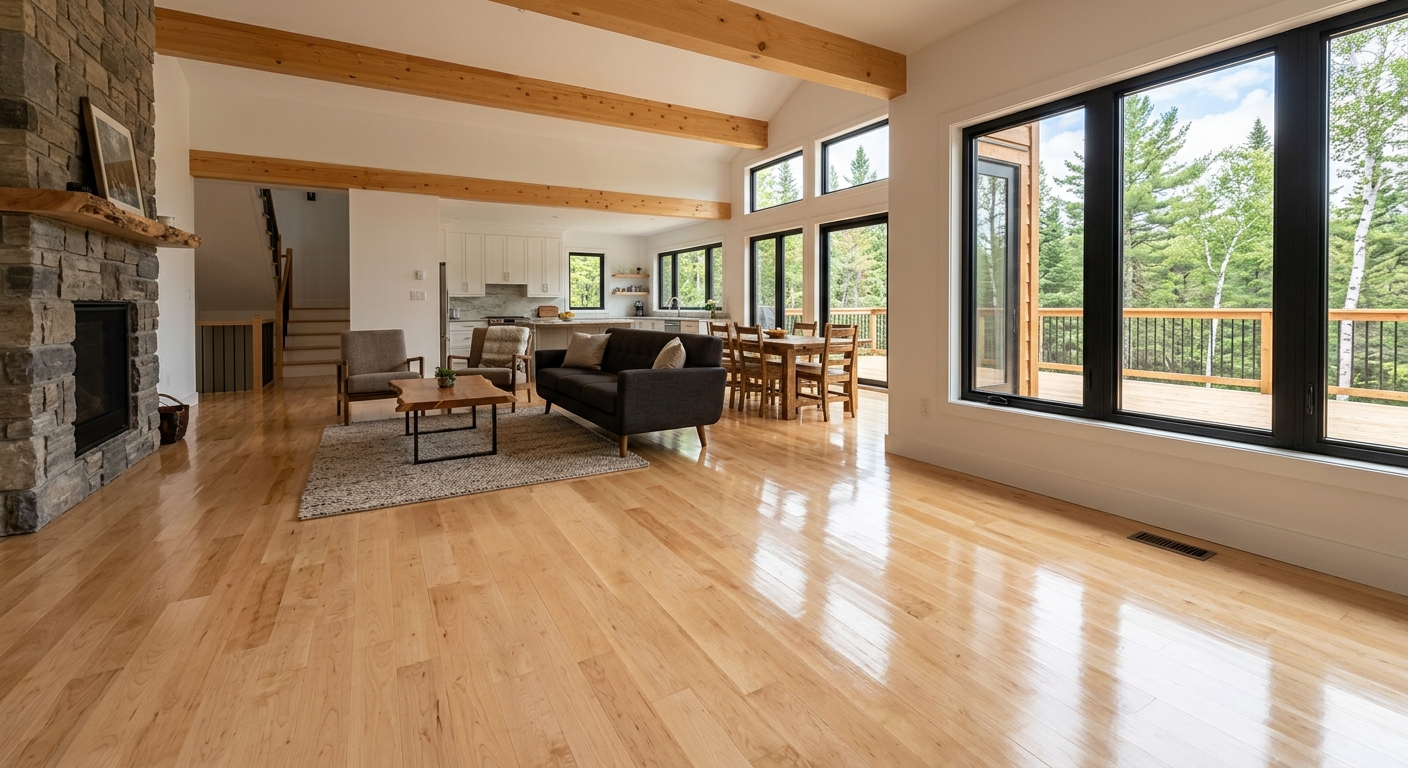
Flooring options and costs in Delbrook
Delbrook homeowners typically have several flooring paths to choose from, but the “best” option depends on your home’s age, site conditions, and how much indoor humidity swings you’re comfortable managing. With a small local population of 2,497 people (Statistics Canada, 2021 Census), you’ll often see fewer installers competing for jobs—so scheduling can affect labour availability and timelines. The bigger cost driver, though, is usually housing condition: much of the Lower Mainland–Southwest housing stock is older, and uneven plywood or concrete subfloors commonly require levelling, patching, and sometimes moisture controls before new flooring can be installed. In practice, that prep is one reason the same room can come in 30–50% different between quotes.
In Delbrook and the surrounding Lower Mainland–Southwest, we deal with a wet, marine climate that creates indoor humidity swings, especially in winter and shoulder seasons. Basements and slab-on-grade areas can also experience moisture “wicking” through concrete, which is why we avoid solid hardwood below grade. When radiant heat is present in newer builds, the specification matters too: some materials can’t handle higher slab temperatures safely. On top of that, Greater Vancouver-area labour rates stay high, so installation method (and how much prep work your subfloor needs) can be the difference between a budget win and a premium finish.
This trade is especially active around the Delbrook/Blueridge corridor, where many homeowners renovate during remodelling cycles and want quick turnarounds without surprises. Use the table below as a baseline for typical material pricing, then we’ll break down what changes the final number in your project.
| Type |
Best Room |
Moisture Resistance |
Lifespan |
Price per sq ft |
| Solid hardwood (nail-down, above grade only) |
Living / dining (main level) |
Low to moderate (sensitive to seasonal humidity) |
20–40 years |
$10 – $18 |
| Engineered hardwood (float or glue, above + on-grade) |
Living / bedrooms |
Moderate to high (better tolerance for humidity) |
15–30 years |
$9 – $16 |
| Laminate (click-lock, above-grade) |
Bedrooms, hallways |
Moderate (water can damage core if not cleaned quickly) |
10–25 years |
$4 – $10 |
| Luxury vinyl plank / LVP (waterproof, any level) |
Kitchen, basement (finished) |
High (waterproof core, handles moisture vapour better) |
15–25 years |
$5 – $12 |
| Porcelain / ceramic tile |
Kitchen, bathrooms |
High (but grout and subfloor prep matter) |
25–50 years |
$12 – $20 |
| Carpet (broadloom or modular tile) |
Master / secondary bedrooms |
Low to moderate (needs good moisture control) |
7–15 years |
$4 – $8 |
Prices are estimates only and vary by project scope, site access and material selection.
What affects the price of flooring in Delbrook
In Delbrook and across the Lower Mainland–Southwest, quotes for the same “type” of flooring can swing by 30–50% because the scope underneath the product is rarely identical. One contractor may include proper moisture testing, a detailed subfloor levelling plan, and removal/disposal; another may treat those as add-ons. Labour availability also varies—when crews are booked for renovations in neighbourhood pockets like Delbrook/Blueridge, the same-day jobsite prep and scheduling can change pricing quickly.
Technically, the Lower Mainland’s wet, marine climate creates indoor humidity swings, and that matters for every material—especially solid hardwood. Solid hardwood expands and contracts with humidity, and it cannot be glued or floated over concrete. That means solid wood performs poorly in basements and slab-on-grade situations where moisture vapour can move through concrete. Engineered hardwood and luxury vinyl plank (LVP) handle humidity far better because layered construction—or PVC cores—tolerate minor temperature and moisture variation.
Cold-inland homes and newer builds using radiant heating also affect material selection. Most solid hardwood is often not recommended over radiant without very careful product specification, while tile, LVP, and many engineered products pair more reliably. Finally, older regional housing stock frequently needs levelling, patching, or repair before install—commonly adding roughly $1–$4 per sq ft. For example, a project that looks like “LVP at $5–$12 per sq ft” can jump upward if the subfloor needs extensive prep. Conversely, in a newer, flat on-grade area, you may get closer to the lower end of vinyl or laminate bands—around $4–$10 per sq ft—because labour hours drop.
Concrete examples I see in Delbrook: (1) replacing water-damaged underlayment or patching bird-baths in plywood can add a full day of labour; (2) adding a vapour management layer on a slab can prevent callbacks and is often where “cheap” quotes get caught later; and (3) removing old glued-down vinyl or thick carpet pad can increase disposal time and tipping fees.
| Price Factor |
Why It Matters |
Cost Impact |
| Room area in sq ft |
Directly drives material quantities and labour hours (layout, cuts, waste) |
Higher square footage generally lowers per-sq-ft labour but increases totals |
| Subfloor condition — levelling or repair needed before install |
Uneven plywood or concrete must be corrected to prevent gaps, squeaks, and failed locking |
Often adds about $1 – $4 per sq ft depending on scope |
| Moisture / below-grade install — rules out solid hardwood |
Below-grade vapour risk affects dimensional stability and warranty coverage |
May shift you from solid hardwood ($10–$18) to engineered or LVP ($5–$12) plus moisture controls |
| Material choice — solid vs. engineered vs. LVP vs. tile |
Different products have different material unit costs and installation methods |
Can change the project by several dollars per sq ft (e.g., laminate $4–$10 vs tile $12–$20) |
| Removal and disposal of existing flooring |
Old flooring removal time, underlayment removal, and dump fees add labour |
Commonly a meaningful add-on, especially with glued-down materials |
| Stair nosing / transitions — charged per step or per linear foot |
Stairs and transitions require precision and specialty trim pieces |
Often increases costs more than homeowners expect for small rooms |
| Radiant heat compatibility — limits material options |
Some products won’t tolerate the temperature profile, so you may need specific engineered/tile |
May require higher-spec product, affecting per-sq-ft price |
| Installation method — float vs. glue-down vs. nail-down |
Method changes prep, adhesives, fasteners, and labour time |
Glue-down and extensive prep usually cost more than straightforward floating |
Permits & regulations in British Columbia
In British Columbia, installing floor coverings on its own usually does not require a building permit. You typically do not need a permit just to put down carpet, laminate, LVP, tile (as a finish), or engineered/solid wood as long as you’re not altering major structural elements. Where permits can come into play is when flooring projects involve associated work such as electrical modifications for in-floor heating, or work that touches wiring and circuits. For example, adding or altering an electrical in-floor heating system can require electrical permits and inspections. Similarly, if moisture remediation involves significant substrate repairs or changes that cross into regulated building work, that can trigger additional requirements depending on scope.
In condominiums, the bigger restriction is often not a government permit—it’s the building’s internal rules. Many condo corporations limit or require specific underlay to meet sound transmission standards (commonly discussed in terms of STC/IIC). Before installing hardwood or tile on an upper floor, request board approval in writing and follow the condo’s required underlay and installation method. This step prevents rework and disputes later.
Step-by-step verification for your Delbrook contractor: (1) ask for their business licence details if applicable and confirm contractor identity; (2) request a current certificate of insurance (liability) naming you/your strata if required; (3) confirm worker coverage such as WSIB/WCB where applicable—ask directly for proof of coverage/clearance letter; and (4) check their registration status through the appropriate online registry for licensed trades or contractors in B.C. Keep copies of everything in a folder before you sign a contract.
Best flooring for each room in your Delbrook home
In Delbrook’s wet, marine climate, the right choice is the one that survives humidity swings and occasional indoor dampness—without trapping moisture where it can cause odour or subfloor breakdown. For living and dining rooms, many homeowners choose engineered hardwood or a high-quality laminate because they provide a warm look while tolerating normal seasonal movement better than solid hardwood. In bedrooms, comfort and quiet are priorities; carpet is often the best feel underfoot, while engineered wood remains a great option for allergy-aware households.
Kitchens and entryways see the most spills and tracked-in moisture. Luxury vinyl plank (LVP) is an easy win because it’s waterproof and handles minor leaks better than laminate or most carpet systems. If you want the “forever” option, large-format porcelain tile also performs extremely well—just know tile installation is sensitive to subfloor flatness and often costs more per square foot. In finished basements, LVP is usually the clear winner: its waterproof core and layered construction handle moisture vapour and below-grade conditions far better than solid hardwood and most laminate. Bathrooms should be porcelain or ceramic tile only, with proper waterproofing details at the substrate.
Radiant heat compatibility is increasingly relevant in British Columbia new construction and renovations. Tile and LVP pair more reliably, while solid hardwood over radiant needs careful product selection and a conservative heating profile. As a practical example: if you’re deciding between laminate (often $4–$10 per sq ft) and LVP (often $5–$12 per sq ft), the extra $1–$2 per sq ft in a basement can be justified because it reduces risk of swelling and costly replacement if moisture vapour levels are higher than expected.
| Room |
Best Material |
Why |
Moisture Risk |
Price Band per sq ft |
| Living / dining room |
Engineered hardwood |
Warm look with better humidity tolerance than solid wood |
Low to moderate (manage indoor humidity for best results) |
$9 – $16 |
| Master bedroom |
Carpet or engineered hardwood |
Carpet improves comfort and sound absorption; engineered keeps a cleaner surface |
Low (avoid excessive humidity and keep vents clear) |
$4 – $14 |
| Secondary bedrooms |
Luxury vinyl plank (LVP) or laminate |
LVP adds spill tolerance; laminate is a budget-friendly, stable option above grade |
Low (higher if windows leak or if basements supply moisture) |
$4 – $12 |
| Kitchen |
Luxury vinyl plank (LVP) or porcelain tile |
LVP handles wet messes; tile stays clean and water-resistant with correct prep |
Moderate to high (spills and steam are common) |
$5 – $20 |
| Basement (finished) |
Luxury vinyl plank (LVP) |
Waterproof core helps with below-grade moisture vapour conditions |
High (concrete moisture vapour risk) |
$5 – $12 |
| Bathroom |
Porcelain / ceramic tile |
Best long-term performance where water exposure is routine |
Very high (use proper substrate and grout/waterproofing details) |
$12 – $20 |
How to choose a flooring contractor in Delbrook
Choosing a flooring contractor in Delbrook is mostly about confirming they’re legitimate, insured, and precise—because subfloor prep and moisture handling are where projects succeed or fail. Start by verifying British Columbia coverage and documentation: ask for their proof of liability insurance (certificate of insurance), then confirm worker coverage such as WSIB/WCB where applicable and request a clearance letter or proof of coverage. Also ask for evidence of experience with your specific flooring type—especially if you’re doing engineered wood on-grade, tile over a repaired subfloor, or LVP in a basement.
Next, get 2–3 itemised written quotes. The best quotes break down labour and materials separately (product price, underlay/adhesives, levelling compounds, moisture barrier where required, removal and disposal, transitions and stair nosing). Avoid “lump-sum only” proposals because scope changes become arguments later. Read the exclusions carefully: what’s not included (old baseboards, thick adhesive removal, subfloor grinding, patch feathering, or levelling beyond a stated thickness)? Confirm whether the contractor will pull permits if required (commonly for electrical in-floor heating scope) and whether disposal is included.
For warranty, ask for both: the workmanship warranty length and whether the manufacturer warranty is tied to certified installation. Also confirm transferability if you sell your home. Payment schedule matters: never pay more than 10–15% upfront; hold a reasonable portion (often until completion and punch list). Finally, obtain a start date and completion estimate in writing, along with how delays (material lead times, subfloor repairs) are handled.
- Provide an itemised quote with labour + materials line items (no vague allowances).
- Show how they’ll handle moisture: testing, vapour barriers, and subfloor conditions.
- Confirm which products are approved for your climate and any radiant heat (if applicable).
- Ask who removes and disposes existing flooring and what’s included in that price.
- Require exact transition details for doorways, thresholds, and stair nosing.
- Request the underlay specifications (especially for laminate and condos with sound rules).
- Verify they carry liability insurance and provide a current certificate of insurance.
- Verify worker coverage such as WSIB/WCB where applicable; request proof/clearance.
- Confirm disposal method and tipping fees included (or clearly excluded).
- Get a written installation schedule and who authorizes changes on site.
- Ask for colour batch control for tile and for hardwood/engineered variation notes.
- Confirm waste factor assumptions (cutting pattern, stairs, and room irregularities).
In Delbrook, specific red flags include: (1) a quote that refuses to discuss moisture vapour and simply proposes solid hardwood in a basement; (2) no itemised line for levelling/patching despite an obviously uneven subfloor; (3) asking for a large upfront payment (more than 10–15%); (4) no proof of insurance/coverage documentation when requested; and (5) promising “unlimited warranty” without explaining manufacturer installation requirements.
Frequently asked questions — flooring in Delbrook
Do I need to level my subfloor first?
In Delbrook, leveling is often the difference between a long-lasting install and callbacks—especially with laminate, click-lock products, and engineered wood. If your subfloor has dips or high spots, you can get joint separation, squeaks, and uneven wear. In older Lower Mainland homes, it’s common to find plywood or concrete that isn’t perfectly flat, so contractors may recommend levelling compounds, grinding, or patching before the new floor goes down. A realistic cost impact can add about $1 to $4 per sq ft depending on how bad the surface is. Practically, if your quote is “laminate at $4–$10 per sq ft” or “LVP around $5–$12 per sq ft,” make sure levelling is included or clearly excluded so you can compare apples to apples.
What's the most durable flooring for pets and kids?
For pets and kids in Delbrook, LVP is usually the most forgiving daily choice because it’s waterproof and resists the kind of accidents that ruin carpet or swell laminate. Look for thicker wear layers and a good locking or glue system; durability also depends on subfloor flatness and proper underlay where required. If you prefer a natural look, engineered hardwood can be durable above grade, but it still needs humidity control—solid hardwood is the least forgiving where indoor moisture fluctuates. If you go with carpet, choose high-traffic or modular options and plan for quicker cleaning, since spills and dampness can linger. On price, you’re typically choosing between laminate (often $4–$10 per sq ft) and LVP (often $5–$12 per sq ft); that small jump often buys peace of mind in a Lower Mainland climate.
How do I choose flooring for humidity in Delbrook?
Delbrook sits in a wet, marine climate where indoor humidity swings are common in winter and shoulder seasons. Solid hardwood expands and contracts with those changes, and it can’t be glued or floated over concrete—so it’s usually avoided in basements and slab-on-grade areas. Engineered hardwood and LVP handle humidity far better because their layered construction or PVC cores tolerate variation. For basements, LVP is typically the safest option because below-grade moisture vapour can wick through concrete even when floors “look dry.” If you have radiant heating, confirm compatibility first—most solid hardwood is more restricted, while tile and many engineered/LVP systems handle it more reliably. A good contractor will discuss humidity management (and may propose moisture testing) rather than just telling you a product is “water-resistant.”
Do condos restrict hard flooring?
Yes—often. In British Columbia condo buildings, the restrictions are usually set by the corporation’s rules on sound transmission. Many require specific underlay and installation methods for hard surfaces like hardwood, engineered wood, and tile, especially on upper floors. Even if flooring work doesn’t require a building permit, you may still need board approval before installation begins. Ask for the condo’s requirements in writing, including underlay specifications and whether you must use a particular type of underlayment or floating system. This matters because incorrect underlay can trigger noise complaints and rework. If you’re deciding between engineered wood (commonly $9–$16 per sq ft) and LVP (commonly $5–$12 per sq ft), the condo’s sound rules may strongly influence your actual best option.
How do I compare flooring quotes?
Start by making sure you’re comparing the same scope, not just the same flooring name. Ask each contractor for an itemised quote showing labour and materials separately: product cost, underlay/adhesives, levelling/patching, moisture barriers if needed, removal and disposal, and transitions/stair nosing. Confirm what’s excluded—like subfloor grinding, baseboard adjustments, or any permit-related work for electrical in-floor heating. Also check warranty wording: workmanship coverage length, what conditions void it, and whether the manufacturer warranty requires certified installation. In Delbrook’s market, quotes can vary because levelling and moisture management are often add-ons; older housing stock may require extra prep, which can add about $1–$4 per sq ft. Finally, watch payment terms—requesting more than 10–15% upfront is a common problem.
Can I install flooring over existing tile in Delbrook?
Often, yes—but it depends on the tile condition, subfloor stability, and the flooring type you want to install on top. For LVP or laminate, installers typically want the existing tile surface to be fully intact, well-bonded, and reasonably flat; cracked or loose tiles should be repaired first. For tile directly over tile, it may be possible in specific scenarios, but proper substrate evaluation and correct underlayment/thinset compatibility are critical. If the goal is to reduce height changes and avoid demolition, a good contractor will measure for height transitions and ensure the surface won’t compromise the new flooring’s locking or fastening system. The basement moisture-vapour issue in the Lower Mainland can also affect decisions—if there’s moisture migration, waterproof flooring can help, but you still need to address the subfloor. When in doubt, request a site test and a written scope before accepting a “surface over tile” plan.