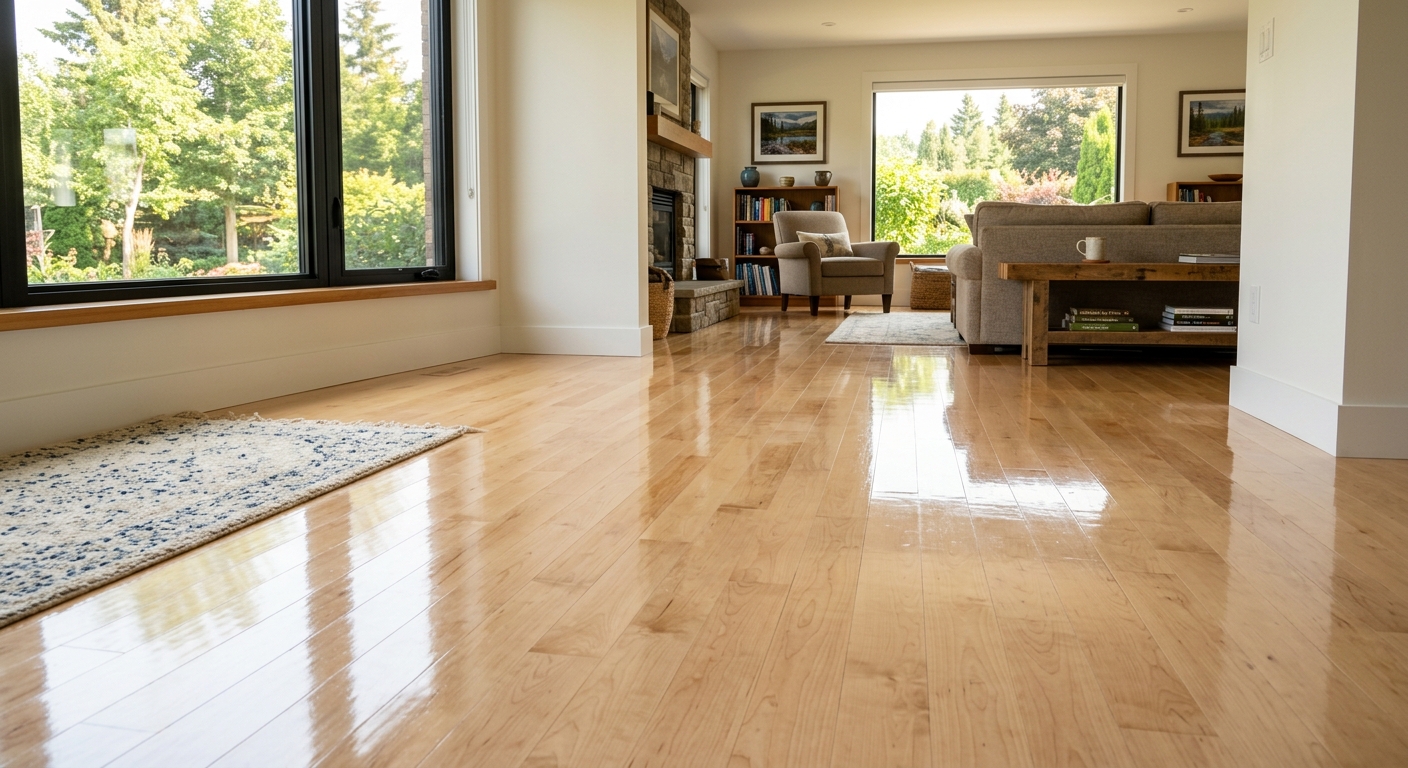
Flooring options and costs in Harbour Village
In Harbour Village, your flooring choices are shaped by both local home age and the wet, marine climate of the Lower Mainland–Southwest. With a population of 2,711 (Statistics Canada, 2021 Census), the area has a steady mix of owner-occupied homes and renovations, and that means you’ll see lots of “same-day” material availability—yet scheduling can still be competitive because labour demand stays high. A big cost driver is older housing stock: many existing plywood floors aren’t perfectly flat or may have patchy subfloor repairs from past plumbing or roofing leaks. In practice, that often means levelling or resurfacing work before install, which commonly adds about $1–$3 per sq ft (sometimes more when moisture mitigation is required).
The region’s indoor humidity swings—especially in winter and shoulder seasons—affect solid hardwood most. Solid boards expand and contract with moisture; they can cup, gap, or crown if humidity isn’t controlled. For basements and slab-on-grade areas, we typically avoid solid hardwood and recommend engineered hardwood or luxury vinyl plank (LVP), because layered construction and modern cores tolerate humidity better and handle minor temperature changes more consistently.
In neighbourhoods around the central residential corridors where lots of homes are being updated for resale, flooring installs are especially in demand between spring and early fall. For most homeowners, the best approach is to pick a product that matches each room’s moisture and traffic needs, then compare realistic price ranges and lifespans. Use the table below as your baseline for budgeting, and we’ll fine-tune it once we see your subfloor and layout.
| Type |
Best Room |
Moisture Resistance |
Lifespan |
Price per sq ft |
| Solid hardwood (nail-down, above grade only) |
Living rooms, dining rooms (above grade) |
Low to moderate (needs controlled indoor humidity) |
25–60 years |
$9–$18 |
| Engineered hardwood (float or glue, above + on-grade) |
Main living areas, hallways (above grade, some on-grade) |
Moderate to high (better with humidity swings) |
20–40 years |
$10–$17 |
| Laminate (click-lock, above-grade) |
Secondary bedrooms, offices |
Moderate (not for wet areas) |
10–25 years |
$4–$10 |
| Luxury vinyl plank / LVP (waterproof, any level) |
Kitchens, basements, entryways |
High to very high (waterproof core systems) |
15–30 years |
$5–$12 |
| Porcelain / ceramic tile |
Bathrooms, kitchens (and foyers) |
Very high (impervious surface) |
25–50+ years |
$10–$20 |
| Carpet (broadloom or modular tile) |
Bedrooms, stairs |
Low to moderate (needs dry subfloor) |
7–15 years |
$3–$9 |
Prices are estimates only and vary by project scope, site access and material selection.
What affects the price of flooring in Harbour Village
Even when two homeowners in the Lower Mainland–Southwest are installing the “same” flooring, the total quote can swing by 30–50% from one contractor to another. The reasons are practical: subfloor conditions, how much prep is required, the amount of removal/disposal, and how a crew manages moisture risk and levelling. When you compare across British Columbia, the labour market and scheduling can also shift, and that’s a real factor in an area with high renovation activity and strong demand for skilled installers.
Technically, the biggest drivers in Harbour Village are indoor humidity swings and below-grade moisture. Solid hardwood expands and contracts with humidity, so it typically cannot be glued or floated over concrete and performs poorly in basements unless you’re doing a very specific system. Engineered hardwood and LVP handle humidity far better, and they’re the common go-to choices for areas where moisture vapour can wick through concrete slabs.
Colder inland pockets and newer builds also increase the use of radiant heat, which can rule out most solid hardwood and some laminate products. That can push homeowners toward engineered hardwood, LVP rated for temperature change, tile, or specific laminate with documented radiant compatibility.
Older regional housing stock frequently needs subfloor levelling or repair—commonly adding $1–$4 per sq ft depending on how uneven the plywood or concrete is and whether moisture remediation is needed. For example, if you choose laminate at roughly $4–$10 per sq ft but your subfloor needs levelling, your “cheap per sq ft” plan can end up close to an engineered hardwood option once prep is included. Conversely, LVP can look more expensive than carpet on paper, but it often saves money in the basement because it avoids complicated moisture mitigation steps that solid wood would require.
| Price Factor |
Why It Matters |
Cost Impact |
| Room area in sq ft |
Materials and crew time scale directly with square footage |
High (largest driver of total cost) |
| Subfloor condition |
Levelling, repair, or resurfacing must be completed before installation |
Medium to high (often adds $1–$4/sq ft) |
| Moisture / below-grade install |
Moisture vapour rules out solid hardwood and limits laminate suitability |
Medium (may require barrier/mitigation) |
| Material choice |
Solid vs engineered vs LVP vs tile have different install requirements and tolerance for humidity |
High (moves you into different price bands) |
| Removal and disposal of existing flooring |
Prep time, hauling fees, and disposal requirements vary by material |
Medium |
| Stair nosing / transitions |
Complex edges, mouldings, and transitions are charged per step or per linear foot |
Medium |
| Radiant heat compatibility |
Limits product selection and can require specific underlay/installation methods |
Medium (product constraints can increase costs) |
| Installation method |
Float vs glue-down vs nail-down changes labour time and prep level |
Low to medium (but can change total labour effort) |
Permits & regulations in British Columbia
In British Columbia, installing flooring by itself typically does not require a building permit. That said, you can trigger permit or inspection requirements if the job includes associated work beyond “finish flooring.” For example, electrical permits may be needed if you’re adding, modifying, or repairing in-floor radiant heating wiring, or making electrical adjustments related to that system. If your project involves subfloor removal that exposes issues requiring structural repair beyond cosmetic patching, that can also pull in additional approvals depending on scope.
In condos and multi-unit buildings in Harbour Village’s region, the bigger “regulatory” piece is usually the building’s own by-laws and the corporation’s sound transmission rules. Hard flooring on upper floors often needs specific underlay and installation details to meet STC/IIC expectations, and some buildings require approval before you start. Always review the condo declaration and request board approval in writing before installing hardwood or tile above grade in a multi-unit setting.
To verify a contractor in British Columbia step-by-step:
- Ask for their business details and check any applicable provincial trade registration information listed on official government/registry pages.
- Request a certificate of insurance (general liability) showing your address or project site coverage.
- Confirm workers’ compensation coverage (WSIB/WCB equivalent clearance) so you’re not financially exposed if a worker is injured.
- Get the licence/clearance information in writing before work starts.
- If possible, match the certificate name to the company name on your contract to avoid mismatches.
Best flooring for each room in your Harbour Village home
Choosing the right floor in Harbour Village is less about what’s trending and more about moisture tolerance, day-to-day traffic, and comfort underfoot—especially in a Lower Mainland–Southwest home where humidity can shift quickly. For living and dining areas, engineered hardwood or a high-quality laminate is usually the sweet spot: they offer warmth and looks while tolerating typical indoor swings far better than solid hardwood. For a master bedroom, many homeowners choose carpet for comfort and sound absorption, but engineered hardwood is a great alternative if you want easier maintenance and fewer allergy concerns.
In kitchens, go with luxury vinyl plank (LVP) or large-format porcelain tile. LVP is tough, water-resistant, and forgiving if a spill happens; tile is ideal if you like a hard surface and easy deep-cleaning. Basements are where the marine climate shows up hardest: LVP is the clear winner because it’s fully waterproof and handles moisture vapour and below-grade installations far better than solid wood and most laminate. Bathrooms should be porcelain or ceramic tile only, because you’re relying on a waterproof surface and correct installation details around wet zones.
If your home uses radiant heating (increasingly common in newer British Columbia builds), be selective: engineered wood, LVP rated for radiant use, and tile are the safest practical choices. Solid hardwood and some laminate can be problematic unless carefully specified. As a cost example, moving from carpet (roughly $3–$9 per sq ft) to LVP in a basement can cost more upfront, but it often avoids moisture-risk prep that would be needed for other materials—so the total project price stays steadier over time.
| Room |
Best Material |
Why |
Moisture Risk |
Price Band per sq ft |
| Living / dining room |
Engineered hardwood |
Warm look with better humidity tolerance than solid in coastal seasons |
Low to moderate |
$10–$17 |
| Master bedroom |
Carpet or engineered hardwood |
Comfort and quiet (carpet) or easy maintenance (engineered) |
Low to moderate |
$4–$16 |
| Secondary bedrooms |
Laminate (click-lock) or carpet |
Durable and practical for daily traffic; carpet adds softness |
Low |
$4–$10 |
| Kitchen |
Luxury vinyl plank (LVP) |
Water-resistant, forgiving underfoot, quick cleanup |
Moderate |
$5–$12 |
| Basement (finished) |
Luxury vinyl plank (LVP) |
Handles moisture vapour and slab-related humidity swings best |
High |
$5–$12 |
| Bathroom |
Porcelain / ceramic tile |
Impervious surface and reliable wet-area performance |
Very high |
$10–$20 |
How to choose a flooring contractor in Harbour Village
Choosing the right flooring contractor in Harbour Village comes down to proof, paper, and process. Start by verifying British Columbia coverage and credentials: ask for a certificate of general liability insurance, confirm workers’ compensation clearance (WSIB/WCB equivalent) so you’re not responsible if someone is hurt, and request any trade registration/licence information the contractor uses in their marketing. Then confirm your contractor is insured for your project type—especially if you’re doing basement work where moisture mitigation and subfloor levelling are common.
Next, get 2–3 itemised written quotes. You want a breakdown that separates labour, materials, underlay, prep/levelling, any moisture barrier system, stair work, and removal/disposal. A lump-sum number alone makes it easy for “extras” to appear later. Read the scope carefully: what’s excluded (trim, transitions, door undercuts, floor levelling)? Is the permit work included if radiant heating electrical modifications require it? Is disposal included?
Warranty should be explicit. Ask for workmanship warranty length and whether it’s transferable if you sell, and confirm the product/manufacturer warranty terms (and any conditions tied to humidity control). Payment schedule matters too: never pay more than about 10–15% upfront. Hold back payment until the job is complete and you’ve confirmed the final installation matches the plan. Finally, ask for a start date and completion estimate in writing—local crews can be busy, but you should still have a date target.
- Request insurance certificates (liability) and workers’ compensation clearance documentation before signing.
- Confirm who will be installing (crew name and lead installer) and their experience with your chosen material.
- Ask for an itemised quote: labour, materials, underlay, levelling/prep, transitions, and disposal.
- Specify whether moisture testing or vapour barriers are included if your home has a basement or slab.
- Confirm stair and transition pricing: per step and/or per linear foot.
- Ask for the installation method to be written into the scope (float vs glue-down vs nail-down).
- Verify product acclimation and indoor humidity expectations prior to install.
- Confirm underlay type and thickness (especially under laminate/LVP).
- Ask about transition pieces at thresholds and around doorways.
- Request a workmanship warranty in writing, including coverage exclusions.
- Use a payment schedule with small upfront deposit and holdback until completion.
- Get a written timeline with milestones and a clear change-order process.
Red flags to watch for: (1) they won’t itemise labour vs materials, (2) they dismiss moisture concerns for basements, (3) they refuse to provide insurance or clearance documents, (4) they quote “solid hardwood anywhere” over concrete or below grade, and (5) they won’t commit to a start/completion date in writing.
Frequently asked questions — flooring in Harbour Village
Can I install hardwood over concrete?
In Harbour Village and across the Lower Mainland–Southwest, you can sometimes install certain hardwood systems over concrete, but it depends on the slab conditions and the product construction. Solid hardwood is typically limited to above-grade nail-down installs because it responds strongly to humidity swings and doesn’t perform well when moisture vapour travels through concrete. For concrete slabs, homeowners more often choose engineered hardwood (with the correct underlayment and/or glue-down system as specified by the manufacturer) or porcelain tile. If you’re budgeting, note that engineered hardwood commonly lands in a similar range to solid—often around $10–$17 per sq ft—while LVP can be a simpler basement solution. The key is moisture assessment and a written installation method that matches your product.
How long does flooring installation take?
Typical timelines in British Columbia depend on square footage, subfloor prep, and how much removal is involved. For a mid-sized room, a straightforward laminate or LVP install might be done in a day, but Harbour Village projects often include levelling, patching, and acclimation—especially if the home is older or the basement has humidity concerns. Stair work and transitions can add time, and tile installs generally take longer due to layout, thinset cure times, and grout. If your quote includes subfloor levelling, expect extra scheduling for prep before flooring can go down. As a planning benchmark, many renovation crews aim for “room-by-room” completion over several working days, with completion timelines clearly stated in the contract so you can plan occupancy.
What flooring works with radiant heat?
Radiant heat compatibility is a product-by-product requirement, but in Harbour Village the safer choices are usually porcelain tile, engineered hardwood designed for radiant systems, and LVP rated for temperature change. Solid hardwood is often more problematic because of expansion/contraction sensitivity, and it requires very careful specification and control of heat cycles to reduce gapping or cupping. Laminate may work only if the manufacturer explicitly approves it for radiant floors and the installation uses the correct underlay system. If your home has radiant heating in British Columbia new construction, confirm compatibility in writing before purchasing. For pricing, tile is often in the $10–$20 per sq ft range, while LVP can be closer to $5–$12 per sq ft depending on grade and design.
Engineered vs solid hardwood — what's the difference?
Solid hardwood is a single species of wood with full thickness boards designed to be installed in specific ways (commonly nail-down above grade in coastal climates). Engineered hardwood is made from multiple layers of wood with a real hardwood veneer on top; that layered construction makes it more tolerant of humidity swings and better suited to some on-grade or controlled conditions. In the Lower Mainland–Southwest, where indoor humidity can shift and basements/slabs can bring moisture vapour, engineered hardwood is often the practical upgrade from solid. Both can look identical at the surface, but engineered typically performs more reliably in real-life Harbour Village conditions. If you’re deciding on budget, solid hardwood often sits around $9–$18 per sq ft, while engineered commonly overlaps—commonly in the $10–$17 range depending on grade.
Do I need to level my subfloor first?
Often, yes—especially in Harbour Village where older homes may have uneven plywood or concrete patches from prior repairs. If your subfloor has dips, humps, or poorly fastened panels, click-lock laminate and LVP can feel “springy” and grout/tiles can crack over time. For tile, a flat substrate is crucial for proper thinset coverage and long-term durability. For engineered hardwood, the flatness requirement matters as well, even if it’s more forgiving than solid. A good contractor measures flatness before installing and includes levelling/prep in the scope when needed. Levelling and repair commonly add about $1–$4 per sq ft in this region, which is why itemised quotes matter—sometimes “cheap” flooring becomes expensive once prep is accounted for.
What's the most durable flooring for pets and kids?
For pets and kids in British Columbia, durability is about impact resistance, scratch resistance, and moisture tolerance. In many Harbour Village homes, the top practical choice is waterproof LVP because it handles spills, wet paws, and everyday abuse better than laminate, and it’s more tolerant of basement/slab-related humidity issues. If you want a harder surface, porcelain tile is also extremely durable and easy to clean, but it’s less comfortable for long sitting or play and can be harder on dropped items. Carpet is comfortable but can stain and hold odours if moisture or accidents happen, which matters in a wet marine climate. If you’re comparing price bands, LVP often lands around $5–$12 per sq ft, while tile is typically $10–$20 per sq ft—many families choose LVP for value and easier everyday maintenance.