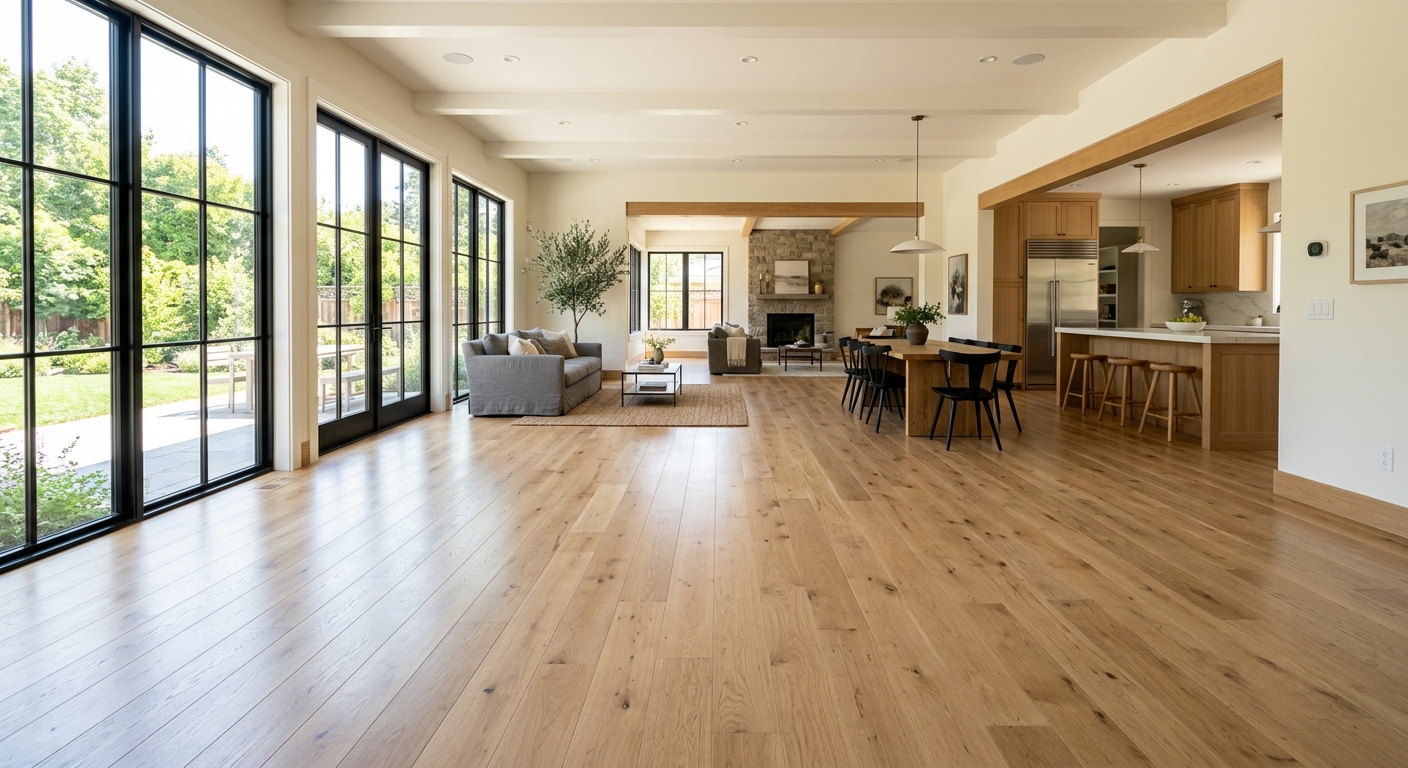
Flooring options and costs in Victoria-Downtown
In Victoria-Downtown, the right flooring choice starts with understanding how the home behaves—especially in the older housing stock that makes up much of the neighbourhood fabric. With a population of 46,309 in the city area (Statistics Canada, 2021 Census), demand is steady for mid-range upgrades, and that affects both scheduling and contractor availability. On projects that involve older subfloors, it’s common to encounter wavy plywood, patched OSB, or uneven concrete that needs levelling or repair before the new surface goes down. That kind of preparation typically adds time and material; many Victoria-Downtown homeowners budget roughly $1–$3 per sq ft (and sometimes $4/sq ft on more problematic floors) before any finished flooring is installed.
On Vancouver Island and the Coast, costs are also shaped by humidity swings and coastal moisture. Indoor relative humidity often drifts outside the ideal 35–55% band, so flooring must tolerate expansion and contraction to avoid cupping, gaps, or edge lifting. That’s why below-grade spaces and damp basements usually call for engineered hardwood or luxury vinyl plank (LVP) rather than solid hardwood. Finally, electrically heated homes and radiant-ready layouts are increasingly common, which can influence pricing by narrowing material choices—solid hardwood isn’t always ideal over radiant systems, while LVP, many laminates, tile, and most engineered woods are typically compatible when installed with the proper underlayment and temperature controls.
This trade is particularly busy in and around James Bay and the Wharf/Inner Harbour area, where older homes are frequently renovated while staying close to active street access. Use the table below to compare realistic installed cost ranges, then we can refine the budget based on your room sizes and subfloor condition.
| Type |
Best Room |
Moisture Resistance |
Lifespan |
Price per sq ft |
| Solid hardwood (nail-down, above grade only) |
Living rooms, dining rooms |
Low to moderate; sensitive to humidity |
25–50 years |
$9,–$18 |
| Engineered hardwood (float or glue, above + on-grade) |
Living rooms, bedrooms, hallways |
Moderate; better dimensional stability |
20–40 years |
$10,–$17 |
| Laminate (click-lock, above-grade) |
Bedrooms, offices |
Low to moderate; fails with standing water |
10–25 years |
$5,–$10 |
| Luxury vinyl plank / LVP (waterproof, any level) |
Kitchen, basement (finished) |
High; waterproof core |
15–25 years |
$6,–$12 |
| Porcelain / ceramic tile |
Kitchen, bathrooms, entries |
Very high; needs proper waterproofing |
20–50 years |
$12,–$25 |
| Carpet (broadloom or modular tile) |
Bedrooms, stairs |
Low; sensitive to dampness |
7–15 years |
$4,–$9 |
Prices are estimates only and vary by project scope, site access and material selection.
What affects the price of flooring in Victoria-Downtown
In Victoria-Downtown and across Vancouver Island and the Coast, two quotes for what looks like the same flooring job can land 30–50% apart. The main reason isn’t usually the material—it’s the “behind-the-floor” work: subfloor preparation, moisture management, and the labour details that make a floor perform long-term. If your existing floor is on older plywood, the crew may need levelling, repairs, or adding surface stability before they can install, especially in homes with a history of seasonal movement. For Vancouver Island’s coastal climate, indoor humidity often shifts more than homeowners expect, and that raises the importance of using dimensionally stable options where moisture risk exists.
Technically, solid hardwood expands and contracts with humidity, and it also isn’t appropriate over concrete or in basements. That’s why engineered hardwood and LVP are common on Victoria-Downtown projects. It also ties into radiant-ready design: colder pockets and electrically heated homes increasingly favour radiant-compatible flooring. This typically rules out most solid hardwood and some laminate products, while LVP, many laminates, and tile can work with hydronic or electric radiant systems using the right underlayment and temperature controls.
Local examples of cost swings: (1) If you’re levelling a wavy plywood subfloor, plan for labour and patch materials—commonly $1–$4 per sq ft before installation. (2) If you remove old carpet pad and tack strips, disposal and prep time adds cost, even if the finished surface price stays within a band. As a result, your all-in budget might start near the laminate/LVP ranges (roughly $5–$10 per sq ft for laminate/vinyl materials-and-install in many typical scopes), or climb into tile/higher-end engineered hardwood once preparation, underlayment, and transitions are included—tile often lands in the $12–$25 per sq ft band depending on format and substrate needs.
Finally, housing age matters: when older Vancouver Island homes require subfloor repair or moisture remediation, your “extra” can be the difference between a $9–$12/sq ft finish budget and a $14–$18/sq ft finish budget for the same room size.
| Price Factor |
Why It Matters |
Cost Impact |
| Room area in sq ft |
Material coverage and labour time scale directly with square footage. |
Small rooms often cost more per sq ft due to minimum labour charges and extra cuts. |
| Subfloor condition — levelling or repair needed before install |
Old plywood and uneven concrete require patching, flattening, or surface prep for a warranty-grade result. |
Commonly adds $1–$4 per sq ft depending on how far out-of-flat the substrate is. |
| Moisture / below-grade install — rules out solid hardwood |
Basements and damp areas demand waterproof or moisture-tolerant products and vapour management. |
Switching to engineered or LVP can increase material cost but reduces failure risk. |
| Material choice — solid vs. engineered vs. LVP vs. tile |
Durability, underlayment requirements, and installation complexity vary by flooring type. |
Solid hardwood and tile generally cost more; laminate/LVP usually sit lower. |
| Removal and disposal of existing flooring |
Demo time, hauling, and surface cleaning can be labour-intensive. |
Often adds a meaningful per-project cost; it can move a quote by 10–20%. |
| Stair nosing / transitions — charged per step or per linear foot |
Transitions and stairs aren’t “covered” by square footage alone. |
Can add 5–15% to a typical renovation depending on count and complexity. |
| Radiant heat compatibility — limits material options |
Some products can warp or delaminate with incorrect temperature profiles. |
May require specific underlayment or installation steps; can change total labour time. |
| Installation method — float vs. glue-down vs. nail-down |
Different methods change prep, adhesive/fasteners, and labour time. |
Glue-down and nail-down often cost more in labour than floating click-lock systems. |
Permits & regulations in British Columbia
In British Columbia, the flooring installation itself generally does not require a building permit. Where permitting can become relevant is the associated work around the floor: structural subfloor repair, significant moisture remediation, and in-floor heating circuit changes. If your project involves electrical work—like adding, altering, or connecting in-floor heating components—those changes may trigger electrical permit requirements under provincial electrical rules. For condominiums, even when a permit isn’t required, the building’s bylaws and the corporation’s sound-transmission requirements (STC/IIC) often restrict or require specific underlay under hard flooring on upper floors.
Step-by-step, here’s how a Victoria-Downtown homeowner can verify contractor readiness before signing: (1) Check the contractor is properly registered/licensed for the trade activity they’re performing, and confirm the exact scope on their proposal. (2) Ask for a certificate of insurance and verify it includes liability coverage appropriate for your project. (3) Confirm workers’ compensation coverage (WSIB/WCB) for any employees—request proof and ensure it aligns with the crew working on-site.
Practically, request these items in writing: licence/registration details, a current certificate of insurance, and proof of clearance/coverage. Then compare those documents to the quote scope: if a contractor won’t provide the paperwork up front, or they won’t clearly state what’s included (subfloor repair, disposal, underlayment, transitions), it’s a warning sign—especially in older Victoria-Downtown homes where moisture and substrate conditions drive the job.
Best flooring for each room in your Victoria-Downtown home
Choosing flooring in Victoria-Downtown is about matching each room’s moisture exposure, foot traffic, and comfort needs to a material that can handle Vancouver Island’s humidity swings. For living and dining spaces, engineered hardwood or high-quality laminate offers warmth while staying more dimensionally stable than solid hardwood—helpful when indoor humidity drifts. In the master bedroom, carpet is still a top comfort choice because it reduces noise and feels warm underfoot in colder months; alternatively, engineered hardwood works well if your relative humidity stays within a reasonable range.
Kitchens need resistance to spills and frequent cleaning. Luxury vinyl plank (LVP) or large-format porcelain tile are the usual winners because they manage moisture better than laminate and are easier to maintain. For basements (finished), LVP is the clear winner in Victoria-Downtown: it’s fully waterproof at the plank level and tolerates the kinds of below-grade conditions where solid wood and most laminate can fail over time. Bathrooms should be porcelain or ceramic tile only, because the system can be waterproofed and cleaned without worrying about swelling from repeated moisture.
Radiant heat compatibility is increasingly relevant in British Columbia. Many laminates and engineered woods can be installed over hydronic or electric radiant systems if the installation and temperature controls are followed, but solid hardwood is more commonly limited. If you’re deciding between options, consider value: a typical laminate instal might land around $5–$10 per sq ft, while engineered hardwood might run roughly $10–$17 per sq ft—often worth it when you want a longer service life and better stability in Victoria-Downtown’s coastal climate.
| Room |
Best Material |
Why |
Moisture Risk |
Price Band per sq ft |
| Living / dining room |
Engineered hardwood |
Warm feel with better stability than solid in coastal humidity swings. |
Low to moderate (main-floor seasonal movement) |
$10,–$17 |
| Master bedroom |
Carpet or engineered hardwood |
Carpet adds comfort and sound absorption; engineered adds easier maintenance. |
Low (avoid if you have recurring dampness) |
$4,–$17 |
| Secondary bedrooms |
Laminate or carpet |
Laminate handles daily traffic well; carpet is budget-friendly and quiet. |
Low to moderate (protect from spills) |
$5,–$9 |
| Kitchen |
Luxury vinyl plank (LVP) or porcelain tile |
LVP resists spills; tile handles water and heavy cleaning. |
Moderate to high (spills and humidity from cooking) |
$12,–$25 |
| Basement (finished) |
LVP (waterproof core) |
Best tolerance for below-grade moisture conditions and vapour management needs. |
High (vapour and occasional dampness) |
$6,–$12 |
| Bathroom |
Porcelain / ceramic tile |
Supports a proper waterproofing approach and holds up to repeated wetting. |
High (direct and prolonged moisture exposure) |
$12,–$25 |
How to choose a flooring contractor in Victoria-Downtown
Choosing a flooring contractor in Victoria-Downtown should start with proof, not promises. Ask for British Columbia licence/registration details that match the scope they’re offering, then request liability insurance documentation showing they’re covered for on-site work. Also verify workers’ compensation coverage (WSIB/WCB) for their employees—get it in writing and ensure it’s current before any materials are delivered. If a contractor can’t provide documentation promptly, it’s usually because they don’t meet the standards homeowners should expect.
Next, get 2–3 itemised written quotes. You want a breakdown that separates materials and labour, lists underlayment requirements, shows whether levelling/repair is included, and clarifies removal and disposal. Avoid a “lump sum with vague scope” quote; it makes disputes more likely when subfloor repairs surface (which is common in older Victoria-Downtown homes). Confirm whether permits are included if electrical work or any related scope requires it, and ask whether the quote includes stair nosing and transitions.
Warranty matters in British Columbia coastal conditions. Make sure you understand the workmanship warranty length, the product/manufacturer warranty terms, and whether the warranty is transferable to future owners. Payment schedule is also key: never pay more than 10–15% upfront. Hold back payment until the job is complete, cleaned, and punch-listed.
Finally, ask for a start date and completion estimate in writing. A clear timeline reduces the risk of partially finished areas—especially on projects where subfloor prep and moisture corrections extend the schedule.
- Request licence/registration details that match the scope in writing.
- Verify current liability insurance (certificate of insurance) before work begins.
- Confirm WSIB/WCB coverage for employees and subcontractors used on your job.
- Get 2–3 itemised quotes: labour line items + material line items.
- Confirm removal and disposal is included (or priced separately).
- Ask what’s included for subfloor levelling/repair and moisture remediation.
- Ensure underlayment/vapour barriers match the product and climate requirements.
- Verify radiant heat compatibility steps if your home has in-floor heating.
- Confirm how stairs and transitions are priced (per step / per linear foot).
- Read warranty terms: workmanship duration and product warranty coverage.
- Keep upfront payment to 10–15% and hold back until punch list completion.
- Get a written start/completion timeline and site protection plan.
In Victoria-Downtown, common red flags include: (1) refusing to provide insurance or workers’ compensation proof, (2) quoting click-lock laminate over a clearly uneven subfloor without planning levelling, (3) promising “waterproof” claims for products that aren’t truly waterproof at the core level, (4) skipping proper underlayment/vapour management near concrete or damp areas, and (5) starting work without confirming condo sound requirements (STC/IIC) where applicable.
Frequently asked questions — flooring in Victoria-Downtown
What flooring holds up best to pets in a Victoria-Downtown home?
For most Victoria-Downtown homes with pets, luxury vinyl plank (LVP) is the most forgiving overall because it’s typically waterproof and easier to clean after accidents. It also tolerates the region’s humidity swings better than solid hardwood, which can expand and contract. If you prefer a wood look, choose engineered hardwood with a reputable wear layer and keep nails/claws maintained; it’s durable but not the same “spill-proof” approach as LVP. For carpet, pick a higher-density, stain-resistant option and address humidity—carpet can struggle if you have damp basements. Budget-wise, LVP commonly fits within the laminate/vinyl bands (often around $6–$12 per sq ft installed depending on material and subfloor prep). (Statistics Canada, 2021 Census)
How do I fix squeaky floors in my Victoria-Downtown home?
Squeaks usually come from movement between joists, nails, or subfloor layers—not from the surface flooring itself. In older Victoria-Downtown homes, it’s common to find a loose subfloor layer or fasteners that have loosened over time. The practical fix is to remove the finished flooring (and sometimes underlay) so the subfloor can be re-secured properly from above or below, then re-install with the correct fastening pattern and underlayment. If the floor is already cupped or uneven due to moisture, you must correct the substrate first to avoid repeating the problem. For budgeting, the cost to address squeaks can be hidden inside “subfloor repair/levelling” line items; many homeowners see additional $1–$4 per sq ft when the crew has to flatten/repair before installing the new surface.
What is luxury vinyl plank and is it worth it in Victoria-Downtown?
Luxury vinyl plank (LVP) is a synthetic, layered flooring with a waterproof core designed to resist spills and daily wear. In Victoria-Downtown and across Vancouver Island and the Coast, it’s often worth the upgrade because coastal moisture and humidity swings can create expansion/contraction issues for less-stable materials. LVP is also a smart fit for kitchens, entries, and finished basements—areas where vapour and damp risk are more likely. Solid hardwood can be great on main floors, but we typically avoid it on concrete slabs and in chronic moisture areas. LVP often lands in the laminate/vinyl price bands (commonly around $5–$10, and sometimes higher when you choose thicker wear layers or do extra subfloor prep). If you want a “low-fuss” floor that stays looking good through seasonal changes, LVP usually earns its keep.
How much does flooring cost in Victoria-Downtown?
In Victoria-Downtown, all-in installed pricing generally follows the local British Columbia bands: hardwood flooring often runs roughly $9–$18 per sq ft, laminate and vinyl plank commonly come in around $5–$10 per sq ft, and tile is usually in the $12–$25 per sq ft range. Carpet installation often sits around $4–$9 per sq ft. Real-world totals can move up when you need subfloor levelling/repair, which is common in older homes; that prep can add about $1–$4 per sq ft. If you tell us your room sizes, existing flooring type, and whether there’s on-grade or below-grade moisture risk, we can tighten the estimate. Note that condos may also require specific sound underlays (STC/IIC), which can add cost.
Hardwood vs laminate vs vinyl plank — which is best?
“Best” depends on your room and moisture risk in Victoria-Downtown. Solid hardwood looks great and can last 25–50 years when installed correctly, but it’s sensitive to humidity and typically only makes sense above grade—not over concrete and not in damp basements. Laminate is budget-friendly (often $5–$10 per sq ft installed) and durable for many bedrooms and living areas, but it’s not designed for standing water. Luxury vinyl plank is usually the most versatile: it’s waterproof at the plank level and handles coastal moisture swings better, especially in kitchens and finished basements. In practice, homeowners who want one material to cover multiple spaces often choose LVP; those who prioritize an authentic wood feel usually choose engineered hardwood on main floors and reserve LVP for high-moisture zones. (Statistics Canada, 2021 Census)
What flooring is best for a Victoria-Downtown basement?
For basements in Victoria-Downtown, the best choice is typically waterproof luxury vinyl plank (LVP) because below-grade spaces can experience vapour pressure and seasonal dampness. LVP tolerates these conditions far better than solid hardwood and most laminate, which can fail if moisture reaches the surface or edges. If your basement is only occasionally used, carpet can seem appealing for comfort, but it’s a risk in damp environments. Tile can work as well—especially if the waterproofing and substrate prep are done correctly—but it usually costs more and adds cold-underfoot feel unless you have radiant or rugs. When budgeting, remember to include subfloor evaluation and any moisture remediation or levelling. In many Victoria-Downtown basement projects, homeowners see LVP fall into the roughly $6–$12 per sq ft installed range once prep is accounted for.