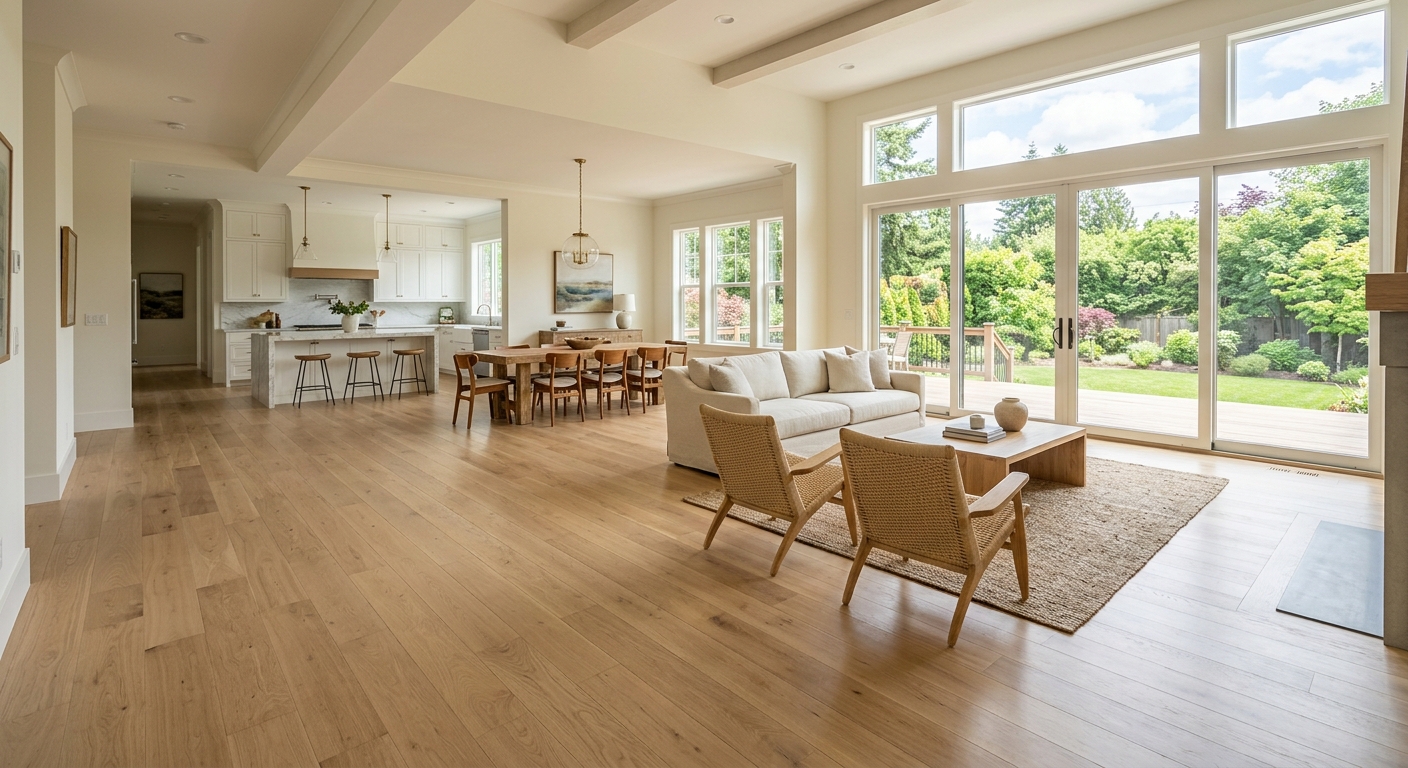
Flooring options and costs in Tsawwassen
Tsawwassen homeowners usually have a short list: engineered hardwood, luxury vinyl plank (LVP), laminate, and tile. With a population of 21,588 people (Statistics Canada, 2021 Census), the Lower Mainland–Southwest market stays busy, and pricing reflects strong demand plus some of the highest trade labour costs in Canada. Another cost driver we see often here is housing condition—Tsawwassen’s older housing stock can require subfloor levelling or repair before any new finish goes down. That’s one reason you may see budgets swing by material type even when the room size is the same.
The wet, marine Lower Mainland climate matters, especially during winter and shoulder seasons when indoor humidity swings can be noticeable. In slab-on-grade and basement areas, moisture can wick up through concrete, so solid hardwood is usually limited to above-grade installations only. For below-grade or anywhere you’re concerned about vapour, engineered wood and LVP are typically the safer calls because their layered construction and, in the case of LVP, PVC cores tolerate humidity better.
Contractors also know where the work is concentrated: in Tsawwassen’s established neighbourhoods closer to the waterfront and older residential pockets, we’re often called in for resurfacing, levelling, and moisture control before installing new floors. From there, your quote usually transitions into a comparison of material performance and realistic price ranges—see the table below.
| Type |
Best Room |
Moisture Resistance |
Lifespan |
Price per sq ft |
| Solid hardwood (nail-down, above grade only) |
Main living areas |
Low to moderate (humidity-sensitive; avoid basements and slab-on-grade) |
25–60 years |
$9,00 – $18,00 |
| Engineered hardwood (float or glue, above + on-grade) |
Living areas, bedrooms |
Moderate (better for on-grade; still manage humidity) |
20–40 years |
$9,00 – $16,00 |
| Laminate (click-lock, above-grade) |
Living areas, bedrooms |
Moderate (resistant to everyday spills; not ideal for chronic moisture) |
10–25 years |
$4,50 – $10,00 |
| Luxury vinyl plank / LVP (waterproof, any level) |
Kitchens, basements, main floors |
High (waterproof; handles vapour movement and minor subfloor issues) |
15–25 years |
$4,50 – $10,00 |
| Porcelain / ceramic tile |
Bathrooms, kitchens, entries |
Very high (but needs proper substrate prep) |
25–50 years |
$10,00 – $20,00 |
| Carpet (broadloom or modular tile) |
Bedrooms, media rooms |
Low to moderate (avoid if you have recurring moisture) |
7–15 years |
$6,00 – $12,00 |
Prices are estimates only and vary by project scope, site access and material selection.
What affects the price of flooring in Tsawwassen
In Tsawwassen and the broader Lower Mainland–Southwest, it’s common to see 30–50% differences between quotes for the same “type” of flooring. That gap usually isn’t the showroom product—it’s the unseen prep and site factors: subfloor flatness, moisture mitigation, removal and disposal, and the complexity of transitions and stairs. Labour is a major component here because Greater Vancouver rates are among the highest in Canada, so anything that adds hours (levelling, patching, careful cutting) quickly changes the total.
Technically, indoor humidity swings are a key driver. Solid hardwood expands and contracts with humidity; it also cannot be glued or floated over concrete and tends to perform poorly in basements. That’s why below-grade installs typically steer toward engineered hardwood or LVP. Radiant heating in colder inland pockets of the region also affects what you can use: most solid hardwood needs very careful specification, and some laminate options are limited to specific temperature profiles.
Older housing stock in the Lower Mainland often needs levelling or repair before install, and that prep commonly adds roughly $1–$4 per sq ft. For example, if you’re choosing engineered wood in a main floor area, a flat subfloor might keep you closer to the lower end of the $9–$18 hardwood range; but if the crew finds dips in older plywood or requires resurfacing, your costs can climb toward the upper end. On the other hand, switching to waterproof LVP can reduce moisture-related prep for basement or on-grade areas, keeping budgets closer to the $4–$10 laminate/vinyl band when moisture is the main risk.
| Price Factor |
Why It Matters |
Cost Impact |
| Room area in sq ft |
More surface = more material and more labour hours |
Direct driver; affects both materials and install time |
| Subfloor condition — levelling or repair needed |
Uneven plywood or concrete increases labour and sometimes requires resurfacing |
Often adds about $1–$4/sq ft in older homes |
| Moisture / below-grade install |
Solid hardwood is typically avoided; vapour barriers and prep may be required |
Can shift costs upward if mitigation is needed |
| Material choice — solid vs. engineered vs. LVP vs. tile |
Different products carry different material and underlayment/substrate requirements |
Typical bands: hardwood $9–$18; vinyl/laminate $4–$10; tile $10–$20 |
| Removal and disposal of existing flooring |
Tear-out time, disposal fees, and potential subfloor damage |
Often a noticeable add-on for glued-down or thick systems |
| Stair nosing / transitions |
Transitions are more labour-intensive than flat areas |
Charged per step or per linear foot |
| Radiant heat compatibility |
Limits product selection and may require approved underlay/installation details |
Specialist materials can raise the per sq ft price |
| Installation method — float vs. glue-down vs. nail-down |
Adhesives, fasteners, and substrate prep vary |
Nail-down and glue-down usually cost more in prep labour |
Permits & regulations in British Columbia
In British Columbia, installing new flooring by itself generally does not require a building permit. However, associated work can trigger permits—especially when you move beyond “surface finishes.” For example, electrical permits may be required if you’re adding or modifying in-floor heating wiring or related electrical components. Moisture remediation can also involve additional trades depending on the diagnosis (for instance, removing damaged assemblies or correcting water ingress), and structural subfloor repairs may require coordination if anything touches building framing.
In condominiums, the building’s rules matter as much as the law. Many corporations restrict hard flooring on upper floors due to sound transmission, and they may require specific underlay systems or assemblies to meet building criteria (often referenced through STC/IIC performance). Before you install hardwood or tile on an apartment-level floor, review the condo declaration and ask for board approval in writing—especially if you’re replacing carpet with a hard surface.
To verify a contractor in Tsawwassen, do three checks. First, confirm the contractor’s licence/registration information (where applicable) and trade status through the appropriate provincial online resources. Second, request a current certificate of liability insurance and confirm it matches the legal entity name on the quote. Third, ask for WSIB/WCB clearance documentation (or proof of coverage), and keep copies for your records. A reputable installer will provide these documents before work starts and will not pressure you to skip them.
Best flooring for each room in your Tsawwassen home
In Tsawwassen’s wet, marine climate, the “best” flooring is the one that matches moisture exposure and how your home reacts to indoor humidity swings. For living and dining areas, engineered hardwood is a favourite: it delivers a real-wood look while handling humidity changes better than solid hardwood when installed correctly with proper expansion gaps and acclimation. High-quality laminate can also work in main living spaces when you keep spills cleaned quickly and avoid long-term dampness.
For bedrooms, carpet remains popular because it feels warm underfoot and dampens sound—useful in family homes and in condos where noise matters. If you prefer hard flooring, engineered wood is usually the safer pick. In kitchens, LVP is often the practical choice because it stands up to drips and easy cleaning; large-format porcelain tile is also excellent when you’re okay with a harder, cooler surface. Basements in the Lower Mainland commonly face moisture vapour coming through slab or subflooring, so LVP is usually the clear winner—waterproof, forgiving of minor imperfections, and far more tolerant than solid wood or most laminate for below-grade conditions. Bathrooms should be porcelain or ceramic tile only.
If your home has radiant in-floor heating (increasing in newer construction and colder inland pockets nearby), choose products rated for that temperature range and use the approved underlay and installation method. As a cost example, you might choose tile at the $10–$20 band where water exposure is high; swapping it to LVP at the $4–$10 band can be justified in kitchens where you want waterproof practicality and fewer under-assembly requirements.
| Room |
Best Material |
Why |
Moisture Risk |
Price Band per sq ft |
| Living / dining room |
Engineered hardwood |
Warm look, better humidity tolerance than solid |
Low to moderate (humidity swings, but not wet zones) |
$9,00 – $16,00 |
| Master bedroom |
Carpet or engineered hardwood |
Comfort and sound control (carpet) or durable warmth (engineered) |
Low |
$6,00 – $12,00 |
| Secondary bedrooms |
Carpet |
Cost-effective comfort and noise reduction |
Low |
$6,00 – $12,00 |
| Kitchen |
Luxury vinyl plank (LVP) or porcelain tile |
Easy cleaning; waterproof performance for spills |
Moderate (daily wet cleaning and occasional splashes) |
$4,50 – $20,00 |
| Basement (finished) |
LVP (waterproof) |
Handles moisture vapour and below-grade installs better than wood |
High |
$4,50 – $10,00 |
| Bathroom |
Porcelain / ceramic tile |
Best wet-room durability and water resistance |
Very high |
$10,00 – $20,00 |
How to choose a flooring contractor in Tsawwassen
Choosing the right contractor in Tsawwassen starts with verification. Ask for proof of British Columbia licensing/registration where applicable for their trade category, and request a certificate of liability insurance that lists the correct legal business name and includes worksite coverage. For workers’ coverage, request WSIB/WCB clearance or proof of coverage—then confirm it’s current and matches the crew doing the job. If a contractor hesitates on documentation, treat that as a warning sign.
Next, get 2–3 itemised written quotes. You want a breakdown that separates labour, materials, underlay/adhesives, and any levelling or moisture barriers. Avoid quotes that only state a single “lump sum” without explaining what’s included. Confirm whether permit pull (if needed for electrical work or in-floor heating modifications) is included, and whether disposal and site clean-up are part of the scope.
Warranty is another key selection tool. Ask for the workmanship warranty length and whether it’s transferable if you sell your home. Also review the manufacturer warranty for the product—failing to follow acclimation, underlay requirements, or approved installation methods can reduce coverage.
For payment, never pay more than 10–15% upfront. Use a holdback until the job is complete and you’ve done a final walkthrough. Finally, ask for a written start date and a realistic completion timeline.
- Ask for insurance and WSIB/WCB proof before signing.
- Get an itemised quote (labour + materials + underlay/adhesives).
- Verify subfloor preparation requirements are included in writing.
- Confirm moisture barriers/primers are specified if on-grade or basement.
- Ensure removal and disposal are included (and priced clearly).
- Check how stairs, nosing, and transitions are charged.
- Request proof of product acclimation instructions and who handles them.
- Confirm dust control and daily site clean-up practices.
- Review workmanship warranty terms and claim process.
- Ask if the warranty is transferable to future homeowners.
- Use a payment schedule with a meaningful holdback.
- Get start date and completion estimate in the contract.
Red flags in Tsawwassen include: quotes that don’t mention subfloor flatness or moisture prep, refusal to provide certificate of insurance/WSIB/WCB documentation, vague “one price includes everything” language with no exclusions list, pressure to pay most of the total upfront, and no clear warranty details for both labour and product installation.
Frequently asked questions — flooring in Tsawwassen
Do condos restrict hard flooring?
Yes, many condos in British Columbia restrict or regulate hard flooring on upper floors because of sound transmission. The building may require specific underlay assemblies and may prohibit certain products if they don’t meet criteria commonly discussed as STC/IIC performance. Before installing hardwood or tile, review your condo declaration and ask the corporation for board approval in writing. If you’re in Tsawwassen, the practical part is to confirm what they’ll accept—carpet with padding is often easiest, while engineered wood and tile usually need compliant underlay and careful installation. If you’re comparing materials, remember that even at a similar aesthetic level, costs shift: LVP often sits around the $4–$10 band, while hardwood and tile typically start higher (for example, hardwood is commonly in the $9–$18 band) once proper underlay and prep are included.
How do I compare flooring quotes?
Start by comparing apples to apples. Ask for itemised quotes showing labour, material supply, underlay/adhesives, subfloor levelling/repair, and removal/disposal. Make sure each quote includes the same scope: acclimation, manufacturer-approved installation method, and whether a moisture barrier is required for on-grade or basement areas common in the Lower Mainland–Southwest. Also confirm how stairs and transitions are priced (per step or per linear foot). You’ll often see big differences even when the listed flooring looks similar. For instance, a low vinyl quote in the $4–$10 band may turn higher if levelling and moisture mitigation are excluded. Conversely, a hardwood quote in the $9–$18 band can look expensive until you see that it includes proper prep and expansion-gap detailing to reduce cupping and gapping during humidity swings.
Can I install flooring over existing tile in Tsawwassen?
Sometimes, but it depends on the tile condition, height transitions, and substrate readiness. In Tsawwassen, the climate itself doesn’t prevent tile-over-tile, but your concrete surface and the thickness build-up can create problems. A contractor should check flatness (tile lippage matters), whether grout lines are properly profiled, and whether you can meet required underlayment/adhesive instructions for the new flooring. For LVP, many installs can go over sound, properly prepared tile, but you still need a smooth, stable base. For engineered wood or laminate, the same flatness rules apply, and moisture barriers may be required depending on the assembly and whether the area is on-grade or below grade. If tile is cracked or loose, removal may be safer—especially in basements where moisture vapour can be an issue in older housing stock.
What is the best flooring for a high-traffic area in Tsawwassen?
For high-traffic areas in Tsawwassen, look for durability plus moisture tolerance. Engineered hardwood is a strong choice for main living spaces if the subfloor is sound and the humidity is managed—solid hardwood is typically limited to above-grade installs for this reason. If the area sees frequent spills, wet cleaning, or a higher chance of tracked-in moisture, waterproof LVP is often the best practical option because it’s designed for “any level” use and stands up well to humidity swings common in the Lower Mainland–Southwest. If you want an easy-clean, long-life finish and you don’t mind the feel, porcelain tile is also excellent, typically in the $10–$20 band. Carpet can work, but in high-traffic zones it wears faster and can hold onto moisture if your cleaning habits or humidity conditions are aggressive.
How do I prepare my subfloor before new flooring?
Proper preparation is what makes your new floor last, especially in British Columbia’s wet-marine conditions where humidity swings and below-grade moisture are real concerns. The contractor should first inspect and measure flatness; dips and ridges cause joint failure in click-lock floors and poor adhesion in glue-down systems. Next, repair soft or damaged sections of plywood or concrete. For on-grade and basement areas, you’ll typically need the right moisture barrier system specified for your flooring type; this is one reason solid hardwood is usually avoided below grade. If levelling is required, ask whether it’s included in the quote and how it’s achieved (patching vs full resurfacing). In Tsawwassen’s older housing stock, that prep work can add roughly $1–$4 per sq ft, so confirming it early helps you judge whether a quote in the $9–$18 hardwood range (or $4–$10 vinyl/laminate band) is truly comparable.
Is cork or bamboo flooring a good choice in Tsawwassen?
Cork and bamboo can be comfortable and visually appealing, but in Tsawwassen they’re not usually the first pick for moisture-prone areas. Both materials are sensitive to excessive humidity and can be affected by vapour movement if installed over basements or on-grade slabs without the correct system. In the Lower Mainland–Southwest, where moisture vapour and indoor humidity swings show up in winter and shoulder seasons, you’d typically choose engineered hardwood or LVP for better humidity tolerance. Bamboo durability varies by product type: some engineered or properly finished systems perform well in dry, above-grade areas, but they still require careful acclimation and strict installation details. If you’re considering cork or bamboo, keep it to main, dry rooms and confirm the manufacturer’s warranty conditions in writing. For wet zones like bathrooms or any basement, porcelain tile or waterproof LVP is the safer match in British Columbia.