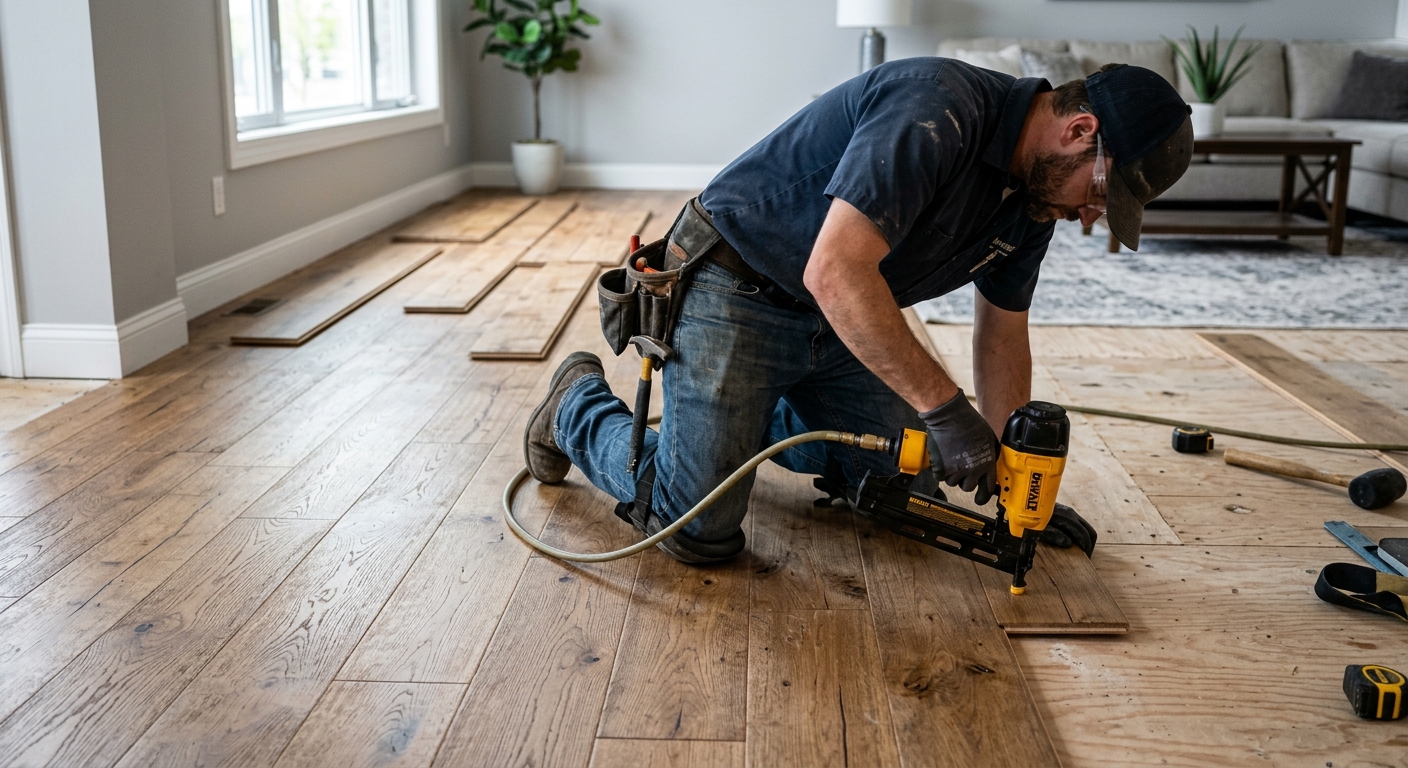
Flooring options and costs in Strawberry Hill
In Strawberry Hill, the most common flooring upgrades start with a simple goal: make the home feel warmer and cleaner—without inviting moisture problems. With a population around 41,000 in 2021 (Statistics Canada, 2021 Census), the Lower Mainland–Southwest keeps a steady stream of renovations, and that demand shows up in pricing because contractors are busy part of the year. Another local reality is older housing stock in many Surrey-area pockets, which often means the subfloor needs levelling, patching, or sometimes a plywood resurfacing before new flooring goes in. That prep step commonly adds about $1–$3 per sq ft to the total project cost, and it’s one reason two “same-room-size” quotes can land far apart.
The wet, marine climate across the region also matters. Seasonal humidity swings are pronounced in winter and shoulder months, and basements or slab-on-grade areas can develop moisture wicking through concrete. For below-grade spaces, solid hardwood is typically avoided because it expands and contracts with humidity and doesn’t perform well over concrete. Instead, engineered hardwood and luxury vinyl plank (LVP) are the most practical choices, because their layered construction (and PVC cores in LVP) tolerate humidity and minor temperature changes better. If your home has radiant heating, that can further steer you toward engineered wood, LVP, tile, and select laminates—while most solid hardwood needs careful specification.
In neighbourhoods around the Strawberry Hill area by Guildford Town Centre (where condo conversions and family upgrades are frequent), homeowners often choose engineered wood for main floors and LVP for basements, then spend on transitions only where it improves the look. Use the comparison table below to line up options with typical cost ranges for Strawberry Hill.
| Type |
Best Room |
Moisture Resistance |
Lifespan |
Price per sq ft |
| Solid hardwood (nail-down, above grade only) |
Main living areas |
Low to moderate (above grade only) |
25–50 years |
$9,–$18 |
| Engineered hardwood (float or glue, above + on-grade) |
Living rooms, halls, bedrooms |
Moderate to good |
20–40 years |
$10,–$16 |
| Laminate (click-lock, above-grade) |
Bedrooms, offices (dry areas) |
Low to moderate (not ideal for below grade) |
10–25 years |
$4,–$10 |
| Luxury vinyl plank / LVP (waterproof, any level) |
Kitchen, basement (finished) |
High (waterproof) |
15–30 years |
$5,–$12 |
| Porcelain / ceramic tile |
Kitchen, bathrooms |
Very high |
25+ years |
$10,–$20 |
| Carpet (broadloom or modular tile) |
Bedrooms, stairs (comfort) |
Moderate (needs good moisture control) |
7–15 years |
$6,–$12 |
Prices are estimates only and vary by project scope, site access and material selection.
What affects the price of flooring in Strawberry Hill
In Strawberry Hill and the wider Lower Mainland–Southwest, it’s common to see the same flooring idea quoted 30–50% differently. The gap usually isn’t the “brand”—it’s the real scope: what’s happening with the subfloor, how much removal/disposal is needed, how many transitions and stair nosings are included, and whether moisture control steps are required. Labour also plays a major role here; Greater Vancouver-area installation costs tend to be among the highest in Canada, so prep and careful installation can add up quickly when a contractor has to level uneven plywood, address spots of concrete moisture, or handle lots of cuts around ducts and built-ins.
Technically, the Lower Mainland’s wet, marine climate drives many decisions. Indoor humidity swings make solid hardwood expand and contract, so it’s generally limited to above-grade installs. That’s a key reason solid hardwood quotes can be higher in terms of “risk-managed” workmanship (extra acclimation time, gaps, careful fastening patterns) and why basements and slab areas typically shift you to engineered wood or LVP. Colder inland pockets and newer builds also pair floors with radiant heating, which rules out most solid hardwood and some laminates not rated for higher temperatures. Meanwhile, older housing stock frequently needs subfloor levelling or repair—often adding $1–$4 per sq ft once you include patching, flattening compounds, and labour.
Two practical Strawberry Hill examples I see often: (1) a finished basement where moisture wicking is suspected can add membrane/underlayment labour and sometimes floor prep, pushing an LVP project toward the higher end of the laminate/vinyl band; (2) a main-floor install with significant floor variation may add levelling work, turning a solid hardwood plan (within the $9–$18 band) into an “engineered + levelling” budget because engineered tolerates minor movement better. Those choices flow directly into your final invoice—so quote comparisons should start with scope, not just price.
| Price Factor |
Why It Matters |
Cost Impact |
| Room area in sq ft |
Material and installation time scale with coverage and waste |
Direct driver of total; smaller rooms often cost more per sq ft |
| Subfloor condition — levelling or repair needed |
Uneven or damaged subfloors require prep to avoid squeaks and failure |
Often adds about $1–$4 per sq ft depending on severity |
| Moisture / below-grade install — rules out solid hardwood |
Basement humidity and concrete moisture require suitable products/systems |
May shift cost from solid hardwood to engineered or LVP |
| Material choice — solid vs. engineered vs. LVP vs. tile |
Product price and warranty requirements vary |
Can swing overall budget by several dollars per sq ft |
| Removal and disposal of existing flooring |
Old flooring adds demo time and dump fees |
Common hidden cost; can be a noticeable percentage on small jobs |
| Stair nosing / transitions |
Transitions and stair work are labour-intensive and priced separately |
Can add per step or per linear foot charges |
| Radiant heat compatibility |
Only certain products handle higher floor temperatures safely |
May limit options and require different underlay/spec |
| Installation method — float vs. glue-down vs. nail-down |
Different methods require different prep and labour |
Glue-down and nail-down are often more labour intensive |
Permits & regulations in British Columbia
In British Columbia, installing flooring itself typically does not require a building permit. However, associated work can trigger permitting—especially when the scope touches electrical circuits, structural changes, or engineered systems. For example, if you’re adjusting or adding in-floor heating circuits (including thermostat changes, new wiring, or modifications to existing electrical components), you may need an electrical permit. If your project involves structural subfloor repair beyond simple surface patching—such as significant framing correction, replacing damaged joists, or work that impacts structural integrity—permits can become relevant depending on the extent of changes.
In condominiums across Strawberry Hill and the Lower Mainland, the key “rule” is often not a building permit, but the building’s sound-control requirements. Most condo corporations have restrictions around underlay for hard flooring and may require specific underlay systems to meet sound transmission targets (STC/IIC). Before installing hardwood or tile on upper floors, review the condo declaration and request board approval in writing. It’s much easier to submit product/underlay details up front than to reverse-course after an inspection.
To verify a contractor in BC step-by-step: (1) confirm they’re properly licensed for the scope you’re hiring them for (when applicable) and that their business details match your quote; (2) ask for a current certificate of insurance (liability) and ensure the policy covers flooring work and your project address; (3) verify WSIB/WCB coverage—request their clearance letter or proof of active coverage. If they can’t provide these documents quickly, that’s a serious warning sign.
Best flooring for each room in your Strawberry Hill home
Choosing the right flooring in Strawberry Hill is mostly about matching material to moisture exposure, foot traffic, and how your home responds to humidity. For living and dining areas, I usually steer homeowners toward engineered hardwood or a high-quality laminate: both bring warmth, look realistic, and can tolerate normal day-to-day humidity better than solid wood. In a master bedroom, carpet is still a strong choice for comfort and sound absorption, especially in multi-unit buildings, while engineered hardwood remains a great “durable long-term” option if you prefer an open, easy-to-clean feel.
In kitchens, LVP or large-format porcelain tile are the practical winners. The region’s wet climate means spills and condensation aren’t rare, and waterproof LVP helps you manage drips without worrying about swelling—where laminate can be sensitive at seams. For basements (finished), LVP is the clear leader. Basements and slab-on-grade areas in the Lower Mainland–Southwest often face moisture wicking through concrete, and solid hardwood is generally a poor match there. Tile can work in basements if installed correctly, but LVP typically offers a faster, more comfortable underfoot solution for many homeowners. Bathrooms should be porcelain or ceramic tile only—this is where waterproofing and easy cleaning matter most.
If your home uses radiant heating, spec matters. Engineered wood, LVP, and tile are commonly compatible, but solid hardwood and some laminates can be problematic over in-floor heat unless rated for it and installed with the right expansion planning.
As a concrete cost example: if your main floor would land at the middle of the hardwood band (around the $9–$18 range), switching a basement from solid hardwood to LVP often prevents moisture-related failures and repairs. That’s a place where spending a bit more on the right system avoids bigger downstream costs.
| Room |
Best Material |
Why |
Moisture Risk |
Price Band per sq ft |
| Living / dining room |
Engineered hardwood |
Warm look with better tolerance for humidity swings than solid |
Low to moderate (above grade) |
$10–$16 |
| Master bedroom |
Carpet or engineered hardwood |
Carpet adds comfort and sound control; engineered lasts with easier maintenance |
Low (above grade) |
$6–$12 |
| Secondary bedrooms |
Laminate or carpet |
Laminate handles everyday use when kept dry; carpet is budget-friendly and quiet |
Low (above grade) |
$4–$10 |
| Kitchen |
Luxury vinyl plank (LVP) or porcelain tile |
Water resistance for spills; tile gives maximum cleanability |
Moderate (spills and humidity) |
$5–$20 |
| Basement (finished) |
Luxury vinyl plank (LVP) |
Handles moisture vapour and below-grade conditions far better than solid wood |
High (concrete moisture wicking risk) |
$5–$12 |
| Bathroom |
Porcelain / ceramic tile |
Hard surface designed for wet environments; durable grout system when done right |
Very high |
$10–$20 |
How to choose a flooring contractor in Strawberry Hill
Start by confirming the essentials for a Strawberry Hill contractor: licensing where applicable, liability insurance, and WSIB/WCB coverage. The practical approach is simple—ask for a certificate of insurance and a clearance letter/proof of active coverage before work begins. Don’t accept “we’re covered” without documents. Next, request 2–3 itemised written quotes that break down labour and materials separately. You want to see product line items (underlay/membrane included or not), surface prep, demo/disposal, and installation method.
Read the scope carefully. What’s excluded (like moving appliances, removing toilets, patching subfloor voids, or dealing with uneven plywood)? Is disposal included, and will they haul away the old flooring? For stairs and transitions, confirm what’s priced per step or per linear foot. Warranty matters too: ask for the workmanship warranty length, the manufacturer warranty terms, and whether warranties are transferable if you sell the home.
Payment schedules should protect you. Never pay more than 10–15% upfront; hold back a portion until the job is complete, punch-list items are corrected, and you’ve confirmed transitions, trim, and finishing are done. Finally, insist on a start date and estimated completion date in writing. Given Strawberry Hill’s wet season and material lead times, a schedule in writing reduces delays and avoids “reschedule creep.”
- Provide proof of liability insurance (certificate) before signing.
- Provide WSIB/WCB clearance or proof of coverage.
- Confirm whether they will level subfloors and how (and what it costs).
- Get an itemised quote: labour, materials, underlay/membranes, and finishing.
- Ask if removal and disposal are included and where debris goes.
- Confirm stair nosings and transitions are priced clearly (per step/linear foot).
- Ask for product specifications: thickness, wear layer (LVP), or core rating (laminate).
- Request moisture plan details for basements (vapour barrier/underlayment system).
- Verify radiant heat compatibility if you have in-floor heating.
- Ask about acclimation and jobsite humidity control expectations.
- Confirm warranty coverage: workmanship duration and manufacturer warranty details.
- Use a staged payment plan: small deposit, holdback until completion.
Red flags I see in Strawberry Hill: a contractor who won’t show insurance/coverage documents; quotes with “lump sum” language that hides prep or moisture steps; vague warranty terms (“we stand behind it” with no duration); pressure to pay most of the job upfront; and ignoring condo sound requirements or underlay details when installing hard flooring upstairs.
Frequently asked questions — flooring in Strawberry Hill
Do condos restrict hard flooring?
Yes, many condos in Strawberry Hill and across British Columbia restrict or regulate hard flooring because of sound transmission. The usual issue is not the flooring itself—it’s the underlay system and installation method needed to control impact noise (and sometimes airborne sound). Your condo corporation may require a specific underlay brand/type, or it may require board approval with details of the flooring, underlay, and sometimes even the installation approach. Before you buy product, request the condo’s written requirements and submit the underlay/spec sheet. If you’re planning hardwood or tile on an upper floor, don’t assume “standard underlay” will be acceptable. This requirement can affect both material selection and cost, particularly if you were estimating within a laminate/vinyl band like $4–$10 per sq ft and then need a higher-spec system.
How do I compare flooring quotes?
Compare quotes the way you’d compare apples to apples: start with scope, not totals. Ask each contractor for itemised breakdowns for labour, materials, subfloor prep (levelling/patching), underlay or moisture membranes, and disposal of old flooring. In Strawberry Hill’s wet, marine climate, ask whether the quote includes moisture protection steps for basements or slab-on-grade areas and whether they address humidity-related movement for solid hardwood. Also confirm the installation method (float vs. glue-down vs. nail-down), and whether transitions, stair nosings, and moulding/trim are included. Two quotes that both “fit the $10–$16 engineered hardwood range” can still differ by thousands if one includes proper levelling and the other assumes the subfloor is ready. Finally, verify warranties and the payment schedule so you’re protected if materials or workmanship don’t meet expectations.
Can I install flooring over existing tile in Strawberry Hill?
Sometimes, but it depends on the condition and the new floor type. Installing over existing tile can work if the tile surface is stable, well-bonded, and properly level; otherwise, new flooring may fail or telegraph imperfections. For LVP, some systems can be installed over hard, flat surfaces with the correct prep and underlayment approach, but you still need to address grout ridges and any loose or cracked tiles first. For laminate and engineered wood, you typically need a very flat substrate; raised grout lines and unevenness can increase levelling needs (adding cost, often in the $1–$4 per sq ft range when significant prep is required). In Strawberry Hill basements where moisture vapour is a concern, surface conditions are even more critical. A good contractor will assess flatness and moisture risk before agreeing to install over tile.
What is the best flooring for a high-traffic area in Strawberry Hill?
For high-traffic areas in Strawberry Hill, I generally recommend materials that handle frequent cleaning and minor water exposure. LVP is a top pick for entryways and busy hallways because it’s waterproof and performs well during the Lower Mainland–Southwest’s humidity swings—especially if you track in wet boots in winter. If you want a wood look, engineered hardwood is also a strong choice above grade, but you’ll want to use proper acclimation and maintain indoor humidity to avoid seasonal movement. For budgets, many homeowners compare options in bands like $9–$18 for solid hardwood or $5–$12 for LVP, then choose based on where moisture risk is highest. If the high-traffic area is near a bathroom or kitchen, tile is hard to beat for durability and easy maintenance.
How do I prepare my subfloor before new flooring?
Subfloor prep is where good results are won in Strawberry Hill, because older homes and older concrete/subfloor assemblies can be uneven or affected by humidity. A proper process starts with inspection: measuring flatness, checking for loose materials, and identifying high spots, dips, or damaged plywood. If levelling is needed, it’s typically addressed before installation with approved patch/leveling products and proper curing time. For below-grade areas, the contractor should plan for moisture vapour control—solid hardwood is usually not appropriate, while engineered and LVP have better tolerance for humidity and minor movement. You can help by clearing the work area (move furniture, detach appliances if needed, and make access easy). Avoid DIY “quick fixes” like screwing down loose boards without a plan, because incomplete prep often shows up later as squeaks, gaps, or edge lifting.
Is cork or bamboo flooring a good choice in Strawberry Hill?
Cork and bamboo can be attractive, but they need careful product selection for Strawberry Hill’s wet, marine climate. Cork is generally more comfortable underfoot and offers some sound absorption, yet it can still be sensitive to sustained moisture. Bamboo can be harder and often used as a wood look, but the same humidity-movement realities apply: below grade is the problem area. In basements or any area with moisture vapour risk, I’d typically steer homeowners toward LVP (waterproof) or tile. Above grade, cork or bamboo may work if the product is from a reputable manufacturer with clear humidity guidance and if the subfloor is level and dry. When getting quotes, don’t assume they fall neatly into the standard bands—ask the contractor to specify the exact product line and compare it to known local ranges, such as $10–$16 for engineered hardwood and $5–$12 for LVP, then weigh durability and warranty terms.