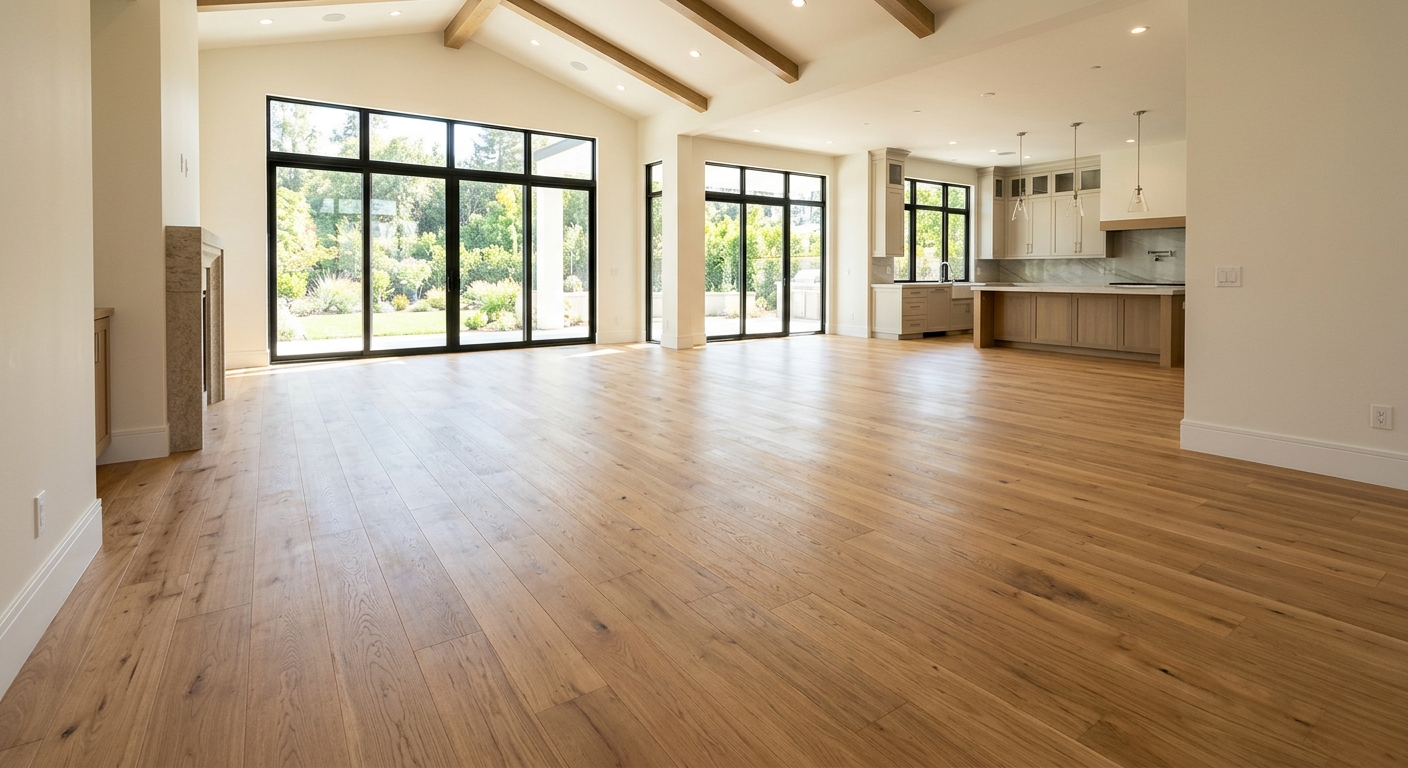
Flooring options and costs in Norgate
Norgate homeowners usually have three very different flooring paths: warm solid wood for above-grade living areas, engineered wood where humidity can swing, or water-friendly surfaces like LVP and tile for kitchens, entries and especially basements. With Norgate’s population at 3,035 (Statistics Canada, 2021 Census), you’ll often see fewer large installers than in Vancouver proper, so scheduling can be a factor, particularly for tile crews and stair/transition work. Also, many homes in the Lower Mainland–Southwest market fall into older housing stock, which commonly means uneven subfloors and plywood patching before install—those prep steps alone can add about $1–$4 per sq ft to the overall project.
The wet, marine climate around Norgate brings indoor humidity swings—winter and shoulder seasons can cause moisture migration, and basements or slab-on-grade areas sometimes wick moisture through concrete. Because of that, we typically avoid solid hardwood below grade, and we recommend engineered hardwood or luxury vinyl plank (LVP) instead. In main living areas, solid hardwood is still popular, but we plan for expansion gaps and strict indoor humidity control to reduce cupping and gapping. If you have radiant heating in a newer-build pocket, engineered wood, LVP and tile are generally the safest pairings; most solid hardwood and some laminates need very careful specification.
In Norgate, flooring demand is especially steady around the residential streets closer to transit and school corridors, where families are doing renovations to keep projects on schedule and budgets predictable. Below is a cost-and-performance comparison to help you line up your quote with the right material choices.
| Type |
Best Room |
Moisture Resistance |
Lifespan |
Price per sq ft |
| Solid hardwood (nail-down, above grade only) |
Living / dining (above grade) |
Low–medium (needs humidity control; avoid basements) |
25–60 years with proper conditions |
$9,00 – $18,00 |
| Engineered hardwood (float or glue, above + on-grade) |
Living areas, hallways, bedrooms |
Medium–high (better tolerance to humidity swings) |
20–40 years |
$10,00 – $16,00 |
| Laminate (click-lock, above-grade) |
Secondary bedrooms, hallways (above grade) |
Medium (fine with spills when promptly cleaned; avoid flooding) |
10–25 years (depends on wear layer) |
$4,50 – $10,00 |
| Luxury vinyl plank / LVP (waterproof, any level) |
Kitchen, entry, basement (finished) |
High (waterproof core; handles minor moisture better) |
15–25 years |
$5,00 – $11,00 |
| Porcelain / ceramic tile |
Kitchen, bathrooms, laundry |
Very high (tile is water-resistant; grout needs maintenance) |
30–50 years |
$10,00 – $20,00 |
| Carpet (broadloom or modular tile) |
Bedrooms, basement family rooms (where moisture is controlled) |
Low–medium (needs good underlay plan; avoid chronic dampness) |
8–15 years |
$3,50 – $9,00 |
Prices are estimates only and vary by project scope, site access and material selection.
What affects the price of flooring in Norgate
Two contractors can price the “same” flooring dramatically differently in the Lower Mainland–Southwest—often by 30–50%—because the real drivers are rarely the board itself. They’re the prep work (levelling, moisture barriers, underlay), the install method (float vs. glue-down vs. nail-down), and the finish details (transitions, stair nosing, and waste). In a wet, marine climate, moisture management isn’t optional; it’s a scope item that shows up in your quote. That’s why solid hardwood pricing in Norgate can look competitive until you factor in subfloor checks and indoor humidity requirements, then it becomes clearer why many basements are better with engineered wood or LVP.
Technically, solid hardwood expands and contracts with humidity, and it can’t be glued or floated over concrete. For basement or slab-on-grade areas, that’s a practical limitation, not a preference—so the material choice changes the labour and prep. Radiant heating also matters: colder inland pockets and newer builds increasingly pair in-floor heating with engineered wood, LVP, tile, and some higher-rated laminates, which can shift your material shortlist. Finally, older regional housing stock frequently needs subfloor levelling or repair, adding roughly $1–$4 per sq ft.
Here are examples you’ll see around Norgate: (1) a living-room hardwood install that needs plywood re-screwing and skim patch can add $2–$3 per sq ft before the planks even go down; (2) an LVP basement job that includes a vapour-management system and careful perimeter sealing may land in the laminate/vinyl band near $5,00 – $11,00, but a “quick-over” approach is what causes future buckling and callbacks; and (3) tile layouts with lots of cuts for vents or irregular joists can push costs toward the tile band of $10,00 – $20,00, especially with premium grout and edge finishing.
| Price Factor |
Why It Matters |
Cost Impact |
| Room area in sq ft |
Material quantities, waste, and labour hours scale with square footage |
Typically +/− directly proportional; higher sq ft often reduces per-sq-ft waste |
| Subfloor condition |
Levelling, patching or re-screwing affects prep time and calls |
Commonly +$1–$4 per sq ft in older homes |
| Moisture / below-grade install |
Moisture wicking through concrete can fail solid wood and some laminates |
May add moisture barrier and change material choice; can swing total by 10–25% |
| Material choice |
Solid vs engineered vs LVP vs tile changes both install method and labour complexity |
Broad ranges: hardwood up to ~$9,00 – $18,00; LVP around $5,00 – $11,00 |
| Removal and disposal of existing flooring |
Demo time, hauling, and substrate prep can be substantial |
Often adds $1–$4 per sq ft depending on buildup and debris |
| Stair nosing / transitions |
Steps and doorways are labour-intensive finish work |
Charged per step or per linear foot; can add 5–15% to total |
| Radiant heat compatibility |
Some products must be specified for temperature swings |
May restrict materials and increase underlayment/adhesive cost |
| Installation method |
Float, glue-down, or nail-down changes underlay, adhesives, and labour steps |
Glue-down and nail-down usually cost more than basic floating systems |
Permits & regulations in British Columbia
In British Columbia, most flooring installation does not require a building permit. If you’re simply removing existing flooring and installing new materials (carpet, LVP, laminate, engineered wood on an appropriate substrate, or tile on a proper backer) without altering structural elements or mechanical systems, you typically do not need to pull a permit. The permitting picture changes when the project includes associated work that touches electrical circuits or major structural components. For example, installing or modifying in-floor heating wiring/circuits usually triggers electrical permit requirements, and significant subfloor structural repairs may require additional approvals depending on scope.
In condominiums around the Lower Mainland–Southwest, the governing factor is often the building’s rules rather than a permit. Sound transmission requirements (STC/IIC) can restrict underlay choices and how hard flooring is installed on upper floors. Always check the condo declaration and request board approval in writing before installing hardwood or tile—especially when you’re adding hard surfaces that can affect neighbours below.
To verify a contractor in Norgate step-by-step: (1) confirm their business licence and trade credentials (where applicable) through relevant provincial directories; (2) ask for a current certificate of liability insurance and ensure the expiry date and coverage limits are listed; (3) request proof of workers’ compensation coverage (WSIB/WCB) to ensure they’re set for their labour obligations; (4) obtain a clearance letter or coverage confirmation if they provide it; and (5) match the name on the insurance and coverage documents to the contractor’s invoice and contract. This is the fastest way to avoid uninsured risk during a high-moisture, multi-step install.
Best flooring for each room in your Norgate home
In Norgate, your best flooring choice depends on moisture exposure, foot traffic, and comfort—plus the reality of Lower Mainland humidity swings. For living and dining areas, engineered hardwood or high-quality laminate is a practical balance: you get a warm look, while the layered construction tolerates seasonal changes better than solid wood. In the master bedroom, carpet is still a strong comfort choice (sound absorption and underfoot warmth), or you can use engineered hardwood for a cleaner maintenance routine.
In kitchens, choose luxury vinyl plank (LVP) or large-format porcelain tile. LVP’s waterproof core helps with everyday spills and sink or dishwasher leaks, while tile handles water well and is forgiving to mopping. Basements (finished) are where LVP wins in most Norgate homes: it’s fully waterproof and handles minor vapour exposure and below-grade installs far better than solid hardwood and most laminate. For bathrooms, stick with porcelain or ceramic tile only.
If you have radiant heating, compatibility matters. Engineered wood, LVP, and tile are generally the safest pairings, while solid hardwood needs careful product specification and strict humidity control. As a concrete cost example: if you’re deciding between laminate at $4,50 – $10,00 versus LVP at $5,00 – $11,00 for a kitchen, the “few dollars per sq ft” difference is usually justified by better spill tolerance and fewer moisture-related callbacks—especially in a marine climate.
| Room |
Best Material |
Why |
Moisture Risk |
Price Band per sq ft |
| Living / dining room |
Engineered hardwood |
Warmth and appearance with better humidity tolerance than solid |
Low–medium (watch winter humidity swings) |
$10,00 – $16,00 |
| Master bedroom |
Carpet or engineered hardwood |
Comfort and sound control; engineered keeps a polished look |
Low (assuming no basement-style dampness) |
$5,50 – $14,00 |
| Secondary bedrooms |
Laminate or carpet |
Budget-friendly durability and easy care |
Low |
$4,50 – $10,00 |
| Kitchen |
Luxury vinyl plank (LVP) or porcelain tile |
Water resistance, easy cleaning, and strong day-to-day durability |
Medium (spills and wet-mop cleanup) |
$5,00 – $20,00 |
| Basement (finished) |
LVP |
Waterproof performance for below-grade moisture vapour conditions |
High (moisture wicking through slab or concrete) |
$5,00 – $11,00 |
| Bathroom |
Porcelain / ceramic tile |
Best-in-class water handling with reliable long-term wear |
Very high (direct and repeated water contact) |
$10,00 – $20,00 |
How to choose a flooring contractor in Norgate
Choosing the right flooring contractor in Norgate is mostly about confirming they’re insured for the work they’ll do and that their quote matches your subfloor and moisture reality. Start with British Columbia requirements and risk checks: ask for a current certificate of liability insurance (verify coverage details and expiry date) and proof of workers’ compensation coverage (WSIB/WCB) so you’re not exposed if something goes wrong on site. If the contractor offers “we’re licensed” claims, request the documentation and confirm the names match the invoice and contract. For your own protection, also verify they can explain their moisture-prep approach—because in the Lower Mainland–Southwest, humidity swings and below-grade moisture management are what protect your flooring warranty.
Next, get 2–3 itemised written quotes. You want the breakdown separated into labour, materials, underlay/adhesives, removals and disposal, and transitions/stairs. Avoid lump-sum-only quotes that don’t say what’s included (like levelling/patching, vapour barriers, or underlayment). Ask for the warranty terms in writing: workmanship warranty length, product/manufacturer warranty coverage, and whether the warranty is transferable to future owners. Finally, payment scheduling matters—never pay more than about 10–15% upfront, and use a holdback until the job is complete and any minor deficiencies are corrected.
For timelines, request a start date and a completion estimate in writing, including the expected drying/curing period if levelling compounds or adhesives are used. In Norgate’s climate, rushing the prep stage is one of the fastest ways to create future cupping, gapping, or lifting edges.
- Provide a written, itemised quote (materials + labour + underlay/adhesives separate).
- Confirm liability insurance with expiry date and coverage limits.
- Request WSIB/WCB proof and/or a clearance letter.
- Get the moisture plan in writing (what they do for subfloor vapour and humidity).
- Ask whether subfloor levelling is included or billed separately.
- Clarify removal scope: floor demolition, plywood overlay, and disposal.
- Confirm underlayment and moisture barrier specifics (especially above concrete).
- For hardwood, require an installation method statement (nail-down above grade; acclimation plan).
- Review stair nosing and transitions pricing (per step or per linear foot).
- Check warranty coverage: workmanship duration + product warranty details.
- Use a payment schedule with a holdback until punch list items are complete.
- Require start date, working hours, and a written completion estimate.
Red flags in Norgate include: (1) refusing to put moisture/levelling steps in the contract; (2) offering the same “universal” approach for basements (solid hardwood installed below grade) without explaining risks; (3) quoting a very low price with no allowance for transitions, stair nosing, or waste; (4) taking large upfront payments (well beyond 10–15%); and (5) vague warranty language that doesn’t specify workmanship vs product coverage or whether it’s transferable.
Frequently asked questions — flooring in Norgate
How do I prepare my subfloor before new flooring?
In Norgate and across the Lower Mainland–Southwest, subfloor preparation is where projects succeed or fail because of humidity swings and occasional moisture movement through older plywood and concrete. Your contractor should start with an inspection and flatness check (to confirm the surface is level enough for the chosen flooring). If they find dips or high spots, they may need to re-screw subfloor panels, patch with a suitable levelling compound, or add a plywood overlay where appropriate. For on-grade or below-grade areas, ask specifically about moisture barriers/vapour management and how they’ll test or assess moisture conditions before installing. For solid hardwood, the expectation is strict: above-grade only, proper acclimation, and a stable substrate. Skipping levelling is one reason you’ll see callbacks like squeaks, gaps, or early wear, and it can quickly erase the savings you were expecting on materials like laminate in the $4,50 – $10,00 band.
Is cork or bamboo flooring a good choice in Norgate?
Cork and bamboo can be great underfoot options, but in Norgate (BC’s wet, marine climate) the key question is how they’re constructed and how they’ll be installed relative to moisture. Cork is generally more dimensionally stable than some “hard” natural materials, but it still can be vulnerable if your basement is damp or if there’s moisture wicking from concrete. Bamboo varies widely: many products behave like engineered wood when they’re engineered/composite, but some are more sensitive when treated as a traditional solid-style product. If you want these materials, prioritize engineered formats, use a proper vapour barrier where required, and ensure your installer manages expansion gaps and acclimation. For basements, most homeowners in the Lower Mainland–Southwest do better with waterproof LVP rather than natural products. If your goal is a warm look with reliable performance, engineered hardwood or LVP typically lands in the more predictable bands like $10,00 – $16,00 for engineered wood or $5,00 – $11,00 for LVP.
What is the difference between floating and glued-down flooring?
Floating floors don’t get mechanically fixed to the subfloor. Instead, they click together (common with laminate and some engineered products) or sit over an approved underlay, with an expansion gap around the perimeter. Because they’re not bonded to the slab or plywood, they’re typically easier to install and they can tolerate minor subfloor movement—though they still require a flat surface. Glued-down flooring, by contrast, is installed with adhesive so each plank/board is bonded to the subfloor (common with some engineered hardwood systems and certain rigid vinyl products depending on the product). Glue-down methods can improve stability when the substrate is prepared correctly, but they require the right adhesive and careful moisture conditions—especially over concrete. In Norgate’s environment, this is where quotes vary: the installer’s moisture plan and substrate prep can add cost, even if the material itself sits in a similar band, like laminate at $4,50 – $10,00 versus engineered hardwood at $10,00 – $16,00.
What flooring holds up best to pets in a Norgate home?
For pets in Norgate, the “best” flooring is usually the one that handles messes and claws without being ruined by routine moisture cleanup. Luxury vinyl plank (LVP) is a top pick because it’s waterproof and resistant to liquid spills—helpful for accidents during wet winter months when floors get tracked and mopped more. Choose a reputable LVP with a thicker wear layer for claw resistance. Porcelain tile is also strong against scratches and stains, but it’s harder underfoot and can be louder without proper underlay/systems. Engineered hardwood can work well for many pet owners, but you’ll need quick cleanup and careful humidity control to reduce wood movement. Avoid solid hardwood in basements in BC, and be cautious with carpet if you have frequent accidents—especially if the basement has any moisture. If you’re comparing budgets, LVP typically sits around $5,00 – $11,00, while carpet is commonly priced lower for material but can cost more long-term if it needs replacement due to stains or odours.
How do I fix squeaky floors in my Norgate home?
Squeaks usually come from movement between subfloor layers, loose fasteners, or gaps where the flooring meets framing—not from the final finish material alone. In Norgate homes, this is more likely in older housing stock where subfloor panels may have loosened over time, or where humidity swings caused slight shifting. The fix depends on what’s moving: often, it’s solved by re-screwing the subfloor and/or adding blocking between joists so the layers stop rubbing. Sometimes a plywood patch or re-layment is needed. A good contractor will inspect the structure before tearing everything up, and they’ll explain whether the squeak is in the subfloor or the finish layer. If you’re planning new flooring anyway, it can be efficient to address squeaks during the prep phase—especially if you’re investing in engineered hardwood at $10,00 – $16,00 or going with tile. Avoid “quick fixes” like trying to fill squeaks from above without solving the underlying movement.
What is luxury vinyl plank and is it worth it in Norgate?
Luxury vinyl plank (LVP) is a multi-layer flooring product with a wear layer on top and a waterproof core in most higher-quality options. In Norgate and the Lower Mainland–Southwest, it’s often worth it because it’s tolerant of humidity swings and it performs well where moisture is a concern—particularly basements and on-grade areas with concrete or older slab conditions. While solid hardwood is popular for above-grade living rooms, LVP’s waterproof performance helps reduce the risk of swelling or failure from minor moisture exposure, which is a real issue when homes experience marine humidity and seasonal indoor changes. LVP also tends to be more forgiving if you have kids or pets, since spills can be cleaned without immediately damaging the flooring. Budget-wise, LVP commonly falls in the $5,00 – $11,00 band per sq ft, which often makes the “cost difference” versus laminate easier to justify in kitchens and finished basements.