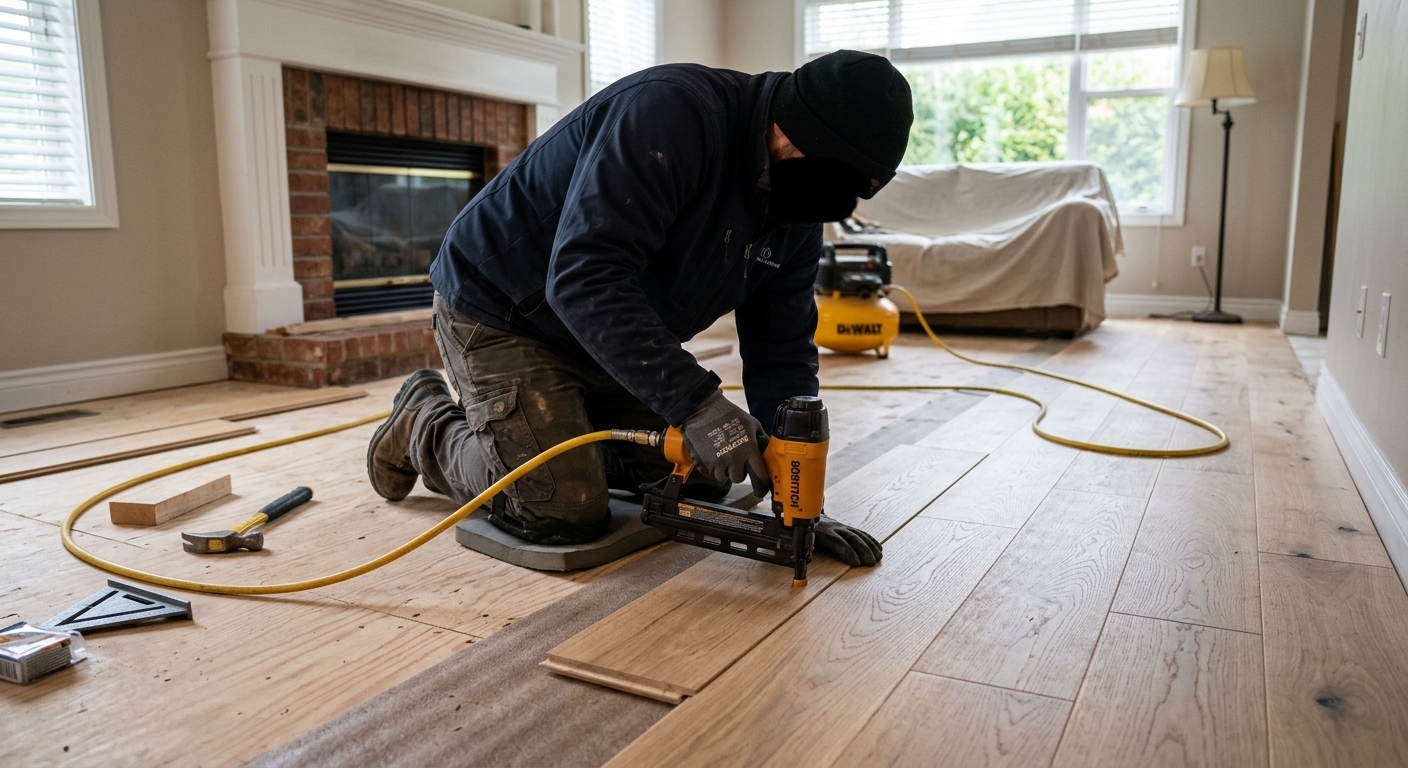
Flooring options and costs in Chilliwack-Downtown
Flooring choices in Chilliwack-Downtown come down to balancing comfort, appearance, and the Lower Mainland–Southwest reality: a wet, marine climate with indoor humidity swings that can be especially noticeable in winter and shoulder seasons. With a population of 31,410 (Statistics Canada, 2021 Census), the area has plenty of trades capacity, but the most in-demand installs tend to be the moisture-resilient products and “repair-first” projects—particularly in older pockets of town where subfloors are uneven. Many homeowners also find that before new floors can go down, they need levelling or plywood repair to smooth out older framing and patches, which commonly adds about $1–$3 per sq ft to the project. When concrete or slab-on-grade is involved, moisture wicking is a frequent concern; in those cases, solid hardwood below grade is a high-risk choice, while engineered wood and luxury vinyl plank (LVP) typically perform far better.
Because Greater Vancouver–area labour rates are on the higher side of the country, installation work is a major portion of the total spend, so you’ll often see bigger gaps between quotes when subfloor prep is more or less included. If your home has radiant heating, that also narrows options: solid hardwood needs very careful specification, while engineered wood, LVP, and tile are more straightforward. Demand is especially strong in convenient, established residential areas near the downtown core, where homeowners want quick turnarounds without sacrificing long-term durability.
Below is a practical comparison of common flooring types, what rooms they suit best here, and the typical price ranges you’ll see for supply and install together.
| Type |
Best Room |
Moisture Resistance |
Lifespan |
Price per sq ft |
| Solid hardwood (nail-down, above grade only) |
Main living areas above grade |
Low to moderate (avoid basements and slab-on-grade) |
25–60 years |
$9,000–$18,000 |
| Engineered hardwood (float or glue, above + on-grade) |
Living rooms, hallways, bedrooms |
Moderate to high (handles humidity swings better than solid) |
20–40 years |
$9,000–$16,000 |
| Laminate (click-lock, above-grade) |
Bedrooms, living rooms (not wet areas) |
Low to moderate (improve results with quality underlay) |
10–25 years |
$4,000–$10,000 |
| Luxury vinyl plank / LVP (waterproof, any level) |
Kitchens, mudrooms, finished basements |
High to very high (PVC core/waterproof construction) |
15–30 years |
$5,000–$12,000 |
| Porcelain / ceramic tile |
Bathrooms, kitchens, entryways |
Very high (with proper membrane and grout selection) |
25–50 years |
$10,000–$20,000 |
| Carpet (broadloom or modular tile) |
Bedrooms, rec rooms |
Low to moderate (sensitive to moisture at the subfloor) |
8–15 years |
$4,000–$8,000 |
Prices are estimates only and vary by project scope, site access and material selection.
What affects the price of flooring in Chilliwack-Downtown
In Chilliwack-Downtown and across the Lower Mainland–Southwest, it’s common to see quotes for the “same” flooring job differ by 30–50%—even when the surface material looks comparable. The biggest reasons are (1) subfloor prep and moisture work, (2) how much labour complexity is involved, and (3) local availability of skilled installers during peak seasons. In British Columbia, indoor humidity swings combined with older housing stock can turn a straightforward install into a repair-and-level project. For example, solid hardwood expands and contracts with humidity and should not be glued or floated over concrete; it also performs poorly in basements where moisture vapour can be present. Engineered hardwood and LVP handle humidity far better, and LVP’s waterproof construction is why it’s the go-to for many finished basements. Meanwhile, colder inland pockets and newer builds that add radiant heating increasingly push homeowners toward engineered wood, LVP, tile, and selected laminates rated for higher temperatures—limiting some of the cheapest options.
Here’s what typically drives cost up or down in Chilliwack-Downtown: if your home has uneven plywood or concrete, levelling and repairs can add about $1–$4 per sq ft. If you’re converting wet-prone areas (like a basement rec room) to flooring, the need for a moisture barrier or additional prep is usually reflected in labour. Another cost swing comes from product placement: tile often lands in the $10–$20 per sq ft band, while LVP/laminate commonly sit closer to the $4–$10 range depending on quality and thickness. Finally, stair work and transitions can add a noticeable premium because steps are measured and installed differently than flat flooring.
| Price Factor |
Why It Matters |
Cost Impact |
| Room area in sq ft — direct driver of material and labour cost |
Larger areas use more flooring, underlay, fasteners/adhesive, and time for cutting and fitting |
Low to high (generally scales with total square footage) |
| Subfloor condition — levelling or repair needed before install |
Uneven plywood/patches can telegraph through and can cause gaps, squeaks, or failure of glue-down systems |
Commonly +$1–$4 per sq ft in older homes |
| Moisture / below-grade install — rules out solid hardwood |
Slab moisture vapour and humidity swings can cause cupping/gapping in solid wood |
May require switching to engineered wood/LVP and adding barrier prep |
| Material choice — solid vs. engineered vs. LVP vs. tile |
Different cores, wear layers, installation systems, and specialty underlay/membranes |
Solid/engineered often land in higher bands than laminate/LVP |
| Removal and disposal of existing flooring |
Demo affects labour hours and tipping/disposal fees |
Can add a meaningful line item, especially for glued-down materials |
| Stair nosing / transitions — charged per step or per linear foot |
Stairs require precise cuts and finishing profiles; transitions need exact measurements |
Often one of the most overlooked cost adders |
| Radiant heat compatibility — limits material options |
Heat cycling tolerance affects which products can be installed safely |
May shift you from solid/cheaper laminate toward engineered/LVP/tile |
| Installation method — float vs. glue-down vs. nail-down |
Labour time and material system requirements differ by method |
Glue-down and tile usually require more skilled labour time |
Permits & regulations in British Columbia
In British Columbia, a flooring installation itself typically does not require a building permit. Most flooring swaps—like engineered hardwood, LVP, laminate, carpet, or tile over an existing sound subfloor—are considered finishing work. However, associated work may trigger permit requirements depending on what’s being changed.
Work that can require permits includes electrical or in-floor heating modifications. For example, if you’re installing new radiant heating wiring/mats and connecting to an electrical circuit, that electrical component may require the right permits and inspections. If your project involves more extensive structural changes—like significant subfloor reinforcement, moisture remediation that affects building envelope components, or anything that alters structural elements—ask your contractor to confirm whether permits are needed based on the scope.
Condominiums are another key consideration. Even when permits aren’t required, the corporation’s rules around sound transmission (STC/IIC) often restrict what underlay you can use and how hard surfaces are installed on upper floors. Before starting, review your unit’s declaration and request board approval in writing where required—especially for hardwood and tile.
To verify a contractor in Chilliwack-Downtown: (1) confirm their BC business details/credentials through the provincial licensing and trade registry listings they provide, (2) ask for a Certificate of Insurance for liability and ensure the coverage is current, and (3) request proof of workers’ coverage (WSIB/WCB as applicable for their workers). You should also be able to provide a clearance letter or coverage document upon request, usually on the first call or in the quote package.
Best flooring for each room in your Chilliwack-Downtown home
Choosing flooring in Chilliwack-Downtown is easiest when you match the material to the room’s moisture exposure, foot traffic, and comfort needs. In the living and dining areas, homeowners typically want warmth underfoot and a natural look, so engineered hardwood or a high-quality laminate can be a balanced choice for our humidity conditions. In the master bedroom, carpet is still a favourite for comfort and quiet—just ensure the subfloor is dry and the installer uses the right underlay system. If you have kids, pets, or heavy traffic, focus on abrasion-resistance and the right underlay rather than chasing the thinnest cheapest roll.
For kitchens, the Lower Mainland–Southwest climate makes spills and tracking a constant reality, so luxury vinyl plank (LVP) or large-format porcelain tile is usually the best pairing. LVP handles minor moisture events well and is forgiving if you ever replace a fridge or dishwasher line later. Basements (even when “dry”) are where moisture vapour becomes the deciding factor; LVP is the clear winner because it’s fully waterproof and suits below-grade installations far better than solid hardwood or most laminate. Bathrooms should be porcelain or ceramic tile only, with proper waterproofing/membrane where required. Over radiant heat, engineered wood, LVP, and tile are generally more compatible; solid hardwood can work only with careful product selection and correct humidity control.
Where price differences are justified: a move from laminate in the $4–$10 per sq ft band to tile in the $10–$20 per sq ft band is often worth it in bathrooms or entryways because tile’s performance and cleaning durability are superior, and it tolerates moisture far better.
| Room |
Best Material |
Why |
Moisture Risk |
Price Band per sq ft |
| Living / dining room |
Engineered hardwood |
Warm look with better humidity tolerance than solid |
Moderate (humidity swings; avoid below-grade installs) |
$9,000–$16,000 |
| Master bedroom |
Carpet or engineered hardwood |
Comfort and sound control (carpet), or stable warmth (engineered) |
Low to moderate |
$4,000–$10,000 |
| Secondary bedrooms |
Carpet (or durable laminate if you prefer hard floors) |
Good for playrooms and quieter spaces; easy maintenance with laminate |
Low to moderate |
$4,000–$10,000 |
| Kitchen |
Luxury vinyl plank (LVP) or porcelain tile |
Spill-friendly, stable under everyday moisture exposure |
Moderate to high (spills and wet traffic) |
$5,000–$20,000 |
| Basement (finished) |
LVP (waterproof) |
Best match for below-grade humidity/moisture vapour concerns |
High (avoid solid hardwood and most laminate) |
$5,000–$12,000 |
| Bathroom |
Porcelain / ceramic tile |
Water-resistant surface and long-term durability |
Very high (steam and splash zones) |
$10,000–$20,000 |
How to choose a flooring contractor in Chilliwack-Downtown
Picking the right flooring contractor in Chilliwack-Downtown is mostly about verifying coverage, getting clear written scope, and protecting yourself financially. Start by confirming their British Columbia credentials and asking for up-to-date liability insurance (a Certificate of Insurance with proper effective dates and coverage limits). For workers’ coverage, request proof of WSIB/WCB as applicable—this matters when they’re working inside your home and using tools that create dust, noise, and material handling risks. If a contractor can’t provide documentation quickly, that’s a strong warning sign.
Next, get 2–3 itemised written quotes that separate labour and materials. Make sure the quote lists: the exact flooring product, underlay/membrane (including thickness and brand where relevant), adhesives/fasteners, stair nosing or transition profiles, and disposal/dump fees. Don’t accept a vague “flooring and install” line—ask what’s excluded (subfloor levelling? moisture barrier? trim undercut? removal and disposal?). If radiant heating is involved, confirm whether the flooring system is rated and what acclimation/humidity steps they’ll follow.
For warranty, confirm both parts: the workmanship warranty length and the manufacturer product warranty. Ask if the warranty is transferable to you if you sell the home later. Payment schedules should be conservative—never pay more than about 10–15% upfront, and hold back funds until the job is complete and you’ve done a walkthrough.
Finally, insist on a start date and a completion estimate in writing, plus a plan for what happens if subfloor prep uncovers issues like additional patching or moisture remediation needs.
- Ask for liability insurance and verify the Certificate of Insurance is current.
- Request proof of workers’ coverage (WSIB/WCB as applicable) before work begins.
- Confirm the installer’s experience with your specific type (tile over membrane, glue-down engineered, LVP below-grade).
- Get 2–3 itemised quotes with labour and materials broken out.
- Verify what’s included in subfloor prep: levelling, scraping, patching, and underlayment prep.
- Ask whether removal and disposal of existing flooring is included (and how it’s handled).
- Make sure transitions/stair nosings are priced per step or per linear foot, not hidden in labour.
- Confirm acclimation procedures for engineered wood or laminate (important in humidity swings).
- Request the moisture plan for basements and slab-on-grade areas (barrier/membrane and product choice).
- Review warranty details: workmanship period, product warranty term, and transferability.
- Keep deposits to about 10–15% max; hold back until final walkthrough.
- Get the schedule in writing: start date, duration estimate, and what triggers change orders.
Concrete red flags in Chilliwack-Downtown: (1) they won’t provide insurance or workers’ coverage documentation, (2) they quote “solid hardwood anywhere” without discussing below-grade humidity risk, (3) they give lump-sum pricing with no line items for subfloor prep or transitions, (4) they avoid talking about levelling or moisture barriers until after demo, and (5) they request large upfront deposits beyond 10–15%.
Frequently asked questions — flooring in Chilliwack-Downtown
How long does flooring installation take?
Most flooring installs in Chilliwack-Downtown are measured in days, not weeks, assuming the subfloor is ready and materials are on hand. A small area (like one bedroom) can often be completed in 1–2 days, while multi-room jobs commonly take longer due to transitions, stair work, and careful acclimation steps. If levelling is required or if the contractor discovers additional subfloor repairs after removal, expect schedule changes—this is common in older housing stock in the Lower Mainland–Southwest. For perspective, projects that stay within the simpler bands (for example, basic laminate or LVP install ranges) tend to move faster than tile layouts with many cuts and membrane steps. Ask your contractor for a written start/completion estimate, and confirm what happens if moisture testing or subfloor repair expands the scope.
What flooring works with radiant heat?
In British Columbia, radiant heating is becoming more common in newer builds, and it affects which products are safest and most stable. Generally, engineered hardwood, luxury vinyl plank (LVP), and porcelain/ceramic tile are the most straightforward compatibility choices because they handle temperature cycling better than solid hardwood. Many laminates can work too, but only if the product is specifically rated for radiant heat temperatures and the installer follows manufacturer requirements. Solid hardwood over radiant systems requires very careful specification, proper installation practices, and strict indoor humidity control—so it’s not something to improvise. In Chilliwack-Downtown’s wet marine climate, maintaining indoor humidity helps prevent gapping and keeps the floor performing as intended. If you have radiant heat, ask your contractor to confirm the exact flooring product rating and installation method in writing.
Engineered vs solid hardwood — what's the difference?
Solid hardwood is a single piece of wood across its thickness and tends to move more with humidity. That’s why, in Chilliwack-Downtown and the Lower Mainland–Southwest, solid hardwood is typically limited to above-grade installations with appropriate expansion gaps and consistent indoor humidity. Engineered hardwood uses multiple layers (a stable core with a hardwood wear layer), so it tolerates humidity swings better and can be installed in more situations, including many on-grade areas (and some below-grade applications when specified). In a basement, solid wood is usually a poor match due to moisture vapour risk, while engineered and especially LVP are chosen for resilience. Pricing often reflects these differences: you’ll generally see higher ranges for hardwood types (commonly aligning with the $9–$18 band), while LVP or laminate may fall lower (around the $4–$10 band).
Do I need to level my subfloor first?
Often, yes—especially in older homes around Chilliwack-Downtown where plywood may be uneven or patched. Leveling matters because it prevents issues like gaps in click-lock floors, noise (squeaks), stressed joints, and cracking in tile. The need for levelling is usually determined after the existing floor is removed and the subfloor is checked for flatness. Your contractor should explain whether they’re doing spot-levelling/patching or a full resurfacing approach. Moisture also changes the answer: if moisture is present near concrete or below grade, simply levelling without addressing moisture can cause problems later. As a guideline, levelling/repair in older regional housing stock can add roughly $1–$4 per sq ft, which is why clear subfloor scope in your quote is so important.
What's the most durable flooring for pets and kids?
For pets and kids in British Columbia’s humidity swings, LVP is often the safest “durability with practicality” choice. Luxury vinyl plank is waterproof, resists everyday splashes, and tends to be more forgiving if accidents happen—making it especially good for kitchens and finished basements. If you prefer a traditional look, engineered hardwood can work well above grade, but it’s more sensitive to ongoing humidity and can be affected by rough paw traffic at seams if the subfloor isn’t prepped correctly. Tile is also very durable in traffic areas, but it’s harder and can be colder underfoot unless paired with radiant heat. Carpet can be comfortable and quiet, but it’s more vulnerable to moisture intrusion if the subfloor isn’t dry. For budgeting, many homeowners find the value of LVP within the $4–$10 per sq ft range for laminate/vinyl-type options—then they spend more only where it truly counts (like tile in wet rooms or higher-end wear layers).
How do I choose flooring for humidity in Chilliwack-Downtown?
Start with the reality of Chilliwack-Downtown’s Lower Mainland–Southwest climate: indoor humidity swings and occasional below-grade moisture concerns. The first rule is location: avoid installing solid hardwood in basements or over slab-on-grade unless the contractor has a moisture plan and the product is explicitly specified for that condition. Engineered hardwood and LVP are better suited because their layered construction (and LVP’s waterproof PVC core) tolerates humidity changes more effectively. For radiant heat homes, verify radiant ratings—solid hardwood needs extra care, while engineered, LVP, and tile are usually simpler choices. Also, insist on proper acclimation and correct installation details like expansion gaps for wood and proper underlay for floating floors. If you’re comparing quotes, look for subfloor preparation and moisture barriers in the scope—those details can be the difference between a floor that stays stable and one that develops gapping or cupping.