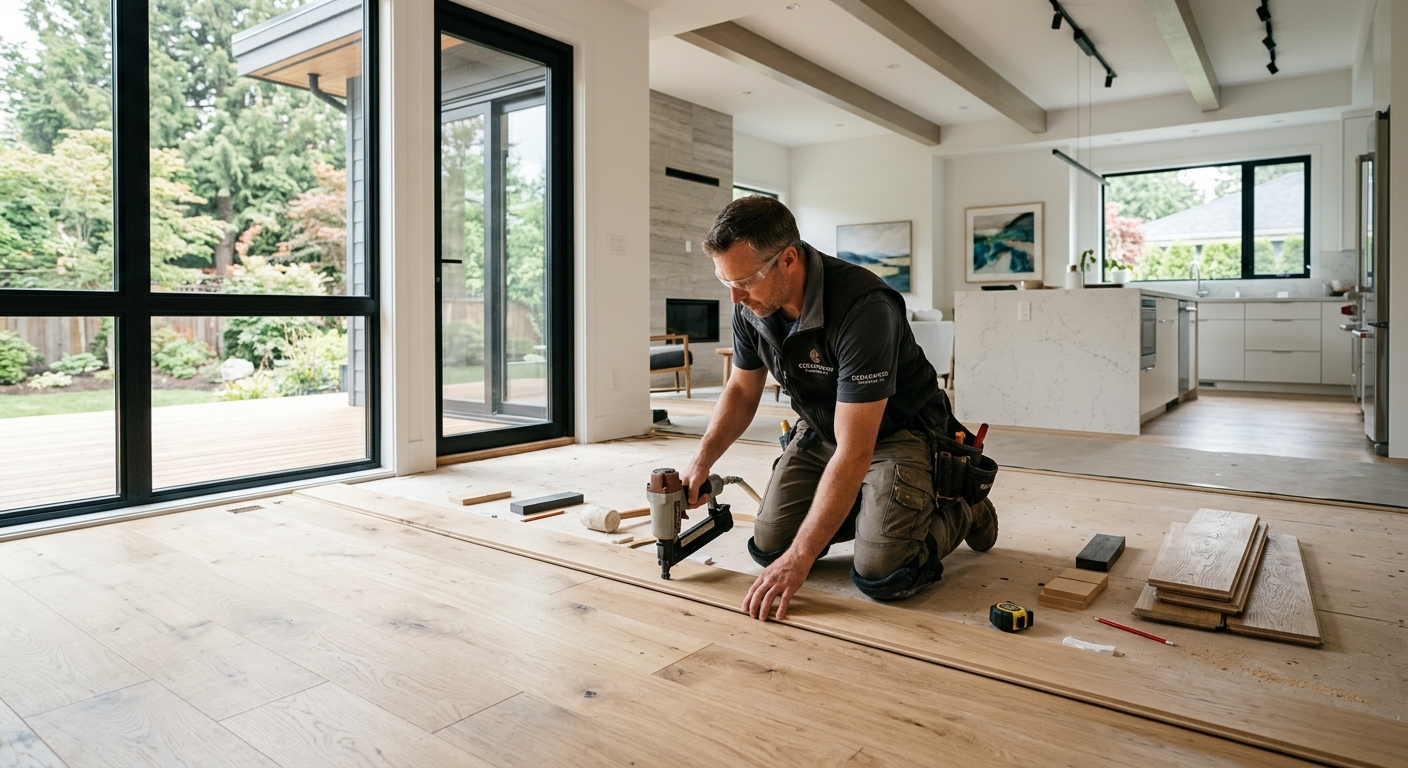
Flooring options and costs in Eastern Hillsides
In Eastern Hillsides, British Columbia homeowners usually have three big flooring goals: a warm, clean look, good durability under daily use, and—most importantly—performance through the region’s wet, marine humidity swings. With a population of 3,450 (Statistics Canada, 2021 Census), the local contractor pool is smaller than the big cities, so scheduling can affect your final cost if you’re trying to hit a tight move-in date. Eastern Hillsides also has a noticeable mix of older housing stock; in Lower Mainland–Southwest homes, uneven plywood or concrete subfloors are common, and levelling or repair often adds roughly $1–$3 per sq ft to get to a flat, stable base.
Because Lower Mainland–Southwest winters can mean moisture wicking up through slab-on-grade, we generally avoid solid hardwood below grade. Solid hardwood expands and contracts with indoor humidity and is not a good match for basements or direct-concrete installs. For main living areas, solid hardwood can still work well above grade when gaps/expansion space are respected and indoor humidity is controlled. In colder inland pockets and newer builds with radiant heat, engineered wood, LVP, and many tile options pair more reliably than solid hardwood—and in practice, product availability can narrow the “cheapest” quote if your first choice isn’t compatible.
If you’re in higher-demand areas like the East and North-side residential pockets (where families are most often renovating living rooms and kitchens), most homeowners end up balancing engineered hardwood or premium laminate for warmth versus waterproof LVP for risk reduction—then comparing ceramic/porcelain tile for wet zones. Use the table below to anchor your budget before you talk to contractors.
| Type |
Best Room |
Moisture Resistance |
Lifespan |
Price per sq ft |
| Solid hardwood (nail-down, above grade only) |
Living/dining, bedrooms (above grade) |
Low to moderate (humidity sensitive) |
25–60 years |
$9 – $18 |
| Engineered hardwood (float or glue, above + on-grade) |
Main living areas, hallways |
Moderate (better humidity tolerance) |
20–40 years |
$9 – $16 |
| Laminate (click-lock, above-grade) |
Living rooms, bedrooms |
Low to moderate (needs prompt leak cleanup) |
10–25 years |
$4 – $10 |
| Luxury vinyl plank / LVP (waterproof, any level) |
Kitchen, basement (finished) |
High (waterproof core) |
15–25 years |
$4 – $10 |
| Porcelain / ceramic tile |
Bathrooms, kitchens, entryways |
Very high (but grout maintenance) |
25–50 years |
$10 – $20 |
| Carpet (broadloom or modular tile) |
Bedrooms, stairs, media rooms |
Low (can hold odours if moisture is present) |
8–15 years |
$5 – $12 |
Prices are estimates only and vary by project scope, site access and material selection.
What affects the price of flooring in Eastern Hillsides
In Lower Mainland–Southwest, you can see the same flooring “type” quoted 30–50% differently across British Columbia because labour costs, subfloor prep needs, and product compatibility with moisture and climate vary widely from house to house. In Eastern Hillsides specifically, indoor humidity swings and the wet marine climate drive more subfloor conditioning than in drier parts of the province. Moisture wicking through concrete is a common issue in slab-on-grade areas, so contractors may need an approved moisture mitigation approach and tighter installation procedures—those steps cost money, even if the surface product price looks similar.
Technical drivers are the biggest reason solid hardwood quotes stretch upward. Solid hardwood expands and contracts with humidity, and it cannot be glued or floated over concrete; that’s why basements or slab areas often rule out solid wood. Engineered hardwood and luxury vinyl plank (LVP) typically handle humidity and minor temperature changes far better, making them more reliable in this region. If your home is over radiant heating, many solid hardwood specifications and some laminate products become limited; the safer choices are engineered wood, LVP, and tile rated for higher temperatures.
Local housing stock also matters. If you start with older subfloors that need levelling, the typical $1–$3 per sq ft that contractors add for levelling/repair becomes a real budget swing—especially on larger open-concept living spaces. For example, a 600 sq ft living area at a $9–$18 hardwood band can effectively climb when levelling is required; conversely, switching the basement to waterproof LVP in the $4–$10 range often saves money because it reduces the risk of moisture-related failure and can reduce specialized prep.
| Price Factor |
Why It Matters |
Cost Impact |
| Room area in sq ft |
More square footage increases materials and labour time |
Directly proportional; small rooms cost more per sq ft |
| Subfloor condition — levelling or repair needed before install |
Old plywood/concrete often needs flattening for click/float systems and to prevent squeaks |
Typical add-on: $1–$4 per sq ft |
| Moisture / below-grade install — rules out solid hardwood |
Basements and slab-on-grade may need moisture barriers or different product selection |
Can increase prep and change materials to engineered/LVP |
| Material choice — solid vs. engineered vs. LVP vs. tile |
Material price and installation method differ significantly by product |
Major driver within bands (hardwood $9–$18; tile $10–$20; LVP $4–$10) |
| Removal and disposal of existing flooring |
Old underlay, glue residue, nails, and haul-away time add labour |
Often a separate line item; can add noticeable cost on larger jobs |
| Stair nosing / transitions — charged per step or per linear foot |
Transitions require trim, reducers, and careful layout |
Costs rise quickly with stairs and multiple room transitions |
| Radiant heat compatibility — limits material options |
Some products aren’t rated for in-floor heating temperatures |
May force higher-spec products and add time for proper acclimation |
| Installation method — float vs. glue-down vs. nail-down |
Method affects labour time, adhesives, and substrate prep |
Nail-down and glue-down often cost more than basic click systems |
Permits & regulations in British Columbia
In British Columbia, a flooring installation itself usually does not require a building permit. However, permitting can come into play when your flooring project overlaps with other trades—especially electrical work or structural/moisture remediation. For Eastern Hillsides homeowners, the most common “permit-trigger” items are: repairing/altering structural subfloors that involve engineering-level changes, moisture remediation that includes significant substrate treatment beyond typical underlay work, and any work that touches in-floor heating control wiring (which can involve electrical permits depending on the scope). If you’re working on an in-floor heating circuit, always confirm whether a licensed electrician is required for the specific connection and thermostat work.
For condominiums, the corporation’s rules on sound transmission are often the bigger constraint than permits. Upper-floor hard flooring may require a specific underlay system to help meet sound performance targets, and boards often require approval in writing before any hardwood or tile goes down. Always request board approval and keep documentation.
Step-by-step contractor verification (BC): (1) Confirm licensing/registration status through the appropriate provincial registry channels, then (2) ask for a Certificate of Insurance showing general liability coverage limits, and (3) verify Workers’ Compensation coverage (WSIB/WCB as applicable) by requesting a clearance letter or proof of coverage. Review the dates—expired coverage is as risky as having none. Lastly, ask for a written scope and labour warranty so you’re not relying on verbal assurances.
Best flooring for each room in your Eastern Hillsides home
Choosing the right flooring in Eastern Hillsides is less about trends and more about matching material behaviour to the room’s moisture risk, foot traffic, and comfort needs in the Lower Mainland–Southwest climate. Living and dining rooms typically sit above grade and benefit from a balance of warmth and durability; engineered hardwood or a high-quality laminate often gives you the look with better humidity tolerance than solid hardwood alone. For a master bedroom, carpet remains a strong choice because it improves comfort and quietness—useful in homes where sound travels through older framing.
Kitchens and entry areas are where the climate and lifestyle meet: spills happen, and wipe-down cleaning is daily. Luxury vinyl plank (LVP) is usually the easiest win because it’s waterproof and forgiving if something gets missed. For bathrooms, stick with porcelain or ceramic tile. Tile is also an excellent option for kitchen floors if you want maximum water resistance and a long service life.
Basements are the deciding factor. In this region, moisture wicking through concrete can show up where you can’t see it, so the clear winner for finished basements is waterproof LVP—solid wood and most laminate can fail when humidity isn’t controlled. If your home has radiant heating, engineered wood, LVP, and properly rated tile are your best bets; solid hardwood over radiant heating needs careful specification and acclimation.
As a concrete budget example: if your living area is 500 sq ft, moving from a laminate band ($4–$10) to engineered hardwood ($9–$16) might cost roughly an extra $2–$6 per sq ft once you include better underlay/installation requirements—so it’s justified when you care about long-term appearance and feel, not just short-term cost.
| Room |
Best Material |
Why |
Moisture Risk |
Price Band per sq ft |
| Living / dining room |
Engineered hardwood or premium laminate |
Warm look with better humidity tolerance than solid; durable under daily traffic |
Low to moderate (mostly above grade) |
$9 – $16 (engineered) or $4 – $10 (laminate) |
| Master bedroom |
Carpet or engineered hardwood |
Comfort and sound absorption for carpet; stable appearance for engineered |
Low |
$5 – $12 (carpet) or $9 – $16 (engineered) |
| Secondary bedrooms |
Carpet or laminate |
Budget-friendly comfort; resilient for kids and everyday use |
Low |
$5 – $12 (carpet) or $4 – $10 (laminate) |
| Kitchen |
Luxury vinyl plank (LVP) or porcelain tile |
Waterproof practicality for spills; easy cleaning and strong resistance to wet messes |
Moderate to high (spill-prone) |
$4 – $10 (LVP) or $10 – $20 (tile) |
| Basement (finished) |
Luxury vinyl plank (LVP) |
Waterproof core handles moisture vapour and below-grade installs better than wood/laminate |
High (humidity and wicking potential) |
$4 – $10 |
| Bathroom |
Porcelain / ceramic tile |
Very high water resistance; long service life with proper grout maintenance |
High |
$10 – $20 |
How to choose a flooring contractor in Eastern Hillsides
When you’re hiring for Eastern Hillsides, start with proof of coverage and proper credentials. In British Columbia, verify general liability insurance by asking for a Certificate of Insurance and confirming coverage dates. Then ask for proof of workers’ compensation coverage (WSIB/WCB clearance letter as applicable) so you know subcontractors and crews are properly covered. Licensing requirements can vary by trade scope, so don’t stop at “they have a business number”—request the correct credentials for the work they’re doing.
Next, get 2–3 written quotes that are itemised: labour line items, underlay/moisture products, removal/disposal, transitions, and stair work. Avoid lump-sum pricing that hides scope gaps. Carefully read what’s excluded (baseboards, moving appliances, subfloor repair, moisture mitigation testing, or haul-away). Ask whether permits (if any overlapping electrical/structural work is required) are included and who pulls them. Confirm warranty terms: workmanship warranty length and whether the product warranty is manufacturer-backed and transferable if you sell the home.
Payment schedule matters locally. Never pay more than 10–15% upfront, and hold a portion until the job is fully complete and cleaned. In the Lower Mainland–Southwest, scheduling delays can happen, so insist on a start date and realistic completion estimate in writing—especially if you’re working around humid-season indoor conditions that affect acclimation and adhesive cure times.
- Ask for insurance COI (general liability) and confirm it matches your project start/end dates.
- Request a workers’ compensation clearance letter (WSIB/WCB) for the installing company and crew.
- Get an itemised quote with labour, materials, removal/disposal, and transitions separated.
- Confirm whether the subfloor will be levelled and how they’ll measure/verify flatness.
- Ask about moisture management for slab-on-grade or below-grade areas.
- Review underlay recommendations for laminate/LVP and sound requirements if applicable.
- Clarify what happens if the subfloor is worse than expected (change order limits).
- Confirm stair nosing details: per step or per linear foot pricing.
- Get a workmanship warranty in writing (length and what it covers).
- Check product warranty details (coverage, exclusions, acclimation requirements).
- Use a payment schedule capped at 10–15% upfront; holdback until closeout.
- Ensure you receive a written start date, timeline, and completion plan.
Red flags in Eastern Hillsides include: refusing to provide an insurance certificate or workers’ compensation proof, quoting without subfloor assessment (then blaming “hidden issues” later), using vague scopes like “prep as needed” with no moisture plan, pressuring for large upfront payments, or starting work without discussing acclimation and expected indoor humidity—especially critical for hardwood and engineered installs.
Frequently asked questions — flooring in Eastern Hillsides
What is luxury vinyl plank and is it worth it in Eastern Hillsides?
Luxury vinyl plank (LVP) is a layered flooring system with a waterproof PVC-based core designed to handle spills and humidity better than laminate or most wood floors. In Eastern Hillsides and the broader Lower Mainland–Southwest region, the wet, marine climate and winter indoor humidity swings can create real risk for traditional wood products, particularly in basements and slab-on-grade areas. That’s why LVP is often the most cost-effective “safe” choice for finished basements: it’s typically installed over prepared subfloors with moisture-tolerant underlay methods.
On pricing, LVP usually falls in the $4–$10 per sq ft band, which can be a meaningful budget win versus tile ($10–$20) or engineered hardwood ($9–$16), especially when you factor in reduced moisture failure risk. If you like a wood-grain look but want durability, LVP is usually worth it here.
How much does flooring cost in Eastern Hillsides?
Flooring costs in Eastern Hillsides depend on product type, room size, and how much prep your subfloor needs. As a practical anchor, hardwood flooring typically lands in the $9–$18 per sq ft range, while laminate and vinyl plank often sit around $4–$10 per sq ft. Tile is commonly $10–$20 per sq ft, and carpet installation is often budgeted separately (commonly $4–$8 for installation in many local quotes).
One major local cost driver is subfloor condition in older homes—uneven plywood or concrete may require levelling or repair before the new floor can be installed properly. In the Lower Mainland–Southwest, that prep often adds about $1–$3 per sq ft (sometimes more) when there are dips, low spots, or moisture mitigation requirements. That’s why two quotes for “the same room” can differ: one contractor may include proper levelling and moisture measures while another may not.
Hardwood vs laminate vs vinyl plank — which is best?
“Best” in British Columbia is usually about the room. Hardwood (solid) is great above grade when you can control indoor humidity, but it’s the least forgiving choice for below-grade basements or direct concrete situations. Laminate is often budget-friendly (typically $4–$10 per sq ft), but it’s more vulnerable if moisture gets underneath; it needs prompt leak cleanup and dry conditions. Vinyl plank (LVP) is typically the most reliable in Eastern Hillsides for moisture-prone areas because it’s waterproof and tolerant of humidity variations, especially in basements and slab-on-grade spaces.
Cost-wise, if you’re comparing hardwood at $9–$18 per sq ft to LVP at $4–$10 per sq ft, hardwood can be justified for living spaces where you’ll maintain stable indoor conditions and want long-term value. For basements or kitchens, LVP usually wins for practical durability and lower moisture-related risk.
What flooring is best for a Eastern Hillsides basement?
The best flooring for a basement in Eastern Hillsides is typically waterproof luxury vinyl plank (LVP). The Lower Mainland–Southwest climate and common housing conditions—like moisture wicking through concrete—mean basements can develop humidity even if they “feel dry.” Solid hardwood is usually a poor match because it expands and contracts with humidity and can’t be installed safely over concrete in the way people expect. Laminate can also be risky if moisture reaches the core.
LVP’s waterproof construction helps it tolerate minor humidity swings and occasional moisture vapour better than wood-based products. You’ll often see LVP in the $4–$10 per sq ft band, which can be a smarter basement investment when you want a finished look without paying for repeated remediation. If you have known moisture issues, ask contractors what moisture mitigation plan they recommend and whether they’ll test the slab or address vapour control before installing.
Can I install hardwood over concrete?
In most Eastern Hillsides basements or slab-on-grade scenarios, installing solid hardwood directly over concrete is not recommended. Solid hardwood typically needs an appropriate subfloor environment (and the standard nail-down approach is generally used above grade). Concrete can transfer moisture, and solid wood is highly sensitive to humidity—leading to cupping, gapping, and failure over time.
If you want a wood look on concrete, engineered hardwood is often the better choice because it tolerates humidity changes more effectively and can be installed with approved methods (including glue-down or floating systems depending on the product spec). That said, you still need proper moisture mitigation and correct prep, especially in the Lower Mainland–Southwest where moisture wicking is common. A good contractor will check slab conditions, confirm the product’s installation requirements, and outline your moisture plan in writing.
How long does flooring installation take?
Installation time varies based on product type, room layout, subfloor prep, and whether demolition/removal is included. For a typical Eastern Hillsides project, a straightforward single-room install might take a day or two, while multi-room jobs often take several days. The biggest timeline swings usually come from subfloor levelling/repair and moisture mitigation steps.
Hardwood installs (especially when you need extra subfloor work) can take longer than click-lock laminate because nail-down or glue-down methods require careful spacing, acclimation, and often more detailed prep. LVP is usually faster to install than tile but still depends on underlayment and flatness. If you’re also dealing with stair transitions or multiple doorways, add time for transitions and trim. Always request a written start date and completion estimate—and in the Lower Mainland–Southwest, plan around humidity and curing requirements so delays don’t become budget surprises.