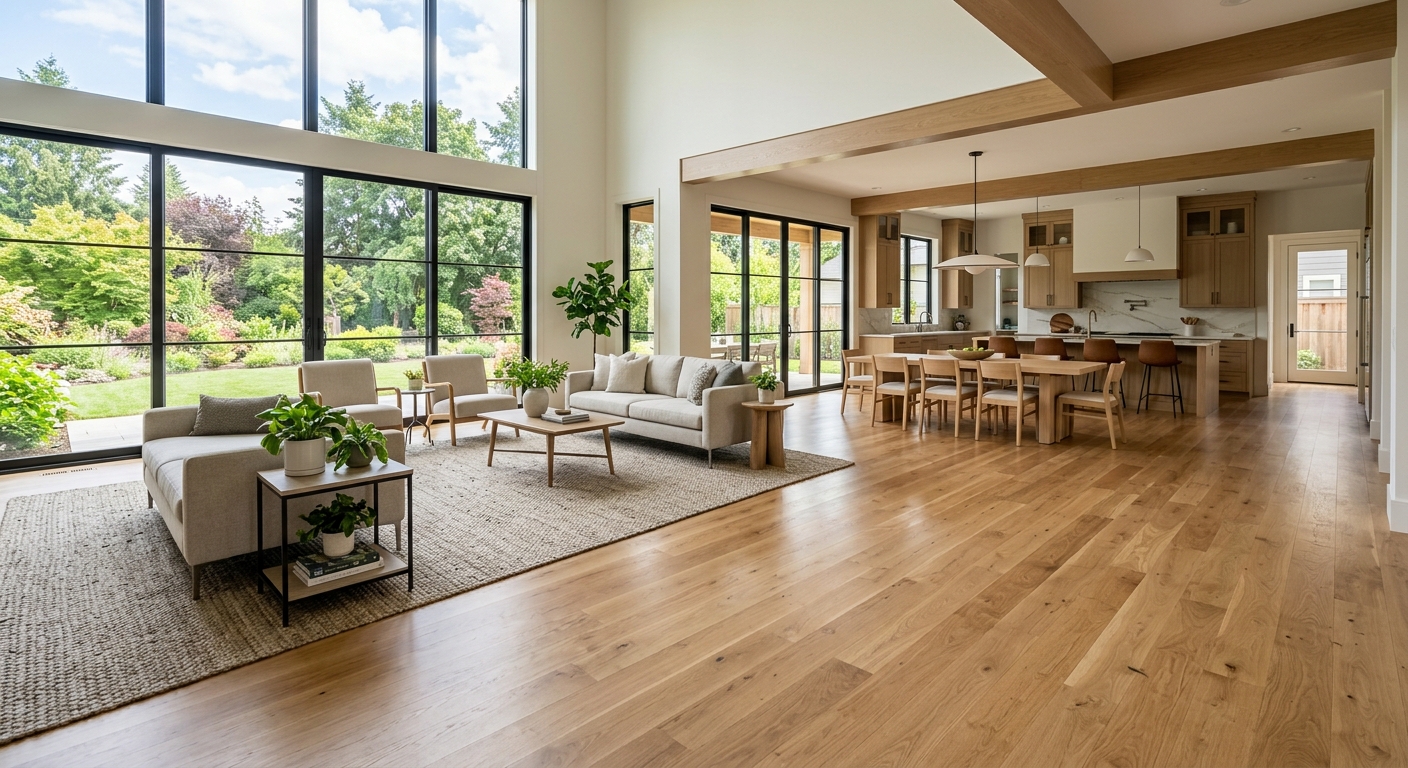
Flooring options and costs in Maple Ridge
Maple Ridge homeowners have plenty of choices, but the real differences show up once you factor in our Lower Mainland–Southwest wet, marine climate and the way it affects indoor humidity. With 28.6% of local homes built before 1981, it’s common to run into older plywood or uneven subfloors that need levelling or patching before any “finish” flooring can be installed. That subfloor prep is one reason some projects add material and labour costs in the neighbourhood of $1–$3 per sq ft. Another reason Maple Ridge bids can vary is contractor availability and site logistics: labour in the Greater Vancouver area is among the highest in Canada, so installation time and access (long walks, narrow stairs, parking, furniture moves) can swing your total price even when you pick the same product.
In Maple Ridge, demand for refinishing and new floors is especially strong around the West Central and Albion core areas, where many families are renovating kitchens, living rooms, and basements to keep up with modern layouts. And because moisture can wick through concrete in slab-on-grade and basement setups, we generally avoid solid hardwood below grade. Instead, engineered hardwood or waterproof LVP performs better through humidity swings, and it also tolerates minor temperature changes more consistently.
Use the table below as a practical starting point for choosing materials and understanding typical Maple Ridge pricing—then we can talk about your specific rooms and subfloor conditions.
| Type |
Best Room |
Moisture Resistance |
Lifespan |
Price per sq ft |
| Solid hardwood (nail-down, above grade only) |
Main living areas above grade |
Low to moderate (humidity sensitive) |
25–50 years |
$9 – $18 |
| Engineered hardwood (float or glue, above + on-grade) |
Living areas, bedrooms |
Moderate to high (better with humidity) |
15–35 years |
$10 – $17 |
| Laminate (click-lock, above-grade) |
Bedrooms, hallways |
Low to moderate (protect from standing water) |
10–25 years |
$4 – $10 |
| Luxury vinyl plank / LVP (waterproof, any level) |
Living areas, kitchens, basements |
High to waterproof (PVC core systems) |
15–25 years |
$5 – $12 |
| Porcelain / ceramic tile |
Bathrooms, kitchens, entries |
Very high (water tolerant) |
30–60 years |
$10 – $20 |
| Carpet (broadloom or modular tile) |
Bedrooms, stairs, media rooms |
Moderate (avoid prolonged dampness) |
7–15 years |
$4 – $12 |
Prices are estimates only and vary by project scope, site access and material selection.
What affects the price of flooring in Maple Ridge
Even with the same room size and the same product name, flooring quotes in the Lower Mainland–Southwest can land 30–50% apart across projects in British Columbia. The biggest reasons are (1) how much subfloor work you actually need, (2) how the installer handles moisture risk, and (3) labour hours for removal, transitions, and detailed cutting around doors and cabinets. In Maple Ridge, we commonly see indoor humidity swings in winter and shoulder seasons, which can cause solid hardwood to expand and contract. Solid hardwood is also a poor choice for basements, and it generally cannot be glued or floated over concrete without proper design—so when moisture is likely, we steer clients to engineered wood or waterproof LVP.
Another cost driver tied to local housing stock is that older homes often have uneven plywood or concrete that needs levelling or repair. If your quote includes patching and smoothing, expect a realistic $1–$4 per sq ft add-on compared to “perfect” subfloors. For example, a main-floor engineered hardwood installation might start around the $10–$17 per sq ft band, but the total project can climb toward the higher end if levelling is substantial. In contrast, waterproof LVP (often $5–$12 per sq ft) can stay more consistent because it tolerates minor subfloor irregularities better and doesn’t require the same humidity sensitivity controls as solid hardwood.
Concrete examples from Maple Ridge jobs: a finished basement with a slab may require a vapour-control approach and careful layout to reduce trapped moisture risk; a 1970s bungalow with squeaky, out-of-flat underlayment may need full resurfacing before installation; and homes with radiant heating (in newer builds and some colder inland pockets) may restrict choices, because not every laminate or solid product is rated for higher-temperature transfer.
| Price Factor |
Why It Matters |
Cost Impact |
| Room area in sq ft |
Direct driver of material quantities and labour hours |
Large areas can reduce per-sq-ft labour, but totals still scale up |
| Subfloor condition — levelling or repair needed |
Uneven plywood/concrete increases labour and may require patching |
Often adds roughly $1–$4 per sq ft in older homes |
| Moisture / below-grade install — rules out solid hardwood |
Basements and slab-on-grade need moisture-tolerant systems |
Switching from solid to engineered/LVP can stabilize costs |
| Material choice — solid vs. engineered vs. LVP vs. tile |
Different price bands and install requirements |
May move total by several dollars per sq ft (and change labour time) |
| Removal and disposal of existing flooring |
Haul-away and demo time vary by flooring type |
Commonly a significant separate line item in Maple Ridge |
| Stair nosing / transitions |
Complex edges, stair measurements and custom transitions |
Charged per step or per linear foot, can add meaningful cost |
| Radiant heat compatibility |
Not all products tolerate higher/variable surface temperatures |
May require higher-spec engineered wood or specific rated products |
| Installation method — float vs. glue-down vs. nail-down |
Method changes prep, adhesives, and drying/curing time |
Glue-down typically increases labour and schedule complexity |
Permits & regulations in British Columbia
In British Columbia, the flooring installation itself typically does not require a building permit. That said, certain related scopes can trigger permit or inspection requirements—especially when you touch structural or electrical components. Examples of work that DOES commonly require permits/qualified trades include electrical work connected to in-floor heating circuits, any work that modifies wiring, and structural subfloor repair that goes beyond minor patching. Moisture remediation may also involve licensed professionals depending on what’s being addressed (for instance, if it requires correcting a larger building-envelope moisture issue).
For condominium units, the key “rules” are usually through the strata corporation: sound transmission requirements (often discussed in terms of STC/IIC) can restrict what underlay you can use under hard flooring. Even when a permit isn’t required, you should review the condo declaration and obtain board approval in writing before installing hardwood or tile on upper floors.
To verify a contractor in Maple Ridge, start with the contractor’s business licence status if applicable and, more importantly, confirm their credentials and coverage: request their liability insurance certificate showing your address or “project location” as an insured interest where offered, and ask for their clearance/coverage documents for workers (WSIB/WCB in Ontario/other provinces; in B.C. you’ll commonly be dealing with WCB through WorkSafeBC). You can also ask for a written workmanship warranty copy, then verify any claims through the contractor’s certificate details you’re given (coverage dates matter). Step-by-step, compare the quote scope to what they promise to provide, and keep all paperwork organized before work starts.
Best flooring for each room in your Maple Ridge home
Choosing the right flooring in Maple Ridge means matching the product to moisture exposure, day-to-day traffic, and comfort—while respecting our Lower Mainland–Southwest humidity swings. For living and dining areas, engineered hardwood is a strong “sweet spot”: it offers the look of wood with improved stability compared to solid, and it’s usually the safer choice if your home has seasonal humidity changes. Laminate can work well above grade too, but we avoid using lower-quality products near exterior doors or in rooms that can get damp during wet-season traffic.
For bedrooms, carpet is popular for comfort and sound absorption, especially in families with kids or upstairs noise concerns. If you prefer hard surfaces, engineered hardwood still tends to be the better pick for stability. In kitchens, LVP is often the clear winner for everyday spills and quick cleanup; for a more upscale, durable finish that stays water-tolerant, large-format porcelain tile is excellent as well.
Basements are where Maple Ridge homeowners see the biggest performance difference: waterproof LVP is the best default because it tolerates moisture vapour better than solid wood and most laminate. Bathrooms should be porcelain or ceramic tile—no compromises there. If you’re installing over radiant heating, choose products rated for radiant systems; solid hardwood is generally more restrictive and needs careful specification.
Price-wise, you can often justify choosing LVP over laminate when you consider basement risk and replacement cycles. For instance, laminate at roughly $4–$10 per sq ft may look cheaper, but waterproof LVP at about $5–$12 per sq ft can save money long-term by reducing the chance of edge swelling in our wet, marine climate.
| Room |
Best Material |
Why |
Moisture Risk |
Price Band per sq ft |
| Living / dining room |
Engineered hardwood |
Warm look with better humidity stability than solid |
Low to moderate (manage indoor humidity) |
$10 – $17 |
| Master bedroom |
Carpet or engineered hardwood |
Comfort and quieter steps; engineered for stability |
Low (avoid placing near exterior door leaks) |
$4 – $12 |
| Secondary bedrooms |
Laminate (high-quality) or engineered hardwood |
Durable for kids and pets; easier maintenance than carpet |
Low (above grade) |
$4 – $17 |
| Kitchen |
Luxury vinyl plank (LVP) or porcelain tile |
Handles spills; tile adds a premium, water-tolerant finish |
Moderate (spills and wet-season tracking) |
$5 – $20 |
| Basement (finished) |
Luxury vinyl plank (waterproof) |
Best performance over slab and in humidity fluctuations |
High (moisture vapour/ground moisture potential) |
$5 – $12 |
| Bathroom |
Porcelain / ceramic tile |
Water tolerant and long-lasting with proper underlayment |
Very high |
$10 – $20 |
How to choose a flooring contractor in Maple Ridge
To choose the right flooring contractor in Maple Ridge, verify three things up front: credentials/licensing (where applicable), liability insurance, and coverage for workers. In British Columbia, ask for proof of liability insurance with your project listed (or confirm coverage extends to “project locations” in B.C.), and request their worker coverage documentation through the appropriate provincial workplace coverage system. If a contractor can’t provide current paperwork or provides only verbal reassurance, take that as a red flag.
Next, get 2–3 itemised written quotes, not lump sums. A good quote separates materials and labour, includes subfloor preparation (levelling/patching), specifies underlay/vapour-control details, and lists removal/disposal if you’re starting from existing flooring. Confirm whether the contractor’s price includes transitions, stair nosing, moulding/trim, and any grinding or priming needed for concrete. Also confirm what’s excluded: furniture moving, appliance lifting, moving furniture back, floor trimming under cabinets, and any repairs needed due to moisture issues that are discovered after demo.
For warranties, ask for two parts: workmanship warranty (how long the installer stands behind labour) and product/manufacturer warranty (what happens if the material fails). Ask whether warranties are transferable if you sell the home.
Payment schedule matters too: never pay more than 10–15% upfront. Hold back a portion until the job is fully complete and cleaned up. Finally, get a start date and completion estimate in writing so you can plan around family schedules—especially if you’re working in West Central/Albion area homes where parking and access can be tight.
- Ask for their certificate of insurance and confirm coverage dates are current.
- Request worker coverage documentation (B.C. coverage through the appropriate system).
- Confirm the quote is itemised: materials, labour, and subfloor prep.
- Check whether removal and disposal are included, with dump fees if applicable.
- Verify vapour barrier/underlay and moisture-control details are specified.
- Ask how they handle out-of-flat subfloors and what tolerance they measure.
- Get a clear transition plan for doorways, stairs, and adjoining rooms.
- Confirm stair nosing details (type, material, and per-step or per-linear-foot pricing).
- Ask for the workmanship warranty length and what it covers/doesn’t.
- Review schedule and timeline in writing; don’t rely on “we’ll get it done”.
- Use a payment schedule with a holdback until completion.
- Make sure dust control/cleanup expectations are written in the scope.
Common red flags I see in Maple Ridge: (1) quotes that don’t mention subfloor levelling or moisture protection but still promise “perfect results”; (2) no proof of insurance or coverage when asked; (3) large upfront deposits (beyond 10–15%); (4) unclear warranty terms or “manufacturer warranty only” with no workmanship coverage; and (5) vague scopes that omit removal/disposal or stair/transition pricing.
Frequently asked questions — flooring in Maple Ridge
How do I compare flooring quotes?
Start by comparing the scope, not just the final number. In Maple Ridge and the Lower Mainland–Southwest, two quotes can look close until you notice one includes subfloor levelling, vapour control/underlay, and transitions while the other doesn’t. Ask each contractor to itemise materials and labour line-by-line, and include removal and disposal if you’re starting fresh. Confirm whether you’re paying within the typical bands—hardwood often sits around $9–$18 per sq ft, and waterproof LVP is commonly closer to $5–$12 per sq ft—then check that the product grade matches (thickness, wear layer, underlay). Finally, compare warranties: workmanship plus manufacturer terms, not just “best effort”. (Statistics Canada, 2021 Census)
Can I install flooring over existing tile in Maple Ridge?
Sometimes yes, but it depends on tile condition, height changes, and the system you’re installing. In Maple Ridge, tile is often stable enough to cover, yet the bigger question is whether the tile surface is flat and properly prepared. For click-lock laminate, you need a very smooth base and an appropriate underlay that won’t compress unevenly. For LVP, you can sometimes install over tile if the tile is secure and flat, but you may still need a flattening method. For hardwood, it’s usually not the first choice over tile unless the installer specifies a compatible underlayment/leveling system and keeps proper expansion gaps. Ask your contractor to measure flatness and describe the prep step they’ll do before any flooring goes down.
What is the best flooring for a high-traffic area in Maple Ridge?
For high-traffic areas above grade—entries, hallways, and main living zones—engineered hardwood and high-quality LVP are the most reliable choices in our wet, marine climate. Engineered wood handles humidity swings better than solid hardwood, which can cup or gap when indoor moisture fluctuates. Waterproof LVP is also excellent because it’s more forgiving with wet-season tracking and quick cleanup, especially around exterior doors. If you’re comparing costs, engineered hardwood often lands in the $10–$17 per sq ft range, while LVP commonly sits around $5–$12 per sq ft, so you can balance budget with performance. For basements (even if “finished”), I generally recommend LVP rather than solid hardwood or laminate because moisture vapour risk can be higher.
How do I prepare my subfloor before new flooring?
Subfloor prep is where projects are won or lost. In Maple Ridge, older homes (many built before 1981) often need patching, levelling, or repairs due to uneven plywood or older concrete surfaces that can be out of plane. A proper process starts with inspection: check flatness, fastener conditions (squeaks/loose boards), and whether any dampness is present. Then the contractor should specify the method: sanding or grinding for small high spots, patch/level compound for low areas, and appropriate primers or moisture-control systems when required. For above-grade wood installs, correct underlay matters. For tile and radiant heating scenarios, compatibility requirements become even more specific. Don’t assume “it’ll be fine under the flooring”—ask how they’ll measure and correct.
Is cork or bamboo flooring a good choice in Maple Ridge?
Cork can be a comfortable option and it has natural resilience, but it still needs the right humidity and subfloor conditions. In Maple Ridge’s Lower Mainland–Southwest climate, where indoor humidity swings can be noticeable in winter and shoulder seasons, cork must be installed with good moisture control and should generally stay above grade. Bamboo varies: some bamboo products are more stable than others depending on construction, but it still isn’t as forgiving as waterproof LVP if you have below-grade moisture concerns. If you’re considering cork or bamboo, insist the product is rated for the install conditions you have (above grade vs. on slab), and ask what vapour barrier/underlayment they require. For basements, I’ll typically steer homeowners toward waterproof LVP instead because moisture vapour is the harder variable to manage.
What is the difference between floating and glued-down flooring?
Floating flooring (like click-lock laminate or some engineered wood) isn’t mechanically fixed to the subfloor; it “floats” over an underlayment. Because it can move slightly, it generally needs proper expansion gaps around the perimeter and a more specific underlay for comfort and sound. Glued-down flooring is adhered directly to the subfloor, which can reduce movement and sometimes improves stability—but it increases preparation requirements and typically requires careful moisture control and adhesive selection. In Maple Ridge, the humidity factor matters: floating systems can be more forgiving when specified correctly, while glued-down requires the installer to ensure the subfloor and moisture conditions are suitable. If you have radiant heating, ask which method is recommended by the manufacturer so temperature and movement remain within the product’s limits.