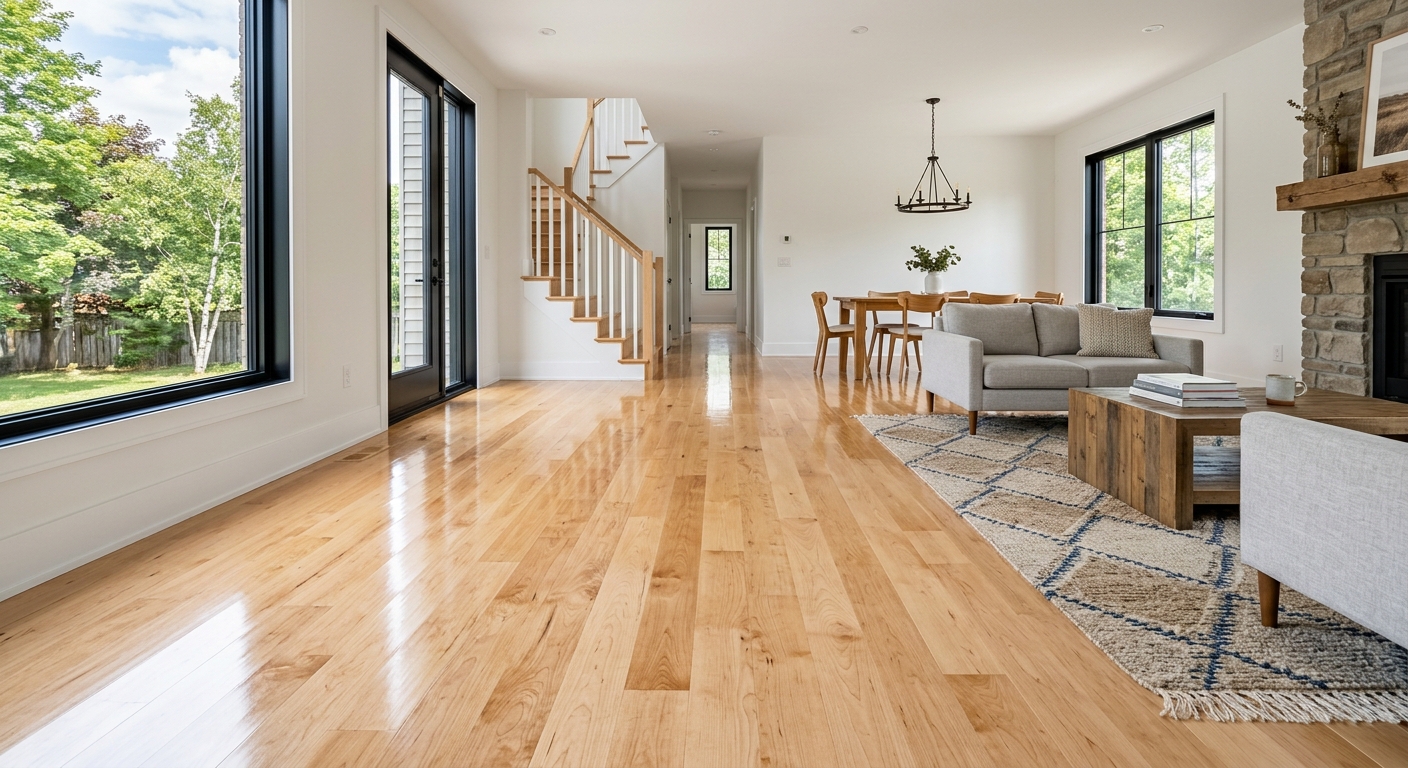
Flooring options and costs in Caledonia-Fairbank
In Caledonia-Fairbank, choosing flooring is partly a comfort decision and partly a moisture-management decision. With a population of 9,955 (Statistics Canada, 2021 Census), the town’s neighbourhoods and nearby communities see plenty of mid-century home turnarounds, where carpet-to-hard-surface upgrades are common. In this area, older basements and original subfloors often need attention—think levelling compound, repair of soft spots, or an OSB overlay—before new flooring can sit flat. That “prep” work can add roughly $2 to $4 per sq ft depending on how far the subfloor must be corrected.
In the Hamilton–Niagara Peninsula, humidity swings are the constant theme: dry indoor air in winter and higher humidity in summer. That seasonal cycling raises callbacks for poorly acclimated materials and the wrong product type. It’s one reason engineered hardwood and luxury vinyl plank (LVP) are frequently chosen for on-grade and below-grade areas, while traditional solid hardwood is typically limited to above-grade installations. The colder climate also makes radiant-heat compatibility a frequent requirement, and it influences which underlay and adhesives contractors recommend.
Contractor availability and scheduling also reflect market demand—around Brant County Road and the Fairbank Road corridor, we often see faster lead times in peak renovation months because many homes are similar in size and layout and share the same scope: removal, subfloor prep, transitions, and installation.
Below are realistic installed cost bands you can use as a starting point, before site-specific factors like moisture mitigation, levelling, and transitions are added.
| Type |
Best Room |
Moisture Resistance |
Lifespan |
Price per sq ft |
| Solid hardwood (nail-down, above grade only) |
Living, dining (dry, above-grade) |
Low–moderate (sensitive to humidity) |
25–50 years (with proper conditions) |
$9,–$18, |
| Engineered hardwood (float or glue, above + on-grade) |
Living, dining, bedrooms |
Moderate (more stable than solid) |
15–30 years |
$10,–$17, |
| Laminate (click-lock, above-grade) |
Bedrooms, living rooms |
Low–moderate (flood risk if seams get wet) |
10–20 years |
$4,–$10, |
| Luxury vinyl plank / LVP (waterproof, any level) |
Kitchen, main floor, finished basements |
High (waterproof cores) |
15–25 years |
$6,–$12, |
| Porcelain / ceramic tile |
Kitchen, bathrooms, entries |
Very high (tile tolerates moisture well) |
25+ years |
$10,–$22, |
| Carpet (broadloom or modular tile) |
Bedrooms, stairs, living comfort areas |
Low (needs dry subfloor) |
7–15 years |
$4,–$9, |
Prices are estimates only and vary by project scope, site access and material selection.
What affects the price of flooring in Caledonia-Fairbank
In the Hamilton–Niagara Peninsula, two homeowners can receive bids that differ by 30% to 50% for the “same” floor—mainly because the quote isn’t just the material. Labour scope, subfloor condition, moisture mitigation, and how the installer handles transitions can all swing the total. Ontario also has supply-and-demand pressure around renovation seasons, and that affects scheduling and crew efficiency, which can show up in pricing.
Technically, indoor humidity swings and below-grade moisture are the key drivers. Solid hardwood expands and contracts with humidity and can’t be reliably glued or floated over concrete. It performs poorly in basements because vapour pressure and temperature cycling move moisture through the slab. That’s why engineered hardwood and luxury vinyl plank are typically favoured: engineered wood is far more dimensionally stable, and LVP is often treated as waterproof for practical everyday spills and damp environments.
Colder regions in Ontario also favour radiant-heat-compatible flooring. That limits which solid hardwoods and some laminate builds are practical, and it can push you toward engineered wood, LVP designed for heat, and many tile systems.
In Caledonia-Fairbank, older housing stock frequently needs subfloor levelling or repair—commonly adding $1 to $4 per sq ft. For example: (1) if your existing carpet has a heavily worn underlay and the subfloor shows dips, levelling compound and patching add cost before you can install; (2) if you’re installing across a basement slab, moisture barrier materials and careful layout can increase the per-square-foot job cost, while switching from solid hardwood to LVP can prevent expensive rework; and (3) if you choose tile, the labour for prep, layout, and grouting is a real driver compared with laminate in the $4 to $10 band. If your goal is value, pairing LVP (often in the $6 to $12 reality) with proper underlayment and transitions can be cheaper than tile when you add the levelling and line-matching work.
| Price Factor |
Why It Matters |
Cost Impact |
| Room area in sq ft |
Materials and labour scale directly with square footage |
Low to high (small rooms often cost more per sq ft due to minimum labour) |
| Subfloor condition |
Levelling or repair is frequently needed when removing carpet |
Often +$1 to $4 per sq ft for patching/levelling/repairs |
| Moisture / below-grade install |
Vapour control rules out solid hardwood and affects underlay choices |
Can add +$0.50 to $3 per sq ft via barriers, primers and remediation |
| Material choice |
Solid, engineered, LVP, and tile have different prep, installation and warranty requirements |
Shifts the base budget across bands (e.g., laminate $4–$10; tile $10–$22) |
| Removal and disposal of existing flooring |
Hauling and disposal fees add time and cost |
Commonly +$0.75 to $3 per sq ft depending on thickness and debris |
| Stair nosing / transitions |
Steps and transitions are labour-intensive and require matching profiles |
Often charged per step or per linear foot; can add hundreds |
| Radiant heat compatibility |
Not all products tolerate thermal cycling without performance issues |
May shift you to engineered/LVP/tile and add product premiums |
| Installation method |
Float vs. glue-down vs. nail-down changes labour and sometimes subfloor prep |
Nail-down and glue-down typically increase labour compared to floating |
Permits & regulations in Ontario
In Ontario, flooring installation itself typically does not require a building permit. Most interior floor replacements—like installing laminate, LVP, engineered hardwood, or ceramic/porcelain tile on an existing floor—are normal home improvements that don’t trigger permits on their own.
Where permits can come into play is the “associated work” that ties into building systems. For example, if you’re repairing or modifying a subfloor in a way that affects structure (major structural repairs, not just levelling), you may need permit review depending on scope and engineering requirements. If your project includes moisture remediation that involves electrical or mechanical systems, or if it ties into radiant in-floor heating circuit work, electrical permits may be required. In floor-heating upgrades, thermostat wiring and circuit modifications are the parts that often pull in electrical compliance.
For condominiums, you also have a separate layer of rules. Even when no permit is needed, the corporation’s regulations for sound transmission (often referenced via STC/IIC requirements) can limit underlay choices or require specific products on upper floors to reduce noise transfer. Before work begins, always review the condo declaration and get board approval in writing where required—especially for hardwood and tile installations.
To protect yourself in Caledonia-Fairbank, verify: (1) the contractor’s Ontario licence status through the proper online registry, (2) liability insurance with a current certificate of insurance naming you (or the property owner) where appropriate, and (3) WSIB/WCB clearance if they’re required to carry coverage for workers. Request those documents before scheduling; a reputable contractor will provide them easily and consistently.
Best flooring for each room in your Caledonia-Fairbank home
Choosing the right floor in Caledonia-Fairbank is about matching the product to moisture risk, everyday traffic, and comfort—while respecting the Hamilton–Niagara Peninsula’s humidity swings and the reality of damp basements. For living and dining areas, engineered hardwood or a high-quality laminate often hits a good balance: warmth underfoot in winter, a more stable build than solid wood, and a finish that holds up to daily wear. In Ontario homes where radiant heat is increasingly common, you’ll want products explicitly designed to be compatible with in-floor heating.
For primary bedrooms, carpet remains a strong choice for comfort and sound absorption. It also helps buffer the temperature feeling of colder floors overnight—something many homeowners notice in our winter months. That said, ensure the subfloor is dry and properly prepped; carpet doesn’t forgive moisture problems.
Kitchens are where LVP and porcelain tile usually win. Luxury vinyl plank is popular because it’s waterproof for everyday spills and easy cleaning, while large-format porcelain reduces grout lines and handles water well. In basements (especially finished ones), LVP is often the clear winner: the waterproof core and tolerant installation approach usually outperform solid hardwood and many laminate builds under below-grade conditions. Bathrooms should be porcelain or ceramic tile only because the environment is consistently wet.
To see where price differences make sense: upgrading from laminate in the $4 to $10 band to engineered hardwood in the $10 to $17–ish installed reality can be justified if you want a longer usable life and a more natural feel in living spaces. But if your goal is budget stability in a basement, moving to LVP can avoid the expensive mistake of trying to run solid hardwood where moisture vapour is a constant.
| Room |
Best Material |
Why |
Moisture Risk |
Price Band per sq ft |
| Living / dining room |
Engineered hardwood |
Warm look with better dimensional stability than solid wood |
Low (above-grade), moderate if humidity control is inconsistent |
$10,–$17, |
| Master bedroom |
Carpet |
Comfort, sound dampening, and a warmer feel on colder mornings |
Low (if subfloor stays dry) |
$4,–$9, |
| Secondary bedrooms |
Laminate |
Good durability for kids/traffic at a lower cost than wood |
Low–moderate (keep seams dry) |
$4,–$10, |
| Kitchen |
Luxury vinyl plank (LVP) |
Waterproof performance and easy cleaning with under-sink spill management |
Moderate (spills and humidity) |
$6,–$12, |
| Basement (finished) |
Luxury vinyl plank (LVP) |
Handles below-grade moisture vapour and seasonal cycling better than wood/laminate |
High (use proper moisture barrier where recommended) |
$6,–$12, |
| Bathroom |
Porcelain / ceramic tile |
Best all-around moisture tolerance and long service life |
Very high (wet zones) |
$10,–$22, |
How to choose a flooring contractor in Caledonia-Fairbank
Picking the right flooring contractor in Caledonia-Fairbank is mostly about verifying the basics and then reading the fine print. Start with Ontario licensing and your contractor’s coverage documents. For liability insurance, request a current certificate of insurance and confirm it lists the correct business name and the worksite/property address (or at least notes the jobsite is covered). For WSIB/WCB, ask for WSIB clearance (or the appropriate WCB proof) that confirms the company is covered for workers. A contractor who can’t provide these quickly is a risk to you in case of injury or damage.
Next, get 2 to 3 written itemised quotes—not lump sums. The quote should break out labour and material, including underlayment/moisture barrier, patching/levelling, transitions, stair work, and disposal. Make sure it states what’s included and excluded: for example, whether subfloor prep is “included up to a certain tolerance” or billed separately if the installer finds dips beyond normal correction.
Warranty matters in our climate because moisture and thermal cycling can reveal problems over time. Confirm the workmanship warranty length and what it covers (labour only vs. labour plus parts), and whether the product manufacturer warranty is valid for your installation method (especially for LVP and engineered hardwood). Also ask if warranties are transferable if you sell.
Finally, the payment schedule should be conservative. Never pay more than 10% to 15% upfront. Hold back the final amount until the job is complete, cleaned, and you’ve confirmed transitions and edges are properly finished. In your timeline, request the start date and a completion estimate in writing, including lead time for materials.
- Provide Ontario licence/registration information (and confirm it matches the company name on the quote).
- Show current liability insurance with jobsite coverage details.
- Provide WSIB/WCB clearance or proof of coverage before work starts.
- Use an itemised quote: labour, materials, underlay/moisture barrier, and disposal.
- State who levels/repairs subfloor and the tolerance or limits of that work.
- Clarify what happens if the subfloor is worse than expected.
- Confirm stair nosing and transitions are priced per step/linear foot where applicable.
- Ask what underlayment is used (and whether it’s compatible with radiant heat if relevant).
- Get details on acclimation time for hardwood/LVP products.
- Verify the warranty: workmanship duration, product warranty, and any conditions.
- Use a payment schedule with a small upfront deposit (10% to 15% max).
- Set a written start date and completion date/estimate, plus a contact method for changes.
Concrete red flags I see in Caledonia-Fairbank include: (1) refusing to show insurance/WSIB/WCB documentation, (2) quoting a single “all-in” number without itemising levelling/moisture barrier/transitions, (3) claiming solid hardwood “works fine in a basement” over concrete, (4) no written scope for what’s excluded (especially disposal and subfloor repair), and (5) asking for most payment upfront before any materials are confirmed.
Frequently asked questions — flooring in Caledonia-Fairbank
How do I fix squeaky floors in my Caledonia-Fairbank home?
Squeaks usually come from movement between the subfloor layers, fastener fatigue, or gaps around joists—not from the finish floor itself. In older Hamilton–Niagara Peninsula homes, it’s common after years of seasonal movement and humidity cycling. If you’re planning a flooring replacement, the best approach is often to address squeaks during subfloor access: lift a section (or remove flooring where feasible), locate squeak points, then re-secure subfloor to joists using the correct fasteners and spacing. If you’re installing over an existing subfloor, don’t skip the prep—your installer should check for loose boards before laying laminate or LVP. If the squeak is widespread, repair costs can add to the job similarly to subfloor levelling (often about $1 to $4 per sq ft), which helps explain why quotes can differ.
What is luxury vinyl plank and is it worth it in Caledonia-Fairbank?
Luxury vinyl plank (LVP) is a synthetic flooring with a waterproof core designed to resist spills and moisture better than laminate and traditional wood. In Caledonia-Fairbank, it’s often worth it because below-grade humidity and damp basements are real, especially when you’re converting from carpet. LVP can be installed on above-grade and many below-grade applications when the subfloor is properly prepared, and many products are compatible with thermal cycling better than solid hardwood. On price, installed LVP often lands in the $6 to $12 per sq ft range; that can be a better value than tile’s $10 to $22 per sq ft when you want a warm, quiet floor without grout maintenance. For maximum performance, choose the right underlayment (or none, if required) and ensure seams and edges are treated correctly.
How much does flooring cost in Caledonia-Fairbank?
Installed flooring costs in Caledonia-Fairbank typically fall into recognizable Ontario bands, but your exact total depends on square footage, subfloor prep, and transitions. As a practical guide, laminate and vinyl plank are commonly priced in roughly $4 to $10 per sq ft for laminate and about $6 to $12 per sq ft for LVP reality, while tile often runs $10 to $22 per sq ft. Solid hardwood generally starts higher, commonly around $9 to $18 per sq ft, with engineered hardwood often in the $10 to $17-type range. If your existing carpet is hiding dips, gaps, or damaged OSB, levelling/repair can add around $1 to $4 per sq ft. Basement moisture mitigation can also increase prep costs, but choosing a moisture-tolerant product like LVP can prevent costly rework later.
Hardwood vs laminate vs vinyl plank — which is best?
“Best” depends on room moisture and how you live day to day in Ontario. Hardwood (especially solid) is best when the space stays consistently dry and climate-stable; it’s typically limited to above-grade use. Laminate can be a budget-friendly option (often $4 to $10 per sq ft), but it’s less forgiving if spills reach the seams or if humidity is high. Vinyl plank is usually the most practical choice for kitchens and finished basements because many products are waterproof and handle humidity swings better. In Caledonia-Fairbank’s Hamilton–Niagara Peninsula climate, engineered hardwood can be a middle path: it offers a real-wood look with improved stability versus solid. If you want one simple rule: pick laminate for dry rooms, pick engineered/wood for above-grade living areas, and pick LVP for water-prone areas and basements.
What flooring is best for a Caledonia-Fairbank basement?
For basements in Caledonia-Fairbank, luxury vinyl plank (LVP) is usually the top choice because it’s waterproof and far more tolerant of below-grade moisture vapour than solid hardwood. Solid hardwood over concrete also doesn’t perform well in basements because vapour pressure and thermal cycling can push the wood to expand/contract, causing gaps or cupping. Tile can work very well in basements too, but it’s a different cost and comfort profile—often $10 to $22 per sq ft once prep and tile labour are included. If you’re finishing a basement, your installer should evaluate moisture conditions, recommend a moisture barrier or vapour-control system where needed, and ensure the subfloor is level. The most common basement cost drivers are moisture mitigation and subfloor levelling before installation.
Can I install hardwood over concrete?
Sometimes—depending on the type of hardwood and the concrete condition. Solid hardwood is generally not a basement-friendly choice and is typically restricted to above-grade nail-down installs because it’s sensitive to humidity. Engineered hardwood is the product that most often gets installed over concrete in Ontario because it’s more dimensionally stable; it may be installed with a glue-down method or with an appropriate floating system that meets the manufacturer’s specs. Before installing any wood over concrete, the key steps are moisture testing and subfloor prep: verify moisture levels, use the correct primer/moisture system if required, and ensure the slab is flat enough for the installation method. If moisture isn’t addressed, you risk buckling or gaps—problems that can cost more to fix than the difference between laminate ($4 to $10) and engineered wood.