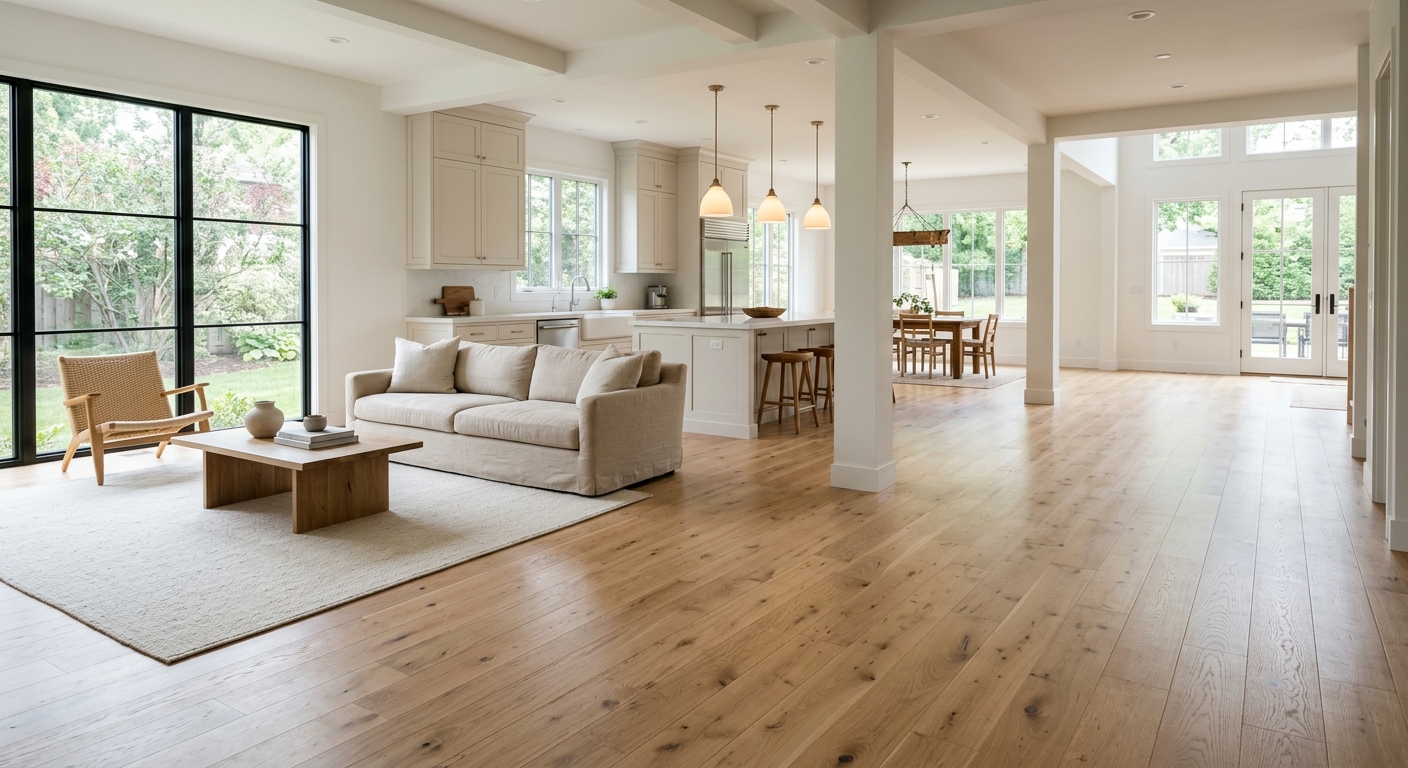
Flooring options and costs in Markham
Markham homeowners today are weighing looks, comfort, and real-world practicality—especially with Ontario’s seasonal swings in indoor humidity and the fact that a large portion of local housing stock is older. In Markham, about 18.5% of homes were built before 1981 (Statistics Canada, 2021 Census), and that matters because many of these houses have uneven subfloors, older underlay, and moisture-vulnerable materials that need levelling, repairs, or patching before you can install new flooring. On top of that, Toronto-area demand keeps contractor schedules busy, so labour and project coordination can run higher than in many other parts of the province.
That climate reality is why we steer many clients toward engineered hardwood or luxury vinyl plank (LVP), particularly in condos, over slab, and in areas where moisture can fluctuate. Solid hardwood can be beautiful, but it’s more sensitive to humidity movement and is typically limited to above-grade installs; it’s risky in basements and generally not suitable over concrete. If you’re also dealing with in-floor radiant heat (in some newer custom builds and renovations), material choice and installation method become even more important—certain products perform better when the system cycles.
In Markham’s more renovation-heavy pockets—like Unionville and parts of Markham Village—you’ll see frequent subfloor prep and underlay upgrades bundled into quotes. Once those prep steps are accounted for, the cost differences between flooring types become easier to compare. Use the table below as a practical guide to typical price ranges per square foot for common options in Markham.
| Type |
Best Room |
Moisture Resistance |
Lifespan |
Price per sq ft |
| Solid hardwood (nail-down, above grade only) |
Living / dining, bedrooms (above grade) |
Low to moderate (humidity sensitive; not basement-friendly) |
25–60 years |
$9–$18 |
| Engineered hardwood (float or glue, above + on-grade) |
Main floors, hallways |
Moderate to high (more stable across humidity swings) |
20–35 years |
$10–$17 |
| Laminate (click-lock, above-grade) |
Living areas and bedrooms (non-wet zones) |
Moderate (stands up to normal spills; avoid standing water) |
10–25 years |
$4–$9 |
| Luxury vinyl plank / LVP (waterproof, any level) |
Kitchen, finished basement, main floors |
High to very high (waterproof when installed correctly) |
15–25 years |
$5–$12 |
| Porcelain / ceramic tile |
Kitchen, bathrooms, foyers |
Very high (impervious surface; grout still needs care) |
30–50+ years |
$12–$25 |
| Carpet (broadloom or modular tile) |
Bedrooms, stairs (comfort-focused) |
Low to moderate (avoid basements unless well-controlled) |
8–15 years |
$5–$11 |
Prices are estimates only and vary by project scope, site access and material selection.
What affects the price of flooring in Markham
In Markham and the broader Toronto market, it’s common to see quotes for the “same” flooring land 30–50% apart once you look past the product price. The biggest drivers are technical site conditions and how the installer handles moisture, levelling, and transitions. Toronto-area homes often face wide indoor humidity swings across seasons, and below-grade moisture can show up as musty odours, damp patches, or efflorescence on slabs. Solid hardwood expands and contracts with humidity and is therefore not a good fit for basements; it also shouldn’t be installed over concrete. Engineered hardwood and luxury vinyl plank handle humidity and below-grade applications far better, so they’re the typical recommendation for many renovation projects.
Older Markham housing can also require prep work before install. With about 18.5% of homes built before 1981 (Statistics Canada, 2021 Census), we frequently see subfloor levelling, plywood patching/replacement, or moisture mitigation prior to installation. That prep commonly adds roughly $1–$4 per square foot, and in tougher cases it can be more—especially where the existing floor is out of plane or materials are failing.
Here are concrete examples from the region that change cost quickly: a 600 sq ft job on a plywood subfloor that’s flat may stay near the laminate band of $4–$9 per sq ft, while the same size job with required levelling and adhesive upgrades can move higher. A finished basement where LVP must include a proper vapour-control system and careful edge detailing is often still a value versus trying to use solid hardwood or most laminate. On the other hand, upgrading to porcelain tile in a kitchen or entryway may land in the $12–$25 per sq ft range—but that can be justified if you need long-term durability and easy clean-up.
| Price Factor |
Why It Matters |
Cost Impact |
| Room area in sq ft |
Material and labour scale directly with square footage |
Large rooms reduce per-sq-ft overhead; small rooms often cost more per sq ft |
| Subfloor condition |
Levelling and repairs are required for a smooth, long-lasting installation |
Commonly adds about $1–$4/sq ft; can increase with plywood replacement |
| Moisture / below-grade install |
Determines whether solid wood is viable and whether vapour control is needed |
Usually pushes projects toward engineered hardwood or LVP; adds prep materials |
| Material choice |
Different products have different install systems and underlay requirements |
Moves the project between typical bands (e.g., laminate vs tile) |
| Removal and disposal of existing flooring |
Existing materials and glue can be labour-intensive to remove |
Can add several hundred dollars depending on type and subfloor damage |
| Stair nosing / transitions |
Stairs and door transitions require more precise cutting and finishing |
Often charged per step or per linear foot; can materially change totals |
| Radiant heat compatibility |
Heat cycling impacts some flooring assemblies and limits choices |
May require specific products, underlay, or acclimation steps |
| Installation method |
Float, glue-down, and nail-down each have different prep and workmanship demands |
Glue-down and nail-down often increase labour and prep time |
Permits & regulations in Ontario
In Ontario, installing flooring itself typically does not require a building permit. Most homeowners can proceed with flooring replacement (hardwood, vinyl, laminate, tile, carpet) without pulling a permit. The exceptions are the “associated work” items that involve electrical systems or structural change: for example, modifications to in-floor radiant heating wiring/circuits can trigger electrical permitting requirements, and structural repairs to the building framing or subfloor (beyond typical patching) may require additional approvals depending on scope.
For condominiums in Markham, the practical “rule” is often the building’s declaration and bylaws. Even where flooring doesn’t need a permit, the condo corporation may restrict hard flooring on upper levels because of sound transmission. You may be required to use a specific underlay system, meet STC/IIC expectations, or obtain written approval before work begins—especially for tile and engineered hardwood.
Step-by-step, here’s how a homeowner can verify a contractor in Ontario: (1) confirm the business name and worker credentials through the applicable online registry or licensing information used in Ontario trade contracting; (2) ask for a current certificate of liability insurance with your project address listed as applicable; (3) request proof of WSIB/WCB coverage (or a clearance letter where applicable) before work starts; and (4) keep everything in writing—your quote, scope, and the contractor’s insurance documents. If a contractor can’t provide these promptly, that’s a red flag.
Best flooring for each room in your Markham home
Choosing flooring in Markham means matching the product to the room’s traffic, moisture exposure, and comfort needs. In living and dining areas, engineered hardwood or a high-quality laminate often hits the best balance: a warmer feel than tile, improved stability versus solid wood, and a practical lifespan for busy households. For bedrooms, carpet is still a strong choice in Ontario homes because it cushions footsteps and absorbs sound—helpful for upstairs comfort in a region where many residents are in attached housing or condos. If you have pets or allergies, modular carpet tile can also be easier to manage.
Kitchens and entries take more abuse from water tracking and quick spills. Luxury vinyl plank (LVP) is a popular Markham solution because it’s waterproof when installed correctly and it’s forgiving during real-life messes. If you prefer a “forever” surface, large-format porcelain tile is also excellent—tile doesn’t care about humidity swings the way wood does. In finished basements, LVP is usually the clear winner: basements in this climate can experience vapour pressure and intermittent dampness, and solid hardwood plus most laminate are high-risk.
Bathrooms should be porcelain or ceramic tile only. And if you’re working over radiant floor heating—which is increasingly common in Ontario new builds and renovations—focus on products that are rated for heat cycling. For example, moving from laminate at $4–$9 per sq ft to engineered hardwood around $10–$17 per sq ft can be justified when you want a more authentic wood look and better stability for day-to-day humidity swings.
| Room |
Best Material |
Why |
Moisture Risk |
Price Band per sq ft |
| Living / dining room |
Engineered hardwood |
Warm look, better dimensional stability than solid wood in humidity swings |
Low to moderate |
$10–$17 |
| Master bedroom |
Carpet or engineered hardwood |
Comfort and sound control (carpet) or a cleaner, low-maintenance option (engineered) |
Low |
$5–$17 |
| Secondary bedrooms |
Laminate (click-lock) or carpet |
Good durability for kids’ rooms; carpet improves comfort and sound |
Low |
$4–$11 |
| Kitchen |
Luxury vinyl plank (LVP) or porcelain tile |
Handles spills and frequent cleaning; LVP is waterproof, tile is long-lasting |
Moderate |
$5–$25 |
| Basement (finished) |
Luxury vinyl plank (LVP) |
Most stable choice over below-grade conditions; resists vapour and moisture better than wood |
High |
$5–$12 |
| Bathroom |
Porcelain or ceramic tile |
Impervious surface; designed for wet environments |
Very high |
$12–$25 |
How to choose a flooring contractor in Markham
Choosing a contractor in Markham is mostly about verification and clarity. Start with Ontario compliance: ask for proof of liability insurance and WSIB/WCB coverage (or a clearance letter where applicable). Before anyone removes your existing flooring, confirm the contractor can provide these documents and that the coverage is current. Next, get 2–3 itemised written quotes—not just a lump sum. A solid quote breaks out materials, labour, underlay/vapour control (if applicable), and any subfloor prep items like levelling compound or plywood replacement. If a quote only lists a total price, it’s much harder to compare.
Read the scope carefully for exclusions. Typical “gotchas” include: whether subfloor repairs beyond a limited allowance are included; whether grout sealing is included for tile; whether moisture testing or vapour barrier installation is part of the plan; and whether stair work, transitions, and disposal are covered. Also confirm whether permits (or electrical coordination for radiant systems) are handled by the contractor when needed.
Warranty matters: ask for the workmanship warranty length and what it covers (including what happens if there’s movement, gapping, or edge lifting). Confirm the product/manufacturer warranty terms and whether it’s transferable to subsequent homeowners. For payment schedule, never pay more than 10–15% upfront; use a holdback until the job is complete and you’ve reviewed the final walkthrough. Finally, get the timeline in writing with a start date and completion estimate.
- Provide WSIB/WCB clearance letter (or coverage proof) before work begins
- Show a current certificate of liability insurance
- Use itemised quotes: materials, labour, underlay/vapour control, and prep
- List what’s included for demolition, prep, and disposal
- State subfloor tolerances and levelling/repair allowance in writing
- Confirm transition and stair nosing pricing method (per step or per linear foot)
- Include acclimation instructions and the expected subfloor moisture plan
- Provide manufacturer installation instructions and product-specific requirements
- Workmanship warranty terms in plain language, not just “included”
- Clarify payment schedule and holdback amount
- Provide a written start date and completion estimate
- Ask for references for similar Markham basements or condo installs
Red flags in Markham include: refusing to provide insurance/WSIB documentation, quoting without a subfloor prep plan (especially for older homes), vague scopes that omit transitions or stair work, only accepting large upfront payments, and “flooring-only” promises that ignore moisture mitigation or condo sound requirements.
Frequently asked questions — flooring in Markham
Do condos restrict hard flooring?
Yes—often. In Markham condos, the restriction usually isn’t about permits; it’s about condo corporation rules on sound transmission and impact noise. Even if flooring installation itself doesn’t require a permit in Ontario, the building may require specific underlay under engineered hardwood or tile, and it may limit installation methods on upper floors. Before you buy materials, request approval in writing (or ask for the condo’s approved underlay list) and confirm whether your unit needs to meet STC/IIC targets. This is particularly important for engineered hardwood and tile, where harder surfaces can amplify footsteps if the underlay system isn’t compliant.
How do I compare flooring quotes?
Compare quotes like-for-like by looking at scope, not just the total. Ask each contractor to list material and labour separately, and include line items for subfloor prep (levelling, plywood replacement), underlay/vapour control, transitions, and disposal. In Toronto-area homes, moisture and levelling work can change totals quickly, especially in older properties where subfloors aren’t perfectly flat. For pricing reality, a quote that’s cheaper on paper may still be higher once you add necessary repairs. For example, if one option is laminate at the typical $4–$9 band but another includes proper moisture mitigation and levelling, the “higher” quote may actually be the more complete and cost-effective one over the long term.
Can I install flooring over existing tile in Markham?
Sometimes, but it depends on the condition and the flooring system. In many Markham renovations, tile removal is labour-intensive, so homeowners ask whether they can install over it. The key issues are tile flatness, grout condition, height buildup (door clearances), and whether the subfloor is stable. For LVP and some laminate installs, installers may require a specific underlayment plan and an assessment for ridges—uneven tile can cause joint failure or squeaks. For tile-to-tile, additional height can also affect transitions. A proper quote should include an evaluation of flatness and edge conditions; if the tile is cracked or uneven, the best long-term move is often to remove it and rebuild the subfloor.
What is the best flooring for a high-traffic area in Markham?
For high-traffic spaces, you want durability, good wear layers, and an installation that resists moisture movement. Many Markham families land on luxury vinyl plank (LVP) in hallways and kitchens because it’s waterproof and handles spills from winter tracking. If you prefer a natural look, engineered hardwood is also a strong choice, but it still benefits from correct acclimation and a stable subfloor due to humidity swings in Ontario. Carpet can work well in living spaces for comfort, but in heavy traffic it will show wear and can be harder to keep clean. As a rough budget check: LVP typically sits around the $5–$12 per sq ft range, while porcelain tile commonly comes in higher at $12–$25 per sq ft—tile can be excellent for durability but costs more and needs proper underlayment planning for comfort.
How do I prepare my subfloor before new flooring?
Preparation is the step most often missed in bad installs. In Markham, you’ll commonly see two needs: levelling and moisture control. If the floor is out of plane, the installer should plan for levelling compound or plywood patching so the new surface stays tight and doesn’t flex. If you’re installing over concrete slab or a basement area, the plan usually needs vapour control and careful detailing to prevent moisture migration—solid hardwood is generally not recommended in those conditions. For older homes (Statistics Canada shows a meaningful share built before 1981), expect the possibility of repairs or material replacement where subfloor layers have aged. Ask your contractor to explain the exact prep steps in your quote, including what they’ll do if they uncover damage during demo.
Is cork or bamboo flooring a good choice in Markham?
Cork and bamboo can work, but they’re not our default pick in Markham basements or anywhere moisture vapour is a concern. The issue is stability: Ontario’s indoor humidity swings and potential below-grade moisture can cause movement, gapping, or edge lift if the product and installation system aren’t truly suited for those conditions. Cork is often more dimensionally stable than solid wood, and it’s comfortable underfoot, but it still needs a well-prepared, dry subfloor and correct underlayment. Bamboo behaves like a wood-based product and can react to humidity if not properly engineered for your installation method. For many homeowners in Markham, engineered hardwood or LVP offers a safer performance profile—especially when you want water resistance. If you’re considering cork or bamboo, ask for product-specific guidance for humidity, slab/basement suitability, and radiant heat compatibility where applicable.