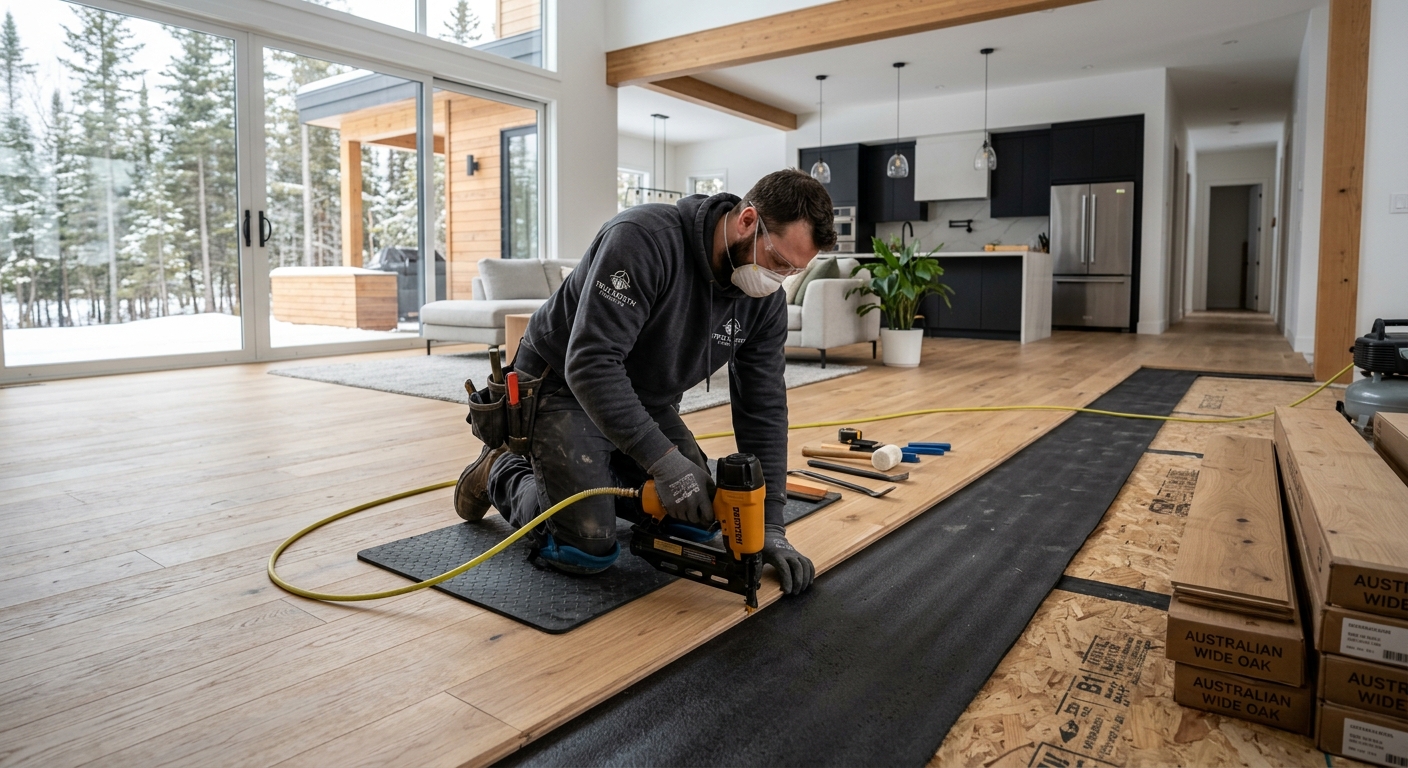
Flooring options and costs in Emo
Emo, Ontario is a small community where flooring decisions are tightly linked to home type and age. With 54.3% of dwellings built before 1981 (Statistics Canada, 2021 Census), many homes have older subfloors that need levelling, patching, and sometimes a plywood or OSB underlayment layer before new flooring can sit flat. That prep work can add a noticeable line item before you even pick the finish, especially in rooms with uneven joists or soft spots.
In Northwest Ontario, costs are also influenced by our indoor humidity swings: winters are long and cold, while summers can get humid. Solid hardwood moves with that seasonal change, which is why it’s usually limited to above-grade rooms. Engineered hardwood and luxury vinyl plank (LVP) are popular in Emo because their stable cores and click systems tolerate normal movement better, and they’re more forgiving when a home has minor below-grade moisture risk. For homeowners near the trail-and-lake areas where people spend more time indoors in shoulder seasons, comfort and easier maintenance matter too—especially in high-traffic living spaces.
In Emo, installs are especially in demand around the core residential areas where older bungalows are being updated room-by-room—commonly kitchens and living/dining spaces first. From there, the biggest cost variables tend to be subfloor prep and moisture-safe material selection. Use the comparison below to quickly budget per square foot, then we’ll break down what drives the final quote.
| Type |
Best Room |
Moisture Resistance |
Lifespan |
Price per sq ft |
| Solid hardwood (nail-down, above grade only) |
Living/dining, bedrooms (not basements) |
Low to moderate (humidity-sensitive) |
25–60 years |
$12–$20 |
| Engineered hardwood (float or glue, above + on-grade) |
Living/dining, master, secondary rooms |
Moderate to high (more stable than solid) |
20–40 years |
$11–$18 |
| Laminate (click-lock, above-grade) |
Bedrooms, living spaces (dry areas) |
Moderate (water can still damage edges) |
10–25 years |
$6–$12 |
| Luxury vinyl plank / LVP (waterproof, any level) |
Kitchen, hallways, basement (finished) |
High to waterproof |
15–25 years |
$6–$13 |
| Porcelain / ceramic tile |
Bathrooms, kitchens, entries |
High (with proper underlayment) |
25–50 years |
$15–$30 |
| Carpet (broadloom or modular tile) |
Bedrooms, rec rooms (comfort-focused) |
Low to moderate (moisture must be managed) |
5–15 years |
$5–$10 |
Prices are estimates only and vary by project scope, site access and material selection.
What affects the price of flooring in Emo
Two homeowners in Emo can receive very different quotes for what sounds like the same floor, and it’s not unusual to see a 30–50% spread across Northwest Ontario. The big reasons are technical prep (especially subfloors), moisture conditions below the finished surface, and how far the installer has to go to get the surface flat and stable enough for your chosen product.
Indoor humidity swings are the key driver here. Solid hardwood expands and contracts with moisture and temperature, so it’s a poor fit for basements and for homes sitting on concrete where vapour can migrate. In contrast, engineered hardwood and luxury vinyl plank (LVP) are designed to tolerate seasonal movement far better, and LVP’s waterproof construction makes it a safer call in finished basements. Cold regions also favour radiant heat compatibility: many solid hardwood options are limited, while engineered wood, LVP and tile generally work well over in-floor heating circuits.
Older local housing stock is another cost lever. With 54.3% of homes built before 1981 (Statistics Canada, 2021 Census), uneven joists and dated subfloors are common. Levelling, patching and OSB/plywood overlay can add roughly $1–$4 per sq ft before the finish goes down. That prep is why one quote might land closer to laminate/vinyl plank pricing (often in the $6–$12 band), while another rises toward engineered or tile once the underlayment and moisture protections are included.
Concrete examples I see in Emo: (1) a living room that measures “straight and level” on paper but has dips from older boards—once we prep for flatness, labour jumps; (2) a basement where moisture testing changes the system—if a vapour barrier and waterproof flooring are used, you may pay more up front than carpet, but you reduce the risk of cupping and adhesive failure.
| Price Factor |
Why It Matters |
Cost Impact |
| Room area in sq ft |
Materials and labour scale directly with square footage |
Low areas still pay trip/minimums; larger jobs spread fixed costs |
| Subfloor condition — levelling or repair needed before install |
Older bungalows often need patching/overlay to meet flatness |
Can add material + labour; commonly increases cost by $1–$4/sq ft |
| Moisture / below-grade install — rules out solid hardwood |
Vapour migration and humidity swings require appropriate systems |
May increase cost if moisture testing + barriers + waterproof products are needed |
| Material choice — solid vs. engineered vs. LVP vs. tile |
Different cores and assemblies handle moisture/heat differently |
Shifts the finish price band (e.g., tile often $15–$30; LVP often $6–$13) |
| Removal and disposal of existing flooring |
Existing underlay, staples, and old adhesive take time to remove |
Often adds several hours and disposal fees; can noticeably change the quote |
| Stair nosing / transitions — charged per step or per linear foot |
Transitions cost more than straight runs |
Can add a chunk for hallways, stairs, and doorways |
| Radiant heat compatibility — limits material options |
Some products need specific approvals and underlayment |
May increase cost by requiring a compatible engineered wood, LVP or tile assembly |
| Installation method — float vs. glue-down vs. nail-down |
Labour intensity and tooling requirements differ |
Nail-down and glue-down typically take more labour than floating systems |
Permits & regulations in Ontario
In Ontario, the flooring installation itself typically does not require a building permit. However, the associated work that comes with some flooring projects can trigger permit requirements—especially when you’re altering electrical systems or making structural changes. For example, if your scope includes structural subfloor repair, moisture remediation with significant remediation work, or work tied directly to in-floor heating circuits, electrical permitting may be required for portions of the job.
In condominiums (and sometimes in townhomes with common-element rules), you also need to follow the corporation’s sound transmission requirements. Upper-floor hard flooring is often regulated through sound rules (commonly framed through STC/IIC targets) and may require specific underlay or a contractor-approved product system. Always review the condo declaration and request board approval in writing before installing hardwood or tile on above-grade floors in a multi-unit building.
How to verify your contractor in Emo, step-by-step:
- Confirm they carry valid liability insurance—request a certificate of insurance listing the insured parties and project address.
- Ask for proof of coverage for workers (WSIB/WCB) and verify it’s active for the current work period.
- Verify Ontario licensing where applicable to their trade category, and ensure the quote is from the same legal entity on the insurance paperwork.
- Request a clearance letter/coverage confirmation if anything is unclear (especially if they’re subcontracting removal or subfloor work).
- For higher-risk scopes (basements, radiant heat, or any electrical tie-in), confirm who is responsible for permits and inspections, if required.
Best flooring for each room in your Emo home
Choosing the right flooring in Emo is mostly about matching the material to moisture exposure, traffic, and comfort—because our older housing stock and Northwest indoor humidity swings can quickly reveal the wrong choice. For living and dining areas, engineered hardwood is a strong “all-season” option: it delivers warmth like wood but handles seasonal movement better than solid hardwood. If you want a lower-cost look, high-quality laminate is workable on above-grade floors, but it still needs careful edge protection around wet cleanup.
For the master bedroom, carpet (broadloom or modular tile) often wins on comfort and sound absorption, especially in homes where you’re minimizing echoes during long winters. In the kitchen, luxury vinyl plank (LVP) or large-format porcelain tile makes the most sense because spills and routine cleaning don’t threaten the surface the way they can with wood finishes. In finished basements, LVP is the clear winner: it’s waterproof, tolerates below-grade installs far better than solid wood, and helps avoid the cupping and adhesion failures that can show up with moisture pressure.
Bathrooms should be porcelain or ceramic tile only, installed with the right waterproofing approach for the wet zone. If you’re installing over radiant heat, confirm compatibility: many solid hardwood options are limited, while engineered wood, LVP and tile are more commonly radiant-compatible.
As a practical budget example: if you compare carpet at $5–$10 per sq ft to engineered hardwood closer to $12–$20, the higher spend is usually justified in high-traffic areas you want to keep for decades—but many homeowners still put carpet in bedrooms for comfort.
| Room |
Best Material |
Why |
Moisture Risk |
Price Band per sq ft |
| Living / dining room |
Engineered hardwood |
Warm, durable finish that tolerates seasonal movement better than solid |
Low (as long as above-grade humidity is managed) |
$11–$18 |
| Master bedroom |
Carpet or engineered hardwood |
Carpet adds comfort and sound control; engineered maintains a cleaner, longer-wearing surface |
Low |
$5–$18 |
| Secondary bedrooms |
High-quality laminate or carpet |
Cost-effective and easy to live with; carpet is forgiving for knocks and noise |
Low |
$5–$12 |
| Kitchen |
Luxury vinyl plank (LVP) or porcelain tile |
Excellent cleanability and water tolerance around sinks and quick spills |
Moderate (spills happen; manage them quickly) |
$6–$30 |
| Basement (finished) |
LVP (waterproof) |
Handles moisture vapour and below-grade conditions better than solid wood or most laminate |
Higher (needs moisture-safe system and proper prep) |
$6–$13 |
| Bathroom |
Porcelain / ceramic tile |
Designed for wet areas; long-lasting when installed with correct waterproofing |
High |
$15–$30 |
How to choose a flooring contractor in Emo
In Emo and the Northwest, a good installer makes or breaks your outcome—especially because subfloor prep and moisture-safe assemblies are where projects succeed. Start by verifying the essentials: an Ontario-appropriate licence (where their trade requires it), active liability insurance, and current WSIB/WCB coverage for their workers. You can check insurance by requesting a certificate of insurance (COI) that matches the company name doing the work, and you can verify WSIB/WCB status by asking for proof/certificates or a clearance letter. If they can’t produce documentation or answer clearly, that’s a warning sign.
Next, ask for 2–3 itemised written quotes. You want a breakdown that separates labour, removal/disposal, subfloor work (levelling/plywood/OSB/patching), underlay/vapour barrier, transitions, and the actual floor materials. Avoid lump sums that hide prep costs—those are the quotes that can jump by thousands once we get into the existing subfloor. Also confirm what’s excluded: does disposal include stairs? Is permit pull included if you’re connecting radiant heat or addressing electrical-related scope?
Warranty matters too. Ask for the workmanship warranty length, how it’s handled if there’s a product issue, and whether the manufacturer warranty is transferable. For payment, a safe rule is never more than 10–15% upfront; keep a holdback until the job is fully complete and inspected. Finally, get the start date and completion estimate in writing so seasonal weather delays are factored realistically.
- Request their insurance COI and WSIB/WCB proof before signing.
- Confirm the legal company name on the quote matches the insurance and contract.
- Insist on an itemised quote: labour, materials, underlay/vapour barrier, and transitions.
- Ask what subfloor flatness standard they aim for and how they handle dips.
- Clarify whether moisture testing is included for basements.
- Confirm removal scope (including underlay staples) and disposal included.
- Ask how they manage humidity conditioning of flooring before installation.
- Get a written timeline: start date, milestones, and completion estimate.
- Review the transition plan: stair nosing, thresholds, and door jamb trimming.
- Know the warranty terms: workmanship vs. manufacturer, and what voids coverage.
- Set a payment schedule with a holdback until completion.
- Check how they protect floors, stairs, and walls during demo and install.
Red flags I see with flooring contractors in Emo: quotes that don’t include disposal or subfloor prep details, refusal to provide insurance/WSIB documents, vague “luxury vinyl included” language without specifying underlayment/vapour protection, no written start date or completion estimate, and warranties explained only verbally.
Frequently asked questions — flooring in Emo
What is luxury vinyl plank and is it worth it in Emo?
Luxury vinyl plank (LVP) is a synthetic flooring with a wear layer on top, a printed look layer, and a stable core that can be designed to be waterproof. In Emo and the Northwest of Ontario, it’s often worth it because our basement and slab-on-grade areas can see moisture pressure and strong humidity swings through the year. LVP is also easier to maintain than carpet and far less fussy than solid hardwood around routine spills. If you’re budgeting, LVP typically lands in the $6–$13 per sq ft band, which can be a better value than moving up to tile in kitchens and basements. Just make sure your contractor addresses subfloor flatness and uses the correct vapour/moisture steps where needed.
How much does flooring cost in Emo?
In Emo, flooring costs depend on both the finish and the prep work required to get your subfloor ready. As a starting point for homeowners: laminate and many vinyl plank installs often sit around the $6–$12 per sq ft band, while hardwood and engineered floors commonly fall higher—hardwood typically around $12–$20. Tile is usually the most expensive finish choice, often in the $15–$30 per sq ft range. Installation on top of that can also shift with labour scope. Because 54.3% of local homes were built before 1981 (Statistics Canada, 2021 Census), subfloor levelling/patching is frequently required, which can add before-finish cost. The fastest way to get an accurate total is an itemised quote that separates removal, prep, underlayment/vapour barrier, transitions, and material selection.
Hardwood vs laminate vs vinyl plank — which is best?
“Best” depends on the room and moisture exposure. Solid hardwood is beautiful, but it’s usually best limited to above-grade spaces in Ontario because it expands/contracts with indoor humidity. Laminate is more budget-friendly and can work well above grade, but water intrusion at seams or swelling from spills is the common failure point. Luxury vinyl plank is often the top practical pick for Emo because many LVP products are waterproof and tolerate seasonal movement better, including in finished basements when paired with proper moisture-safe prep. If you want a simple rule: bedrooms and living rooms often favour engineered hardwood or laminate; kitchens and basements often favour LVP. Cost-wise, if you’re starting around $6–$12 per sq ft, vinyl/laminate can stretch the budget, while hardwood options typically price closer to $12–$20 per sq ft.
What flooring is best for a Emo basement?
For a basement in Emo, I typically recommend luxury vinyl plank (LVP) because it’s waterproof and more tolerant of below-grade moisture vapour than solid hardwood and most laminate systems. With our Northwest climate, indoor humidity swings and winter condensation risks make moisture management important, especially in older homes. The “best floor” still depends on prep: your contractor should address subfloor flatness, use appropriate vapour barrier/underlayment where needed, and ideally test moisture before installing. Carpet can be comfortable, but it’s usually a higher risk choice for basements unless moisture is very well controlled. If you’re comparing budgets, LVP commonly falls around the $6–$13 per sq ft band, while tile tends to be higher at $15–$30 per sq ft. For many homeowners, the added waterproofing value of LVP is the smarter long-term spend.
Can I install hardwood over concrete?
Yes in some cases, but “hardwood” matters. Solid hardwood is generally limited to above-grade installations and doesn’t perform well over concrete where moisture and vapour can migrate—so it’s rarely the right call for slab-on-grade or below-grade areas in Emo. Engineered hardwood is the more suitable option for concrete because many engineered products are designed to handle normal seasonal movement and can be installed appropriately (floating with a proper system or glue-down with correct adhesives). The contractor’s job is to assess the concrete moisture conditions and verify whether a vapour barrier and underlayment are required for your specific product. If there’s active moisture risk, switching to LVP or tile is often the safer route. For many homeowners, that avoids future issues like cupping or edge swelling that can show up when concrete moisture isn’t controlled.
How long does flooring installation take?
Timing depends on floor type, room complexity (stairs, transitions), and prep needs like levelling or plywood/OSB overlay. A straightforward above-grade installation in a small Emo home might take a few days from start to finish, while multi-room projects commonly take a week or longer once you include removal and prep. Basements typically add time because moisture assessment, vapour barrier steps, and subfloor correction are often required before the finish goes down. Also, older housing stock (54.3% pre-1981 in Emo area, Statistics Canada, 2021 Census) can extend timelines if we uncover uneven subfloors or damaged areas that need repair. Ask your contractor for a written schedule with start date and completion estimate, and make sure the quote states what’s included—so delays from prep don’t become surprises.