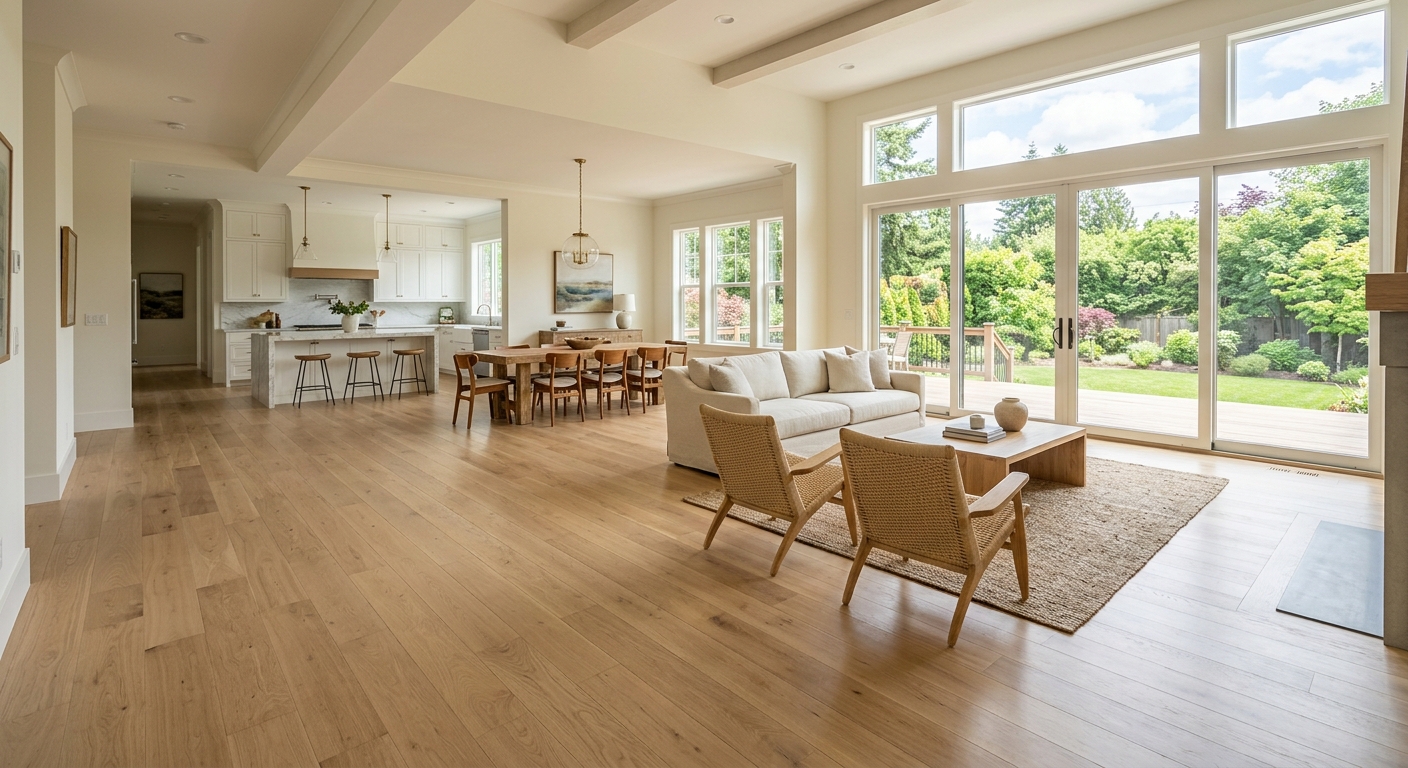
Flooring options and costs in Cherry Hill
In Cherry Hill, Ontario, the right flooring choice usually comes down to balancing looks with stability. With a population of 3,027 (Statistics Canada, 2021 Census), Cherry Hill is small enough that contractor availability can feel tight during peak renovation season, which is one reason labour rates in the Toronto area can stay firm. At the same time, much of the housing stock in the wider Toronto market includes older homes that commonly need subfloor levelling, plywood replacement, or moisture mitigation before new flooring goes down—especially when switching from dated finishes to modern hard-surface flooring. That prep work can add a meaningful line item even if you’re selecting a mid-range material.
Toronto-area indoor conditions also matter. Across seasons, you can see wide indoor humidity swings, and that’s where Ontario quotes start to diverge. Solid hardwood is beautiful, but it expands and contracts with humidity and is risky over concrete and in basements. Engineered hardwood and luxury vinyl plank (LVP) are typically more dimensionally stable and are specifically designed for challenging installs, including higher-humidity areas and below-grade spaces.
In Cherry Hill neighbourhoods like the older residential pockets closer to the St. Thomas Road and downtown corridor, finishes and renovations often move in cycles—so demand is especially strong for contractors who can handle subfloor prep and moisture checks on 1960s–1990s-era homes. From there, it’s easiest to compare options side-by-side, so you can see what drives your budget before you talk numbers with installers.
| Type |
Best Room |
Moisture Resistance |
Lifespan |
Price per sq ft |
Price Range |
| Solid hardwood (nail-down, above grade only) |
Living / dining, hallways |
Low (humidity-sensitive; avoid basements/over concrete) |
25–50 years |
$9–$18 |
$9,000–$18,000 |
| Engineered hardwood (float or glue, above + on-grade) |
Living / dining, bedrooms |
Medium to high (more stable with humidity) |
20–35 years |
$10–$16 |
$10,000–$16,000 |
| Laminate (click-lock, above-grade) |
Bedrooms, living rooms (not bathrooms) |
Low to medium (edges/standing water can swell) |
10–20 years |
$4–$9 |
$4,000–$9,000 |
| Luxury vinyl plank / LVP (waterproof, any level) |
Kitchens, basements, main floors |
High (waterproof core; handles below-grade better) |
15–25 years |
$5–$10 |
$5,000–$10,000 |
| Porcelain / ceramic tile |
Bathrooms, kitchens, entryways |
Very high (tile is impervious; grout maintenance applies) |
25–50 years |
$12–$25 |
$12,000–$25,000 |
| Carpet (broadloom or modular tile) |
Bedrooms, rec rooms |
Medium (needs clean subfloor; avoid moisture-prone areas) |
7–15 years |
$4–$9 (install varies) |
$4,000–$9,000 |
Prices are estimates only and vary by project scope, site access and material selection.
What affects the price of flooring in Cherry Hill
In the Toronto economic region around Cherry Hill, it’s common to see quotes for the “same” floor run 30–50% apart once you account for subfloor prep, product grade, and installation complexity. That gap isn’t usually because contractors disagree on basics—it’s because conditions in real homes vary. A job that requires only installation with a flat, dry subfloor will price very differently from one that needs levelling, plywood replacement, or moisture mitigation before materials even get delivered to site.
Toronto-area indoor humidity swings are a technical driver. Solid hardwood expands and contracts, so it can’t be safely glued or floated over concrete and performs poorly in basements. Engineered hardwood and LVP are more dimensionally stable and are made for above-grade and on-grade installs; LVP is the better call where below-grade moisture vapour is a concern. In colder Ontario homes, radiant floor heating is increasingly common in new custom builds and renovations, which often limits your choices—solid hardwood is frequently not recommended over heat cycles, while engineered wood, tile, and many vinyl systems are more compatible.
Older regional housing stock also changes cost. If you’re on a 1960s–1990s-era subfloor, levelling and repairs often add $1–$4 per sq ft to your scope before your main material is installed. For example, switching from laminate at roughly $4–$9 per sq ft to engineered hardwood or LVP may look like a jump, but the added stability can reduce risk of callbacks after seasonal humidity changes. Likewise, tile at $12–$25 per sq ft can be a better long-term value when paired with proper prep, especially in kitchens and bathrooms where water and cleaning demands are constant.
| Price Factor |
Why It Matters |
Cost Impact |
| Room area in sq ft |
Material quantity, waste factor, and labour time scale with square footage |
Most direct driver |
| Subfloor condition |
Levelling compound, plywood replacement, or spot repairs must be done before flooring |
Often adds $1–$4/sq ft |
| Moisture / below-grade install |
Solid hardwood is humidity-sensitive; below-grade vapour typically favours engineered/LVP |
May add moisture mitigation system costs |
| Material choice |
Hardwood vs engineered vs LVP vs tile changes both material price and labour complexity |
Can shift total by 20–60% |
| Removal and disposal of existing flooring |
Asbestos-free confirmation, underlay removal, and hauling disposal fees affect scope |
Commonly adds a noticeable line item |
| Stair nosing / transitions |
Steps and door transitions are labour-intensive and priced per step or linear foot |
Frequently $50–$200+ per feature |
| Radiant heat compatibility |
Heat cycles limit solid hardwood and some laminate options; engineered/tile often work better |
May increase material cost but reduce failure risk |
| Installation method |
Float vs glue-down vs nail-down changes labour time and substrate requirements |
Nail-down/glue-down usually costs more |
Permits & regulations in Ontario
In Ontario, installing new flooring by itself usually does not require a building permit. Replacing flooring surfaces, adding underlay, and fitting trim typically fall under “finishing work” rather than structural or major building changes. However, associated work can require permits—especially when you’re touching electrical circuits for radiant heating or altering elements that affect structure or safety.
Where permits may be required includes: installing or modifying in-floor heating that connects to electrical circuits (often requiring an electrical permit and inspection), and any electrical work that changes wiring or panel connections. If your project includes moisture remediation that involves mechanical systems, plumbing adjustments, or substantial alterations to the structure, your contractor should confirm what applies before starting.
For condominiums in the Toronto area, the bigger “rule” is often the corporation’s sound-transmission requirements. Upper-floor installs may require specific underlay systems to meet STC/IIC expectations. Always review the condo declaration and request written board approval when required—particularly before installing hardwood or tile where underlay selection and subfloor prep impact impact-noise performance.
To verify your contractor in Cherry Hill, Ontario: check licensing status online, request a certificate of insurance (liability) matching the project address, and confirm WSIB coverage (or the applicable WCB coverage for the company). Ask for clearance letters or proof of coverage documentation before work begins—reputable installers won’t hesitate to provide these.
Best flooring for each room in your Cherry Hill home
Choosing the best flooring by room is the fastest way to get a result that holds up to Cherry Hill’s Ontario reality: temperature shifts, seasonal indoor humidity swings, and the day-to-day cleaning demands of family life. For living and dining areas, engineered hardwood or high-quality laminate can deliver warmth and style while handling typical seasonal changes more reliably than solid hardwood. If your home has radiant floor heating in a renovation or newer build, engineered wood is often the more compatible hardwood option, while tile and certain vinyl systems are also widely used with heat.
In a master bedroom, comfort matters. Carpet is a practical choice for sound absorption and underfoot warmth, especially in cooler months, while engineered hardwood is a good option if allergies or pet dander are a concern and you prefer easier maintenance. Kitchens benefit from luxury vinyl plank (LVP) or large-format porcelain tile. LVP is forgiving with spills and quick clean-ups, and tile is unmatched for water exposure and long-term wear.
Basements in this region are where you’re most likely to see humidity-related callbacks. LVP is typically the clear winner for finished basements because it’s waterproof and better suited for below-grade installs than solid wood or most laminate. For bathrooms, porcelain or ceramic tile only is the safest match for water management. If you’re paying for upgrades, a straightforward example is this: moving from laminate at about $4–$9 per sq ft to LVP in a basement can be a “justified spend” when you factor in moisture resilience, since laminate edges can be vulnerable even when the main surface looks fine.
| Room |
Best Material |
Why |
Moisture Risk |
Price Band per sq ft |
| Living / dining room |
Engineered hardwood |
Warm feel, good stability through seasonal humidity swings |
Low |
$9–$16 |
| Master bedroom |
Carpet or engineered hardwood |
Comfort and sound control, with optional durable hard-surface |
Low |
$4–$16 |
| Secondary bedrooms |
Carpet or laminate |
Budget-friendly comfort or a durable click-lock option |
Low |
$4–$9 |
| Kitchen |
Luxury vinyl plank (LVP) or porcelain tile |
Easy cleaning, spill tolerance, strong daily wear performance |
Medium |
$5–$25 |
| Basement (finished) |
Luxury vinyl plank (waterproof) |
Better for below-grade moisture vapour and common slab conditions |
High |
$5–$10 |
| Bathroom |
Porcelain / ceramic tile |
Water resistance and long-term durability |
Very high |
$12–$25 |
How to choose a flooring contractor in Cherry Hill
Choosing the right flooring contractor in Cherry Hill, Ontario starts with proof, not promises. First, verify Ontario licensing where applicable to the trade and your contractor’s ability to perform the work you’re requesting. Ask for liability insurance and confirm WSIB/WCB coverage (depending on the company structure). You should be able to see a current certificate of insurance naming the business and confirming coverage for the period of work; for WSIB/WCB, request documentation or clearance letters showing the account is in good standing.
Next, get 2–3 itemised written quotes. You want a materials-and-labour breakdown (including underlay, adhesive or fasteners where relevant, subfloor levelling items, moisture mitigation if needed, and floor transitions). Avoid quotes that only state a single lump sum without clarifying what’s included and excluded.
Read the scope line-by-line. Are removal and disposal included? Is subfloor prep included (and what level of levelling)? Is the permit pull included if radiant heat or related electrical work is part of the project? Confirm who is responsible for site protection, baseboard/trim handling, and final cleanup. Ask about warranty coverage: workmanship warranty length, manufacturer warranty terms, and whether warranties are transferable to you if you sell your home.
For payment schedule, never pay more than 10–15% upfront. Hold back the remainder until the job is complete and defects are corrected. And insist on a start date and completion estimate in writing—seasonal demand in the Toronto area can shift timelines quickly.
- Check for current insurance certificates and confirm the address/job scope matches
- Confirm WSIB/WCB coverage with a clearance letter or proof document
- Ask what subfloor test steps they do for moisture before installing hard flooring
- Require itemised pricing for labour, prep, and materials (not just totals)
- Clarify inclusions: removal, disposal, underlay, spacers, transitions, and trim work
- Confirm whether levelling/plywood repair is included or quoted as an allowance
- Verify that transitions and stair nosing are priced per step or per linear foot
- Ask who supplies and installs vapour barriers (where required for engineered/LVP systems)
- Get the product SKU/model number for every flooring item in writing
- Request a written warranty for workmanship (and manufacturer warranty details)
- Set a payment schedule with a clear holdback for punch-list completion
- Demand a written start date and completion timeline, plus a process for change orders
Concrete red flags in the Cherry Hill market: contractors who won’t show insurance/WSIB paperwork before booking, quotes that omit subfloor prep and moisture requirements, vague product descriptions (no model numbers/SKUs), and crews that refuse to put the timeline and scope in writing. Also be cautious if they pressure you for large upfront payments or can’t explain the installation method (float vs glue-down vs nail-down) and why it’s chosen for your subfloor.
Frequently asked questions — flooring in Cherry Hill
What is the difference between floating and glued-down flooring?
In Cherry Hill and the wider Toronto area, the “float” vs “glue-down” decision is mainly about how the planks interact with your subfloor. Floating floors (common with laminate and many engineered products) clip together and sit over an underlay—so the boards expand and contract with minimal direct bonding to the concrete or wood. Glued-down installs bond the flooring to the substrate with adhesive, which can provide a more solid feel, but it requires a very stable, well-prepped surface and careful humidity control. In homes with moisture vapour concerns (especially basements), a properly specified LVP system or engineered setup is usually safer than assuming any glue-down method works everywhere. If you’re deciding between options priced roughly around $4–$9 per sq ft (laminate band) and $9–$18 per sq ft (hardwood band), the best choice depends on your subfloor and moisture, not just the sticker price.
What flooring holds up best to pets in a Cherry Hill home?
For pets in Ontario homes—including Cherry Hill—durability and cleanability matter as much as scratch resistance. Luxury vinyl plank (LVP) is often the top pick because it’s waterproof, handles small spills and accidents well, and is generally more forgiving underfoot than many hard surfaces. High-quality engineered hardwood can also work well with pets, provided you choose a wear layer that matches your household (and that the install is moisture-appropriate). Carpet may be comfortable, but it can trap odours and stains if accidents happen, and it’s not ideal for moisture-prone basements. If your lifestyle includes frequent paw traffic and the occasional mess, the value of LVP in the $5–$10 per sq ft band is that it reduces damage from moisture events and simplifies cleanup compared with laminate or solid hardwood. For best results, ask your contractor about product ratings and the underlay setup for noise and stability.
How do I fix squeaky floors in my Cherry Hill home?
Squeaks in Cherry Hill are usually caused by movement between boards and joists, loose fasteners, or gaps where flooring meets transitions—not the flooring surface itself. If you have hardwood or engineered on a plywood subfloor, squeaks can often be reduced by identifying the exact location, then tightening screws or adding fasteners from beneath if access is available. If you’re on a slab or the floor is installed as a floating system, squeaks may come from unevenness, missing underlay support, or debris under planks—so levelling and correct underlay placement are key. Before replacing anything, a good contractor will do basic diagnosis: check for loose trim, test plank movement, and confirm whether the issue is subfloor structure vs top surface. If repairs are extensive (especially in older homes that need subfloor levelling), it can shift a budget that you expected to stay in the laminate or vinyl band ($4–$9 or $5–$10 per sq ft) into prep-related costs.
What is luxury vinyl plank and is it worth it in Cherry Hill?
Luxury vinyl plank (LVP) is a resilient flooring made with a wear layer on top and a core designed to resist moisture. In Cherry Hill, it’s often worth it because the local seasonal humidity swings and frequent basement moisture vapour issues make “water-problem” flooring decisions more important. Many LVP products are marketed as waterproof, and that matters if you have below-grade areas or you want one floor system that can handle spills, cleaning, and humidity better than solid hardwood or typical laminate. You’ll usually see LVP installed budgets in the $5–$10 per sq ft range (depending on product grade and prep), which is competitive with laminate ($4–$9) while providing better moisture tolerance than most laminate setups. If radiant floor heating is part of your plan, confirm compatibility for the specific LVP product and thickness—don’t assume all vinyl behaves the same with heat cycles. For many homeowners, LVP’s stability and reduced risk of callbacks are what justify the spend.
How much does flooring cost in Cherry Hill?
In Cherry Hill, Ontario, total flooring cost varies most by material choice and prep work. As a guide, hardwood projects often fall into the $9–$18 per sq ft band, while laminate and vinyl plank commonly land around $4–$9 and $5–$10 per sq ft respectively, and tile is typically $12–$25 per sq ft. Carpet installation is often priced around $5–$11 per sq ft depending on thickness and complexity. The big reason you’ll see different totals for the same square footage is subfloor condition: older Toronto-area homes often need levelling, plywood replacement, or moisture mitigation before installation, which can add about $1–$4 per sq ft to your prep allowance. If you’re trying to budget tightly, ask for quotes that separate labour and materials, and request a moisture check plan for basements or on-grade slabs—those details can swing the final number.
Hardwood vs laminate vs vinyl plank — which is best?
The “best” option in Cherry Hill depends on your moisture risk, room location, and how much seasonal movement you can tolerate. Solid hardwood is the most natural-looking, but it’s the least forgiving in humidity swings and it’s risky for basements and concrete. If you like the hardwood look but want stability, engineered hardwood is commonly the better middle ground, typically within the $9–$18 per sq ft budget band depending on product and prep. Laminate is usually the most budget-friendly within the $4–$9 per sq ft band, but it doesn’t handle standing water as well and can swell at edges if spills aren’t cleaned quickly. Luxury vinyl plank is often the practical “best overall” for mixed Ontario homes because it’s waterproof or water-resistant by design and tolerates high-humidity or below-grade situations better than laminate and solid wood. If you have radiant heat, confirm product compatibility—heat and expansion considerations can rule out some solid hardwood and some laminate setups. For most Cherry Hill basements, LVP tends to win on reliability.