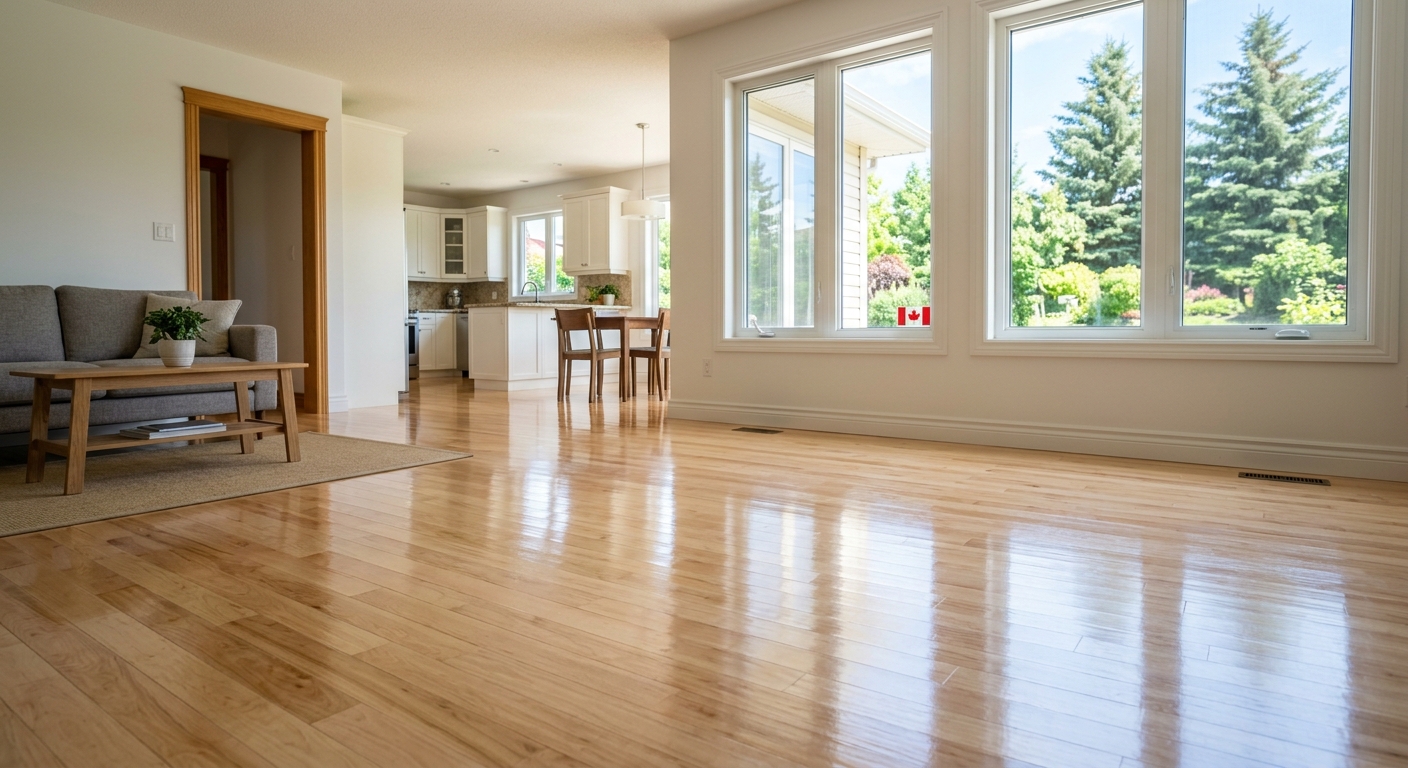
Flooring options and costs in Gloucester
In Gloucester, choosing the right flooring often starts with budgeting for both the material and the prep, especially in older parts of the Ottawa region. Gloucester’s population is 150,012 (Statistics Canada, 2021 Census), and that steady household turnover keeps trades busy—so getting an accurate measurement visit matters. Many homes here sit on mid-century layouts and later additions, which commonly means uneven subfloors, squeaky boards, or transitions that require levelling compounds or new plywood/OSB before a “finish” floor can go down. That prep phase can add several dollars per square foot depending on what’s underneath.
Cost is also shaped by Ottawa’s real-world indoor conditions: large indoor humidity swings between dry winters and humid summers. In basements and other below-grade spaces, moisture and hydrostatic pressure are common, so material choice is critical for long-term performance. Solid hardwood expands and contracts with humidity and is a poor match for basements or installs over concrete; in contrast, engineered wood and luxury vinyl plank (LVP) are more dimensionally stable. Tile remains popular for kitchens and bathrooms, and it can pair well with radiant floor heating when installed to manufacturer specifications.
In neighbourhood pockets like Rogers Farm and other established residential areas, flooring upgrades are particularly in demand because homeowners often renovate older subfloors before swapping finishes. Once you know the prep and the product category, it’s easier to compare options side-by-side—see the table for the typical price bands and performance expectations.
| Type |
Best Room |
Moisture Resistance |
Lifespan |
Price per sq ft |
| Solid hardwood (nail-down, above grade only) |
Living room, bedrooms (above grade) |
Low (avoid basements; humidity sensitive) |
20–40 years (with care) |
$11–$22 |
| Engineered hardwood (float or glue, above + on-grade) |
Living/dining, master, hallways |
Medium–High (stable with proper underlay/vapour barrier) |
15–30 years |
$12–$25 |
| Laminate (click-lock, above-grade) |
Living room, bedrooms (above grade) |
Medium (OK for dry rooms; avoid prolonged moisture) |
10–20 years |
$6–$14 |
| Luxury vinyl plank / LVP (waterproof, any level) |
Kitchen, main level, finished basement |
High (waterproof; handles humidity swings better) |
15–25 years |
$6–$16 |
| Porcelain / ceramic tile |
Kitchen, bathrooms, entry |
Very High (surface waterproof; grout/edges need good sealing habits) |
25–50 years |
$12–$25 |
| Carpet (broadloom or modular tile) |
Bedrooms, media rooms |
Low–Medium (not ideal for below-grade moisture) |
8–15 years |
$5–$11 |
Prices are estimates only and vary by project scope, site access and material selection.
What affects the price of flooring in Gloucester
In Gloucester (Ottawa region), you can see wide pricing differences even when homeowners think they’re comparing “the same flooring.” Across Ottawa and Ontario, quotes commonly vary by 30–50% because labour complexity and subfloor conditions drive costs as much as the flooring itself. Two homes may both have 1,200 sq ft to cover, but one has a flat, ready subfloor while the other needs levelling, patching, and transition work at old addition seams. Those differences show up fast in a detailed quote.
Ottawa’s indoor humidity swings are a key technical driver. In winter, dry indoor air can cause solid wood to tighten; in summer, higher humidity can cause it to loosen and expand. That’s why solid hardwood is typically restricted to above-grade installs. If you’re installing in a basement or over concrete, solid hardwood isn’t the right match—engineered hardwood and luxury vinyl plank are more stable, and they’re often the safer investment when moisture vapour is a concern. In practice, that technical constraint can also protect your budget: choosing LVP or engineered wood avoids costly rework.
Older regional housing stock frequently needs prep. For example, levelling compound and patch repair are often in the $1–$4 per sq ft range before new flooring even starts. Uneven joists and transition problems can add more. If you’re comparing material bands, laminate at $6–$14 per sq ft can look cheaper than tile at $12–$25 per sq ft, but if your kitchen has frequent water exposure and you want maximum cleanability, tile’s higher base cost can be justified. Conversely, for a dry living room above grade, engineered wood can cost near hardwood pricing while delivering better stability than solid.
| Price Factor |
Why It Matters |
Cost Impact |
| Room area in sq ft |
Material and labour scale directly with surface area |
Higher total cost on larger footprints; exact square footage reduces waste |
| Subfloor condition — levelling or repair needed |
Uneven floors require prep to meet flatness tolerances |
Often adds roughly $1–$4 per sq ft depending on repairs/compound |
| Moisture / below-grade install — rules out solid hardwood |
Below-grade moisture vapour can damage solid wood |
May shift you to engineered wood or LVP; can increase underlayment/vapour barrier costs |
| Material choice — solid vs. engineered vs. LVP vs. tile |
Different products have different install methods and tolerances |
Solid hardwood typically sits in the $11–$22 band; LVP often in the $6–$16 band; tile commonly $12–$25 |
| Removal and disposal of existing flooring |
Tearing out old flooring and hauling debris is labour-intensive |
Can add meaningful dollars, especially with glued-down flooring or tile demolition |
| Stair nosing / transitions — charged per step or per linear foot |
Transitions, finishing strips, and stair work are highly detailed |
Often increases per-linear-foot or per-step line items versus “flat floor” areas |
| Radiant heat compatibility — limits material options |
Not every product handles heat cycles or underfloor systems |
May add costs for suitable products and manufacturer-approved installation steps |
| Installation method — float vs. glue-down vs. nail-down |
Method changes subfloor prep, adhesives, and labour time |
Glue-down and nail-down often cost more in labour than floating systems |
Permits & regulations in Ontario
In Ontario, installing new flooring by itself usually does not require a building permit. However, associated work can trigger permit requirements depending on what’s being altered. For example, structural subfloor repair involving changes to framing (or work that affects load paths), any required moisture remediation that involves significant alterations, and in-floor heating circuit work can require permits—especially where electrical connections are involved.
In condominiums, the bigger constraint is often the building’s rules. Corporation requirements around sound transmission (commonly referenced through STC/IIC expectations) can restrict underlay thickness/type and may require specific underlay systems for hard flooring. Before installing hardwood or tile on upper-floor units, review the declaration and request board approval in writing if the building asks for it.
Here’s how a Gloucester homeowner can verify a contractor properly: first, confirm the installer’s Ontario business/contractor licensing status using the appropriate provincial registry search (when applicable for the trade). Next, ask for a current certificate of liability insurance—verify the policy is active and that it lists the correct jobsite address. For workers on the site, request proof of WSIB/WCB coverage (or a clearance letter, where applicable). A strong contractor will provide these documents up front and match them to your project dates and location.
Finally, don’t assume “permit handled” is automatic: ask whether permits are required for any electrical/radiant heat tie-ins and whether the permit cost is included in the quote or excluded.
Best flooring for each room in your Gloucester home
In Gloucester’s Ottawa-area climate, the best flooring choices come down to moisture risk, comfort, and how well the product tolerates indoor humidity swings. In living and dining areas, homeowners usually want a warm feel and strong wear resistance without the fragility of solid wood in fluctuating conditions. That’s why engineered hardwood or a high-quality laminate (click-lock, installed above grade) often fits well: they balance appearance, stability, and a competitive price.
For master bedrooms, carpet is still a top pick for comfort and sound absorption, particularly in older homes where footsteps travel. If you prefer hard surfaces, engineered hardwood works well above grade. In kitchens, choose luxury vinyl plank (LVP) or large-format porcelain/ceramic tile because spills are common and mop-cleaning is part of daily life; tile also resists moisture at the surface.
Basements in the Ottawa region are where moisture choices matter most. In finished below-grade spaces, LVP is the clear winner because it’s waterproof and tolerates vapour and minor moisture events better than solid hardwood and most laminate. Bathrooms are a straightforward call: porcelain or ceramic tile only, with proper underlayment and attention to grout and edges.
Radiant floor heating is increasingly common as homeowners improve energy efficiency. Most engineered wood, quality vinyl, and most tile systems can pair with radiant heat when installed to the manufacturer’s temperature and installation requirements—while many solid hardwood options are limited or not approved for heat cycles. A practical budget example: if you’re deciding between laminate at $6–$14 per sq ft and tile at $12–$25 per sq ft for a kitchen, the added tile cost is easier to justify when you want maximum water resistance and long-term durability.
| Room |
Best Material |
Why |
Moisture Risk |
Price Band per sq ft |
| Living / dining room |
Engineered hardwood |
Warm look with better dimensional stability for humidity swings |
Low (above grade) |
$11–$22 |
| Master bedroom |
Carpet or engineered hardwood |
Comfort for mornings; quieter than hard flooring |
Low (above grade) |
$5–$14 |
| Secondary bedrooms |
Laminate (premium click-lock) or carpet |
Good wear value; carpet adds sound control |
Low (above grade) |
$6–$14 |
| Kitchen |
Luxury vinyl plank (LVP) or porcelain tile |
Easy cleaning and reliable performance around spills |
Medium (spills; frequent damp mopping) |
$12–$25 |
| Basement (finished) |
Luxury vinyl plank (waterproof) |
Best tolerance for moisture vapour and below-grade conditions |
High (below grade) |
$6–$16 |
| Bathroom |
Porcelain / ceramic tile |
Water-resistant surface designed for wet areas |
Very High |
$12–$25 |
How to choose a flooring contractor in Gloucester
Choosing a contractor in Gloucester is mostly about reducing risk: verifying the business, demanding itemised pricing, and making sure the scope matches your building’s realities. Start by confirming Ontario compliance and coverage. Ask for proof of liability insurance (certificate with active dates and your jobsite). Then request WSIB/WCB coverage or a clearance letter so you know the contractor’s workers are properly covered. If your contractor can’t provide documents quickly, that’s a warning sign.
Next, get 2–3 itemised written quotes. Don’t accept a vague lump sum. You want a breakdown that separates labour from materials (including underlay/vapour barriers, adhesives, levelling compound, and stair/transition labour). Confirm what’s excluded: removal of old flooring, subfloor repairs, disposal fees, and any special prep required to meet flatness tolerances. Ask whether permits are included if you’re adding radiant heat or doing electrical tie-ins—permit-related costs shouldn’t be assumed.
Warranty matters on two levels: workmanship and product. Ask for the workmanship warranty length (and what “conditions” apply), plus the manufacturer warranty coverage and whether it’s transferable if you sell the home. Payment schedules should be conservative: never pay more than 10–15% upfront. Use a holdback tied to completion and punch-list items. Finally, insist on a start date and a completion estimate in writing so you can plan around Ottawa winter schedules and delivery windows.
- Provide proof of Ontario business status (when applicable) and willingness to show it before quoting.
- Show a current certificate of liability insurance with your job address listed or clearly described.
- Provide WSIB/WCB clearance letter or proof of coverage for workers.
- Give at least two itemised options (labour + materials) rather than one “best price.”
- Break out subfloor prep: levelling/patching, new plywood/OSB, and how flatness will be achieved.
- Specify underlay, vapour barriers, and any moisture-control layers—especially for basements.
- Include removal and disposal line items so you’re not surprised at the end.
- Clarify stair nosing and transitions pricing (per step and/or per linear foot).
- Confirm radiant heat compatibility in writing if your home has in-floor heating.
- State workmanship warranty terms and what’s covered if there’s a failure (e.g., gapping, buckling, separation).
- Provide delivery timelines and allow for seasonal material lead times.
- Use a payment schedule with a holdback until the final walk-through and cleanup are complete.
Red flags in Gloucester: (1) quoting “any condition” without discussing moisture, flatness, and underlay; (2) refusing to list material brands/models or giving only a floor total with no breakdown; (3) asking for large deposits beyond 10–15% upfront; (4) not providing insurance/WSIB paperwork; and (5) giving verbal promises about subfloor prep or disposal without putting them in the contract.
Frequently asked questions — flooring in Gloucester
How long does flooring installation take?
In Gloucester, installation time depends mainly on area size, subfloor condition, and how much prep is needed. If your subfloor is flat and dry (common in well-maintained above-grade rooms), a typical project can progress quickly—often within days for a single level. However, older Ottawa-area homes can need levelling compound or OSB/plywood repair; that prep can add time before the new floor even begins. For basements, we also plan for moisture-control steps and proper vapour barriers, which can extend the schedule. Radiant heat upgrades can add additional coordination. Ask your contractor to include a start date, completion estimate, and day-by-day dependencies in writing.
What flooring works with radiant heat?
For Ontario homes with radiant floor heating, the safest approach is to choose products that the manufacturer explicitly approves for in-floor heating and to follow their temperature limits. In practice, many engineered hardwood products and most tile systems are compatible when installed to spec, and quality vinyl (including many LVP systems) can be compatible as well. Solid hardwood is often limited because it’s more sensitive to heat-driven moisture and expansion/contraction cycles; if a product isn’t approved, it can lead to gapping or movement. Laminate can work in some cases, but not all products handle the heat output consistently. If you’re planning radiant heat, request compatibility confirmation in writing before purchasing materials—then your contractor can prep the right underlay and installation method.
Engineered vs solid hardwood — what's the difference?
Solid hardwood is one continuous piece (installed typically nail-down) and is designed for stable, above-grade environments. It’s sensitive to humidity swings—an issue in the Ottawa region where indoor humidity can vary significantly between winter and summer—so basements and concrete slabs are generally poor matches. Engineered hardwood is layered with a stable core and is usually more dimensionally stable; it can often be installed floating or glue-down on appropriate subfloors, including on-grade and many properly prepped below-grade situations. If you compare budgets, solid hardwood often sits in the $11–$22 per sq ft band, while engineered options can land near or slightly above that depending on thickness and wear layer. For Gloucester homes with moisture concerns, engineered hardwood is usually the more resilient choice.
Do I need to level my subfloor first?
Often, yes—at least to the tolerance required by your flooring system. In Gloucester and the wider Ottawa region, older home layouts and uneven addition seams can create dips, high spots, or uneven transitions that telegraph through the finished floor. Laminate and LVP can be more forgiving than some hardwood installs, but they still require a flat, stable base to avoid joint separation, clicking noise, or premature wear. Tile generally demands very careful flatness as well because uneven subfloors can lead to cracked grout lines or loose tiles. Your contractor should measure flatness and propose the exact prep plan—levelling compound, sanding, or repairing/adding plywood/OSB—rather than guessing. In many cases, levelling/repair prep can add roughly $1–$4 per sq ft depending on what’s found.
What's the most durable flooring for pets and kids?
For pets and kids in Gloucester, durability usually means resisting scratches, handling moisture from spills, and tolerating daily wear. Luxury vinyl plank (LVP) is often the practical “best all-rounder” for families because it’s typically waterproof and easier to maintain if accidents happen—making it especially useful in basements. If you prefer hard flooring in living spaces, consider engineered hardwood with a strong wear layer, but still keep moisture expectations in check. Tile is also extremely durable for high-traffic areas, particularly kitchens and bathrooms, and it handles water well. Carpet offers comfort and falls are kinder, but it can be harder to protect from ongoing moisture exposure; it’s best in above-grade bedrooms rather than below-grade areas. On price, LVP commonly falls in the $6–$16 per sq ft band, while tile often lands in $12–$25 per sq ft—worth it when you want maximum resilience.
How do I choose flooring for humidity in Gloucester?
Start with location within your home. Above-grade rooms tolerate more variation, but basements and below-grade areas need extra caution because moisture and hydrostatic pressure can be present even if you don’t see visible leaks. In Gloucester’s Ottawa-region climate, indoor humidity swings between dry winters and humid summers make solid hardwood a risky choice outside above-grade installs. For basements, prioritize products that are dimensionally stable and moisture-tolerant—engineered wood can be viable when installed to manufacturer requirements, and waterproof LVP is usually the safest option. For tile, moisture doesn’t damage the surface, but proper underlayment and edging details still matter. If you’re installing radiant heat, confirm the temperature compatibility too. A good quote will include a moisture-control plan (vapour barrier/underlay choices) rather than treating humidity as an afterthought.