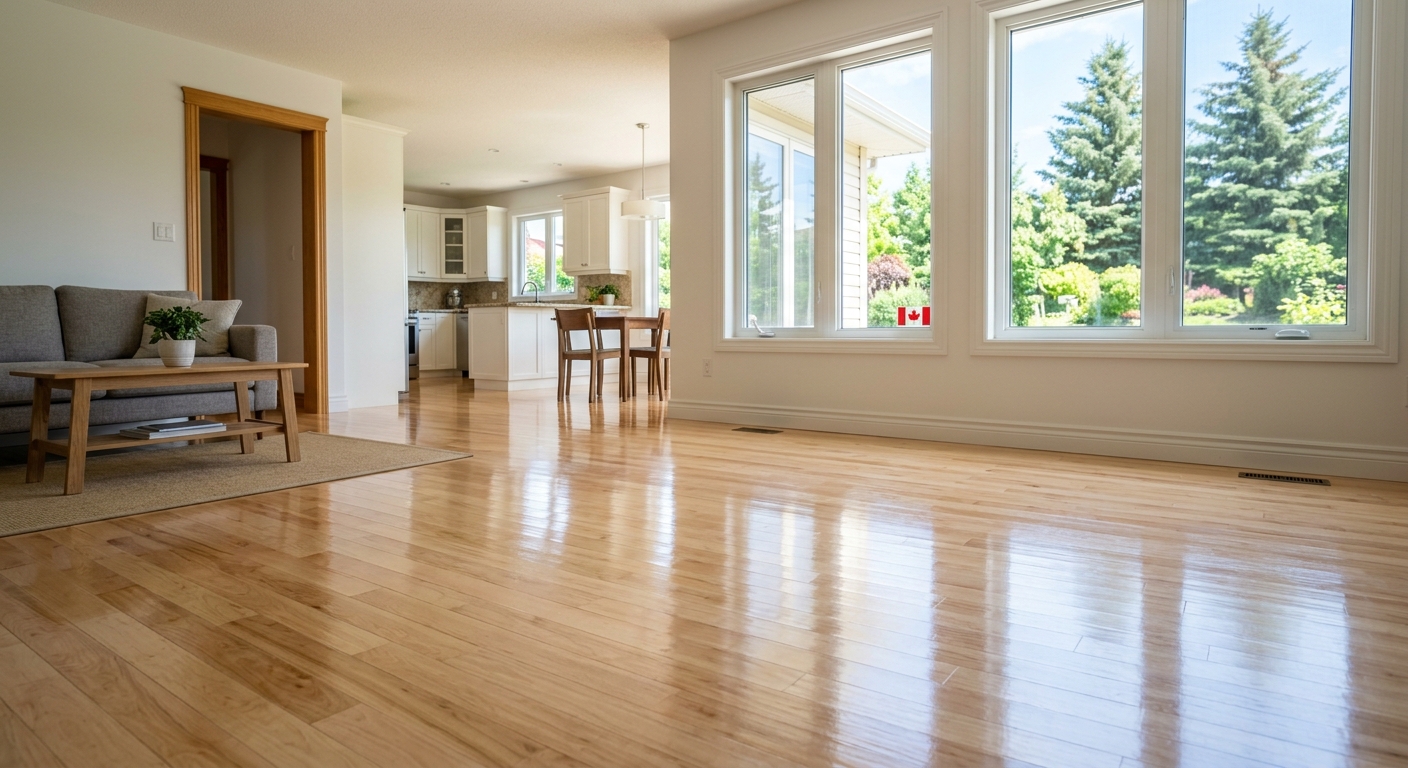
Flooring options and costs in Waterford
Waterford homeowners typically find they’re choosing flooring in the middle of a Toronto-area renovation market—busy contractors, competitive product pricing, and a climate that creates real performance differences between materials. With a population of 3,132 (Statistics Canada, 2021 Census), Waterford may be smaller than the GTA core, but local trades still price off the same broader labour and material reality. And just like in many nearby communities, a lot of homes in the Toronto region were built from the 1960s to 1990s, which often means you may need subfloor levelling, plywood replacement, or moisture mitigation before any new surface goes in.
That prep work can be a meaningful part of your budget even when you choose a mid-range finish: levelling and repairs commonly add roughly $1 to $4 per sq ft, and in some cases more if there’s water damage or significant height differences. Toronto-area humidity swings—wet seasons, drying indoor heat, then back again—are a big reason we steer many clients toward engineered hardwood or luxury vinyl plank. Solid hardwood can be beautiful, but it expands and contracts more, so it’s a higher-risk choice over concrete and in basements. If you’re working in a newer custom home where radiant floor heating is present, engineered products and many LVP or tile systems tend to pair more reliably than traditional solid hardwood.
If you’re in and around well-travelled residential pockets like central Waterford and the broader commuter corridors, this trade activity is especially common. The next table breaks down typical options and what each one tends to cost per square foot.
| Type |
Best Room |
Moisture Resistance |
Lifespan |
Price per sq ft |
| Solid hardwood (nail-down, above grade only) |
Living / dining, hallways (above-grade) |
Low to moderate (not for basements or direct concrete) |
25–50 years |
$9,–$18 |
| Engineered hardwood (float or glue, above + on-grade) |
Living / dining, bedrooms (above-grade) |
Moderate to high (better with humidity swings) |
20–35 years |
$10,–$17 |
| Laminate (click-lock, above-grade) |
Bedrooms, living areas (dry zones) |
Moderate (depends on core + underlay) |
10–25 years |
$4,–$9 |
| Luxury vinyl plank / LVP (waterproof, any level) |
Kitchen, main floor, finished basement |
High (waterproof surface; handle vapour better) |
15–25 years |
$5,–$11 |
| Porcelain / ceramic tile |
Kitchen, bathrooms, entryways |
Very high (tile itself is water-resistant) |
25–50 years |
$12,–$25 |
| Carpet (broadloom or modular tile) |
Master and secondary bedrooms |
Low to moderate (needs good moisture management) |
8–15 years |
$5,–$11 |
Prices are estimates only and vary by project scope, site access and material selection.
What affects the price of flooring in Waterford
In Waterford, quotes for the same “room size, same product name” can still land 30–50% apart across the Toronto region. The biggest reasons are technical: how challenging your subfloor is, how moisture is managed (especially if you’re below grade), and what labour tasks are included—removal, levelling, transitions, and floor prep. On top of that, renovation demand around the Toronto economic region keeps labour rates firm, so installers can’t always “absorb” extra prep time the way they might in slower seasons.
Toronto-area indoor humidity swings drive costs because some materials tolerate it better than others. Solid hardwood expands and contracts with humidity and can’t be glued or floated over concrete; it also performs poorly in basements where moisture vapour is common. That’s why engineered hardwood and luxury vinyl plank are often priced competitively for real-world installs: they’re built to handle humidity changes and are more appropriate for below-grade and high-moisture conditions than traditional solid wood.
Older regional housing stock frequently needs levelling or repairs—commonly $1 to $4 per sq ft added just to make the surface ready. In Waterford, you may see cost differences like: a “starter” laminate job that looks inexpensive on paper can become closer to LVP once levelling and underlay are included; a tile install jumps quickly if you need substrate repair and additional mortar coverage. Conversely, LVP can stay cost-effective when the existing floor is reasonably flat, because it’s fast to install and tolerates moisture better—helpful if you’re finishing a basement where solid wood and most laminate struggle.
Budgeting in bands helps: mid-range options like LVP at roughly $5,–$11 per sq ft can look very different from tile at $12,–$25 per sq ft once prep, transitions, and labour intensity are counted.
| Price Factor |
Why It Matters |
Cost Impact |
| Room area in sq ft |
Direct driver of material quantity and working hours |
Higher area increases both product and labour totals |
| Subfloor condition — levelling or repair needed before install |
Old floors may be out of plane, damaged, or uneven |
Often adds a noticeable line item (commonly $1 to $4 per sq ft) |
| Moisture / below-grade install — rules out solid hardwood |
Basements and on-grade concrete create moisture/vapour challenges |
May require vapour mitigation and more suitable materials (engineered/LVP/tile) |
| Material choice — solid vs. engineered vs. LVP vs. tile |
Different price bands and install complexity |
Can separate a job by several thousand dollars |
| Removal and disposal of existing flooring |
Tile and older assemblies can be labour-heavy and messy |
Can increase labour cost and add disposal fees |
| Stair nosing / transitions — charged per step or per linear foot |
Edges, steps, and door thresholds require specialised trims |
Often adds cost that surprises homeowners |
| Radiant heat compatibility — limits material options |
Heat and expansion must be managed safely and predictably |
May require specific underlay or engineered/tile/LVP products |
| Installation method — float vs. glue-down vs. nail-down |
Different adhesives/fasteners and different labour time |
Glue-down and nail-down can cost more than floating installs |
Permits & regulations in Ontario
In Ontario, installing flooring itself generally does not require a building permit. That means most typical surface work—removing existing flooring, preparing the subfloor, and installing laminate, engineered hardwood, LVP, carpet, or tile—is handled under the scope of regular contracting rather than a municipal permit process.
Where permitting can come up is with associated work that touches building systems. If you’re doing structural subfloor replacement, significant reconstruction of joists/subfloor framing, or moisture remediation involving major substrate changes, the project may require additional approvals depending on the extent. If your renovation includes radiant floor heating circuit work (or modifications to existing in-floor heating wiring), electrical permitting requirements can apply. In condominiums, there’s also often a non-permit approval route: the corporation’s rules may limit what underlay you can use for sound control and may require specific STC/IIC-compliant products for hard flooring installed above other units.
Step-by-step, here’s how a homeowner in Waterford should verify a contractor’s standing before signing:
- Ask for the Ontario contractor licence details (and confirm the scope matches the work you’re purchasing).
- Request a current certificate of liability insurance showing the contractor’s coverage and effective dates.
- Request proof of WSIB/WCB coverage (or the applicable exemption paperwork, if claimed).
- Get it in writing: include insurance and coverage details in the contract or add them as attachments.
- For condos, request board approval guidance in writing before installing hard surface floors.
It’s better to ask early than to discover gaps after materials are ordered.
Best flooring for each room in your Waterford home
Choosing flooring room-by-room works well in Waterford because Toronto-area conditions create both comfort and performance demands: humidity swings through the seasons, and many homes sit over crawlspaces or concrete that can transmit moisture vapour. Living and dining areas see moderate daily water exposure (from shoes, mopping habits), so engineered hardwood or high-quality laminate can be a great balance of warmth and durability. For bedrooms, comfort matters—carpet is still the best at sound absorption and underfoot softness, while engineered hardwood is a strong choice if you have allergies or prefer easier cleaning.
Kitchens take the biggest day-to-day hit: spills, wet mopping, and occasional high moisture. Luxury vinyl plank (LVP) is usually the safest “real-life” option because it’s waterproof and handles routine cleanup without the risk solid hardwood faces. For bathrooms, porcelain or ceramic tile is the right call—tile systems manage water reliably when installed with proper waterproofing practices at the right interfaces.
Basements are where Waterford homeowners most often regret the wrong material. Solid hardwood and most laminate can be risky over concrete and in below-grade moisture conditions. LVP is the clear winner for finished basements because it’s designed for below-grade installs and typically tolerates vapour better—assuming you still use correct subfloor prep. If you have (or plan for) radiant floor heating, engineered wood, tile, and many LVP systems are typically more compatible than traditional solid hardwood due to heat expansion considerations.
Example: if your choice is between laminate at roughly $4,–$9 per sq ft and LVP at about $5,–$11, spending the extra few dollars can be justified in a kitchen or basement where moisture tolerance protects your investment.
| Room |
Best Material |
Why |
Moisture Risk |
Price Band per sq ft |
| Living / dining room |
Engineered hardwood |
Warm look with better stability through humidity swings |
Low to moderate |
$10,–$17 |
| Master bedroom |
Carpet or engineered hardwood |
Carpet adds comfort and sound control; engineered is easier to maintain |
Low |
$5,–$11 |
| Secondary bedrooms |
Laminate |
Durable enough for daily wear and typically lower-cost than wood options |
Low to moderate |
$4,–$9 |
| Kitchen |
Luxury vinyl plank (LVP) or porcelain tile |
LVP is waterproof and forgiving for spills; tile is long-lasting for heavy messes |
Moderate |
$5,–$11 |
| Basement (finished) |
LVP |
Designed for below-grade installs and moisture vapour conditions |
High (needs good prep) |
$5,–$11 |
| Bathroom |
Porcelain / ceramic tile |
Water-resistant surface with proven performance when properly installed |
Very high |
$12,–$25 |
How to choose a flooring contractor in Waterford
In Waterford, picking the right flooring contractor is less about flashy ads and more about verifying coverage, clarity, and workmanship. Start by confirming Ontario licensing details (where applicable to the contractor’s business), then ask for liability insurance and proof of WSIB/WCB coverage. You should be able to view current certificates and coverage dates before work begins—don’t accept “we have it” without documentation.
Next, get 2 to 3 itemised written quotes that separate labour and materials, and that call out prep work. The quote should specify what’s included in the scope: subfloor prep/levelling, patching, underlay (if required), transitions, trim, and whether removal and disposal are included. If radiant floor heating is part of the plan, ensure the quote references compatible product/installation instructions.
Warranty matters too. Ask for the workmanship warranty length (how long the installer stands behind installation defects) and what the manufacturer warranty covers for the product itself. Confirm whether the warranty is transferable if you sell the home—this can matter to future buyers.
For payment, never pay more than 10 to 15% upfront. Hold back a portion until completion and final clean-up. Also lock in your timeline: the start date and estimated completion should be in writing so you’re not left waiting on materials or labour in a season when contractors are busiest.
- Ask for certificate of insurance and proof of WSIB/WCB coverage.
- Verify coverage dates are current (not expired screenshots).
- Require a written, itemised quote (labour line items and material line items).
- Ensure subfloor prep scope is explicit (levelling/plywood repair/vapour mitigation).
- Confirm underlay details for laminate and any required moisture protection.
- Ask who handles removal and disposal, and where debris goes.
- Clarify stair nosing and transition pricing (per step/linear foot).
- Get start date and completion estimate in writing.
- Confirm warranty terms: workmanship, product, and transferability.
- Review how changes are priced if unexpected subfloor issues are found.
- Put payment schedule in writing (10–15% max upfront; holdback at end).
- Check that the contract includes protection for walls, doors, and stairs.
Red flags in Waterford include: refusing to provide proof of WSIB/WCB, giving only lump-sum pricing with no line items, skipping mention of subfloor prep despite older home conditions, pressuring you for large upfront payments, and offering a short or vague warranty with no written details.
Frequently asked questions — flooring in Waterford
What flooring holds up best to pets in a Waterford home?
For most Waterford homes with pets, luxury vinyl plank (LVP) is the front-runner. It’s waterproof on the surface and tends to be more forgiving if there are occasional spills, muddy paw traffic, or fast clean-ups after accidents—important in a Toronto-area climate with humidity swings and seasonal wetness. Many pet owners choose LVP in the mid band (about $5,–$11 per sq ft) because it offers better real-world durability than laminate when accidents happen. If you prefer a natural look, engineered hardwood can work, but you still need good mats and prompt cleanup because moisture exposure can affect any wood-based floor. For pet claws, look for thicker wear layers and a more rigid core, and plan for felt pads and routine trimming.
How do I fix squeaky floors in my Waterford home?
Squeaks usually aren’t the “flooring” itself—they’re typically from movement in the subfloor system (joists, fasteners, or spacing) or from an underlayment gap. In older Toronto-region homes, it’s common to discover loose fasteners after removal of carpet or laminate. The best fix is to locate the source by walking the area, then address the subfloor movement: adding or tightening fasteners, correcting gaps, or replacing damaged plywood/OSB. If the squeak is coming from the surface you can see, the right approach depends on the existing assembly—carpet underlay issues differ from laminate click joints, and nail-down methods differ from floating installs. Because humidity can change how materials sit, it’s also wise to fix squeaks before new flooring so the new surface doesn’t telegraph movement.
What is luxury vinyl plank and is it worth it in Waterford?
Luxury vinyl plank (LVP) is a multi-layer vinyl floor with a wear layer on top. In Waterford and the wider Toronto area, LVP is often worth it because it’s designed for moisture exposure and below-grade conditions more effectively than laminate and solid hardwood. With the region’s indoor humidity swings and many homes over concrete or with older subfloor assemblies, LVP’s dimensional stability and waterproof surface can reduce the risk of cupping, gapping, and swelling. If you’re comparing costs, LVP often sits around $5,–$11 per sq ft, which can be only slightly higher than laminate in the $4,–$9 range—but the performance gap matters most in kitchens and basements. The “worth it” decision is usually about protecting your investment against real moisture events.
How much does flooring cost in Waterford?
For Waterford homes, total pricing varies based on room size, subfloor prep, and material choice, but typical installed price bands line up with the wider Toronto region. Laminate and many vinyl plank options commonly land around $4,–$9 per sq ft for laminate and $5,–$11 for LVP, depending on the product tier and the complexity of your install. Hardwood and tile are higher: engineered hardwood often falls in the $9,–$18 range depending on thickness and brand, while porcelain/ceramic tile is commonly $12,–$25 per sq ft due to labour intensity. Don’t forget prep—older housing stock may require levelling or plywood replacement, which can add a meaningful line item even before you buy finish materials.
Hardwood vs laminate vs vinyl plank — which is best?
“Best” depends on where the floor is going and how your home behaves. Solid hardwood is beautiful, but in Waterford/Ontario’s humidity swings it’s safest above grade only; it also can be risky over concrete and in basements. Engineered hardwood offers a more stable wood option for many main-floor installs, and it’s often a better match if you want a wood look. Laminate is cost-effective (often around $4,–$9 per sq ft), but it’s more sensitive to standing water and subfloor moisture than LVP. Luxury vinyl plank is usually the most forgiving overall for busy households, kitchens, and finished basements because it’s waterproof on the surface and handles below-grade installations more reliably (typically $5,–$11 per sq ft). If you want the lowest risk in moisture-prone areas, vinyl usually wins.
What flooring is best for a Waterford basement?
For most Waterford basements, luxury vinyl plank (LVP) is the best overall choice. Basements can have higher moisture vapour levels, and Ontario’s climate makes it common to experience seasonal humidity changes that affect materials. Solid hardwood and most laminate can struggle in these conditions—solid wood is especially risky over concrete and in below-grade moisture. LVP is typically built to handle moisture vapour and below-grade installs better, which is why many owners choose it for finished basements. If your basement is truly dry and well controlled, some engineered systems may work on the right subfloor preparation, but LVP remains the safest “default” for performance. Budget-wise, LVP often sits in the $5,–$11 per sq ft range, with any additional cost coming from levelling, prep, and transitions rather than basic material limitations.