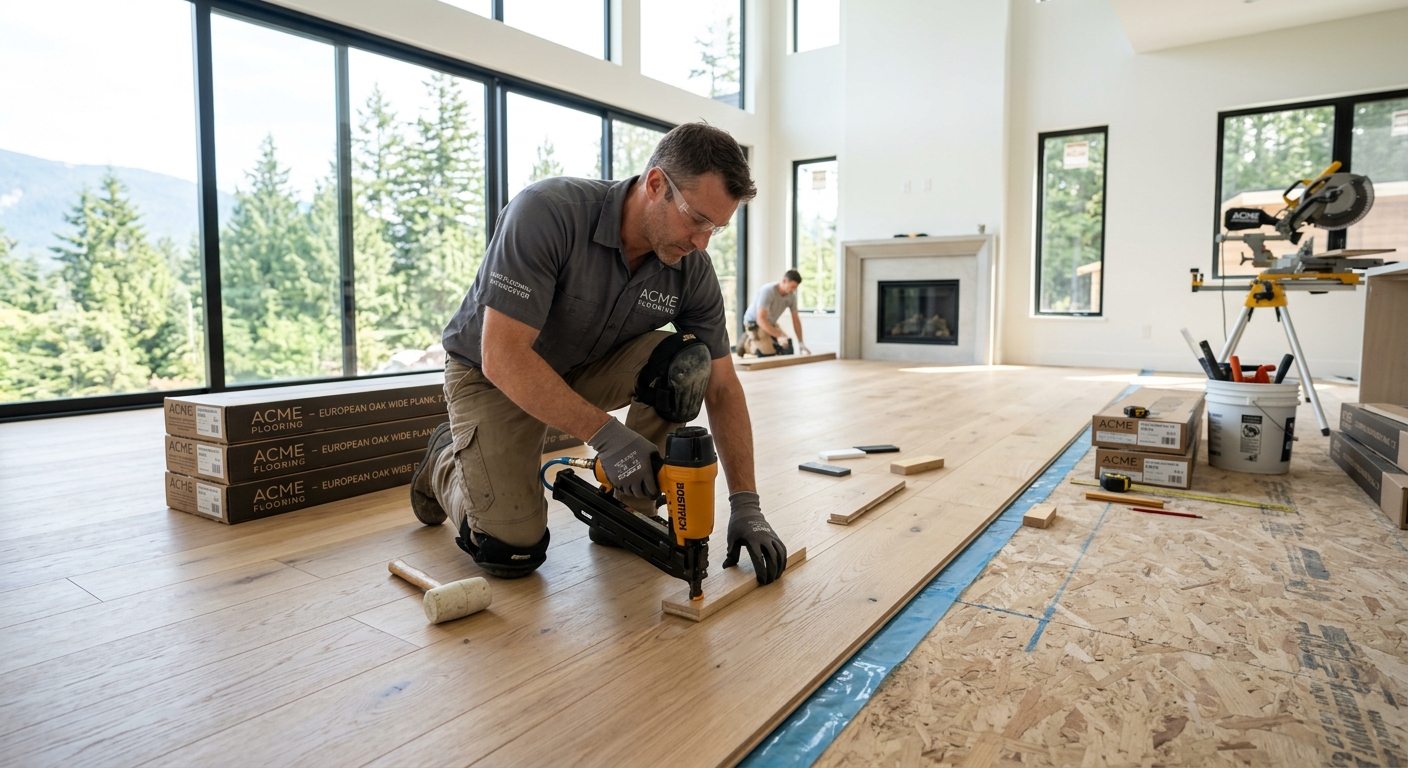
Flooring options and costs in Mattawa
Mattawa homeowners usually choose flooring with both comfort and winter practicality in mind. With 1,881 residents in 2021 (Statistics Canada, 2021 Census) and 64.9% of households owning their homes, many projects are focused on long-term upgrades rather than quick cosmetic changes. One big cost driver is that 78.9% of dwellings were built before 1981 (Statistics Canada, 2021 Census), so it’s common to encounter older subfloors that need levelling, patching, or moisture checks before the new surface goes down.
In the Northeast Ontario climate, humidity swings and seasonal temperature changes affect how materials expand and contract. That’s why solid hardwood—while beautiful—often needs tighter indoor moisture control and is usually limited to above-grade installs. Engineered hardwood and luxury vinyl plank (LVP) are more forgiving when indoor humidity fluctuates, and they’re typically easier to install over the “real-world” subfloors found in older housing stock. Costs can also be influenced by jobsite access (driveways, parking, and stairs), plus labour availability in smaller towns where trades may have to schedule around multiple neighbourhood jobs. In Mattawa, the trade often sees steady demand around the more established residential areas where renovations are replacing dated flooring in living levels and entryways.
Below is a practical cost comparison to help you budget before you request quotes, then we’ll walk through what pushes your total up or down depending on your room and subfloor conditions.
| Type |
Best Room |
Moisture Resistance |
Lifespan |
Price per sq ft |
| Solid hardwood (nail-down, above grade only) |
Main floor living areas |
Low to moderate (not basement-friendly) |
25–60 years |
$11,50 – $18,00 |
| Engineered hardwood (float or glue, above + on-grade) |
Living rooms, bedrooms |
Moderate (better with humidity swings) |
20–40 years |
$10,00 – $16,00 |
| Laminate (click-lock, above-grade) |
Living areas, hallways |
Moderate (protect joints; avoid standing water) |
10–25 years |
$4,50 – $9,50 |
| Luxury vinyl plank / LVP (waterproof, any level) |
Kitchen, finished basement |
High (waterproof core) |
15–25 years |
$6,00 – $10,00 |
| Porcelain / ceramic tile |
Kitchen, bath, entries |
High (with proper underlayment and grout) |
20–50 years |
$12,00 – $22,00 |
| Carpet (broadloom or modular tile) |
Bedrooms, lower-traffic areas |
Low to moderate (sensitive to dampness) |
6–12 years |
$5,00 – $8,00 |
Prices are estimates only and vary by project scope, site access and material selection.
What affects the price of flooring in Mattawa
Even when homeowners request the “same flooring,” Mattawa quotes can differ by 30–50% across Northeastern Ontario job sites because the real cost lives in preparation. In an older housing market—where many homes were built before 1981—subfloors often aren’t flat enough for modern click-lock products, and moisture testing can uncover surprises that require remediation. That extra work affects labour hours, patching/leveler material, and sometimes underlayment choices.
Technical factors are decisive in this region. Indoor humidity swings cause solid hardwood to expand and contract; for that reason, solid boards are generally limited to above-grade installs where moisture can be managed. Basements and slab areas introduce below-grade moisture risk, and solid hardwood typically can’t be glued or floated over concrete in a way that controls long-term movement. Engineered hardwood handles humidity changes far better, and LVP is a strong choice because waterproof cores can tolerate damp subfloor conditions more reliably. Cold-weather homes also increasingly use radiant heat, which is compatible with many engineered floors and many LVP options, but it tends to rule out some solid hardwood and certain laminate constructions.
Two practical Mattawa examples: (1) if your subfloor needs levelling and repair, it commonly adds about $1–$4 per sq ft to the install before flooring even starts; (2) if the job includes removing old flooring and disposing of it, your labour cost rises—especially when there’s tile or built-up layers. That’s why a project that looks like “carpet at the budget rate” (roughly $3–$8/sq ft for installation in the broader Northeast tier) can still land higher once prep and transitions are included. Likewise, upgrading from laminate (often $4–$10/sq ft) to LVP can be justified because you’re buying protection against moisture and easier maintenance in kitchens and finished basements.
| Price Factor |
Why It Matters |
Cost Impact |
| Room area in sq ft |
Material quantity and labour hours scale directly with coverage |
Lower per-sq-ft pricing on larger, straightforward rooms; higher waste on small layouts |
| Subfloor condition |
Levelling or repair is often required in older homes |
Often adds roughly $1–$4 per sq ft when prep is needed |
| Moisture / below-grade install |
Determines which materials are suitable and which underlayments are required |
Solid hardwood typically excluded for basements; remediation adds labour and products |
| Material choice |
Solid vs engineered vs LVP vs tile have different performance and install requirements |
Hardwood/tile generally increase costs versus laminate/LVP; LVP adds value where moisture risk exists |
| Removal and disposal of existing flooring |
Old flooring removal can be time-intensive, especially with adhesives and underlayments |
Can add significant labour and dump fees on multi-layer floors |
| Stair nosing / transitions |
Custom edges and correct transitions are charged separately |
Often charged per step or per linear foot; impacts total even on small areas |
| Radiant heat compatibility |
Limits product selection for stable performance |
May increase material cost if you choose radiant-compatible options |
| Installation method |
Float vs glue-down vs nail-down changes labour time and substrate prep |
Glue-down and tile prep usually costs more than straightforward floating installs |
Permits & regulations in Ontario
In Ontario, installing new flooring by itself generally does not require a building permit. That said, some associated work can trigger permit or code requirements—especially where wiring, structural changes, or in-floor heating circuits are involved. For example, if your project includes electrical work such as connecting or modifying heated flooring controls, upgrading circuits, or making changes that require electrical inspection, you may need an electrical permit handled by a licensed electrician. If you’re doing more extensive subfloor repair, moisture remediation, or structural-level adjustments (for instance, changes that affect load-bearing framing), that may involve additional oversight depending on what’s being altered.
In condominiums, permits aren’t usually the issue for the flooring itself, but the corporation’s rules are. Sound transmission requirements (often discussed in terms of STC/IIC performance) and restrictions on underlay can affect what you can install on upper floors. Always review the condo declaration and obtain board approval in writing before installing hardwood or tile above grade in a multi-unit building—this helps avoid costly removal if the underlay or installation method doesn’t meet the building’s requirements.
To verify a contractor in Mattawa, start by confirming the flooring contractor has the right Ontario business and trade credentials for the work they’re doing, then request their certificate of insurance. Ask for WSIB/WCB coverage evidence (or a clearance letter, depending on their status) before work begins. Finally, obtain liability coverage proof and keep it on file with your contract. When in doubt, ask for clear documentation in advance so you’re not scrambling mid-project.
Best flooring for each room in your Mattawa home
Choosing the best flooring for each room in Mattawa comes down to matching traffic, moisture exposure, and comfort to the material’s real-world behaviour during Northeastern Ontario temperature and humidity swings. For living and dining areas, homeowners typically want warmth underfoot and a durable surface—engineered hardwood or high-quality laminate fit that goal without the same movement sensitivity as solid hardwood. In master bedrooms, comfort and sound matter; carpet is popular for a softer feel and quieter steps, while engineered hardwood is a great upgrade if you want a more uniform look.
Kitchens and entryways see more spills and cleaning. Luxury vinyl plank (LVP) is often the practical pick because it’s waterproof and easier to maintain, and it handles seasonal moisture better than laminate. Large-format porcelain tile is another excellent option where you want maximum water resistance and a long service life, especially in higher-use zones. For basements (particularly older homes), LVP is usually the clear winner because many installations are on or below grade, and waterproof performance is what you’re paying for. Bathrooms should be porcelain or ceramic tile only, with correct installation to manage water at grout and joints.
Radiant heat compatibility is also worth discussing for rooms over in-floor heating, which is increasingly used in Ontario. While solid hardwood may be limited, engineered and many LVP systems are designed to perform with heat cycles. If you’re comparing budgets, the price gap can be meaningful: laminate might land around $4,50 – $9,50 per sq ft, while LVP often sits closer to $6,00 – $10,00 per sq ft—but in kitchens and basements, the extra cost is often justified by moisture tolerance and fewer “early failure” issues.
| Room |
Best Material |
Why |
Moisture Risk |
Price Band per sq ft |
| Living / dining room |
Engineered hardwood or laminate |
Warm look, good durability, less movement sensitivity than solid |
Low to moderate (manage indoor humidity) |
$4,50 – $16,00 |
| Master bedroom |
Carpet or engineered hardwood |
Comfort and sound absorption, or a clean, low-maintenance surface |
Low (avoid damp basements) |
$5,00 – $16,00 |
| Secondary bedrooms |
Carpet or laminate |
Cost-effective comfort; laminate withstands daily wear |
Low |
$3,50 – $9,50 |
| Kitchen |
Luxury vinyl plank or porcelain tile |
Handles spills, easier cleaning, protects subfloor from moisture |
Moderate to high |
$6,00 – $22,00 |
| Basement (finished) |
Luxury vinyl plank |
Waterproof core suited to below-grade moisture conditions |
High (vapour and seasonal dampness) |
$6,00 – $10,00 |
| Bathroom |
Porcelain / ceramic tile |
Excellent water resistance when installed with proper underlayment |
High |
$12,00 – $22,00 |
How to choose a flooring contractor in Mattawa
Choosing the right flooring contractor in Mattawa starts with verification, not just price. Ask for their Ontario business details and confirm they carry liability insurance with a current certificate. Next, request proof of WSIB/WCB coverage (or a clearance letter, depending on their circumstances). You want this before any materials are delivered or demo begins, so you’re protected if an injury happens on site.
Then get 2–3 itemised written quotes. A good quote breaks labour and materials into line items (removal, subfloor prep/levelling, underlayment, transitions, installation, and disposal). Avoid “all-in” figures that don’t show what’s included, because exclusions are where cost creep happens. Carefully read the scope: is permit work included (if electrical work is part of radiant heat), is disposal included, and what’s excluded if you discover additional subfloor issues after demo? Make sure the warranty details are spelled out—workmanship warranty length, product/manufacturer warranty terms, and whether it’s transferable to you if you sell the home.
For payment schedule, never agree to more than about 10% to 15% upfront for typical residential projects, and hold a reasonable portion until completion and final walkthrough. Finally, insist on a start date and completion estimate in writing so you can plan around winter conditions and indoor humidity control during install.
- Confirm liability insurance certificate is current and matches the business name on the contract.
- Verify WSIB/WCB coverage or request the appropriate clearance letter before work starts.
- Request 2–3 itemised quotes with labour and materials separated.
- Ask what’s included in subfloor prep (levelling, patching, moisture checks) and what triggers extra costs.
- Confirm underlayment details (type, thickness, and where it’s required) for laminate/LVP.
- Make sure transitions and stair nosing are priced per step or per linear foot, if applicable.
- Clarify disposal and dump fees for removed flooring and underlayments.
- Get the timeline in writing: start date, milestones, and a completion target.
- Ask how humidity and acclimation are managed for wood products during installation.
- Confirm warranty coverage for both workmanship and materials, including exclusions.
- Check whether the installer is responsible for final alignment and finishing details (edges, caulking, transitions).
- Avoid contractors who won’t provide documentation or who rush you into signing without a scope review.
Red flags I often see in smaller-market flooring deals: contractors who won’t show insurance or WSIB/WCB proof, quotes that omit subfloor prep and then “discover” fees after demo, unclear warranty terms (especially for workmanship), payment requests above 15% upfront, and no written installation timeline—particularly risky when you’re installing wood or when indoor humidity needs to be managed in an older Mattawa home.
Frequently asked questions — flooring in Mattawa
How do I prepare my subfloor before new flooring?
In Mattawa, preparation matters because older homes can have uneven surfaces and sometimes hidden moisture issues. Before installation, the subfloor should be cleaned and assessed for flatness and damage. If your contractor finds high spots or low areas, they typically use patching compounds or self-levelling products to create an even plane, then let it cure fully before anything goes down. For wood products, humidity control is key; solid hardwood usually needs above-grade conditions where indoor moisture is stable. For basements, waterproof LVP is often chosen because it tolerates moisture vapour and damp subfloor conditions better than solid wood or most laminate. If you’re replacing an older floor built prior to 1981, plan for additional prep because that’s when levelling is most common (Statistics Canada, 2021 Census).
Is cork or bamboo flooring a good choice in Mattawa?
Cork can be a comfortable, quieter surface, and bamboo is a fast-growing “hard” option—but both still have limits in Mattawa’s Northeastern Ontario climate. Cork is sensitive to sustained dampness, and bamboo behaves like other wood-based products when indoor humidity swings. That means cork or bamboo can work best on the main floor above grade, where the home can be kept at a stable indoor humidity level year-round. If you’re considering a basement install, LVP is usually the more reliable call because it’s waterproof and handles below-grade moisture conditions better. On the cost side, wood alternatives often don’t land in the same practical band as laminate or LVP; homeowners who want durability in moisture-prone areas typically compare the jump from laminate (often around $4,50 – $9,50/sq ft) to LVP (often around $6,00 – $10,00/sq ft) and choose the waterproof option for peace of mind.
What is the difference between floating and glued-down flooring?
Floating flooring is installed as a “floating” system: planks or boards lock together and sit over an underlayment without being mechanically fastened to the subfloor. Because it moves slightly with temperature and humidity, it needs the subfloor to be level and properly prepared, but it doesn’t require adhesives over the entire surface. Glued-down flooring uses adhesive to bond the material to the subfloor, which can reduce movement but usually increases prep requirements—your concrete or subfloor needs to be clean, stable, and ready for the right adhesive system. In Ontario, and especially in older Mattawa homes, moisture and flatness are common deciding factors. Solid hardwood is often nail-down above grade only, while engineered wood and LVP are typically available as floating or glue-down styles, depending on the product. If radiant heat is present, make sure the installation method and product are rated for it.
What flooring holds up best to pets in a Mattawa home?
For many Mattawa households with pets, luxury vinyl plank (LVP) is the most forgiving choice because it’s waterproof and resilient under daily accidents. It also tends to handle humidity swings better than solid hardwood, which is important in homes built earlier in the housing stock. If your pets shed a lot or you’re concerned about odours, LVP’s easy clean-up is a practical advantage. Laminate can work in living areas, but you must protect the seams from spills and prolonged dampness. Carpet offers warmth and comfort and can be good in bedrooms, but in households with frequent messes, it’s more demanding because dampness can linger and damage backing. If you want a budget-friendly yet durable approach, homeowners often start in the laminate band (roughly $4,50 – $9,50/sq ft), but for basements or moisture-prone zones they commonly move up to LVP around $6,00 – $10,00/sq ft for better performance.
How do I fix squeaky floors in my Mattawa home?
Squeaks usually come from friction between subfloor layers, loose fasteners, or joists that move slightly with foot traffic. The best fix depends on where the squeak originates—sometimes it’s the top surface (like an old underlayment) and sometimes it’s deeper in the assembly. Before installing new flooring, have your contractor identify the squeak location: one common approach is to walk and mark squeak points, then inspect for gaps, loose subfloor panels, or missing nails/screws. In some cases, adding fasteners or addressing a loose subfloor layer can stop the noise without removing the whole floor. If your floor squeaks are tied to joists, the fix may require structural adjustments or adding subfloor thickness from above/below, which is more involved. Because Mattawa’s older housing stock (78.9% built before 1981) can include layered assemblies, prep work can be essential; don’t assume the installer will “cover it up” during installation.
What is luxury vinyl plank and is it worth it in Mattawa?
Luxury vinyl plank (LVP) is a synthetic flooring system designed with a waterproof core, usually topped with a wear layer that resists scuffs and everyday scratches. In Mattawa, it’s often worth it because it tolerates moisture vapour and below-grade conditions far better than solid hardwood and many laminate products. That matters in older homes where basements may have seasonal dampness and where subfloor prep can vary. LVP also installs in a way that can be more forgiving over slightly imperfect surfaces, and it’s typically easier to maintain after renovation. Cost-wise, LVP often sits around $6,00 – $10,00 per sq ft, compared with laminate around $4,50 – $9,50 per sq ft. The difference is commonly justified for kitchens and finished basements because “water tolerance” reduces the risk of early edge swelling, seam failure, and odour issues.