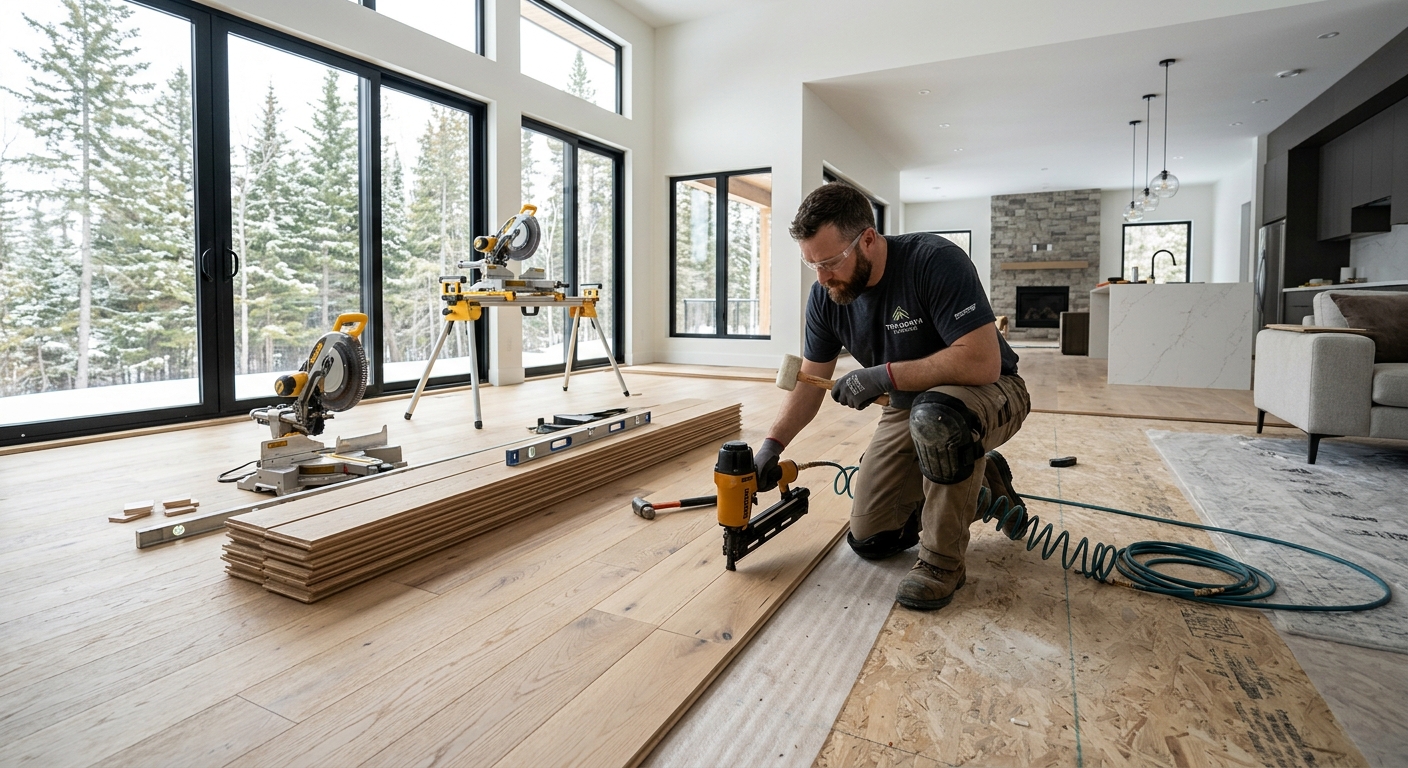
Flooring options and costs in Welland
Welland homeowners have a lot of flooring choices, but the “right” one usually comes down to moisture behaviour and basement conditions. In Welland specifically, 65.6% of homes were built before 1981 (Statistics Canada, 2021 Census), which often means older subfloors, patching, and more levelling work before you can lay hard-surface flooring. Add that to the fact that 64.5% of local dwellings are single-detached homes—typically with more full basements—and you’ll see why moisture-ready products like engineered hardwood and luxury vinyl plank (LVP) are so common.
In the Hamilton–Niagara Peninsula, humidity swings are a real cost driver: winters can be dry indoors while summers bring higher moisture and temperature cycling. Solid hardwood expands and contracts with humidity, and it’s not a good fit over concrete or in most below-grade situations. Engineered hardwood and LVP handle these conditions far better, so they tend to protect your investment and reduce callbacks. Colder-season comfort is another influence—many Welland buyers ask for radiant-heat-compatible flooring, which further favours engineered wood, many LVP options, and tile systems over traditional solid hardwood. Contractors are also busiest in older, established neighbourhoods where owners are converting from carpet to hard surfaces—areas around downtown Welland and the newer infill edges are seeing steady demand for moisture-resistant installs.
Below is a practical comparison of common materials and typical installed ranges for Welland, so you can set realistic expectations before you request quotes.
| Type |
Best Room |
Moisture Resistance |
Lifespan |
Price per sq ft |
| Solid hardwood (nail-down, above grade only) |
Main floors (not basements) |
Low to moderate; poor on below-grade or concrete |
25–60 years |
$9,00 – $18,00 |
| Engineered hardwood (float or glue, above + on-grade) |
Living areas, bedrooms, hallways |
Moderate to high; better stability in humidity swings |
20–40 years |
$10,00 – $17,00 |
| Laminate (click-lock, above-grade) |
Bedrooms, living/dining (not basements) |
Low to moderate; sensitive to prolonged moisture |
10–25 years |
$4,50 – $10,00 |
| Luxury vinyl plank / LVP (waterproof, any level) |
Above grade + finished basements |
High; suitable for moisture-vapour conditions |
15–25 years |
$6,00 – $12,00 |
| Porcelain / ceramic tile |
Kitchens, bathrooms, foyers |
Very high; handles spills and humidity well |
25–50 years |
$11,00 – $22,00 |
| Carpet (broadloom or modular tile) |
Bedrooms, media rooms |
Low to moderate; needs dry subfloor |
7–15 years |
$4,00 – $9,00 |
Prices are estimates only and vary by project scope, site access and material selection.
What affects the price of flooring in Welland
In Welland and across the Hamilton–Niagara Peninsula, two quotes for the “same” flooring type can still differ by 30% to 50%. The main reason isn’t always the material—it’s the condition of the subfloor, the amount of moisture prep required, and the complexity of transitions (doorways, stair edges, and matching heights). Ontario pricing also shifts with labour availability and how much prep work is needed to meet a flat, sound base.
Technically, the key drivers are humidity swings and below-grade moisture. Solid hardwood expands and contracts with indoor humidity, and it typically can’t be glued or floated over concrete. It also performs poorly in most basements where moisture vapour risk is higher. Engineered hardwood and luxury vinyl plank (LVP) are designed for more stable performance and are usually the safer move when you’re dealing with an older home and a basement slab or damp subfloor. Colder-season demand for radiant-heat-compatible flooring further narrows choices: many buyers can’t use solid hardwood, and some laminate products aren’t ideal over heat-cycling systems.
Older local housing stock often needs levelling or repair. In practice, that can add roughly $1–$4 per sq ft depending on whether it’s minor skim-levelling or more involved patching. For example, an average Welland living room conversion from carpet to engineered hardwood can land in the $9 to $18 per sq ft territory once levelling, underlayment, and transitions are included. Meanwhile, the same “hard surface” goal in a finished basement often becomes a better-value LVP project—commonly within a $6 to $12 per sq ft band—because it reduces moisture-related prep and tolerates below-grade conditions better.
| Price Factor |
Why It Matters |
Cost Impact |
| Room area in sq ft |
Material quantity and labour hours scale with surface area |
Large rooms are usually more cost-effective per sq ft |
| Subfloor condition — levelling or repair needed before install |
Old homes often have unevenness, squeaks, or damaged patches |
Commonly adds $1–$4 per sq ft in older Welland homes |
| Moisture / below-grade install — rules out solid hardwood |
Basements and concrete slabs need moisture-appropriate systems |
May shift you from solid to engineered or LVP, changing the total |
| Material choice — solid vs. engineered vs. LVP vs. tile |
Different materials have different material and labour requirements |
Tiles and hardwood typically cost more than laminate/LVP |
| Removal and disposal of existing flooring |
Carpet tack strips, underlay, and adhesive can be labour-intensive |
Can add a noticeable per-room charge |
| Stair nosing / transitions — charged per step or per linear foot |
Complex edges and matching heights add fabrication time |
Often increases total more than homeowners expect |
| Radiant heat compatibility — limits material options |
Not every product tolerates thermal cycling and heat output |
May require specific underlay or product selection |
| Installation method — float vs. glue-down vs. nail-down |
Prep and labour differ by system and required materials |
Glue-down or nail-down is often higher labour than floating |
Permits & regulations in Ontario
In Ontario, installing flooring by itself generally does not require a building permit. Most projects—such as removing carpet and installing laminate, LVP, engineered hardwood, or tile—are considered finishing work. However, associated work can trigger permits depending on what else you’re changing.
What typically does require a permit: electrical work tied to in-floor heating (new circuits, thermostat wiring changes, or modifications to existing electrical components). Also, if you uncover issues that require structural alterations to the subfloor framing, you may need the appropriate approvals before that portion is completed. In multi-unit buildings, condominium rules matter: sound transmission requirements (STC/IIC) and underlay specifications can restrict what you can install on upper floors, and the condo board may require written approval—especially for hard surfaces like hardwood or tile.
Step-by-step, here’s how a Welland homeowner can verify contractor compliance: first, confirm the contractor’s Ontario licence information through the appropriate online registry channels listed on their website or provided paperwork. Second, ask for a certificate of liability insurance showing current coverage for your project (and ensure the effective dates overlap your install window). Third, request proof of WSIB/WCB coverage if applicable, and look for a clearance letter or coverage statement. Finally, keep copies of everything in writing and aligned with your quote scope.
Best flooring for each room in your Welland home
The best flooring in Welland is the one that matches room-specific moisture, traffic, and comfort needs—especially with the Hamilton–Niagara Peninsula’s humidity swings and frequent basement moisture. In living and dining areas, engineered hardwood or high-quality laminate often hits the sweet spot: warm underfoot, good appearance, and better dimensional stability than solid hardwood in fluctuating indoor air. For master bedrooms, carpet remains a strong choice for comfort and sound dampening, but engineered hardwood is also popular when you want a cleaner look and easier maintenance.
Kitchens should be built for real-life spills. Luxury vinyl plank (LVP) or large-format porcelain tile is usually the most practical approach because both tolerate moisture and are easier to clean around sinks and dishwashers. In finished basements, LVP is the clear winner in most Welland homes: it’s waterproof (or very water-tolerant), typically performs better with moisture vapour risk than solid wood or many laminate products, and it helps you avoid “warping” surprises. Bathrooms should be porcelain or ceramic tile only—water exposure is consistent, and tile systems are designed for it.
Radiant heat compatibility is increasingly common in Ontario new construction and renovations. If you’re installing or updating in-floor heating, choose products explicitly rated for radiant heat so you don’t compromise performance. For a cost example: upgrading a small kitchen from laminate to LVP may move you from a lower band toward the mid-range (often the $4 to $10 band for laminate versus a higher $6 to $12 band for LVP), but the extra cost is justified by waterproof performance and fewer moisture-related issues in a Welland kitchen.
| Room |
Best Material |
Why |
Moisture Risk |
Price Band per sq ft |
| Living / dining room |
Engineered hardwood |
Warm feel with better stability for humidity swings |
Low |
$10,00 – $17,00 |
| Master bedroom |
Carpet or engineered hardwood |
Comfort and sound control (carpet) or easy maintenance (engineered) |
Low |
$6,00 – $17,00 |
| Secondary bedrooms |
Laminate or carpet |
Good value and straightforward installation for everyday use |
Low |
$4,50 – $10,00 |
| Kitchen |
LVP or large-format porcelain tile |
Handles spills and frequent cleaning |
Moderate (spills, condensation near cold-water lines) |
$6,00 – $22,00 |
| Basement (finished) |
LVP (waterproof) |
Best fit for below-grade moisture conditions and slab vapour risk |
High |
$6,00 – $12,00 |
| Bathroom |
Porcelain / ceramic tile |
Built for wet areas and easier long-term maintenance |
Very high |
$11,00 – $22,00 |
How to choose a flooring contractor in Welland
Choosing the right flooring contractor in Welland is less about the lowest price and more about proof of compliance, a clear scope, and predictable craftsmanship. Start with verification: request their Ontario licence details (or the licence/registration information they’re required to carry), then ask for a certificate of liability insurance—make sure your effective project dates are covered. Next, verify WSIB/WCB coverage where applicable by asking for proof or a clearance statement; don’t accept vague assurances. A reputable installer will provide these documents without pushing you.
Then get 2 to 3 itemised written quotes. You want a breakdown that separates labour from materials (including underlayment, moisture barrier, adhesives, tile backer boards if needed, and transitions). Avoid lump-sum quotes that don’t show what’s included. Confirm disposal and removal are listed (carpet, underlay, tack strips, or old flooring adhesive can add labour). Also check whether levelling/patching is included or billed separately if the subfloor is worse than expected.
Warranty matters on two levels: workmanship warranty length (how long they’ll fix installation issues) and the manufacturer product warranty (what happens if a plank delaminates or a tile cracks). Ask whether warranties are transferable to future owners. For payment, never pay more than 10% to 15% upfront; hold a portion back until the job is complete and you’ve inspected all rooms. Finally, insist on a written start date and completion estimate.
- Provide licence/registration info in writing and match it to the quote
- Show current liability insurance (certificate with your project dates)
- Confirm WSIB/WCB coverage with proof/clearance
- Use itemised quotes (labour, materials, underlayment/moisture barrier, transitions)
- List what’s included in removal and disposal
- Spell out exclusions (subfloor repairs beyond a defined amount, unexpected flatness issues)
- Confirm levelling plan and whether it’s included for older Welland homes
- Document floor prep requirements for basements (moisture mitigation, vapour barrier system)
- Confirm transition and stair nosing pricing method (per linear foot/step)
- Get written start and completion timelines
- Ask for workmanship warranty terms and how claims are handled
- Use a payment schedule with 10% to 15% maximum upfront, holdback on completion
Common red flags I see around Welland: vague scopes that don’t mention subfloor levelling or moisture prep, refusing to provide insurance/WSIB documentation, “free upgrade” claims that aren’t itemised, progress-payment demands with no holdback, and not explaining why a particular product is chosen for basement vs above-grade installation.
Frequently asked questions — flooring in Welland
What flooring is best for a Welland basement?
For most Welland basements, LVP is the practical top pick because it’s waterproof and tolerates below-grade moisture vapour conditions far better than solid hardwood or most laminate. In an area where many homes are older (65.6% built before 1981) (Statistics Canada, 2021 Census), you’ll often face uneven surfaces, patching, or slab moisture mitigation needs—so choosing a more moisture-tolerant system helps reduce risk. In terms of cost, many finished-basement LVP installs land in the mid-range around $6,00 – $12,00 per sq ft depending on underlayment, prep, and transition complexity. If your basement has known water issues, the foundation problem should be addressed first; flooring won’t “fix” recurring moisture.
Can I install hardwood over concrete?
In most Welland homes, you generally cannot install traditional solid hardwood over concrete. Solid nail-down hardwood is designed for above-grade wood subfloors and tends to struggle with concrete moisture and temperature/humidity swings. If you want the hardwood look on a concrete slab, engineered hardwood is usually the more suitable option—provided the slab is properly prepared, flat, and moisture conditions are acceptable. That’s also why quotes often change when you’re moving from carpet to hard surfaces: you may need levelling/repair, plus the right underlayment or glue-down system. Plan your budget accordingly; engineered hardwood in Welland commonly falls around $10,00 – $17,00 per sq ft, especially when prep work is required.
How long does flooring installation take?
Timelines vary mainly by room count, subfloor condition, and how much prep is required. In Welland, older homes (many built pre-1981) often need patching or levelling before install, which adds time before any planks or tiles go down (Statistics Canada, 2021 Census). As a practical guide, a single room like a living/dining area can be completed faster if the subfloor is already flat and dry, while multi-room jobs with transitions and basement moisture prep take longer. Tile can also extend the schedule due to layout, cutting, and curing times if thinset/backer systems are involved. If you’re switching from carpet, removal and disposal will add day time. Ask your contractor for a written start/completion estimate and confirm what the quote includes for prep, not just the surface install.
What flooring works with radiant heat?
Radiant heat compatibility is important in Ontario because the system cycles temperatures and can stress materials that aren’t rated for it. In the Hamilton–Niagara Peninsula market, buyers commonly choose engineered hardwood, many LVP products that specify radiant heat compatibility, and tile systems designed for in-floor heating. Solid hardwood is often limited because humidity expansion and thermal movement can create gaps or cupping if the product isn’t specifically rated for radiant applications. Laminate can work only if it’s explicitly approved for radiant heat and installed per manufacturer requirements (underlay matters). If your contractor is proposing a product, ask for the manufacturer’s written radiant heat rating and installation conditions. When cost planning, radiant-compatible choices often fall within the same Welland bands as above-grade installs—engineered hardwood typically $10,00 – $17,00 per sq ft, while tile is often $11,00 – $22,00 per sq ft.
Engineered vs solid hardwood — what's the difference?
Solid hardwood is one continuous piece of wood (usually installed nail-down on above-grade wood subfloors). Engineered hardwood is made in layers, with a real wood top surface bonded to plywood or wood-core layers. That layered construction helps engineered wood handle humidity swings better, which matters in Welland where winter indoor dryness and summer humidity can move more moisture than you’d expect. Solid hardwood also isn’t designed for most below-grade or concrete-slab situations. Engineered is often the better choice when you want the hardwood look in a home with basement considerations or when you’re installing near concrete. Cost-wise, engineered hardwood is often in the $10,00 – $17,00 per sq ft band, while solid hardwood projects typically sit higher at around $9,00 – $18,00 per sq ft once prep and transitions are included.
Do I need to level my subfloor first?
In most Welland renovations, yes—subfloor flatness is one of the biggest determinants of a good end result. If you’re installing LVP, laminate, or engineered hardwood, an uneven base can cause rocking, gaps, joint stress, or premature wear. For tile, excessive lippage and thinset thickness issues can lead to weak adhesion or cracking. Older homes in the Niagara region frequently need repair or levelling because of wear, old carpet underlay impressions, or earlier patchwork—especially when converting from carpet to hard surfaces. Levelling is often priced into the project, but sometimes it’s a separate line item if the extent can’t be measured until demo. As a budgeting benchmark, plan on levelling/repair commonly adding roughly $1–$4 per sq ft depending on how far out of spec the subfloor is. Always ask for a flatness plan before the install starts.