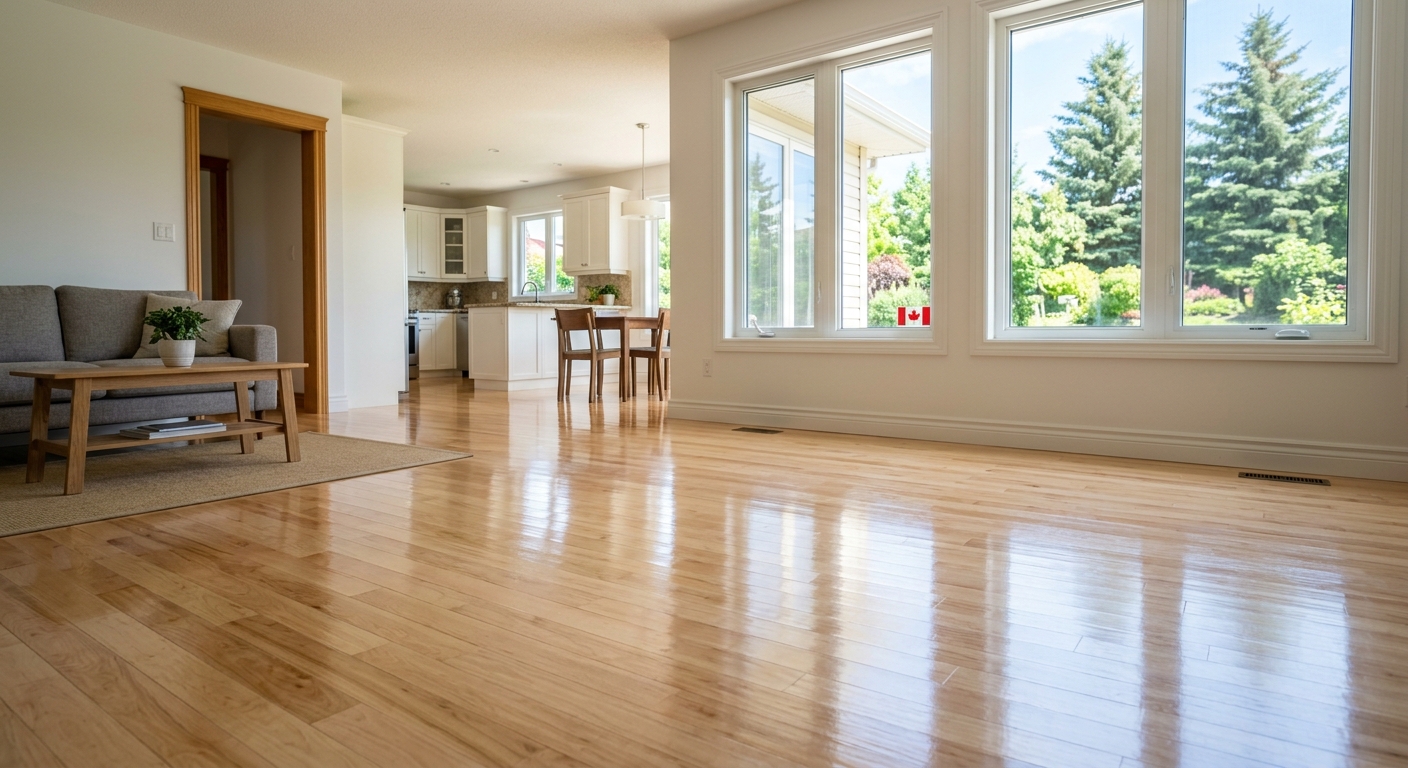
Flooring options and costs in Iroquois Falls
Iroquois Falls is a small northern community where flooring decisions are driven as much by house condition and moisture behaviour as by style. With 83.8% of homes built before 1981, many projects start with older subfloors that are uneven or worn, and that can mean levelling compound, patching, or sometimes an OSB overlay before the new material goes down. At the same time, you’ll often be working around older basements and crawlspaces where dampness can migrate upward, so “nice on the showroom floor” isn’t enough—material stability matters. (Statistics Canada, 2021 Census)
Northeast Ontario and the broader Northeast market tend to see indoor humidity swings through winter and shoulder seasons. That matters for expanding/contracting products like solid hardwood. In these conditions, solid wood is usually restricted to above-grade rooms with tighter moisture control; basements and slab areas typically favour engineered wood or luxury vinyl plank (LVP). Availability can also affect pricing: when crews have fewer days for prep work, the labour line item can rise because subfloor repair becomes a larger share of the total.
In Iroquois Falls, trades are especially in demand around residential pockets near the downtown area, where turnover and renovation cycles cluster and contractors schedule multiple jobs back-to-back. From there, most homeowners are comparing value options like laminate/LVP against longer-term finishes like engineered hardwood or porcelain tile. Use the table below as a realistic starting point for budgeting before you request itemised quotes.
| Type |
Best Room |
Moisture Resistance |
Lifespan |
Price per sq ft |
| Solid hardwood (nail-down, above grade only) |
Living / dining (main floor) |
Low–moderate (must stay dry) |
25–50 years |
$11–$18 |
| Engineered hardwood (float or glue, above + on-grade) |
Main floor and some on-grade areas |
Moderate (better with humidity changes) |
20–40 years |
$11–$18 |
| Laminate (click-lock, above-grade) |
Bedrooms, hallways |
Moderate (water can damage edges) |
10–25 years |
$4–$10 |
| Luxury vinyl plank / LVP (waterproof, any level) |
Kitchen, entry, basement (finished) |
High (waterproof cores) |
15–25 years |
$6–$12 |
| Porcelain / ceramic tile |
Bathrooms, kitchens |
Very high (if grout is maintained) |
30+ years |
$12–$22 |
| Carpet (broadloom or modular tile) |
Bedrooms (when moisture is controlled) |
Low–moderate (avoid damp basements) |
8–15 years |
$3–$8 |
Prices are estimates only and vary by project scope, site access and material selection.
What affects the price of flooring in Iroquois Falls
In Iroquois Falls, you can see the same “square footage + same colour” flooring come back with quotes that differ by 30–50% across the Northeast and Ontario because the real cost drivers are technical: prep, moisture control, and how the product is installed. Solid hardwood, for example, expands and contracts with indoor humidity and cannot be glued or floated over concrete. That’s why it’s typically limited to above-grade nail-down installs. Engineered wood and LVP handle humidity swings and below-grade conditions far better, which often reduces the risk of costly rework. In colder homes, contractors also favour radiant-compatible products so heat systems perform efficiently, and that can narrow your material choices.
Older housing stock in the area is the other big reason pricing moves. Homes built before 1981 are more likely to have uneven subfloors, old adhesives, or areas that need patching before installation. That prep work commonly adds about $1–$4 per sq ft depending on how much levelling or repair is needed. A basement that’s “dry enough to live with” can still require moisture remediation and a more suitable flooring system.
Here are a few typical Iroquois Falls examples: if a room needs extensive levelling, laminate or LVP may jump closer to mid-range pricing even though the material itself sits around the $4–$10 band. If you’re going from LVP at roughly $6–$12/sq ft to porcelain tile at $12–$22/sq ft, the price difference is usually justified by the heavier prep, underlayment/underfloor planning, and labour-intensive setting work. Conversely, in a straightforward main-floor job with a flat subfloor, engineered hardwood can be competitive with solid wood because you avoid the more demanding conditions solid wood demands.
| Price Factor |
Why It Matters |
Cost Impact |
| Room area in sq ft |
Drives material quantity and labour hours |
Lower per-sq-ft on larger jobs; higher on small rooms |
| Subfloor condition |
Levelling/repairs are required before installing |
Often adds about $1–$4 per sq ft in older homes |
| Moisture / below-grade install |
Rules out solid hardwood and some underlayments |
May require LVP vapour barrier and extra testing/prep |
| Material choice |
Solid vs. engineered vs. LVP vs. tile changes labour and tolerances |
Laminate/LVP typically cost less than tile or solid wood |
| Removal and disposal of existing flooring |
Old flooring removal can be messy and time-consuming |
Can meaningfully add cost, especially with tile/adhesives |
| Stair nosing / transitions |
Custom cuts, profiles, and edge detailing take time |
Charged per step or per linear foot; adds in multi-level homes |
| Radiant heat compatibility |
Some materials require specific installation guidelines |
May increase material cost and add system coordination |
| Installation method |
Float vs. glue-down vs. nail-down changes time and subfloor prep needs |
Glue-down typically costs more and demands stricter flatness |
Permits & regulations in Ontario
In Ontario, flooring installation by itself typically does not require a building permit. However, associated work can trigger permitting or inspections. For example, if your project includes electrical work—such as installing or modifying in-floor heating wiring, adding circuits, or tying into an existing electrical system—an electrical permit may be required. If you have to do structural subfloor repair that involves major alterations (beyond simple patching and levelling), additional requirements can apply. In multi-unit settings, the rules often come from the building, not the province: condominium corporations frequently restrict or specify underlay and flooring assemblies to meet sound transmission requirements (STC/IIC), especially on upper floors.
For a homeowner in Iroquois Falls, verifying contractor compliance is straightforward if you do it step-by-step. First, ask for the contractor’s Ontario business details and confirm they are properly registered/licensed for the work they advertise (check the appropriate Ontario listings online). Second, request a current certificate of liability insurance showing coverage effective for your dates of work. Third, ask for WSIB/WCB clearance or equivalent proof that the contractor has coverage for workers. Don’t accept “we’re insured” verbally—ask for documentation. Finally, for condo work, request board approval in writing and keep a copy of the approved underlay/product specs before installation begins.
Best flooring for each room in your Iroquois Falls home
In Iroquois Falls, the “best” flooring is the one that matches the room’s moisture exposure, traffic level, and comfort expectations in a northern climate where indoor humidity can swing hard in winter. Living and dining areas usually do well with engineered hardwood or a high-quality laminate: both give warmth underfoot and tend to hold up better than solid wood when humidity moves. For bedrooms, homeowners often choose carpet for comfort and sound absorption, or they go with engineered hardwood if allergies or pet hair are concerns.
Kitchens demand practicality. Luxury vinyl plank (LVP) is a clear favourite because it’s waterproof and easy to clean if spills happen. If you want a more rigid, premium look, large-format porcelain tile is also excellent—just note that tile is more labour-intensive due to prep and setting work. Basements are where many jobs succeed with LVP: it tolerates below-grade conditions that can cause problems for solid wood and some laminate systems. Bathrooms should be porcelain or ceramic tile only, because water exposure is constant and the assembly must be built to handle it.
Radiant heat compatibility matters too. If you have or plan to add in-floor heating, choose products rated for radiant systems so heat transfers efficiently and you don’t void warranties. As a budget reality check: if LVP is in the $6–$12/sq ft range and porcelain tile is $12–$22/sq ft, the tile premium can be justified in kitchens and bathrooms when you’re prioritising water resistance and a long service life. Conversely, if the subfloor is already flat, switching from laminate at $4–$10/sq ft to engineered wood can feel worth it for appearance without exploding the total cost.
| Room |
Best Material |
Why |
Moisture Risk |
Price Band per sq ft |
| Living / dining room |
Engineered hardwood |
Warm look with better humidity tolerance than solid wood |
Low–moderate (manage indoor humidity) |
$11–$18 |
| Master bedroom |
Carpet or engineered hardwood |
Carpet adds comfort; engineered keeps a cleaner, quieter hard-floor feel |
Low (unless basement access/condensation issues) |
$3–$18 |
| Secondary bedrooms |
Laminate (high quality) or LVP in mixed-use homes |
Laminate handles everyday life; LVP is safer if moisture control is inconsistent |
Low–moderate |
$4–$12 |
| Kitchen |
Luxury vinyl plank (LVP) or porcelain tile |
LVP is waterproof; porcelain offers the toughest cleanability |
Moderate (spills and humidity near exterior doors) |
$6–$22 |
| Basement (finished) |
LVP (waterproof) |
Designed for below-grade installs and moisture vapour tolerance |
Moderate–high (common in older homes) |
$6–$12 |
| Bathroom |
Porcelain / ceramic tile |
Waterproof performance when installed with the right underlayment system |
High (frequent water exposure) |
$12–$22 |
How to choose a flooring contractor in Iroquois Falls
Choosing the right contractor is the fastest way to protect your budget and avoid a “cheap now, expensive later” outcome—especially in Iroquois Falls where subfloor condition and moisture control can make or break a job. Start by verifying Ontario compliance and coverage. Ask for proof of liability insurance (current certificate with your project dates). Confirm workers’ coverage through WSIB/WCB documentation or clearance proof before work begins. Also make sure the contractor’s written scope clearly matches the work they’re quoting—if they’re installing tile or doing glue-down work, your scope should specify that method and the product requirements.
Next, request 2–3 itemised written quotes. You want a breakdown that separates labour and materials, not just a single lump sum. Ask whether disposal of existing flooring is included, whether subfloor levelling/patching is included or billed separately, and whether the quote includes any moisture testing or remediation recommendations. Look for a clear timeline: start date and an estimated completion date in writing.
Warranty is a big differentiator. Ask for both the workmanship warranty length and what it covers (and how it’s handled if the product is faulty). Confirm the manufacturer warranty terms and whether it’s transferable to you. Payment terms should be conservative: never pay more than 10–15% upfront, and hold back payment until the job is complete and you’ve confirmed transitions, trim, and cleanup. Finally, ask how they protect doors, stairs, and ventilation during acclimation and install.
- Provide WSIB/WCB clearance proof before scheduling.
- Show a current certificate of liability insurance.
- Give itemised quotes (labour + materials) and list what’s excluded.
- Confirm whether subfloor levelling is included and up to what square footage.
- Ask who supplies underlayment/vapour barrier where required.
- Require moisture-related steps (e.g., surface prep, vapour barrier, or testing) to be stated in writing.
- Verify the installation method (float, nail-down, glue-down, or tile setting) matches the product specs.
- Request stair nosing and transition costs per step/linear foot if applicable.
- Get the start date and completion estimate in the contract.
- Review warranty coverage in writing for workmanship and products.
- Keep payment staged—10–15% max upfront and holdback until completion.
- Confirm disposal/recycling of old flooring is included or priced separately.
Red flags I commonly see around Iroquois Falls: a quote that doesn’t mention subfloor prep, no plan for moisture vapour issues in basements, refusing to provide insurance/WSIB/WCB documentation, vague “labour included” wording without specifying install method, and pushing for large upfront payments.
Frequently asked questions — flooring in Iroquois Falls
How do I choose flooring for humidity in Iroquois Falls?
In Iroquois Falls, humidity swings and below-grade moisture are the main reasons flooring fails—especially when homeowners choose solid hardwood in areas that see condensation or damp concrete. Solid hardwood is usually best kept to above-grade nail-down rooms where indoor humidity is controlled. Engineered hardwood and luxury vinyl plank (LVP) handle moisture changes much better, which is why they’re practical for main floors with variable conditions and for finished basements. If you’re comparing costs, remember that laminate/LVP can start around the $4–$12/sq ft range depending on product quality, while porcelain tile is commonly $12–$22/sq ft but performs very well in wet areas. For any basement project, ask your contractor what moisture steps they recommend and ensure they’re written into the quote.
Do condos restrict hard flooring?
Yes, in Ontario condominiums, restrictions are often set by the corporation rather than provincial building permits. Many buildings require specific underlay systems and sound performance to meet STC/IIC expectations, especially on upper floors where impact sound matters. Because of that, you should review your condo declaration and ask for board approval in writing before installing hardwood, LVP, or tile above ground level. If the building requires a particular underlay thickness or type, your quote should reflect it—don’t assume “any underlay will do.” Also note that if you’re installing over existing flooring, the added height and transition profiles may need approval to match building standards. Confirm these requirements early so you don’t lose time or have to redo work.
How do I compare flooring quotes?
When comparing flooring quotes in Iroquois Falls, the biggest mistake is judging them by the final total only. Instead, compare whether they include the same scope: subfloor levelling and patching, moisture prep steps, underlayment/vapour barrier, removal and disposal, and the exact installation method (float vs. glue-down vs. nail-down vs. tile setting). Ask for an itemised breakdown so you can see labour and materials separately. Check whether transitions and stair nosing are priced per step or per linear foot. Finally, compare warranties: workmanship coverage length and product warranty terms. If one quote includes prep and moisture remediation and another doesn’t, a 30–50% difference can be normal—and not necessarily bad value.
Can I install flooring over existing tile in Iroquois Falls?
Sometimes, but it depends on how flat and sound the existing tile is and what product you’re installing. In general, tile surfaces must be stable and even enough that your new flooring doesn’t telegraph movement. For LVP and laminate, contractors often assess whether to remove tile or install a proper self-levelling/patch system first, because click-lock products need a flat substrate to avoid joint gaps. For carpet, tile is usually not ideal unless the height build-up and subfloor preparation are handled correctly. For porcelain tile over tile, you’re increasing mass and height, and you may need specialised prep for bonding. Ask your contractor to explain the substrate plan in writing and whether it’s included in the quote—this is where older homes can change the price quickly.
What is the best flooring for a high-traffic area in Iroquois Falls?
For high-traffic areas, durability and impact resistance matter most, plus the ability to handle everyday spills and seasonal moisture. LVP is often the practical winner because it’s waterproof and tolerates humidity changes better than solid wood; it also cleans up easily. High-quality laminate can work too, but it’s more vulnerable at seams and edges if water gets under the product. For maximum longevity, porcelain/ceramic tile is tough and typically costs in the $12–$22/sq ft band, but it’s more labour-intensive to prep and install. If you want a warm look with good durability, engineered hardwood can be a strong choice (often within the $11–$18 range) when installed with correct acclimation and the right subfloor conditions. In any case, the subfloor prep quality and transitions are what prevent premature wear.
How do I prepare my subfloor before new flooring?
Subfloor preparation is where quality shows up—especially in Iroquois Falls where older homes can have uneven surfaces and moisture issues. A good prep plan usually includes inspection (flatness check), removal of loose material, and surface cleaning. If the subfloor is uneven, contractors may use levelling compound or patching materials before installation. For basements and slab areas, moisture vapour considerations are essential; LVP installs typically require the correct vapour barrier/underlayment system, while solid hardwood is generally not appropriate for below-grade unless conditions are proven. If adhesive residue is present, it may need careful removal so the new underlayment or glue-down product bonds properly. Ask your contractor exactly what they will do and confirm it’s included in the quote—older housing stock (Statistics Canada, 2021 Census) often means prep isn’t optional.