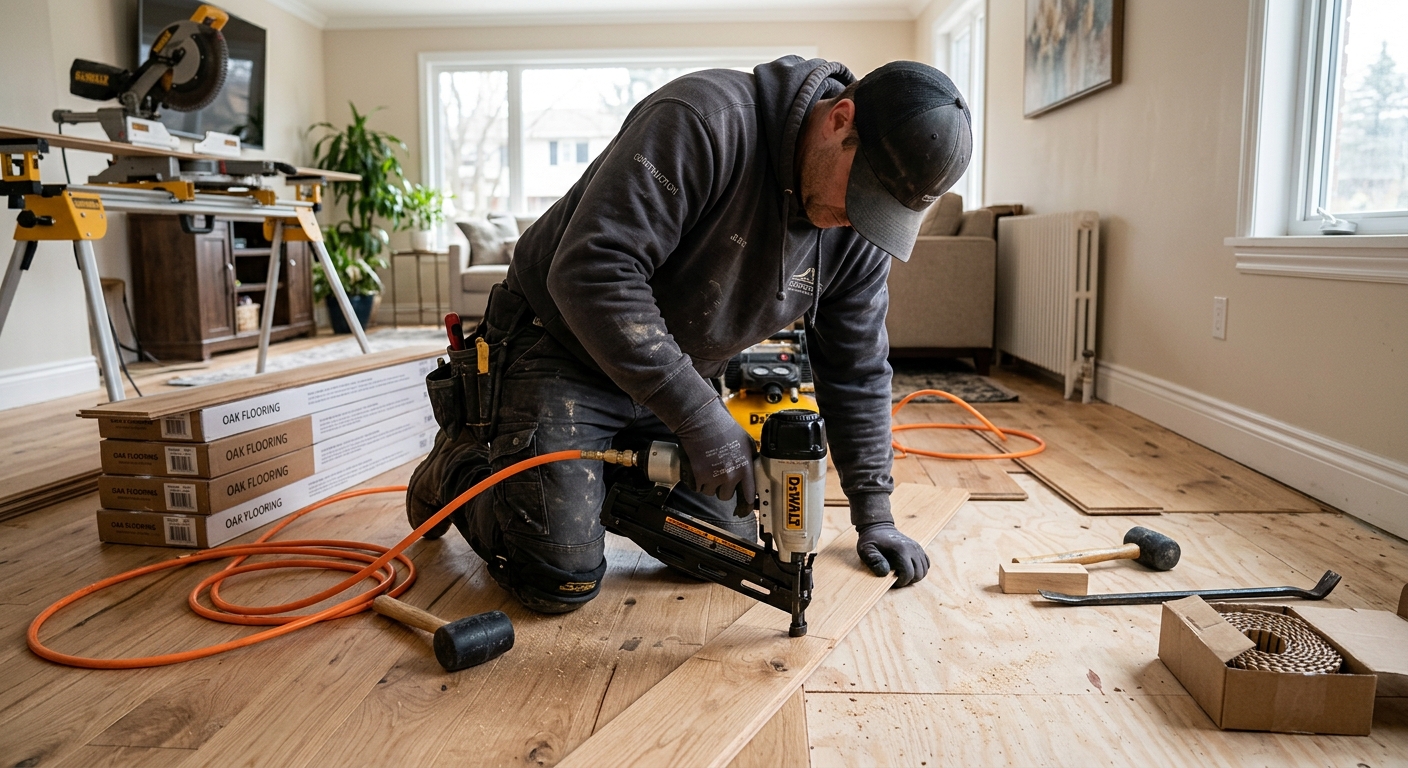
Flooring options and costs in Windsor
In Windsor, Ontario, the best flooring choice usually comes down to how your home manages moisture—because Windsor’s long humid summers and dry winter air create indoor humidity swings that affect install quality. With 68.0% of homes built before 1981, many properties arrive with older subfloors: you often need levelling, patching, or an OSB/plywood overlay before the finish goes down. That preparation step matters for budgeting and can add meaningful labour time and materials. Also, with 58,960 homeowner households in the region (62.5% of households own) the rental-versus-owner mix keeps trades busy year-round, but availability can tighten in spring and early summer when most people schedule installs.
Across Windsor–Sarnia, below-grade spaces are a consistent cost driver. Basements commonly sit over damp concrete, so vapor barriers, moisture testing, and upgraded underlayments are frequently essential for anything other than tile. That’s why homeowners often find engineered hardwood and luxury vinyl plank (LVP) outperform solid hardwood for on-grade or basement-adjacent installs. If you’re considering in-floor radiant heat, Windsor’s colder stretches also steer choices toward materials that tolerate cyclical heat without gaps or cracking.
In neighbourhoods with more older housing—like East Windsor and parts of Walkerville—contractors are especially in demand for subfloor repair and moisture controls before they ever lay a single plank. Next, use the table below to compare typical installed price bands by flooring type and performance level in a typical Windsor home.
| Type |
Best Room |
Moisture Resistance |
Lifespan |
Price per sq ft |
| Solid hardwood (nail-down, above grade only) |
Living / dining (above grade) |
Low (humidity-sensitive) |
25–45 years |
$10–$18 |
| Engineered hardwood (float or glue, above + on-grade) |
Living / dining / bedrooms |
Medium to high (product dependent) |
20–35 years |
$11–$17 |
| Laminate (click-lock, above-grade) |
Bedrooms / hallways |
Low to medium (not for wet areas) |
10–25 years |
$5–$10 |
| Luxury vinyl plank / LVP (waterproof, any level) |
Kitchen / finished basement |
High (waterproof core) |
15–25 years |
$7–$14 |
| Porcelain / ceramic tile |
Kitchen / bathroom |
Very high (with proper grout/underlayment) |
25–50 years |
$12–$22 |
| Carpet (broadloom or modular tile) |
Bedrooms / stairs (comfort) |
Medium (needs dry subfloor) |
7–15 years |
$4–$9 |
Prices are estimates only and vary by project scope, site access and material selection.
What affects the price of flooring in Windsor
Two quotes for the “same-looking” floor in Windsor can differ by about 30–50% across the Windsor–Sarnia corridor because the real cost isn’t just the material—it’s what has to happen to make the subfloor stable and moisture-safe. In older, pre-1981 homes (where 68.0% of housing stock was built), uneven subfloors are common, so levelling compound, plywood patching, or labour-intensive repairs can be required before the finish starts. In addition, basements and ground-adjacent slabs drive technical work: Windsor’s humid summers and damp concrete conditions often require moisture testing and upgraded underlayments, which changes both materials and labour time.
Solid hardwood is the biggest pricing “surprise” item in Ontario because it expands and contracts with indoor humidity and typically cannot be installed over concrete slabs or in below-grade areas. That means if you’re planning solid wood, contractors may still need to rework the under-slab or reroute expectations to above-grade rooms only. Engineered hardwood and LVP handle humidity better and are usually more forgiving for Windsor’s moisture swings; that’s why they often end up being the practical choice in finished basements. Colder regions increasingly use radiant heat, which also rules out most solid hardwood and some laminate lines, pushing homeowners toward engineered wood, tile, or radiant-rated vinyl.
Concrete examples from Windsor jobs: (1) if moisture testing shows elevated slab moisture, a moisture mitigation system and vapour barrier may add hundreds of dollars before underlay goes down; (2) if an older subfloor has dips, self-levelling may be the difference between a straightforward install and a premium “prep-first” scope. Budget-wise, laminate or LVP can start around the lower band (for example, laminate / vinyl plank commonly lands in the $5–$10 range), while tile projects frequently sit higher (often $12–$22) because setting, underlayment, and layout time add up.
| Price Factor |
Why It Matters |
Cost Impact |
| Room area in sq ft |
Materials and installation time scale directly with square footage |
Low to high (big rooms magnify waste, seams, and prep) |
| Subfloor condition — levelling or repair needed before install |
Older Windsor homes often need flattening, patching, or plywood overlays |
Moderate to very high ($1–$4 per sq ft commonly for prep) |
| Moisture / below-grade install — rules out solid hardwood |
Humid summers and damp concrete require vapour control for many applications |
Moderate to very high (testing + mitigation + underlayment) |
| Material choice — solid vs. engineered vs. LVP vs. tile |
Different construction tolerates humidity and temperature swings differently |
Low to high (tile labour/material generally prices higher) |
| Removal and disposal of existing flooring |
Demolition time, disposal fees, and subfloor cleaning affect labour |
Moderate (can be a significant line item) |
| Stair nosing / transitions — charged per step or per linear foot |
Transitions are where floors meet and where finishing is most detail-heavy |
Moderate (adds up quickly in multi-level homes) |
| Radiant heat compatibility — limits material options |
Only certain flooring types are rated for in-floor heat without damage |
Moderate (may increase material cost) |
| Installation method — float vs. glue-down vs. nail-down |
Prep, adhesive, and fastening methods change labour and materials |
Low to high (glue-down can be more labour-intensive) |
Permits & regulations in Ontario
In Ontario, flooring installation itself typically does not require a building permit. Most “finish work” — removing old flooring, installing engineered wood, LVP, laminate, carpet, or tile, and basic trim work — is generally handled under normal contractor scope without a permit. Where permits can come into play is when the flooring project includes electrical or structural-adjacent work.
Here are common items that may require permits: (1) modifications to in-floor heating circuits (especially electrical wiring changes) that can trigger an electrical permit and inspections; (2) structural subfloor repair that alters load-bearing conditions (rare for typical patching, but relevant if joists are replaced or significant structural work is involved); and (3) moisture remediation that intersects with regulated systems or major building envelope interventions, depending on extent and documentation. For typical levelling, plywood patching, vapour barrier installation, and tile underlayment, permits are usually not required.
In Windsor condominiums, the bigger constraint is often not a permit—it’s the building’s sound transmission requirements. Upper-floor hard flooring can require specific underlay or approved assembly to meet the corporation’s STC/IIC expectations. Before you install, review the condo declaration and request board approval in writing, especially if you’re planning hardwood or tile on a concrete slab or above another unit.
To verify your contractor, check three things step-by-step: (1) Ontario licensing/registration relevant to contracting—confirm the contractor number and status from official online sources; (2) liability insurance—request a certificate of insurance naming you (or confirming coverage), ensuring it’s current; (3) WSIB/WCB coverage—ask for proof of clearance. Then ensure the quote references the scope and exclusions, so there’s no disagreement once work starts.
Best flooring for each room in your Windsor home
Choosing the right flooring in Windsor is about matching the product to moisture exposure, foot traffic, and comfort—then planning around the region’s humidity swings. Living and dining rooms are usually best with engineered hardwood or high-quality laminate: they deliver warmth, handle normal indoor moisture better than solid wood, and resist dents better than carpet. For master bedrooms, many homeowners choose carpet for softness and sound absorption (helpful in busy households), while others prefer engineered hardwood for a consistent look through the home.
In kitchens, Windsor homeowners typically want water-resistant performance and easy cleaning. Luxury vinyl plank (LVP) with a waterproof core is a strong match for everyday spills and humidity, and it often costs less to install than tile when you factor in subfloor prep. Large-format porcelain or ceramic tile is also excellent, especially if you want maximum water resistance near sinks and under dishwasher zones. Basements are where LVP usually shines: fully waterproof vinyl (and the right underlay/vapour control) is better suited for below-grade conditions than solid hardwood and many laminate products.
Bathrooms should be porcelain or ceramic tile only, with proper underlayment and grout practices. If your home has radiant heat—an increasingly common feature in Ontario builds and renovations—choose radiant-compatible products (engineered wood, tile, and certain vinyl lines) to reduce the risk of gapping or uneven heating.
To see why costs differ: if you’re choosing between LVP and tile in a kitchen, tile can land in the $12–$22 per sq ft band due to layout, thinset, and labour, while LVP often falls in the $7–$14 per sq ft range. When your subfloor needs only minor prep, that gap is usually easy to justify; when moisture mitigation and levelling are already required, the relative difference can narrow because prep work becomes common to both options.
| Room |
Best Material |
Why |
Moisture Risk |
Price Band per sq ft |
| Living / dining room |
Engineered hardwood |
Warm look with better tolerance to Windsor humidity than solid wood |
Low (above grade, typical lifestyle) |
$11–$17 |
| Master bedroom |
Carpet or engineered hardwood |
Comfort and sound absorption (carpet) or a durable, cleanable finish (engineered) |
Low (keep ventilation consistent) |
$4–$9 |
| Secondary bedrooms |
Laminate or carpet |
Cost-effective durability for kids/guests; easier maintenance than carpet |
Low to medium (avoid spills sitting on underlay) |
$5–$10 |
| Kitchen |
Luxury vinyl plank or porcelain tile |
Water resistance and simple cleaning near high-use areas |
Medium (spills + steam depending on ventilation) |
$7–$22 |
| Basement (finished) |
Luxury vinyl plank |
Waterproof core handles Windsor below-grade moisture conditions better than wood/laminate |
High (vapor + slab moisture potential) |
$7–$14 |
| Bathroom |
Porcelain / ceramic tile |
Best-in-class water performance and long service life |
Very high (wet conditions) |
$12–$22 |
How to choose a flooring contractor in Windsor
When you’re hiring a flooring contractor in Windsor, Ontario, you want proof—not promises—around licensing, insurance, and worker coverage. Start with Ontario contractor registration status (if applicable to the trade), then request a current certificate of liability insurance. Next, ask for WSIB/WCB clearance or documentation showing the company has coverage for its workers; in practice, this helps protect you if someone is injured on-site. A reputable crew should provide these items quickly when you request your quote.
Get 2–3 itemised written quotes rather than lump sums. You want a breakdown that shows materials and labour separately, including subfloor prep (levelling/plywood patching), moisture testing/vapour barrier where required, transitions (stair nosing, door jamb undercuts), and whether removal and disposal are included. Carefully read what’s excluded: for example, “existing subfloor repairs are not included” can translate into thousands of dollars if your basement slab is uneven. Also confirm whether disposal is part of the price or billed separately.
Warranty matters in Windsor because humidity and temperature swings can reveal installation mistakes over time. Ask for the workmanship warranty length, the product/manufacturer warranty terms, and whether the warranty is transferable to you as the homeowner. For payment schedule, never pay more than 10–15% upfront—hold back a portion until the work is complete and cleaned up. Lastly, insist on a start date and an estimated completion date in writing.
- Ask for licence/registration status and check it before signing.
- Request a certificate of liability insurance dated for the current period.
- Provide WSIB/WCB proof (clearance letter or equivalent) for the company and workers.
- Get an itemised quote (labour + materials) rather than a single lump sum.
- Confirm subfloor scope: levelling, plywood patching, and what “minor repairs” means.
- Require a moisture plan for basements: testing, vapour barrier, and the underlayment match.
- Check inclusions: demolition/removal, disposal fees, and stair trims/transitions.
- Verify underlayment compatibility for laminate/LVP and any radiant heat constraints.
- Ask who is responsible for site protection and floor edge sealing.
- Review warranty terms in writing (workmanship + manufacturer) and transferability.
- Use a staged payment schedule: 10–15% max upfront, balance at completion.
- Get a written timeline with a realistic start and completion window.
Red flags in Windsor: vague quotes with “labour only” or no mention of moisture testing, refusing to show insurance/WSIB clearance, charging large deposits (beyond 10–15%) up front, starting without discussing subfloor prep or vapour control, and telling you a basement “doesn’t need” moisture mitigation when the slab is concrete and humidity is typically high.
Frequently asked questions — flooring in Windsor
How do I prepare my subfloor before new flooring?
For Windsor homes, subfloor prep is where projects succeed or fail, especially above basements and on concrete slabs where humidity can creep upward. First, remove existing flooring and inspect for softness, delamination, or visible moisture staining. Next, check flatness: most manufacturers want the surface within a tight tolerance, which often means levelling compound or plywood patching in older houses (Windsor stock includes many homes built before 1981). If you’re installing over concrete or in a basement, ask for moisture testing and a written vapour barrier plan—solid hardwood usually isn’t appropriate for these conditions. Finally, make sure the subfloor is clean, dry, and meets the product’s fastening/underlayment requirements. If you do these steps, you reduce squeaks, movement, and early wear.
Is cork or bamboo flooring a good choice in Windsor?
Cork can be a comfortable option because it has resilience and helps with sound, but in Windsor you still must treat moisture control as a first priority. Cork is generally best for above-grade areas with stable indoor humidity; it’s not a “set and forget” choice for below-grade basements. Bamboo is usually dimensionally more stable than some natural woods, but installation still needs a properly prepared, level subfloor and moisture-aware underlayment. If your plan is for a basement, LVP usually outperforms cork and most bamboo options because many waterproof vinyl systems are rated for “any level.” For budgeting, you’ll often see cork/bamboo marketed near the engineered hardwood range, while LVP typically lands in the $7–$14 per sq ft band. In Ontario’s humidity swings, choosing a moisture-tolerant product usually beats relying on hope and a thin underpad.
What is the difference between floating and glued-down flooring?
Floating flooring is installed over an underlayment with boards that click together (often laminate or some engineered products). It “floats” without being permanently fixed to the subfloor, which makes installation faster and sometimes easier to adjust for minor subfloor imperfections. Glued-down flooring uses adhesive to bond the planks to the subfloor, which can help with stability and reduce movement, but it requires the surface to be properly prepared and dry. In Windsor, this matters because below-grade moisture and vapour drive risk on concrete slabs. If you’re working over a basement slab, floating vinyl systems are often more forgiving, and LVP that’s waterproof can handle moisture better than many wood assemblies. Either method can work well above grade; the right answer depends on your room’s moisture risk and whether the manufacturer’s instructions allow the installation method on your subfloor type.
What flooring holds up best to pets in a Windsor home?
For pets in Windsor, look for scratch resistance, impact durability, and stain cleanability. Waterproof LVP is usually a top choice because it can handle accidents and regular cleanup, and many products have wear layers that resist claws better than softer materials. If you prefer wood visuals, engineered hardwood can work well above grade, but solid hardwood is more humidity-sensitive and isn’t ideal for basement environments. Carpet offers comfort, but it can be harder to keep looking good if accidents happen or if basement humidity is high (vapour can affect underlay). For price context, LVP commonly sits in the $7–$14 per sq ft range, while laminate often lands around $5–$10 when you want a tighter budget. Tile also performs extremely well for pets (especially in kitchens and bathrooms) and typically falls into the $12–$22 per sq ft range due to labour and layout. The best results come from pairing the right material with correct underlayment and a clean, level subfloor.
How do I fix squeaky floors in my Windsor home?
Squeaks are usually caused by movement between subfloor layers or between flooring and joists, and the fix depends on where the noise originates. Start by locating the squeak—walk slowly and mark spots with tape. In older Windsor homes (many pre-1981), squeaks often come from worn nail pops or gaps between subfloor panels; tightening fasteners or adding approved screws can solve the issue before new flooring goes down. If the squeak is in an area that’s over a basement, sometimes the subfloor needs patching or reinforcement, especially if there’s uneven support. It’s generally not a good plan to ignore squeaks and install new floating floors on top; movement can telegraph as gaps, noise, and early wear. A good contractor will include inspection as part of the scope and recommend whether a plywood overlay, adhesive bonding (where appropriate), or subfloor repair is needed before installation.
What is luxury vinyl plank and is it worth it in Windsor?
Luxury vinyl plank (LVP) is a multi-layer vinyl floor with a wear layer on top and a core that’s often waterproof. In Windsor, it’s frequently worth it because humidity and basement moisture are real cost drivers: many basements sit over damp concrete, and LVP systems are designed to tolerate moisture better than solid hardwood and most laminate. When installed correctly—with the right underlayment or vapour barrier and proper expansion gaps—LVP can handle the humid summers and winter dryness swings common in Ontario without the same gap-and-cupping risk you can see with wood. It’s also easier to maintain around kitchens and near entryways. Price-wise, LVP typically fits the $7–$14 per sq ft band in local projects; if you compare it to tile ($12–$22) you’re often balancing waterproof performance versus higher labour and layout time. For finished basements especially, LVP is usually the most practical “value per year” option.