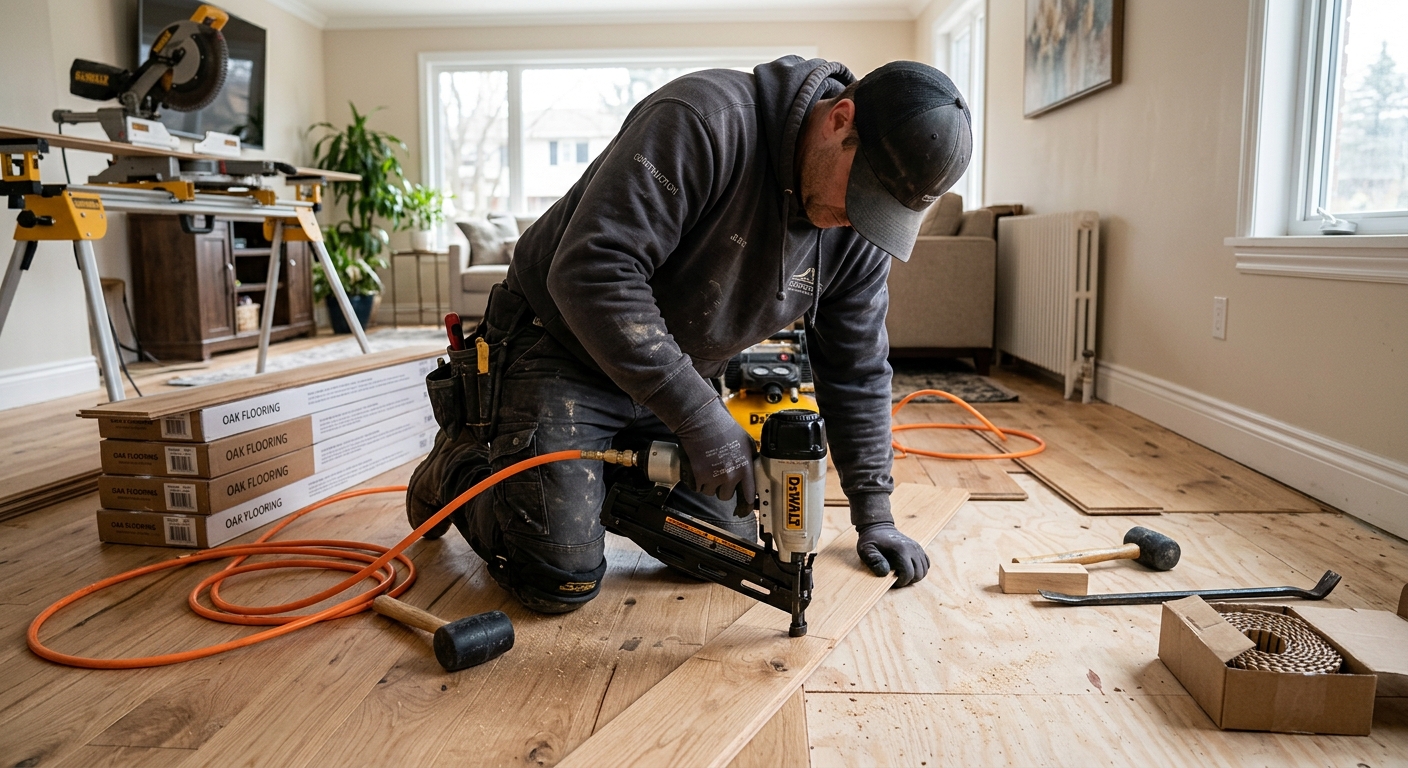
Flooring options and costs in Greater Sudbury
Greater Sudbury homeowners usually don’t choose flooring based on trends alone—our winters, humidity swings, and lots of older housing stock shape what actually performs. With a 2021 population of 166,004 (Statistics Canada, 2021 Census), demand is steady, especially in established areas where many homes were built decades ago and may have uneven subfloors. In practice, that can mean levelling, patching, or even fixing moisture issues before new material can be installed. Those prep steps are a big cost driver, and they’re one reason quotes can land farther apart than you’d expect.
In the Northeast Ontario market, the labour side is also sensitive to jobsite conditions. Basements and main floors often have temperature and moisture movement throughout the year, so installers lean toward dimensionally stable products. Solid hardwood can be stunning on the main floor, but it’s far less forgiving in below-grade spaces because it expands and contracts with indoor humidity and generally isn’t recommended over concrete. Engineered hardwood and luxury vinyl plank (LVP) are often better fits because they tolerate moisture fluctuations and can be installed on-grade or on properly prepped subfloors. Tile is durable, but the prep, underlayment, and setting work make it one of the more labour-intensive options. If radiant heat is part of your plan, that can narrow the choices, because not every product and underlayment performs efficiently in colder homes.
In Greater Sudbury neighbourhoods like Valley East and New Sudbury, contractors often see higher demand during spring and early fall when humidity is more predictable and jobsite drying is easier. Next, here’s a clear cost comparison to help you budget by material type.
| Type |
Best Room |
Moisture Resistance |
Lifespan |
Price per sq ft |
| Solid hardwood (nail-down, above grade only) |
Main floor living areas |
Low (humidity-sensitive) |
25–50 years |
$11,–$18 |
| Engineered hardwood (float or glue, above + on-grade) |
Main floor & hallways |
Medium to high (more stable) |
20–40 years |
$10,–$16 |
| Laminate (click-lock, above-grade) |
Living, bedrooms (dry areas) |
Low to medium (edges can swell) |
10–25 years |
$4,–$10 |
| Luxury vinyl plank / LVP (waterproof, any level) |
Kitchen, basement (finished) |
High (waterproof core) |
15–25 years |
$6,–$12 |
| Porcelain / ceramic tile |
Kitchen, bathrooms, entries |
Very high (if properly grouted) |
25–50 years |
$12,–$22 |
| Carpet (broadloom or modular tile) |
Bedrooms, stairs, some basements |
Low to medium (only if moisture is controlled) |
7–15 years |
$3,–$8 |
Prices are estimates only and vary by project scope, site access and material selection.
What affects the price of flooring in Greater Sudbury
In Greater Sudbury and across Ontario’s Northeast, two bids for what looks like the “same” floor can differ by 30% to 50% once the installer accounts for jobsite conditions and technical constraints. Indoor humidity swings and below-grade moisture are the biggest technical drivers. Solid hardwood expands and contracts with humidity, and it isn’t a good fit for basements or for directly over concrete without a suitable system. Engineered hardwood and luxury vinyl plank handle humidity changes and below-grade applications far better when the subfloor is stable and flat. In colder parts of the year, radiant heat compatibility also matters; when you have in-floor heating, it can limit the materials and underlay used, which changes both material and labour.
Older regional housing stock commonly requires more prep before any finish can perform well. That means levelling or repair to stop the floor from squeaking or flexing, and sometimes moisture remediation when there’s a history of dampness. These steps can add about $1 to $4 per sq ft in typical subfloor remediation/patching work, and more when the issue is widespread. For example, moving from laminate (a value range at roughly $4 to $10 per sq ft) to LVP (often priced higher, like $6 to $12 per sq ft) might be a smart spend if you’re finishing a basement where moisture vapour can be an issue. Conversely, tile at $12 to $22 per sq ft may look expensive, but the higher labour content is often justified in bathrooms and entryways where longevity and cleanability matter.
Here are the main factors that shape your final installed price in Sudbury-era homes and on Northeast schedules.
| Price Factor |
Why It Matters |
Cost Impact |
| Room area in sq ft |
Materials and many labour tasks scale with square footage |
Larger rooms usually lower per-sq-ft due to efficiencies |
| Subfloor condition |
Levelling, patching, and fixing squeaks are often required for a warranty-safe install |
Commonly adds around $1–$4 per sq ft for repairs/levelling |
| Moisture / below-grade install |
Below-grade moisture can rule out solid hardwood and some laminate setups |
May add moisture remediation and drive higher material selection (e.g., LVP) |
| Material choice |
Solid hardwood, engineered wood, LVP, laminate and tile have different build-ups and prep needs |
Can shift budgets from value ($4–$10) to premium ($11–$22) ranges |
| Removal and disposal of existing flooring |
Demo time, hauling, and disposal fees vary |
Often a noticeable add-on, especially with multiple layers |
| Stair nosing / transitions |
Transitions and stair work are labour-heavy and priced per step/linear foot |
Can add several hundred dollars depending on layout |
| Radiant heat compatibility |
Heat systems require products and underlay that conduct heat effectively |
May increase material cost and restrict underlay selection |
| Installation method |
Float, glue-down, or nail-down each needs different prep and skilled labour |
Glue-down and tile are often more labour-intensive than click-lock |
Permits & regulations in Ontario
In Ontario, installing new flooring itself generally does not require a building permit. That said, related scope can trigger permit or compliance steps—especially when the project overlaps with electrical work or significant structural repairs. For example, if you’re adding or modifying in-floor heating circuits, that electrical work typically requires the right permitting and qualified electrician involvement. Similarly, if you discover hidden subfloor rot, major structural deterioration, or you need extensive moisture remediation that involves making safe electrical systems or changing drainage approaches, you may need additional professional assessment before closing everything up.
Condominiums add a separate layer: sound transmission. Many building corporations set requirements around underlay and impact sound control, and they may reference STC/IIC expectations. That can affect your underlay choice under laminate, engineered hardwood, or other hard surfaces on upper floors. Always review the condo declaration and request board approval in writing before installing hard flooring—especially hardwood or tile—so you don’t end up removing work to meet the building’s acoustics rules.
To verify a contractor for Greater Sudbury projects, start with the Ontario licence/registration details you can access online through provincial and trade registries (and confirm their business is active). Ask for a current certificate of liability insurance and confirm coverage amounts match the job size. Also request proof of WSIB/WCB coverage (or a clearance letter). Finally, match the paperwork to the exact scope on your quote—labour, demolition, subfloor prep, and any electrical or specialty work that must be subcontracted.
Best flooring for each room in your Greater Sudbury home
Choosing the right flooring for Greater Sudbury comes down to matching performance to each room’s moisture exposure, traffic, and comfort needs. For living and dining rooms, engineered hardwood or high-quality laminate are popular because they bring warmth without the same humidity sensitivity as solid wood. If you’re installing over older subfloors that can be slightly uneven, engineered products with the right underlayment system often perform more reliably than solid. In master bedrooms, carpet remains a comfort winner—softer underfoot and better for sound absorption—while engineered hardwood is a solid option if you want less maintenance and you keep humidity controlled.
In kitchens, go for luxury vinyl plank (LVP) or large-format porcelain tile. LVP handles spills and easy cleaning well, and it’s a practical choice when temperature swings are noticeable in older homes. Tile is labour-intensive to install, but it’s excellent for water resistance in zones that get frequent wet mopping. For basements, the clear winner in Sudbury conditions is usually LVP (or tile if you want maximum rigidity and long-term durability), because waterproof cores manage moisture vapour and below-grade installs far better than solid hardwood and most laminate. Bathrooms are porcelain or ceramic tile only when you want to control moisture at the source and keep grout lines protected.
If you have radiant heat (or are planning it), confirm the product is radiant-compatible. That often improves comfort and efficiency in our colder months, but it can remove certain underlay or floor build-ups from consideration. As a concrete example, if your main floor is 500 sq ft, choosing engineered hardwood at about $10–$16 per sq ft instead of laminate at roughly $4–$10 per sq ft may cost more upfront—yet it can be justified when you want fewer style compromises and better dimensional stability through indoor humidity swings.
| Room |
Best Material |
Why |
Moisture Risk |
Price Band per sq ft |
| Living / dining room |
Engineered hardwood |
Warm look with better stability than solid wood |
Low (if above grade and humidity is managed) |
$10,–$16 |
| Master bedroom |
Carpet or engineered hardwood |
Comfort and sound control (carpet) or easy maintenance (engineered) |
Low |
$3,–$16 |
| Secondary bedrooms |
Laminate |
Value-friendly durability for daily use |
Low (above grade) |
$4,–$10 |
| Kitchen |
Luxury vinyl plank (LVP) or porcelain tile |
Handles spills and frequent cleaning |
Medium (spills and humidity near exterior doors) |
$6,–$22 |
| Basement (finished) |
Luxury vinyl plank (waterproof) |
Best tolerance for below-grade moisture and vapour |
High (vapour risk) |
$6,–$12 |
| Bathroom |
Porcelain / ceramic tile |
High moisture resistance with long-term performance |
Very high |
$12,–$22 |
How to choose a flooring contractor in Greater Sudbury
Start by verifying your contractor’s Ontario compliance and real coverage. Ask for the business licence/registration details they’re using in Ontario (and confirm the company name matches the quote and invoice). Request a certificate of liability insurance and check that it’s current and includes flooring installation activities. For worker coverage, confirm WSIB/WCB status by asking for proof such as a clearance letter or current coverage documentation—don’t rely on “we’re covered” without paperwork. This matters because a flooring project isn’t just materials; it’s demo, subfloor prep, heavy lifting, and sometimes moisture remediation.
Next, get 2 to 3 itemised written quotes that break labour and materials out separately. You want to see line items for demo and disposal, subfloor levelling/repair, underlayment (if applicable), transitions/stair nosing, and any moisture testing or prep included. Carefully read what’s excluded: moving heavy appliances, hauling old baseboards, levelling beyond a certain tolerance, or permit/electrical scope if you’re touching in-floor heating.
Confirm warranty terms in writing. There should be a workmanship warranty from the installer (length matters), plus the manufacturer’s product warranty details (including whether it transfers if you sell your home). For payment, keep upfront deposits modest—generally no more than 10% to 15%—and use a holdback until the job is complete and defects are corrected. Finally, insist on a start date and estimated completion timeline in the agreement so you can plan around Greater Sudbury weather and indoor humidity stability.
- Ask for proof of liability insurance and verify coverage is current
- Confirm WSIB/WCB clearance or documentation before work begins
- Get an itemised quote (materials vs labour vs prep)
- Ensure demo and disposal are clearly included or clearly excluded
- Specify who levels/repairs the subfloor and to what tolerance
- Confirm underlayment type and thickness for laminate/LVP
- List all transitions, thresholds, and stair nosing costs up front
- Ask how they handle moisture—testing, vapour mitigation, and prep
- Confirm acclimation time for wood products in Sudbury indoor conditions
- Get the workmanship warranty length and what it covers
- Ask if product warranty is maintained when installed per manufacturer specs
- Use a payment schedule with a holdback until final walkthrough
Red flags in Greater Sudbury: a quote that’s only a single lump sum with no labour/material breakdown, no certificate of insurance or WSIB/WCB proof, vague subfloor language (“we’ll make it work”), missing start/finish dates, or refusing to put warranty details and exclusions in writing.
Frequently asked questions — flooring in Greater Sudbury
Hardwood vs laminate vs vinyl plank — which is best?
In Greater Sudbury, “best” depends on moisture and where the floor sits in the home. Hardwood looks premium, but solid hardwood is mainly for above-grade spaces because it’s sensitive to humidity swings; laminate and vinyl are more forgiving. Laminate is a value option in dry rooms and is often priced around $4,–$10 per sq ft, but it can swell at seams if moisture gets underneath. Luxury vinyl plank (LVP) is usually the most practical all-rounder for kitchens and basements because it’s waterproof and handles vapour better than laminate and solid wood; many LVP projects land roughly $6,–$12 per sq ft. If you want a real wood look in an Ontario winter climate, engineered hardwood can be a middle ground, with better stability than solid.
What flooring is best for a Greater Sudbury basement?
For most Greater Sudbury basements—especially those that see seasonal humidity changes—LVP is the most dependable choice. It’s waterproof, can handle typical below-grade moisture vapour better than solid hardwood, and it’s more forgiving if your slab or subfloor has minor imperfections (as long as prep is correct). Laminate can work only when moisture is well controlled and edges stay sealed; otherwise, you can get swelling or separation. Carpet can be comfortable, but it needs a dry, stable environment to avoid odour or persistent dampness. Tile is also an option for long-term durability, but it’s usually more labour-intensive due to underlayment and setting. In general, plan for proper moisture assessment and subfloor preparation before any finish goes down.
Can I install hardwood over concrete?
Sometimes, but it depends on what you mean by “hardwood” and the concrete condition. Solid hardwood is generally not the go-to over concrete in Ontario because of moisture and movement; it’s also typically restricted to above-grade installs and doesn’t handle below-grade humidity the way homeowners expect. Engineered hardwood is more commonly installed over concrete when the slab is properly prepared and any required moisture barriers/underlayments are used per the manufacturer. The key is moisture testing and flattening: if your concrete has moisture issues or the floor isn’t level, you’ll pay for subfloor remediation anyway, and warranties can be affected. If you’re considering a wood look over a slab, ask your contractor what system they use (including underlay/moisture mitigation) and whether it’s compliant with the product warranty.
How long does flooring installation take?
Most residential installs in Greater Sudbury take from a couple of days to about a week, depending on room count, total square footage, and how much prep is needed. A single main-floor project with minimal demo and a flat subfloor can move quickly, while older homes may need levelling/repair—adding days for curing and prep work. Removal and disposal of existing flooring can also extend timelines, especially with multiple layers. Weather can indirectly affect timing too: indoor acclimation for hardwood or engineered wood, and humidity stability during installation, matters in our climate. Ask for a written start date and completion estimate that includes prep and drying time; if a contractor won’t provide it, plan for delays.
What flooring works with radiant heat?
Radiant heat usually favours flooring systems that transfer heat effectively without trapping too much insulation. In Ontario homes where radiant heating is installed, contractors commonly recommend radiant-compatible LVP/engineered wood options and specific underlayments designed for heat flow. Many solid hardwood products are limited because they can be more sensitive to movement and require tight humidity control and temperature management. Laminate can work, but only with products explicitly rated for radiant systems and with the correct underlay. The best approach is to confirm with the manufacturer’s installation instructions—heat compatibility is not universal. If you’re installing over an active system, have your contractor discuss warm-up cycles and temperature ramping so the flooring performs as intended.
Engineered vs solid hardwood — what's the difference?
Solid hardwood is one piece of wood throughout and is typically installed nail-down on above-grade floors where humidity is controlled. Engineered hardwood is made from layers (a stable core with a wood wear layer on top). That construction makes engineered wood more dimensionally stable in fluctuating indoor conditions, which matters in Ontario’s winter/summer humidity swings. For basements or more moisture-prone areas, engineered is usually the safer “wood look” option, while solid is often limited. In cost terms, solid hardwood often sits higher (commonly around $11,–$18 per sq ft), while engineered may land slightly lower depending on thickness and wear layer (often around $10,–$16 per sq ft). Your installer should also match the install method (float vs glue) and subfloor prep to the product specs to protect your warranty.