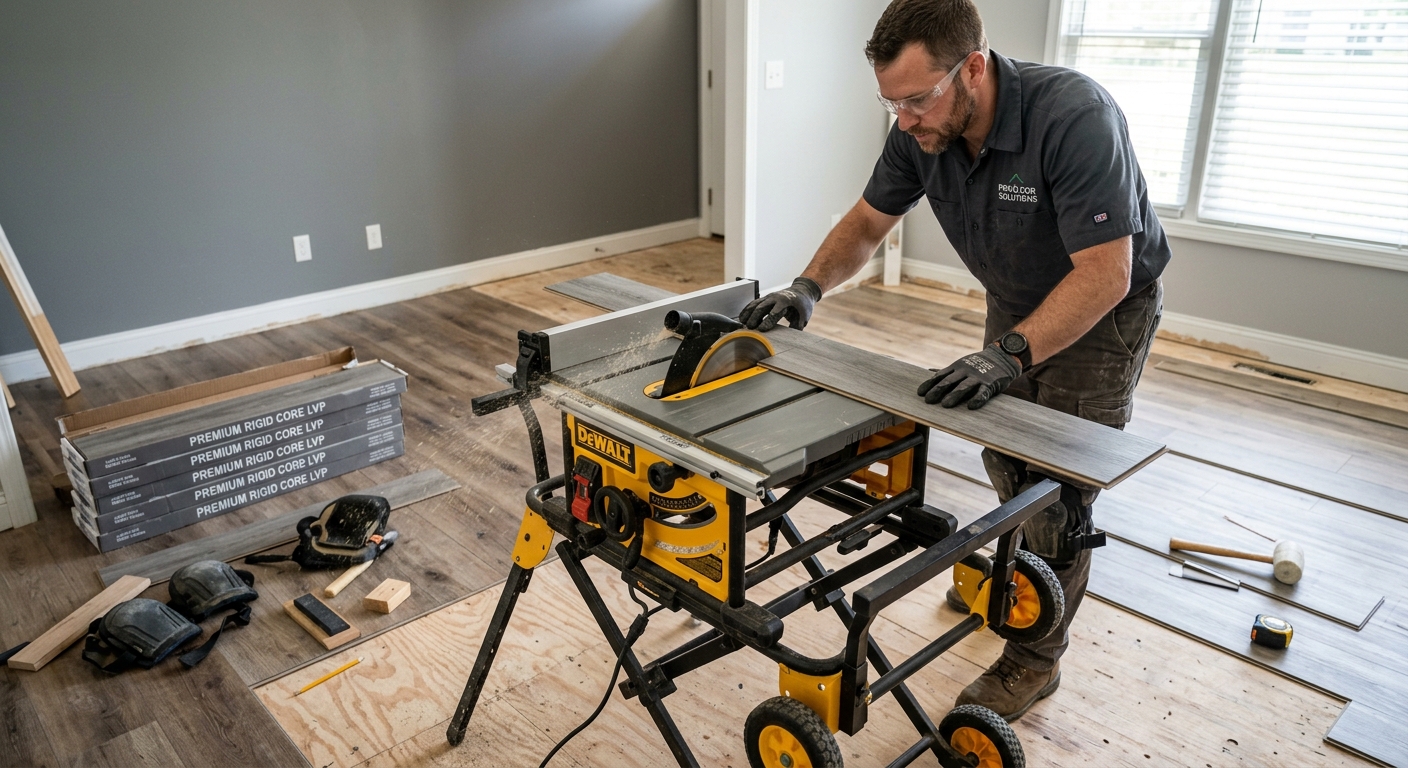
Flooring options and costs in Temiskaming Shores
In Temiskaming Shores, your flooring budget is driven less by fashion and more by how the home sits in the landscape—especially because many properties are older. With 77.5% of homes built before 1981 (Statistics Canada, 2021 Census), you’ll often see uneven subfloors, older sheet goods, or patchwork that needs levelling or remediation before any new surface goes down. That prep work is one reason you can see material-and-labour quotes swing by a wide margin even for the “same” floor. In practice, newer builds and better concrete get you a smoother install; older housing stock usually adds labour and sometimes underlayment or subfloor repair.
Cost also reflects the Northeast’s climate reality: cold winters, indoor humidity swings, and common basement moisture concerns. Solid hardwood can expand and contract with humidity, so it’s typically limited to well-controlled, above-grade rooms; it performs poorly in basements and isn’t the right choice over problematic concrete. Engineered hardwood and luxury vinyl plank (LVP) handle moisture changes far better and are commonly priced as value-to-midrange upgrades. Where homes have in-floor heating, contractors frequently recommend radiant-compatible flooring so the system warms efficiently in colder rooms.
In Temiskaming Shores, installs are particularly in demand around the downtown and harbour-area pockets where renovations are frequent in older dwellings—owners want durable results that look good but tolerate seasonal indoor changes. From there, the comparison table below breaks down common flooring types, typical lifespan expectations, and what you can realistically spend per square foot in this market tier.
| Type |
Best Room |
Moisture Resistance |
Lifespan |
Price per sq ft |
| Solid hardwood (nail-down, above grade only) |
Main floor living areas |
Low (humidity-sensitive; not ideal for basements) |
30–60 years |
$11–$18 |
| Engineered hardwood (float or glue, above + on-grade) |
Living, dining, bedrooms |
Medium–High (better for humidity swings) |
20–40 years |
$10–$17 |
| Laminate (click-lock, above-grade) |
Bedrooms, hallways |
Medium (water spills should be cleaned quickly) |
10–25 years |
$4–$10 |
| Luxury vinyl plank / LVP (waterproof, any level) |
Kitchen, entry, finished basement |
High (waterproof core; good below-grade choice) |
15–25 years |
$5–$12 |
| Porcelain / ceramic tile |
Kitchen, bathrooms, mudroom |
Very High (handled well in moisture zones) |
25–50 years |
$12–$22 |
| Carpet (broadloom or modular tile) |
Bedrooms, stairs (selected homes) |
Low–Medium (must manage basement vapour and spills) |
8–15 years |
$3–$8 |
Prices are estimates only and vary by project scope, site access and material selection.
What affects the price of flooring in Temiskaming Shores
In Temiskaming Shores and across the Northeast/Ontario mix, it’s common for two homeowners to get quotes that look “the same” on paper but differ by 30–50%. The usual cause isn’t the floor itself—it’s the job conditions: the condition of the subfloor, moisture risk, how much prep is needed, and whether transitions, stairs, or radiant considerations are included. In older homes (77.5% built before 1981 per Statistics Canada, 2021 Census), levelling and patching can be the deciding factor. Even small issues like dips in plywood, loose underlayment, or older concrete seams can add labour before any planks, boards, or tile go in.
Technically, indoor humidity swings matter. Solid hardwood expands and contracts and typically shouldn’t be glued or floated over concrete; it’s also a poor basement choice. That’s why engineered hardwood and LVP are so practical in the Northeast—many installations can proceed over on-grade surfaces where solid wood would be too risky. If you’re planning radiant heat compatibility, colder regions in Ontario often make this a requirement; that limits what products perform efficiently.
Two concrete examples from local projects: (1) a 500 sq ft main-floor job where subfloor is wavy can add roughly $1–$4 per sq ft for levelling/patching, pushing a “budget” quote upward; (2) a finished basement conversion from laminate (above-grade only) to waterproof LVP can cost more than the base laminate band, but the long-term risk drops—LVP commonly prices in the mid range, often closer to the $5–$12 per sq ft band, while laminate usually sits at $4–$10 per sq ft.
For ceramic or porcelain, the prep is labour-heavy: setting, underlayment choices, and ensuring a flat substrate is often where the tile quote climbs toward the $12–$22 per sq ft band. Next, this table breaks down the major price drivers contractors use in itemised estimates.
| Price Factor |
Why It Matters |
Cost Impact |
| Room area in sq ft |
Materials, underlayment, and labour scale directly with square footage |
Low to High (bigger rooms reduce waste per sq ft, smaller rooms can increase per-sq-ft labour) |
| Subfloor condition — levelling or repair needed before install |
Uneven floors require patching/feathering so planks or tile sit flat |
Often +$1–$4 per sq ft in older homes |
| Moisture / below-grade install — rules out solid hardwood |
Humidity and vapour affect dimensional stability and warranty coverage |
May move you to engineered hardwood or LVP; can add +$0.50–$6 per sq ft depending on solution |
| Material choice — solid vs. engineered vs. LVP vs. tile |
Product price and installation technique vary |
Solid hardwood commonly in $11–$18; tile in $12–$22; LVP and laminate often in $4–$12 bands |
| Removal and disposal of existing flooring |
Rotated furniture protection, tear-out time, and landfill fees |
Can add several hundred dollars to a typical multi-room job |
| Stair nosing / transitions — charged per step or per linear foot |
Custom finishing and extra trim pieces affect labour |
Often a noticeable add-on on stair-heavy layouts |
| Radiant heat compatibility — limits material options |
Some products aren’t designed for in-floor heat performance |
May add +$1–$5 per sq ft for approved flooring/installation systems |
| Installation method — float vs. glue-down vs. nail-down |
Different systems require different prep, adhesives, and labour time |
Nail-down and tile set are typically the labour heaviest; floating systems are usually faster |
Permits & regulations in Ontario
In Ontario, installing new flooring by itself generally does not require a building permit. Most hardwood, engineered wood, laminate, LVP, carpet, and standard tile replacement falls under “finishing work.” However, associated work can change the answer. If your project includes structural subfloor repair, moisture remediation steps that involve substantial changes to the assembly, or in-floor heating circuit work, you may trigger other approvals—especially where electrical components are involved.
In multi-unit buildings, condo rules can be the bigger constraint than the permit process. Many Temiskaming Shores owners don’t face this locally as often as in larger cities, but if you’re installing in an apartment-style condo or an upper-floor unit, review the corporation’s sound transmission requirements (STC/IIC) and underlay specifications before you buy materials. The safest approach is to ask for written board approval in advance, particularly for hardwood and tile on upper floors where sound control is critical.
Step-by-step for homeowners: (1) verify the contractor’s Ontario licence/registration status using the appropriate online registry for the trade they claim to perform; (2) request a certificate of insurance showing liability coverage that matches the job; (3) confirm WSIB/WCB coverage (clearance letter when applicable); and (4) keep copies of these documents with your contract.
Best flooring for each room in your Temiskaming Shores home
Choosing the right flooring for Temiskaming Shores means matching the material to moisture behaviour, traffic, and comfort needs—especially because Northeast winters can bring humidity swings and because many older homes have basements that see vapour and occasional dampness. Living and dining areas usually do best with engineered hardwood or high-quality laminate: they give a warm look, stand up to day-to-day traffic, and—unlike solid hardwood—tolerate humidity changes better when homes aren’t perfectly controlled. For master bedrooms, carpet can be a comfort win for mornings and stairs-to-bed routines, but engineered hardwood is also popular where you want less dust retention.
In kitchens, I typically steer homeowners toward luxury vinyl plank (LVP) or large-format porcelain tile. LVP’s waterproof core handles spills and frequent wipe-downs without worrying about swelling, while tile is the most moisture-robust in the long run. Basements (even “finished” ones) often favour LVP because it’s waterproof and is more forgiving when the slab or below-grade environment pushes moisture vapour. Bathrooms should be porcelain or ceramic tile only for a durable, water-ready finish.
Radiant heat compatibility is also a real Ontario factor: when a room is above in-floor heating, you’ll want flooring that’s designed to work with the system so the heat transfers efficiently and doesn’t warp or separate. As a cost example, moving from laminate at roughly $4–$10 per sq ft to LVP around $5–$12 per sq ft may be justified in a basement: the extra upfront cost often buys you risk reduction where solid wood and most laminate simply aren’t dependable.
| Room |
Best Material |
Why |
Moisture Risk |
Price Band per sq ft |
| Living / dining room |
Engineered hardwood |
Warm finish with better humidity tolerance than solid wood |
Low to Medium (managed by indoor climate) |
$10–$17 |
| Master bedroom |
Carpet or engineered hardwood |
Comfort and sound reduction; engineered option for lower upkeep |
Low (as long as ventilation is maintained) |
$3–$17 |
| Secondary bedrooms |
Laminate (click-lock) |
Value-friendly durability for kids/pets with easier cleaning than carpet |
Low to Medium (clean up spills quickly) |
$4–$10 |
| Kitchen |
Luxury vinyl plank (LVP) or porcelain tile |
Handles spills and heavy traffic; tile gives maximum water protection |
Medium to High (food/water events) |
$5–$22 |
| Basement (finished) |
Luxury vinyl plank (waterproof) |
Best match for below-grade moisture/vapour concerns |
High (vapour and seasonal swings) |
$5–$12 |
| Bathroom |
Porcelain / ceramic tile |
Most reliable water-ready surface; long service life |
High (direct water exposure) |
$12–$22 |
How to choose a flooring contractor in Temiskaming Shores
For Temiskaming Shores homeowners, the best way to avoid headaches is to hire a contractor who can prove coverage, scope, and jobsite discipline. Start by verifying Ontario licensing/registration for the type of work they’re performing (if they claim a trade that requires registration). Then ask for a certificate of liability insurance—it should be current and name you/your project as appropriate. Finally, request confirmation of WSIB/WCB coverage (a clearance letter where applicable). Don’t accept “we’re covered” without documentation.
Next, get 2–3 itemised written quotes that split labour and materials, including underlayment, transitions, stair work, and any subfloor prep. A quote that’s only a lump sum for “materials and installation” is harder to compare and easier for scope creep. Read the scope carefully: what is excluded (moving furniture, plywood/levelling prep, disposal)? Is permit pulling required for any electrical/in-floor heating components, and is it included or excluded?
Warranty matters in flooring. Confirm the workmanship warranty length and whether it’s transferable if you sell your home. Also check manufacturer warranty conditions—often these specify subfloor flatness, moisture limits, and installation method. Payment should be controlled: never pay more than 10–15% upfront. Hold back the remainder until the job is complete and you’ve received final paperwork.
Finally, demand a start date and an estimated completion timeline in writing, with allowances for drying/curing times when levelling compounds or subfloor repairs are involved.
- Ask for written proof of Ontario registration/licensing for the specific work they’ll do.
- Request the current certificate of liability insurance (with policy number and expiry date).
- Get WSIB/WCB clearance documentation—don’t rely on verbal confirmation.
- Insist on itemised quotes: labour, materials, underlayment, transitions, and stair charges.
- Confirm what’s included for removal and disposal of existing flooring.
- Require a stated flatness/level requirement and what they’ll do if the subfloor is out of spec.
- Ask who provides the underlayment/primer/adhesive system (and whether it’s moisture-rated).
- Clarify mouldings, trims, and stair nosings—these are common add-ons if not listed.
- Verify warranty: workmanship term, manufacturer term, and coverage conditions.
- Set payment milestones tied to stages of completion; keep 10–15% as a holdback.
- Get a written start date, projected completion date, and a plan for weekends/interruptions.
- Confirm cleanup expectations: dust control, floor protection, and final walkthrough.
Red flags I watch for in Temiskaming Shores include: (1) quotes without itemisation or without mentioning subfloor prep; (2) no proof of WSIB/WCB or insurance; (3) promises to install solid hardwood in basements or over moisture-prone slabs without remediation; (4) warranty language that’s “verbal only” or overly vague; and (5) asking for large upfront payments beyond 10–15%.
Frequently asked questions — flooring in Temiskaming Shores
Can I install flooring over existing tile in Temiskaming Shores?
Sometimes, but it depends on the tile’s condition, height changes, and flatness. In Temiskaming Shores, older homes may have tile that’s cracked, uneven, or set over surfaces that have shifted over time. For most new floating floors (like laminate or LVP), the tile must be very flat and securely bonded; otherwise, you’ll feel movement and joints can fail. For glue-down systems, the surface still needs to be sound and appropriately prepared (often including scuffing and checking for height build-up). If the existing tile is loose or uneven, removal may be the better long-term value even if it costs more upfront. Also confirm transition needs to meet door clearances. If you’re aiming for a waterproof basement finish, LVP often lands in the $5–$12 per sq ft range, but prep still determines the final outcome.
What is the best flooring for a high-traffic area in Temiskaming Shores?
For high-traffic areas in Temiskaming Shores—entries, hallways, and main living routes—LVP and engineered hardwood are common winners because they tolerate humidity changes better than solid hardwood and resist everyday scuffs. If you want a straightforward value option, laminate can work well above grade, but spills should be cleaned quickly and you should avoid moisture-prone locations. In households with heavy foot traffic and seasonal mud tracking, LVP’s waterproof core is especially practical, and it can better handle small splashes from snow melt. If you’re going higher-end for appearance, engineered hardwood still holds up well when installed on a properly prepared, above-grade substrate. Solid hardwood can be durable too, but it’s the least forgiving choice in homes with big indoor humidity swings and it’s generally not a basement material. Typical budgeting is often $10–$17 per sq ft for engineered hardwood or $5–$12 per sq ft for LVP, depending on thickness and wear layer.
How do I prepare my subfloor before new flooring?
Good subfloor prep is the difference between a floor that lasts and one that fails early—especially in Northeast Ontario where older homes may have uneven surfaces. The contractor should start by assessing flatness (not just “looks straight”), checking for soft spots or weak plywood, and confirming fasteners are secure. If the subfloor is out of level, levelling/patching is usually required before installation; in older housing stock, that work commonly adds roughly $1–$4 per sq ft. For moisture risk, preparation may include surface testing, removing damaged material, and using a moisture-appropriate system (like underlayment or primers where required by the product warranty). For tile, prep is even more critical because lippage and cracking can show through setting work. A strong quote will explicitly describe what’s included: patching, levelling compound, underlayment type, and any moisture remediation steps.
Is cork or bamboo flooring a good choice in Temiskaming Shores?
Cork and bamboo can be comfortable underfoot, but they’re usually not my first choice for Temiskaming Shores basements or moisture-sensitive areas. Both are sensitive to prolonged moisture and may react to humidity swings, which can be more pronounced in older homes. For above-grade living areas with good ventilation and stable indoor conditions, they can work, but you still need a flat, properly prepped subfloor and careful control of relative humidity. If you’re comparing costs, hardwood-style materials are often priced like a premium finish, and you’ll want to ensure the installation method and underlay match the manufacturer’s warranty requirements. If your goal is dependable performance in the presence of vapour or occasional dampness, LVP is generally the safer route and commonly fits the $5–$12 per sq ft range. In other words: cork/bamboo can be fine for select rooms, but LVP or engineered hardwood usually makes more sense for Northeast Ontario risk profiles.
What is the difference between floating and glued-down flooring?
Floating flooring is installed so each plank/panel “floats” over the subfloor using a click-lock or locking mechanism, typically with an underlayment layer underneath. It does not require adhesive to bond the planks to the subfloor, which can speed installation and allow minor expansion/contraction movement. Glued-down flooring bonds directly to the subfloor with adhesive, which generally improves stability (especially on certain substrates) but requires strict surface prep and careful moisture control. In Temiskaming Shores, moisture and flatness are the key considerations: if moisture conditions are uncertain, you need the right product system and installation method to maintain warranty. For example, engineered hardwood is often installed as a float or glue-down depending on the product design and the subfloor. LVP commonly uses a floating approach as well, though there are glue-down LVP options. Your quote should specify which method is being used and what prep materials are included.
What flooring holds up best to pets in a Temiskaming Shores home?
For pets in Temiskaming Shores, durability and ease of cleaning matter as much as scratch resistance. Waterproof LVP is often the best practical option: it resists spills and urine better than many wood-based or laminate systems, and it’s easier to clean quickly after accidents. It also handles day-to-day impacts from nails better when you choose a thicker wear layer. Laminate can work too in pet-friendly, above-grade zones, but it’s less forgiving with prolonged moisture, and seams can be a weak point if spills aren’t cleaned promptly. Carpet can be comfortable, but it tends to trap odours and can be difficult to manage if moisture conditions aren’t ideal—particularly if you’re considering basements. For a more premium look, engineered hardwood can be durable, but it still needs prompt cleanup and proper installation on a stable, well-prepped substrate. Budget-wise, pet-focused LVP projects commonly fall around the $5–$12 per sq ft band, while tile sits higher (often $12–$22 per sq ft) but is very easy to clean.