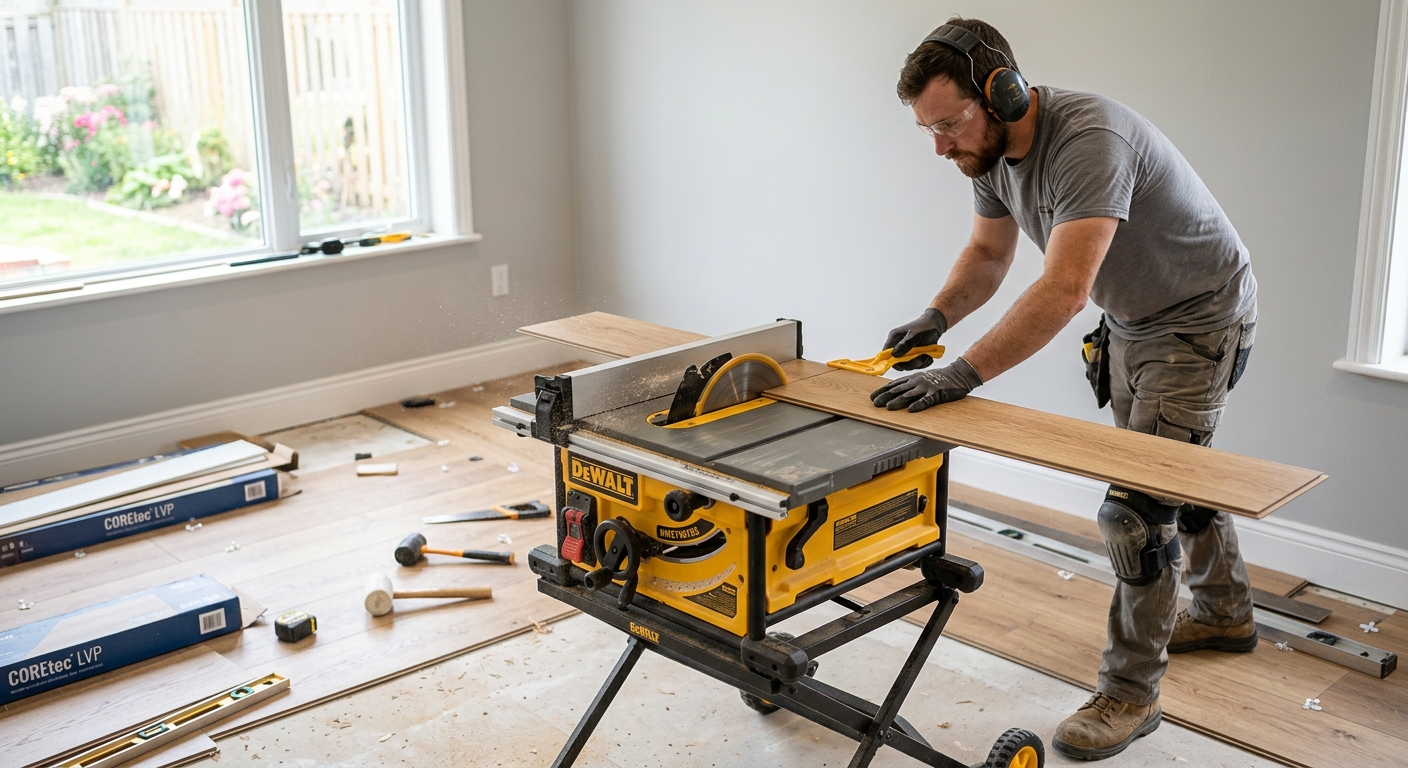
Flooring options and costs in Casselman
Casselman homeowners typically start their search by comparing what fits their home and budget, because the price gap between materials can be surprisingly wide. In Casselman, many properties were built in an era with different construction methods; about 28.8% of homes were built before 1981, and that’s a big reason flooring often needs prep like levelling compound, patching, or an OSB/plywood overlay before the new finish goes down. When prep is required, it can add roughly $2–$4/sq ft to the job before you even choose the final product.
In the Ottawa region, indoor humidity swings are a real cost factor: dry winters followed by humid summers put stress on wood-based products and on adhesive systems. That’s why solid hardwood is usually limited to above-grade areas, while engineered hardwood and luxury vinyl plank (LVP) are better at handling the seasonal movement common in this part of Ontario. Basements and other below-grade spaces also tend to have moisture and, in older houses, hydrostatic pressure—so material choice and vapour management matter.
Because Casselman is part of the Ottawa housing market, demand can be higher in areas with steady renovation activity such as the downtown/Station Road corridor and nearby residential streets where basements are commonly finished. Contractor availability and disposal/freight costs influence labour and installed pricing, especially when additional subfloor work is required. With those variables in mind, the table below gives a realistic per-square-foot starting point to help you compare quotes side by side.
| Type |
Best Room |
Moisture Resistance |
Lifespan |
Price per sq ft |
| Solid hardwood (nail-down, above grade only) |
Main floor living areas, hallways |
Low to moderate (not for basements; needs stable humidity) |
20–45 years |
$11–$22 |
| Engineered hardwood (float or glue, above + on-grade) |
Living/dining, bedrooms, main floor hallways |
Moderate to high (better with humidity swings) |
15–35 years |
$12–$21 |
| Laminate (click-lock, above-grade) |
Bedrooms, dining rooms, main-floor traffic zones |
Low to moderate (not ideal for long moisture exposure) |
10–25 years |
$6–$14 |
| Luxury vinyl plank / LVP (waterproof, any level) |
Basements, main floors, kitchens |
High (waterproof core; handles humidity better) |
15–30 years |
$7–$15 |
| Porcelain / ceramic tile |
Bathrooms, kitchens, entryways |
Very high (when properly set and grouted) |
20–50 years |
$12–$25 |
| Carpet (broadloom or modular tile) |
Bedrooms, stairs, home offices |
Moderate (avoid in damp basements) |
7–15 years |
$5–$11 |
Prices are estimates only and vary by project scope, site access and material selection.
What affects the price of flooring in Casselman
Two quotes for the same room size can easily differ by 30–50% across Ottawa and Ontario because “installed flooring” isn’t just material—it’s the whole prep-and-fit package. In Casselman, the technical drivers are moisture behaviour and subfloor condition. Ottawa-area homes see large indoor humidity swings between dry winters and humid summers, and in below-grade areas the risk rises further due to moisture vapour and hydrostatic pressure. In practice, solid hardwood can expand and contract with humidity and generally performs poorly in basements, so it’s not the best match for rooms where moisture is expected. Engineered hardwood and LVP are more dimensionally stable and, when installed with the right vapour barrier/underlayment system, are a safer investment for many on- and below-grade scenarios.
Colder winters and the growth of energy-efficiency upgrades mean more homeowners are considering radiant floor heating. That compatibility affects the product list and sometimes labour—some solid hardwood and certain laminate assemblies simply aren’t suitable over heating cables or hydronic systems, while many engineered wood and most vinyl tile/plank systems are designed to pair with radiant heat when installed to manufacturer instructions.
Older housing stock frequently needs levelling or repair before flooring goes down; if your subfloor needs attention, costs commonly increase by $1–$4 per sq ft depending on whether the job is patch-and-skim versus full plywood/OSB replacement. For example, a 600 sq ft basement might look inexpensive on paper using laminate, but once moisture remediation and a vapour-safe assembly are priced in, switching to waterproof LVP often narrows the gap. Likewise, comparing hardwood at roughly $11–$22/sq ft to LVP at about $7–$15/sq ft can be justified when you avoid basement-related failures and rework.
| Price Factor |
Why It Matters |
Cost Impact |
| Room area in sq ft |
Materials and labour scale with square footage |
Direct driver; larger rooms reduce per-sq-ft waste percentage |
| Subfloor condition |
Levelling compounds, patching, or OSB/plywood overlays are often needed in older homes |
Commonly adds about $1–$4/sq ft; worst cases can exceed that |
| Moisture / below-grade install |
Basements may require vapour barriers and stricter product selection |
Solid hardwood often avoided; switching to LVP/tile may reduce failure risk |
| Material choice |
Solid vs. engineered vs. LVP vs. tile vary in stability, installation method and downtime |
Material bands can range from about $6–$14/sq ft up to $11–$22/sq ft (hardwood) and $12–$25/sq ft (tile) |
| Removal and disposal of existing flooring |
Demolition time, hauling, and disposal fees vary by type (carpet, tile, nails) |
Can be a significant add-on in older basements |
| Stair nosing / transitions |
Transitions and stair work require custom fitting and sometimes special edging |
Often priced per step or per linear foot; increases project labour |
| Radiant heat compatibility |
Not all products can handle heat cycling safely |
May require switching to engineered wood/LVP or using specific underlayments |
| Installation method |
Float vs. glue-down vs. nail-down changes labour time, subfloor tolerances and materials |
Glue-down can raise prep and adhesive-related costs |
Permits & regulations in Ontario
In Ontario, installing flooring itself typically does not require a building permit. However, related work may trigger permit requirements depending on what’s being changed. For example, if you’re doing electrical modifications for radiant floor heating (new wiring, new circuits, or changes to the electrical feed), that work may require an electrical permit and must be done to code by a properly authorized trade. If you’re doing subfloor remediation that involves structural repairs (for instance, significant joist work due to rot or sagging), that can also require additional approvals based on scope.
In condominiums, even when a permit isn’t required for the floor finish, the building corporation’s rules on sound transmission are common. Above-grade installations in multi-unit buildings often require specific underlay or assembly thickness to meet STC/IIC expectations. Always check the condo declaration and request board approval in writing before installing hard-surface flooring like tile or hardwood.
To verify your contractor in Casselman, start with their proof of business registration and confirm they’re carrying proper insurance. Ask for their liability insurance certificate and confirm coverage limits and dates, then request evidence they cover worker protection obligations (typically verified through WSIB/WCB documentation). For licensing, check the relevant Ontario registry or the appropriate professional listing for your trade; if the contractor is vague or refuses to provide documents, that’s a red flag. Finally, ask for a written clearance letter or up-to-date coverage statement where applicable, so you’re not left holding the cost if something goes wrong.
Best flooring for each room in your Casselman home
Choosing the right floor for each space is the fastest way to protect your budget in Casselman. Because the Ottawa region can swing from dry winter air to humid summer conditions, you want to match the floor to the room’s moisture exposure, traffic level and comfort needs—especially if your home has older construction details. For living and dining areas, engineered hardwood is a popular balance: it brings warmth and looks like wood while handling humidity changes better than solid wood, and it works well on properly prepared subfloors. For master bedrooms, homeowners often choose carpet for comfort and sound control, or engineered hardwood if they prefer a cleaner surface.
Kitchen floors see spills and frequent mopping, so luxury vinyl plank (LVP) or large-format porcelain tile is usually the safer call. In below-grade finished basements, LVP is typically the clear winner because it’s waterproof and performs far better where moisture vapour is possible. Bathrooms should be porcelain or ceramic tile only, with a properly planned water-control system behind and under the tile.
Radiant floor heating is increasingly considered in Ontario, and it can be a deciding factor: many engineered wood and most quality vinyl systems can be used over radiant heating when the installation follows manufacturer temperature limits. By contrast, some solid hardwood and certain laminate assemblies should be avoided for that application. As an example, if you compare hardwood at about $11–$22/sq ft to LVP around $7–$15/sq ft for a 500 sq ft basement, the lower material band often becomes “worth it” when you factor in the reduced risk of moisture-related callbacks and the fact that solid wood is generally not a basement-ready choice.
| Room |
Best Material |
Why |
Moisture Risk |
Price Band per sq ft |
| Living / dining room |
Engineered hardwood |
Warm look with better tolerance for humidity swings |
Low (above-grade, typical lifestyle moisture) |
$12–$21 |
| Master bedroom |
Carpet or engineered hardwood |
Comfort and sound reduction (carpet) or clean durability (engineered) |
Low (keep consistent indoor conditions) |
$5–$20 |
| Secondary bedrooms |
Laminate or engineered hardwood |
Good value and easier maintenance for family use |
Low to moderate (avoid long-standing spills with laminate) |
$6–$14 |
| Kitchen |
Luxury vinyl plank (LVP) or porcelain tile |
Handles spills and cleaning; stable under temperature changes |
Moderate (spills and wet mopping) |
$7–$25 |
| Basement (finished) |
LVP (waterproof) |
Best match for below-grade moisture vapour and stability |
High (vapour/condensation potential in older homes) |
$7–$15 |
| Bathroom |
Porcelain / ceramic tile |
Non-porous surface when properly installed and sealed |
Very high (direct and repeated water exposure) |
$12–$25 |
How to choose a flooring contractor in Casselman
Start with verification that protects you: in Ontario, a solid contractor should be able to show proof of liability insurance before work begins, and they should also provide up-to-date evidence regarding coverage for their workers (commonly verified through WSIB/WCB documentation). Ask to see documents (not just screenshots) and confirm the certificate dates cover your project timeline. For licensing, flooring trades can vary by scope—if they’re handling electrical components for radiant heat or any trade-regulated work, you should confirm appropriate authorizations for that specific work.
Next, get 2–3 itemised written quotes—labour and materials broken out separately (for example: underlayment/vapour barrier, levelling compound, plywood/OSB overlay, transitions, disposal, and stair nosing). Avoid “lump sum” quotes without a clear scope. Read exclusions carefully: is plywood/levelling included if the subfloor is out of flat? Is removal and disposal of old flooring included? Are moulding, transitions, and stair work priced?
For warranty, ask for two things: the workmanship warranty length and what it covers, and the product/manufacturer warranty terms. Confirm whether the workmanship warranty is transferable if you sell your home. Payment schedules matter: never pay more than about 10–15% upfront; hold back until the work is complete and you’ve received all documentation. Finally, get a written timeline with a start date and completion estimate—Casselman jobs often depend on subfloor prep and curing times, so clarity prevents delays.
- Request proof of liability insurance and confirm it’s active for your dates.
- Ask for WSIB/WCB coverage documentation or the appropriate coverage clearance statement.
- Verify the contractor’s business details and contact information are consistent across documents and invoices.
- Get itemised pricing for levelling/patching, underlayments, and vapour barrier components.
- Confirm removal and disposal costs are included (carpet tack strips, nail-down remnants, tile debris).
- Ask whether transitions and stair nosing are included per linear foot or per step.
- Require the quote to list exact product name, thickness, wear layer (if applicable), and grade.
- Ask who supplies thresholds, reducer strips, and matching trim pieces.
- Confirm floor flatness tolerances and what happens if the subfloor is out of spec.
- Check radiant heat compatibility notes if any rooms are heated.
- Get a workmanship warranty in writing with clear start dates and coverage terms.
- Agree on a payment schedule with a holdback until completion and cleanup are verified.
Red flags I see in the Casselman market include: (1) “we’ll make it flat” promises without referencing flatness requirements, (2) refusing to provide insurance/WSIB coverage details, (3) missing itemised scope for transitions/stairs and disposal, (4) vague warranties with no written workmanship terms, and (5) pushing large upfront deposits beyond typical 10–15%.
Frequently asked questions — flooring in Casselman
How long does flooring installation take?
In Casselman, the timeline depends less on the finish and more on prep. A straightforward above-grade job (like click-lock laminate in a clear, level room) can move quickly, while homes built before 1981 often need additional subfloor repair or levelling before installation. For a typical 250–500 sq ft project, many crews can complete flooring in about 1–3 working days, with extra time for curing when levelling compound or glue-down systems are used. Basements may add time due to vapour barrier steps and moisture-related prep. If you’re adding transitions, stair nosing, or removing old tile/carpet, expect the schedule to stretch. Your contractor should provide a start date and completion estimate in writing.
What flooring works with radiant heat?
Radiant floor heating is common in Ontario upgrades, and the key is product compatibility with the heating system’s temperature limits. In practice, engineered hardwood and most quality LVP systems are usually the best bets when installed to manufacturer specs, because they tolerate temperature cycling better than solid hardwood. Many laminate products can be compatible too, but you must choose one that’s explicitly rated for radiant heat and use the required underlayment (no substitutions). Solid hardwood is often restricted because it can react to heat cycling and humidity changes; in a cold region like Ottawa, that risk becomes more noticeable. When you request your quote in Casselman, ask the contractor to confirm which specific products are rated for your radiant setup and to list the correct installation assembly.
Engineered vs solid hardwood — what's the difference?
Solid hardwood is a single piece of wood and is typically nail-down installed for above-grade use only. Engineered hardwood is layered: a stable core (often plywood) with a real wood top layer, which helps it handle the Ottawa region’s humidity swings better. That’s why engineered wood is often chosen for main floors where indoor conditions still vary between seasons. In basements or other below-grade spaces, solid hardwood is generally a poor match due to humidity risk and movement; engineered is closer to acceptable when the vapour barrier and subfloor prep are done correctly. Cost-wise, you’ll often see hardwood projects fall into a band around $11–$22/sq ft for solid, while engineered typically lands near similar or slightly higher installed ranges depending on the product. The right choice is mainly about location (grade level) and the installation system, not just the “wood look.”
Do I need to level my subfloor first?
Most of the time, yes—at least to “make it installer-ready.” If the subfloor is out of flatness or has waves from older patch jobs, even the best flooring will show gaps, telegraphing, squeaks or joint stress. In older Casselman homes (and many around the Ottawa area), it’s common to find uneven subfloors from mid-century builds, additions, or moisture-related shifts. Levelling compound, plywood/OSB overlay, and fixing squeaks can add roughly $1–$4 per sq ft depending on the problem size. If your subfloor is only slightly uneven, a skim/patch approach may keep costs down; if it’s severely out of plane, a full overlay is often the durable fix. Ask your contractor how they plan to measure flatness and what the quote includes if prep is worse than expected.
What's the most durable flooring for pets and kids?
For families in Casselman, “durable” usually means scratch resistance, easy cleaning, and decent moisture handling. Luxury vinyl plank (LVP) is often the top practical choice because it’s waterproof and holds up well to day-to-day spills, which is a big factor in homes with varied humidity and occasional basement dampness. If you choose LVP, look for higher wear layers and confirm the warranty terms cover household pets and normal impacts. Porcelain tile is also extremely durable and resists moisture, but it can be harder underfoot and more brittle than vinyl when dropped items hit. Carpet is comfortable and quiet but needs stain- and odour-focused care, and it’s not ideal for damp basements. Price-wise, LVP frequently sits around $7–$15/sq ft installed, while tile commonly lands around $12–$25/sq ft installed—so you can match durability with your room’s moisture risk and your tolerance for comfort vs hardness.
How do I choose flooring for humidity in Casselman?
Humidity is where flooring failures often start in Ontario, especially in the Ottawa region where seasons swing indoor air conditions. For above-grade rooms, engineered hardwood and properly installed laminate are typically better than solid hardwood if your home’s humidity isn’t tightly controlled. For below-grade spaces like finished basements, you should assume higher moisture vapour risk and choose truly moisture-tolerant options—LVP is usually the safest bet because it’s waterproof and dimensionally stable. Tile is also moisture-proof when installed correctly. Solid hardwood generally isn’t recommended for basements due to expansion/contraction and moisture sensitivity. Before committing, ask your contractor about vapour barriers and moisture management for the specific room. This matters even more in homes built before 1981, where older assemblies may not have the same moisture control. (Statistics Canada, 2021 Census)