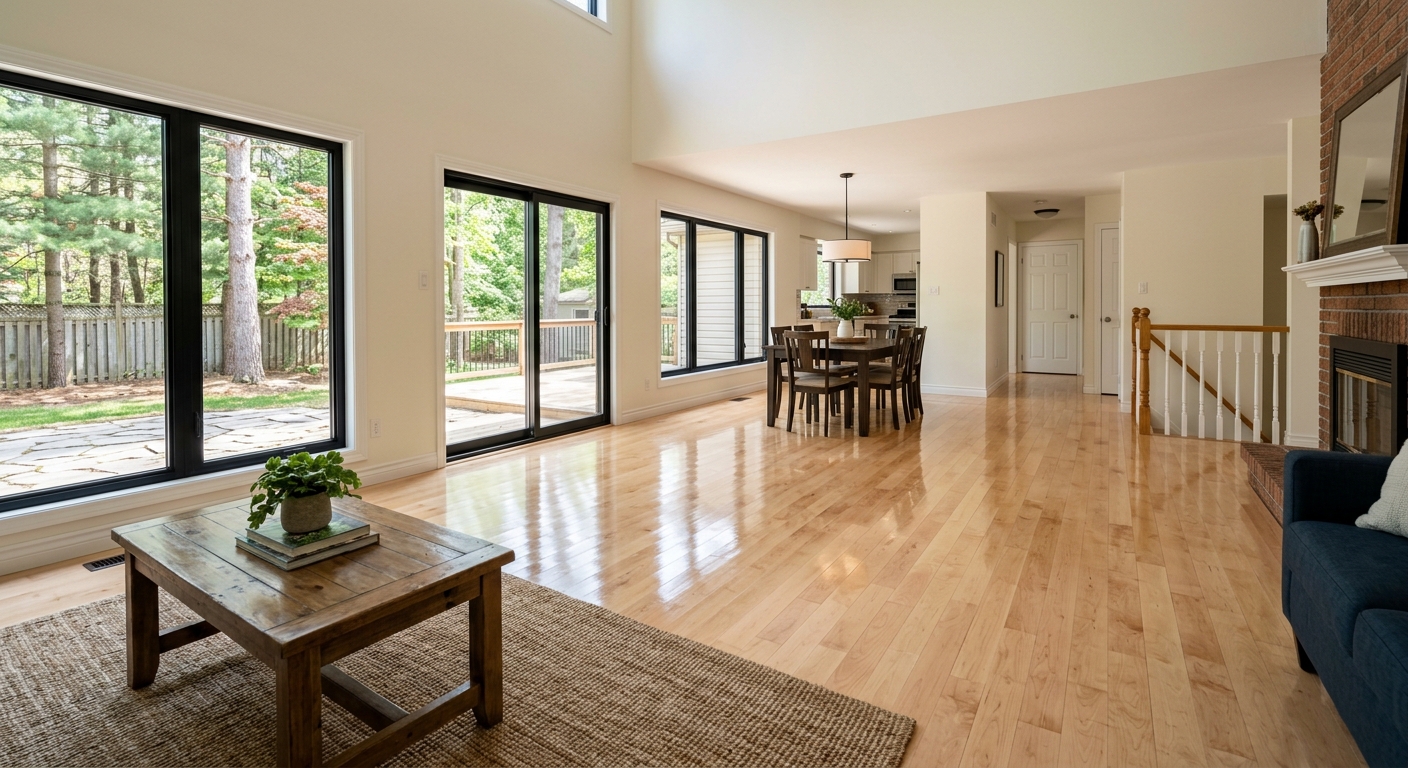
Flooring options and costs in Fallingbrook
Flooring choices in Fallingbrook usually come down to balancing comfort, durability, and moisture performance. With a local population of about 25,000 people (Statistics Canada, 2021 Census), Fallingbrook is large enough to support active renovation demand, and that means contractors are busy in peak seasons—often translating into tighter scheduling and more competitive labour pricing once materials are selected.
One reason quotes can feel “all over the map” is that many Toronto-area homes were built decades ago and commonly require subfloor levelling, plywood replacement, or moisture mitigation before the new floor goes down. Even if your finished material is mid-range, prep can add roughly $1–$4 per sq ft, which is why homeowners should treat “subfloor work” as part of the overall flooring budget. Toronto’s climate also drives costs: indoor humidity swings across seasons are wide, and below-grade moisture is a real risk, especially in basements and walkouts. That’s why we steer most clients toward engineered hardwood or luxury vinyl plank (LVP), particularly in condos and newer infill builds, rather than traditional solid hardwood.
In older neighbourhoods and near active commercial corridors—often where turn-over renovations are frequent—engineered hardwood and LVP tend to move fast because they install cleaner, tolerate humidity better, and are less sensitive over concrete slabs. If your home has radiant floor heating, that can also narrow the material list and slightly adjust the labour plan. Use the table below to compare typical cost ranges and performance, then we’ll break down exactly what pushes prices up or down in Section 2.
| Type |
Best Room |
Moisture Resistance |
Lifespan |
Price per sq ft |
| Solid hardwood (nail-down, above grade only) |
Living room, dining room (above grade) |
Low to moderate; moves with humidity; not recommended over concrete or in basements |
25–50 years with proper conditions |
$9–$18 |
| Engineered hardwood (float or glue, above + on-grade) |
Living areas, bedrooms, halls |
Moderate to high; handles typical indoor humidity swings better |
15–35 years |
$9–$18 |
| Laminate (click-lock, above-grade) |
Bedrooms, living spaces (above grade) |
Low to moderate; water can damage core if spills aren’t cleaned quickly |
10–25 years |
$4–$9 |
| Luxury vinyl plank / LVP (waterproof, any level) |
Kitchen, basement (finished), main floor with active families |
High; waterproof when installed correctly |
15–25 years |
$4–$9 |
| Porcelain / ceramic tile |
Kitchen, bathrooms, entries |
Very high; handles moisture and cleaning |
25–50 years (grout maintenance required) |
$12–$25 |
| Carpet (broadloom or modular tile) |
Bedrooms, stairs (comfort-focused) |
Low to moderate; sensitive to basement dampness |
7–15 years |
$5–$11 |
Prices are estimates only and vary by project scope, site access and material selection.
What affects the price of flooring in Fallingbrook
In the Toronto economic region, two homeowners can receive quotes that differ by 30–50% for “the same floor” because the hidden variables aren’t the product—they’re the site conditions, prep, and the details of installation. Toronto-area labour demand is strong, general construction wages are higher than in many other parts of Ontario, and renovation timelines are often compressed, so installers price risk and scheduling into the quote. On top of that, many homes in the 1960s–1990s range need moisture mitigation and subfloor repair before any finished floor is installed.
Technically, Toronto’s indoor humidity swings are the key driver. Solid hardwood expands and contracts with moisture and is typically not glued or floated over concrete; it also performs poorly in basements where vapour pressure and temperature swings can be harsher. Engineered hardwood and luxury vinyl plank (LVP) are far more dimensionally stable and are designed for on-grade and below-grade applications when the subfloor is sound. In colder parts of the region and in newer custom builds, radiant floor heating is increasingly common; that heat and expansion profile favours engineered wood, tile, and certain vinyl systems instead of traditional solid hardwood and some laminate.
Cost examples we see often in Fallingbrook: if your concrete slab is uneven and needs levelling, that can add material and labour—commonly $1–$4 per sq ft depending on how far off it is. If you’re replacing plywood due to water damage or soft spots, the scope grows quickly. If you’re choosing tile at $12–$25 per sq ft, labour for setting and layout can be a large part of the total, whereas many laminate installs at $4–$9 per sq ft can look cheaper until you factor in underlayment, transitions, and the cost of correcting a wavy subfloor.
| Price Factor |
Why It Matters |
Cost Impact |
| Room area in sq ft |
More square footage increases materials, underlayment, and labour hours |
Direct; typically scales overall cost proportionally |
| Subfloor condition — levelling or repair needed before install |
Uneven or damaged subfloors can ruin click floors and telegraph through LVP or hardwood |
Often adds a noticeable premium; commonly a measurable $/sq ft line item |
| Moisture / below-grade install — rules out solid hardwood |
Basements require moisture-tolerant flooring and correct underlay/subfloor steps |
Can increase cost if mitigation/repairs are required; prevents future failures |
| Material choice — solid vs. engineered vs. LVP vs. tile |
Product price and installation method drive labour intensity and waste |
Ranges widely; tile is commonly higher than laminate/LVP |
| Removal and disposal of existing flooring |
Old flooring, old underlay, and debris removal affect time and disposal fees |
Can materially raise totals, especially with tile/adhesive |
| Stair nosing / transitions — charged per step or per linear foot |
Transitions aren’t “free”; stair details require extra materials and careful finishing |
Frequent add-on; can be surprisingly large on multi-level homes |
| Radiant heat compatibility — limits material options |
Some materials manage heat expansion better than others |
May increase product cost and change prep/installation requirements |
| Installation method — float vs. glue-down vs. nail-down |
Different systems demand different subfloor prep, adhesives, and labour techniques |
Labour method differences can shift pricing even with the same “look” |
Permits & regulations in Ontario
In Ontario, the flooring installation itself usually does not require a building permit. That’s the good news for homeowners in Fallingbrook: most projects (engineered hardwood, LVP, laminate, carpet, and standard tile work) proceed without municipal permit paperwork. However, associated work can trigger permit or code requirements—especially when you’re altering electrical systems or addressing structural/moisture issues beyond “like-for-like” finishing.
Work that typically DOES require permits can include: electrical permit work for radiant heat circuits or thermostat wiring changes; and certain electrical adjustments if you’re adding or modifying in-floor heating components. Also, if your project includes substantial structural subfloor remediation (for example, significant repairs that affect building integrity), the scope may involve permit processes depending on how it’s documented.
Work that typically does NOT require a permit is most floor replacement and finishing: removing old flooring, installing underlay, levelling over existing subfloor (within reason), laying engineered wood/LVP/laminate, installing bathroom tile, and completing transitions and baseboards.
In condominiums, the bigger constraint is often the corporation’s rules. Sound transmission requirements (STC/IIC) can restrict hard flooring, and many buildings require specific underlay systems to reduce impact noise. Before you install, review the declaration, ask for board approval in writing when needed, and ensure the installer can provide product documentation and underlay details.
To verify a contractor is properly set up in Ontario, request their Ontario licence details if applicable for the scope, confirm liability insurance, and check WSIB/WCB coverage. Ask for a current certificate of insurance (COI) showing you as the certificate holder where appropriate, and request proof of coverage. If you’re using a written clearance letter from the employer’s insurer/coverage provider, keep it with your contract—those documents are what protect you if there’s an incident on site.
Best flooring for each room in your Fallingbrook home
Choosing the best floor for each room in Fallingbrook is mostly about matching moisture exposure and comfort needs to a product that can tolerate Toronto-area humidity swings. In living and dining areas, homeowners often want warmth and a natural look without the movement risk of solid wood; engineered hardwood or quality laminate are common winners because they balance appearance with stability above grade. For bedrooms, the trade-off is comfort and sound—carpet remains hard to beat for quiet and underfoot softness, while engineered hardwood can still work well if you maintain indoor humidity within a reasonable range.
Kitchens are a different story. Spills, wet mopping, and foot traffic make luxury vinyl plank (LVP) a practical choice, or you can go with large-format porcelain tile for durability and easy cleaning. In basements, LVP is usually the clear winner: it’s fully waterproof and better suited for below-grade installs where vapour and temperature changes can happen. Traditional solid hardwood and most laminate are riskier in that environment, even if they look great in showrooms. Bathrooms should be porcelain or ceramic tile only, because of repeated water exposure and cleaning demands.
Radiant floor heating is increasingly popular in Ontario new construction. When heat is involved, engineered wood and tile pair more reliably with expansion/heat considerations than solid hardwood, and only certain vinyl systems are appropriate—your installer should confirm the product’s radiant compatibility before committing.
Price-wise, the “justified” difference is often between options that perform differently where moisture matters. For example, spending closer to $12–$25 per sq ft on porcelain tile in a bathroom is usually worth it versus laminate, because the tile stays stable and cleaning-friendly for years. Meanwhile, choosing LVP in the basement at $4–$9 per sq ft can prevent costly callbacks caused by moisture-related failure.
| Room |
Best Material |
Why |
Moisture Risk |
Price Band per sq ft |
| Living / dining room |
Engineered hardwood or high-quality laminate |
Warm feel, stable enough for seasonal humidity, good everyday durability |
Low to moderate (above grade typical) |
$9–$18 |
| Master bedroom |
Carpet or engineered hardwood |
Comfort and sound reduction (carpet) or a cleaner, longer-wearing finish (engineered) |
Low (manage indoor humidity) |
$5–$11 |
| Secondary bedrooms |
Carpet or laminate (click-lock) |
Cost-effective comfort and easy maintenance for family traffic |
Low |
$4–$9 |
| Kitchen |
Luxury vinyl plank (LVP) or porcelain tile |
Handles spills and frequent cleaning; resists wear in busy households |
Moderate (spills/steam exposure) |
$4–$25 |
| Basement (finished) |
Luxury vinyl plank (waterproof) |
Dimensionally stable for below-grade moisture conditions; waterproof surface |
High (vapour and temperature swings) |
$4–$9 |
| Bathroom |
Porcelain / ceramic tile |
Water resistance and long-term durability; best for wet-area cleaning |
Very high |
$12–$25 |
How to choose a flooring contractor in Fallingbrook
Choosing the right flooring contractor in Fallingbrook is less about flashy ads and more about verifying the basics: coverage, clear pricing, and a workmanship approach that fits local conditions. Start by confirming Ontario coverage documents. Ask for proof of liability insurance (with a current certificate of insurance) and request evidence of WSIB/WCB coverage for the people doing the work. If a contractor can’t provide documents promptly, that’s a major warning sign.
Next, get 2–3 itemised written quotes—not lump sums. A solid quote breaks out materials and labour separately and lists what’s included: underlay, levelling compound, adhesive (if glue-down), transitions, stair nosing, and edge finishing. It should also specify what’s excluded (for example, drywall trimming, baseboard removal/reinstall, or additional subfloor repairs discovered after demolition). In a typical Toronto-area renovation, subfloor levelling or plywood repair can meaningfully change the final total, so you want an allowance and a clear process for change orders.
Warranty matters twice: product warranty (from the manufacturer) and workmanship warranty (from the installer). Ask how long each covers, whether the warranty is transferable if you sell your home, and what maintenance is required to keep it valid. Payment schedules should stay conservative—never pay more than 10–15% upfront, and insist on a holdback until you’re satisfied the job is complete. Also request a written start date and completion window.
- Ask for COI (liability) and verify it matches the legal name on the quote/contract.
- Confirm WSIB/WCB clearance or proof of coverage for workers on your site.
- Require itemised pricing for demo, disposal, subfloor prep, materials, and install labour.
- Ensure the quote states the exact product (brand, line, thickness/grade, and colour).
- Check whether levelling/patching is included up to a defined standard (not “as needed” only).
- Ask how moisture is assessed for basements (vapour concerns, subfloor soundness).
- Verify transition and stair work pricing (per step or per linear foot) and whether moulding/baseboards are handled.
- Confirm underlay details for laminate and noise-control underlay for condos (STC/IIC requirements).
- Get the workmanship warranty in writing and learn what triggers a claim denial.
- Clarify disposal: does it include hauling and tipping fees?
- Set a holdback for completion and snag-free final walkthrough acceptance criteria.
- Request a start/completion schedule and a policy for delays caused by material backorders.
Red flags I commonly see with less reliable flooring contractors in the Fallingbrook area include: refusal to provide COIs/WSIB documentation, quotes that omit subfloor prep scope, “cheap” pricing with no line-item transitions or stairs, vague warranty terms, and pressure for large upfront deposits. If any of those show up, keep shopping and insist on a written, detailed scope.
Frequently asked questions — flooring in Fallingbrook
How do I choose flooring for humidity in Fallingbrook?
Fallingbrook homeowners should treat humidity swings as a performance spec, not an inconvenience. Toronto-area seasons can drive noticeable indoor moisture changes, and that matters most for solid hardwood—boards expand and contract, and solid wood isn’t ideal over concrete slabs or in basements. For most above-grade rooms, engineered hardwood is a safer choice because it’s designed to tolerate typical humidity swings better. For basements, luxury vinyl plank (LVP) is usually the best route because it’s waterproof and handles below-grade moisture vapour risk far more reliably than laminate or carpet. If you’re shopping budget, laminate at $4–$9 per sq ft can work above grade, but it’s sensitive to spills if they aren’t cleaned quickly. In any case, have your contractor address subfloor soundness and levelling first—moisture issues often start with prep, not the top layer.
Do condos restrict hard flooring?
Yes, in many Toronto-area condos the corporation’s rules can restrict or control hard flooring, primarily due to sound transmission requirements (STC/IIC). Even when hard flooring is allowed, you may be required to use a specific underlay system or thickness and sometimes need written board approval before work starts. That’s why the “best” product is often the one that fits both moisture performance and the building’s acoustic requirements. If you’re installing engineered hardwood or tile on an upper floor, ask your condo for the underlay requirements and confirm the installer can supply product documentation that matches. In colder months, condo humidity can still swing with HVAC settings, so engineered wood or properly installed LVP is common because it tolerates conditions better than solid hardwood. If you want the quietest hard option, be prepared for additional underlay and sometimes extra labour for transitions.
How do I compare flooring quotes?
To compare quotes in Fallingbrook fairly, you need apples-to-apples line items. Ask for an itemised breakdown that separates labour and materials, including underlay, levelling/patching, adhesive (if relevant), stair nosing, and transitions. Confirm what demolition and disposal include—some quotes only remove the old flooring, while others haul away debris and do subfloor prep. Next, compare scope: does the quote account for expected subfloor levelling or plywood replacement, or is it only “spot repair”? For moisture-sensitive areas like basements, make sure the quote doesn’t assume solid hardwood or laminate will perform without mitigation. Finally, compare warranty terms and payment schedules; a lower price with limited warranty or big upfront deposits can cost more later. As a quick reality check, tile typically sits higher than laminate/LVP in this market (tile commonly $12–$25 per sq ft, laminate/LVP commonly $4–$9), so quotes that ignore that difference often signal incomplete scope.
Can I install flooring over existing tile in Fallingbrook?
Sometimes, but you can’t assume it’s always a smart or approved approach. Over existing tile, the main issues are surface flatness, height changes, and how stable the tile is. If the tile is well-bonded and the surface is reasonably level, a contractor may install an underlayment system appropriate for your new floor type—especially for LVP, but it must be compatible with the manufacturer’s instructions. For engineered hardwood, some systems can go over tile if the substrate meets flatness and moisture requirements, but height and acoustics can become limiting factors. The more critical question is what your contractor plans to do about uneven grout lines and any loose tiles; if you’re planning to “go over it” without addressing movement, the new floor can fail or feel bouncy. Because Toronto-area renovations often include levelling anyway, you may be better off budgeting for prep rather than hoping to skip it.
What is the best flooring for a high-traffic area in Fallingbrook?
For high-traffic areas in Fallingbrook, LVP and tile are usually the most forgiving choices because they handle daily wear, cleaning, and the humidity swings common in Ontario homes. LVP at $4–$9 per sq ft is popular for entries, hallways, and open-plan main floors because it’s waterproof and impact-friendly when installed over a properly level subfloor. Porcelain/ceramic tile (often $12–$25 per sq ft) is also excellent in high-traffic zones, especially where spills happen and you want the longest wear life with easy maintenance. Engineered hardwood can work beautifully in high traffic too, but you’ll want the right wear layer and good matting/maintenance plan, and it still performs best above grade where moisture risk is lower. If you have radiant floor heating, confirm product compatibility—heat can change how some materials expand and contract.
How do I prepare my subfloor before new flooring?
Subfloor preparation is where most Toronto-area flooring projects are won or lost. Before install, your contractor should check flatness, stiffness, and overall moisture risk—especially for basements and any areas over concrete. If the subfloor is uneven, they should level it using approved patch/compound products rather than trying to “hide” it under the finished floor. If there’s water damage, soft plywood, or delamination, the correct fix is repair or replacement of affected panels, not just smoothing. For concrete slabs, the prep can include appropriate moisture mitigation steps depending on conditions and product requirements. If you’re installing engineered hardwood or LVP, proper underlayment and expansion allowances matter just as much as levelling. In many Fallingbrook homes built across older Ontario eras, subfloor repair is common, and it’s one reason total flooring costs often exceed the headline material price.