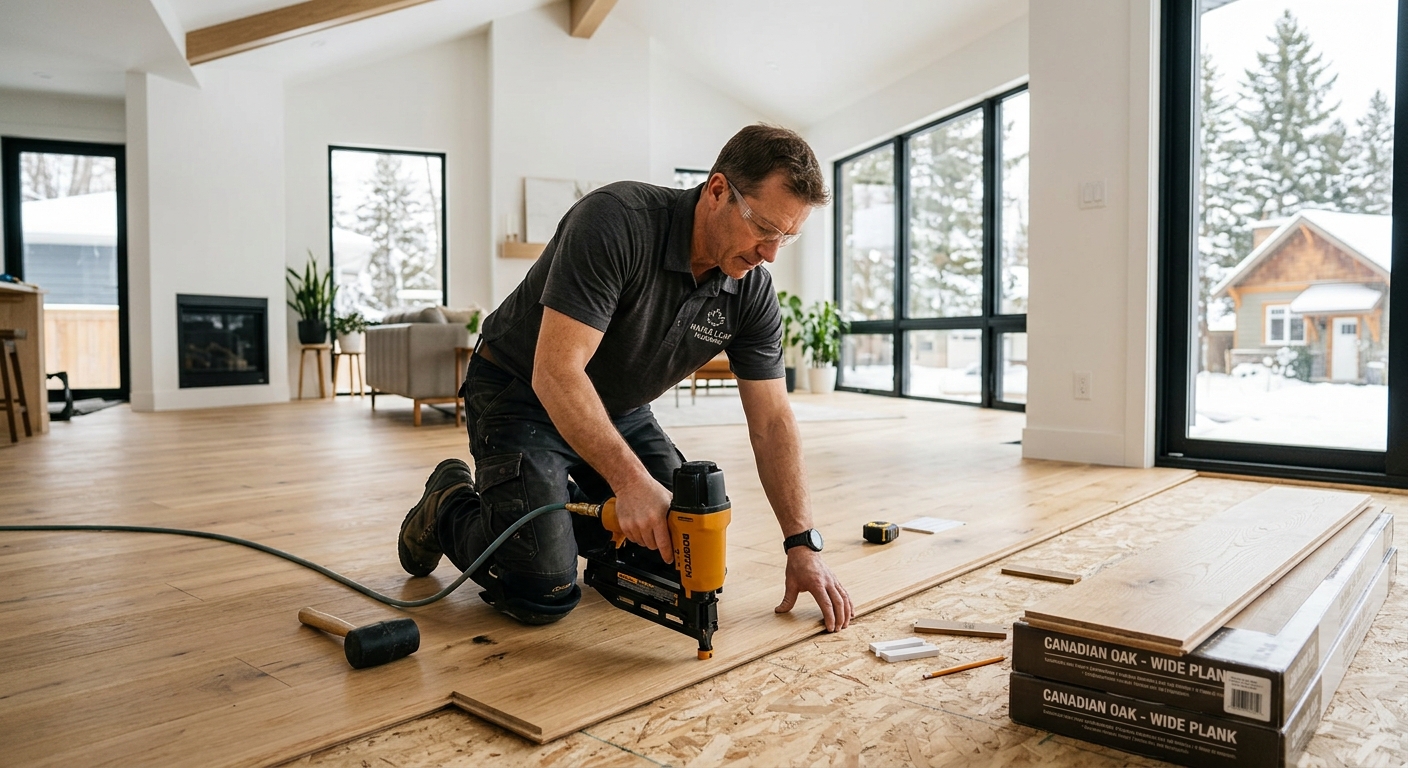
Flooring options and costs in Humber Summit
Humber Summit is a fast-growing pocket of the Greater Toronto Area, and homeowners there tend to price flooring the way contractors do: by durability, installation prep, and how materials handle Ontario’s seasonal indoor humidity swings. With a population of 12,416 (Statistics Canada, 2021 Census), you’ll find strong renovation demand, which supports a steady slate of installers—though it also means labour rates stay firm compared with many other regions.
In this part of Toronto, older homes are common, and they often require subfloor levelling, underlayment upgrades, or even plywood replacement before the “new floor” can be laid. That prep can easily add meaningful cost even when you choose a mid-range product—think roughly $1–$4 per sq ft depending on what’s wrong and how far the contractor has to go to get the surface flat and stable. Toronto-area projects also commonly include moisture mitigation and tighter tolerances on transitions, especially in infill and condo basements where slab conditions vary.
Climatically, the key driver is indoor humidity shifting across winter and summer. Solid hardwood can look exceptional, but it expands and contracts with moisture and is higher risk over concrete and in basements. That’s why, in Humber Summit, many homeowners go engineered hardwood or luxury vinyl plank (LVP) for better dimensional stability—particularly above-grade in condos and on grade where moisture is a concern. The next step is a side-by-side cost comparison so you can map your preferred look to realistic budgeting.
| Type |
Best Room |
Moisture Resistance |
Lifespan |
Price per sq ft |
| Solid hardwood (nail-down, above grade only) |
Living / dining (above grade) |
Low to moderate; sensitive to humidity |
25–60 years |
$9 – $18 |
| Engineered hardwood (float or glue, above + on-grade) |
Living / dining, bedrooms |
Moderate to good; better with humidity swings |
15–35 years |
$10 – $17 |
| Laminate (click-lock, above-grade) |
Bedrooms, hallways |
Low to moderate; not ideal for wet areas |
10–25 years |
$4 – $8 |
| Luxury vinyl plank / LVP (waterproof, any level) |
Kitchen, main floor, basement |
High; waterproof cores available |
12–25 years |
$5 – $9 |
| Porcelain / ceramic tile |
Kitchen, bathrooms, entry |
Very high; tolerates moisture well |
20–50 years |
$12 – $25 |
| Carpet (broadloom or modular tile) |
Master and secondary bedrooms |
Low to moderate; avoid in wet zones |
7–15 years |
$4 – $9 |
Prices are estimates only and vary by project scope, site access and material selection.
What affects the price of flooring in Humber Summit
In Humber Summit and the wider Toronto market, you can see the same “flooring replacement” quoted 30–50% apart because the pricing drivers aren’t just the product—they’re the prep, moisture risk, removal/disposal, and how busy the installer is. Two homeowners can choose the same-looking engineered hardwood, yet one project includes subfloor levelling and moisture mitigation while the other starts on a flat, dry base. That difference alone can swing labour and material time, particularly in homes from the 1960s–1990s that were built before today’s moisture-management expectations.
Toronto-area humidity swings matter technically: solid hardwood expands and contracts with indoor moisture. Over concrete it’s also a problem because traditional nail-down solids aren’t meant to be glued or floated on slabs, and basements are more vulnerable. That’s why engineered hardwood and LVP are usually the safer bets for on-grade and below-grade areas. If you’re in a colder part of the region or upgrading for comfort, radiant floor heating is increasingly common in new custom builds, and it pairs better with engineered wood, tile, and certain vinyl products than with traditional solid hardwood. Older housing stock also frequently needs levelling or repairs—often adding roughly $1–$4 per sq ft.
Here are a few Humber Summit examples that change cost fast: (1) a 300 sq ft job with uneven OSB/plywood may require patching and sanding before any engineered plank can be installed; (2) installing LVP in a finished basement typically adds fewer risk-related steps than solid hardwood, but still requires proper vapour/moisture planning for the slab; (3) large-format tile in a kitchen or entry needs more time for layout, mortar/levelness, and grouting—so even if the tile itself is mid-range, the labour and waste can push you toward the upper end of the $12 – $25 per sq ft band. Once you understand these factors, you’ll be able to compare quotes apples-to-apples.
| Price Factor |
Why It Matters |
Cost Impact |
| Room area in sq ft |
Directly sets material quantity and hours for prep, install, and cleanup. |
Large rooms can be more efficient per sq ft; small jobs cost more. |
| Subfloor condition |
Levelling/repair protects the floor and prevents hollow spots and joint failure. |
Often adds about $1–$4 per sq ft in older Toronto-area homes. |
| Moisture / below-grade install |
Rules out solid hardwood; drives vapour-control and surface prep requirements. |
Switching to engineered or LVP usually reduces moisture-related risk and extra callbacks. |
| Material choice |
Different products have different underlays, thickness, and install complexity. |
Hardwood tends to sit higher than laminate/LVP; tile usually sits highest. |
| Removal and disposal of existing flooring |
Tearing out old carpet, underlay, adhesives, or tile is labour-intensive. |
Can add a noticeable line item—especially with glue-down residue. |
| Stair nosing / transitions |
Stairs and thresholds require custom cuts, trims, and extra finishing. |
Often charged per step or per linear foot and can move the total up quickly. |
| Radiant heat compatibility |
Heat affects expansion; not every product is designed for in-floor heating. |
May limit you to engineered, tile, or specific vinyl—sometimes at a higher material cost. |
| Installation method |
Float, nail-down, and glue-down have different timing, tolerances, and labour intensity. |
Nail-down and glue-down can take longer; float installs may be faster when subfloors are flat. |
Permits & regulations in Ontario
In Ontario, a typical flooring installation usually does not require a building permit. Replacing flooring with a like-for-like finish is generally considered a non-permitted interior trade. However, associated work can trigger permit needs depending on what’s being modified. For example, if you’re repairing or replacing a subfloor that involves structural changes, or doing moisture remediation that requires work beyond simple prep, a permit pathway may come into play. If your project includes in-floor heating circuits or any electrical connections, electrical permits are often required because that work involves certified electrical installation.
In condominiums around Humber Summit, the bigger “rule” is usually the building’s documentation. Hard flooring can affect sound transmission. Many corporations require specific underlay, and they may limit which products you can use on upper floors to meet sound performance expectations. Before you install hardwood or tile on a condo level, review the declaration documents and request written board approval if your building requires it.
To verify a contractor before you sign anything: (1) check the contractor’s Ontario licence status through the appropriate public registry; (2) request a certificate of insurance that shows liability coverage—confirm the effective dates match your job timeline; (3) ask for WSIB/WCB clearance or status (as applicable) to ensure they can legally work and that you’re protected if there’s an incident. Then keep copies of everything in your project file.
Best flooring for each room in your Humber Summit home
Choosing flooring room-by-room is the fastest way to get value in Humber Summit, because Ontario humidity and day-to-day moisture exposure hit some rooms harder than others. For living and dining areas, engineered hardwood or high-quality laminate tends to be the sweet spot: you get a warmer look than tile, good wear for traffic, and better stability than solid hardwood through Toronto’s seasonal indoor swings. For the master bedroom, carpet is still one of the most comfortable choices—especially in winter—while engineered hardwood is the preferred “allergy friendly” option if you want a harder surface.
In the kitchen, go with luxury vinyl plank (LVP) or large-format porcelain tile. LVP is forgiving under spills and easy to clean, while tile is unmatched for moisture exposure. In finished basements, LVP is usually the clear winner because it’s waterproof and designed to handle below-grade installation realities; solid hardwood and most laminate are higher risk over moisture-vulnerable slabs. Bathrooms should be porcelain or ceramic tile only for the moisture environment.
Radiant floor heating is increasingly common in Ontario new construction, and when you build or renovate with heat in mind, engineered wood, tile, and compatible vinyl typically perform better than traditional solid hardwood. As an example of “where the price difference is justified”: if solid hardwood in a basement is avoided and you choose LVP instead, you can be looking at roughly $5 – $9 per sq ft for LVP versus hardwood budgeting that sits in the $9 – $18 band—while also reducing the risk of cupping and moisture-related callbacks.
| Room |
Best Material |
Why |
Moisture Risk |
Price Band per sq ft |
| Living / dining room |
Engineered hardwood |
Warm, premium look with better humidity tolerance than solid. |
Low to moderate (humidity swings, occasional spills) |
$10 – $17 |
| Master bedroom |
Carpet or engineered hardwood |
Carpet improves comfort and sound; engineered keeps it easy to maintain. |
Low |
$4 – $9 |
| Secondary bedrooms |
Laminate or LVP (if kids/pets) |
Durable and easier to replace sections; faster install with click-lock. |
Low to moderate |
$4 – $8 |
| Kitchen |
LVP or porcelain tile |
Handles spills, frequent cleaning, and kitchen traffic. |
Moderate to high |
$12 – $25 |
| Basement (finished) |
Luxury vinyl plank (waterproof) |
Dimensionally stable and made for below-grade and moisture-prone slabs. |
High |
$5 – $9 |
| Bathroom |
Porcelain / ceramic tile |
Best-in-class moisture resistance; long service life. |
Very high |
$12 – $25 |
How to choose a flooring contractor in Humber Summit
In Humber Summit, your best protection is to verify three things before you commit: Ontario licensing (where applicable), liability insurance, and WSIB/WCB coverage. Ask the contractor for their proof of licensing and take a moment to confirm their registration details match the company that will be on site. Request a current certificate of insurance for general liability (and extension where relevant) and confirm the coverage period aligns with your scheduled installation dates. For WSIB/WCB, ask for their clearance letter or status documentation—this is especially important because it reduces your risk if a worker is injured or if there’s a compliance issue.
Next, get 2–3 itemised written quotes. You want a breakdown that separates labour and materials (including underlay, adhesives, levelling/patching, trim, transitions, and any waterproofing/vapour-control products), not just a single lump sum. Carefully read the scope: what’s included for subfloor prep, what’s excluded, and whether removal and disposal of existing flooring are included in the price. Confirm whether permits (if any are required for electrical/in-floor heating work) are the contractor’s responsibility.
For warranty, check both workmanship and product warranty. Ask how long labour is covered and whether the product warranty is transferable if you sell your home. On payment schedule, never pay more than 10–15% upfront; hold back the remainder until the work is complete and cleaned up. Get start date and completion estimate in writing so you have a documented timeline.
- Ask who will do the work (crew names if possible) and how many years they’ve been installing the specific flooring type.
- Confirm liability insurance limits and that the certificate is valid during your install window.
- Request WSIB/WCB clearance/status documentation before work begins.
- Get an itemised quote with labour, materials, underlay, trims, transitions, and subfloor prep listed separately.
- Clarify whether demolition/removal and disposal are included (and whether they handle baseboards).
- Confirm what “level subfloor” means in writing (deflection/flatness expectations).
- Verify moisture control steps for on-grade or below-grade installs (vapour barrier and acclimation approach).
- Ask about stair nosing, reducers, and transition strips—get per-step/per-linear-foot pricing.
- Request product details: thickness, wear layer (hardwood/engineered), core type (LVP waterproof vs water-resistant).
- Review warranty terms in writing for both labour and product; ask if it’s transferable to new homeowners.
- Ensure the contract states payment milestones tied to completed deliverables, not just “progress.”
- Get a written start date and an estimated completion date, plus who to call for scheduling issues.
Red flags to watch for in Humber Summit: a contractor who won’t show proof of insurance or WSIB/WCB documentation; a quote that’s only a single number with no breakdown of prep and transitions; vague warranty language (no labour coverage terms); insisting you pay most of the job upfront; or delaying a site visit and measurements yet promising an exact install date.
Frequently asked questions — flooring in Humber Summit
What flooring holds up best to pets in a Humber Summit home?
For pets in Humber Summit and across Ontario, the most reliable choices are waterproof luxury vinyl plank (LVP) and certain engineered hardwood options—mainly because they can handle accidents and everyday moisture without the same swelling risk as solid hardwood. LVP is especially practical near doorways where winter slush and salt melt can track in, and it’s also the best fit for many finished basements. If you prefer a wood look, choose engineered hardwood with a wear layer designed for heavy traffic and pair it with a quality underlay; then keep humidity reasonably controlled to reduce gapping. In cost terms, LVP budgets often land around $5 – $9 per sq ft, while engineered hardwood is commonly higher in the $10 – $17 range. The real difference isn’t just durability—it’s whether the product’s construction tolerates moisture exposure without shifting.
How do I fix squeaky floors in my Humber Summit home?
Squeaks usually come from movement between subfloor layers, joists, or fastener issues—not from the finished flooring itself. In Humber Summit, older housing stock often needs attention to plywood/OSB condition and fastening before new surface material goes down. A good contractor will identify whether the squeak is in the subfloor/joist connection or caused by an underlayment/anchorage issue, then correct the source by re-fastening or adding proper blocking. If you’re already planning a flooring replacement, it’s often more cost-effective to address squeaks during subfloor prep rather than after the new floor is installed, because removing the finished layer later is labour and disposal again. If the home has radiant heat or a basement slab, the fix strategy changes too—so always ask for a diagnostic inspection before assuming it’s a “loose plank” problem.
What is luxury vinyl plank and is it worth it in Humber Summit?
Luxury vinyl plank (LVP) is a resilient flooring with a printed décor layer and a protective wear layer on top of a vinyl core. In Humber Summit, it’s often worth it because Toronto-area humidity swings and below-grade moisture realities can be tough on solid hardwood and some laminate. LVP is typically waterproof or highly water-resistant, so it’s a strong choice for kitchens, main-floor spill zones, and especially finished basements where vapour and slab moisture can be a concern. You’re also getting good value for performance: LVP commonly falls into the $5 – $9 per sq ft band, which is usually below tile and below many hardwood installs. The “worth it” part depends on product quality—choose a reputable waterproof core and don’t skip subfloor flatness requirements. With the right underlay and proper transitions, it performs very well through Ontario winters and summer humidity.
How much does flooring cost in Humber Summit?
In Humber Summit, total flooring cost depends on the product you choose and how much prep your subfloor needs. As a quick budgeting guide, hardwood flooring typically falls around $9 – $18 per sq ft in this tier, laminate or vinyl plank often sits around $4 – $9 per sq ft, and porcelain/ceramic tile usually ranges about $12 – $25 per sq ft. Carpet installation commonly falls in the $5 – $11 band, depending on the carpet type and project complexity. Your local contractor may also add line items for subfloor levelling/repair (commonly $1–$4 per sq ft in older homes), removal and disposal of existing flooring, and stairs/transitions. Because Toronto labour demand can be high, it’s smart to compare itemised quotes so you can see whether the price gap is from prep work, transitions, or just different material grades.
Hardwood vs laminate vs vinyl plank — which is best?
“Best” depends on where the floor will go and how you live day-to-day in Ontario. Solid hardwood is beautiful, but it’s the most sensitive to humidity and it’s higher risk in basements or over concrete unless the install method is correct for the application (and even then, it’s typically not the first choice). Engineered hardwood is usually the best wood-appearance compromise because it’s more dimensionally stable during humidity swings. Laminate is often a good value option for above-grade rooms, but it generally doesn’t handle standing water well, so it’s not ideal for basements or heavy spill zones. Vinyl plank (especially waterproof LVP) is frequently the practical winner for kitchens, entry areas, and finished basements because it tolerates moisture better and is easier to maintain. In budget terms, laminate/LVP might be around $4 – $9 per sq ft, while engineered hardwood usually runs higher. If you expect recurring moisture exposure, vinyl (properly installed) tends to reduce risk and callbacks.
What flooring is best for a Humber Summit basement?
For a Humber Summit basement, waterproof luxury vinyl plank is usually the top pick because below-grade installs are more exposed to vapour and slab moisture conditions. LVP is designed to tolerate moisture better than solid hardwood and most laminate products, and it can handle everyday spills from kids, laundry areas, or wet seasons where humidity rises. If your basement has radiant floor heating, you’ll also want a compatible product and careful installation sequencing, but vinyl and tile are typically the easiest to spec safely. Porcelain/ceramic tile is also excellent in basements, especially bathrooms and utility zones, but it can be harder underfoot unless you plan for area rugs or heated systems. Carpet can be comfortable, but it’s not the best match if your basement moisture is inconsistent. Budget-wise, many basement LVP projects land in the $5 – $9 per sq ft band, while tile moves toward the $12 – $25 per sq ft range.