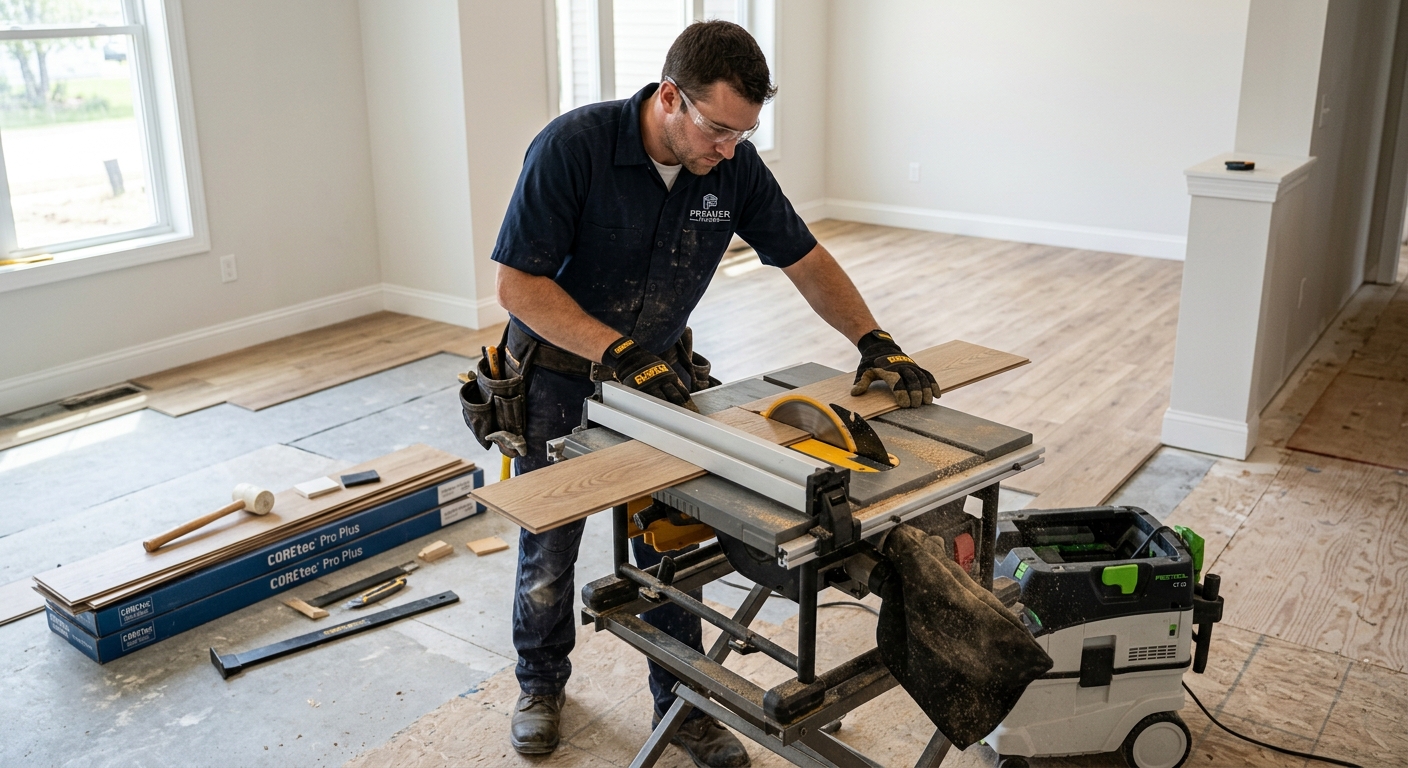
Flooring options and costs in Brant
Flooring in Brant is where practical choices meet local reality. With 39,474 residents and 12,570 homeowner households (Statistics Canada, 2021 Census), many upgrades are happening in established neighbourhoods where floors are already stressed by decades of foot traffic and seasonal swings. Brant’s housing stock also leans older—50.0% of homes were built before 1981 (Statistics Canada, 2021 Census)—so subfloor levelling, patching, or moisture checks are common before any new surface goes down. That’s why two quotes for the “same” material can land far apart: the prep work is often the make-or-break cost driver.
In the Hamilton–Niagara Peninsula, humidity swings and basement moisture are the big technical factors that affect final pricing and material selection. Winter brings dry indoor air, while summer can push humidity higher, and below-grade areas can stay damp longer. Solid hardwood can expand and contract with that movement and can’t be installed over concrete slabs or in basements without careful restrictions. Engineered hardwood and luxury vinyl plank (LVP) are usually the safer bets for above-grade and on-grade installs, while tile systems tend to tolerate temperature cycling well—especially where radiant heat is present.
Trade demand is particularly strong around Brantford-Brant lines and older housing pockets such as Paris and the west end of Brantford-adjacent communities, where many homes are converting from carpet to hard surface. Once you know your best-fit product, it’s easier to compare realistic installed budgets—see the table below for typical ranges.
| Type |
Best Room |
Moisture Resistance |
Lifespan |
Price per sq ft |
| Solid hardwood (nail-down, above grade only) |
Main floor living areas (not basements) |
Low to moderate (humidity-sensitive) |
25–50 years |
$12 – $18 |
| Engineered hardwood (float or glue, above + on-grade) |
Living/dining, bedrooms, some main-floor hallways |
Moderate (more stable than solid) |
20–40 years |
$9 – $16 |
| Laminate (click-lock, above-grade) |
Bedrooms, hallways, lighter traffic zones |
Low to moderate (not for wet basements) |
10–25 years |
$4 – $8 |
| Luxury vinyl plank / LVP (waterproof, any level) |
Kitchens, finished basements, main floors |
High (waterproof core) |
15–25 years |
$7 – $10 |
| Porcelain / ceramic tile |
Bathrooms, kitchens, entryways |
Very high (with proper underlayment) |
25–50 years |
$14 – $22 |
| Carpet (broadloom or modular tile) |
Bedrooms, stairs for comfort and sound control |
Low (moisture-sensitive) |
5–15 years |
$6 – $12 |
Prices are estimates only and vary by project scope, site access and material selection.
What affects the price of flooring in Brant
In Brant and the wider Hamilton–Niagara Peninsula, it’s common to see the same flooring concept quoted 30–50% apart, even when homeowners choose similar-looking materials. The gap usually comes from how much work is needed to get the subfloor ready and whether the install method fits local conditions—especially basement moisture and humidity swings. For example, solid hardwood in this region often triggers extra subfloor prep and strict moisture checks. Engineered hardwood and LVP typically handle Ontario’s thermal cycling more consistently, so the contractor can spend more time installing and less time correcting problem areas.
Technically, solid hardwood expands and contracts with humidity and performs poorly when it’s exposed to below-grade dampness or installed over concrete slabs. In contrast, engineered hardwood and waterproof LVP cores are far more forgiving for on-grade and basement installs. Cold-climate demand also pushes “radiant heat compatible” products; many solid hardwood installs are restricted over heating systems unless the engineered product is specifically rated, and some laminate requires specific underlay to maintain performance.
Older Brant homes—half built before 1981—frequently have uneven subfloors and worn underlayment, so levelling or repair is a frequent cost add. A practical rule of thumb contractors use here is that levelling/repair can run about $1–$4 per sq ft depending on how much height correction and patching is needed. In some projects, moisture remediation can push costs higher; in others, a dry slab with good flatness gets you closer to laminate or vinyl plank band pricing (for instance, $4 – $8 for laminate-type installs, while LVP often lands nearer $7 – $10 per sq ft installed).
Two concrete examples from Brant: (1) converting a main-floor carpet area in an older home often requires extra flattening to avoid “telegraphing” when installing click-lock; (2) finishing a basement usually adds a moisture barrier and careful underlayment planning—major reasons why solid hardwood is rarely the best value in below-grade rooms.
| Price Factor |
Why It Matters |
Cost Impact |
| Room area in sq ft |
More area increases materials, labour time, and waste percentage |
Direct: larger rooms often reduce per-sq-ft labour overhead slightly |
| Subfloor condition |
Levelling compounds, patching, and repairs are labour-heavy |
Can add roughly $1–$4 per sq ft in older homes |
| Moisture / below-grade install |
Determines whether solid hardwood is allowed and which barriers are required |
May require moisture barrier systems; can add moderate to significant cost |
| Material choice |
Solid vs engineered vs LVP vs tile changes both product price and labour method |
Often shifts the overall budget by several dollars per sq ft |
| Removal and disposal of existing flooring |
Carpet, underpad, and old adhesives take time and disposal fees |
Commonly adds a per-job amount and increases labour hours |
| Stair nosing / transitions |
Transitions and stair edge work are skilled details, not “straight runs” |
Typically charged per step or per linear foot |
| Radiant heat compatibility |
Limits material options and can require specific underlay and installation steps |
Can add cost via upgraded materials and stricter install procedures |
| Installation method |
Float vs glue-down vs nail-down changes prep, adhesives, and labour complexity |
Glue-down and tile underlayment often cost more than floating |
Permits & regulations in Ontario
In Ontario, installing new floor covering typically does not require a building permit by itself. Most homeowners can proceed with flooring upgrades without pulling a permit for the floor finish alone—whether it’s LVP, laminate, engineered hardwood, carpet, or tile. That said, certain related work can trigger permitting, and that’s where quotes should be crystal clear.
Work that may require a permit includes electrical-related changes for in-floor heating circuits, any thermostat or wiring modifications, and other scope that touches electrical systems. If your project involves structural subfloor work beyond “surface patching” (for example, significant framing repairs), the municipality may require permits depending on what’s being altered. In condominiums, even when no permit is required, the corporation’s rules for sound transmission (often referenced through STC/IIC requirements) can restrict underlay choice and how hard flooring is installed, especially on upper floors.
Step-by-step: verify your contractor before signing in Brant:
- Ask for a current Ontario business registration and the contractor’s licence/registration details where applicable.
- Request a certificate of insurance showing liability coverage; confirm the dates match the project timeline.
- Confirm WSIB/WCB coverage (or the equivalent exemption details) and ask for documentation in writing.
- For condo projects, request board approval requirements in writing before installing hardwood or tile above grade.
Finally, request itemised scope confirmation: moisture mitigation, underlayment choice, disposal, and whether any permit support is included for electrical work.
Best flooring for each room in your Brant home
In Brant, the “best” flooring choice is the one that matches each room’s moisture behaviour, foot traffic, and comfort needs across Ontario’s humidity swings. Living and dining spaces usually benefit from engineered hardwood or high-quality laminate: they’re warm underfoot, easier to maintain than carpet, and engineered construction is more stable than solid wood when seasons shift. For bedrooms, carpet remains popular because it improves comfort and sound absorption, especially in multi-level homes built around older construction patterns.
For kitchens, choose luxury vinyl plank (LVP) or large-format porcelain tile. LVP is waterproof and handles spills quickly, while tile offers superior scratch and moisture resistance. In basements, LVP is typically the clear winner in finished spaces: it tolerates below-grade conditions and vapour exposure far better than solid hardwood and most laminate, which can swell or fail when moisture finds its way in.
Bathrooms should be porcelain or ceramic tile, with a properly detailed underlayment system. Radiant heat compatibility is also increasingly relevant in Ontario homes with in-floor heating: engineered wood rated for radiant heat and many LVP products work well, while solid hardwood is often restricted by product and installation requirements.
A cost example to justify choices: if laminate is priced at about $4 – $8 per sq ft but LVP is closer to $7 – $10, that extra $3 per sq ft can be worth it in basements or near exterior doors because waterproof performance reduces the risk of callbacks and moisture-related failures.
| Room |
Best Material |
Why |
Moisture Risk |
Price Band per sq ft |
| Living / dining room |
Engineered hardwood |
Warm look, stable in humidity swings, good everyday durability |
Low to moderate (depends on basement access and exterior doors) |
$9 – $16 |
| Master bedroom |
Carpet or engineered hardwood |
Carpet improves comfort and sound; engineered hardwood balances warmth and stability |
Low |
$6 – $14 |
| Secondary bedrooms |
Laminate |
Cost-effective, easy maintenance for kids and guests when installed over a properly flat subfloor |
Low |
$4 – $8 |
| Kitchen |
Luxury vinyl plank (LVP) or porcelain tile |
LVP handles spills; tile resists moisture and heavy cleaning |
Moderate (spills and sink/door traffic) |
$7 – $22 |
| Basement (finished) |
LVP |
Waterproof performance and better tolerance of below-grade conditions |
High if vapour/condensation exists (typical concern) |
$7 – $10 |
| Bathroom |
Porcelain / ceramic tile |
Best moisture resistance with proper underlayment and grouting |
Very high |
$14 – $22 |
How to choose a flooring contractor in Brant
Choosing a contractor in Brant is less about flashy showroom photos and more about proof and process. Start by verifying Ontario contractor credentials and insurance. Ask for a certificate of liability insurance and confirm it’s active during your job dates. For work coverage, request WSIB/WCB documentation (or clear exemption details if applicable). A reputable flooring crew won’t hesitate—if they do, that’s your first warning sign.
Next, get 2–3 itemised written quotes that show a labour + materials breakdown, not a single lump-sum number. You want line items for subfloor prep/levelling, underlayment/moisture barrier, installation method, transitions, stair work, removal and disposal, and any protection or cleanup. Also confirm what’s excluded: plywood replacement, grinding high spots, subfloor flattening to a spec, or electrical permit support for radiant heat.
Warranties matter, too. Ask for the workmanship warranty length and whether the manufacturer warranty is tied to correct installation. Find out if warranties are transferable and whether your proof of purchase and install documentation are provided.
Payment schedule should be cautious: never pay more than 10–15% upfront. Hold back the remainder until the job is complete, cleaned up, and you’ve done your final walkthrough.
Finally, get a start date and completion estimate in writing. Flooring projects can stretch when subfloor moisture issues appear—your contractor should plan for that reality rather than hiding it.
- Ask for their liability insurance certificate and verify coverage dates.
- Confirm WSIB/WCB coverage in writing (or acceptable exemption documentation).
- Request proof of experience installing your specific product type (engineered vs LVP vs tile).
- Get an itemised quote with labour and materials separated.
- Confirm subfloor flatness expectations and whether levelling/repair is included.
- Ask which moisture barrier/underlayment is included for on-grade and basement work.
- Clarify removal and disposal—carpet, tack strip, underpad, old adhesive.
- Check stair nosing and transition pricing: per step or per linear foot.
- Verify radiant heat compatibility where applicable (product rating and install method).
- Confirm warranty details: workmanship duration, product warranty terms, transferability.
- Require a written timeline with start and completion dates.
- Use a payment schedule with a holdback until final inspection.
Red flags in Brant include: vague “turnkey” quotes that don’t list underlayment/moisture barrier, refusing to show insurance/WSIB documentation, quoting only per-sq-ft material price without levelling scope, starting before confirming condo rules or radiant heat compatibility, and requesting large deposits beyond 10–15%.
Frequently asked questions — flooring in Brant
What is the best flooring for a high-traffic area in Brant?
For high-traffic zones in Brant—think main-floor hallways and busy living areas—engineered hardwood and LVP are usually the best balance of durability and season-proofing. Engineered hardwood looks premium and stands up well when installed over a properly prepped, flat subfloor; it’s also more stable than solid wood through winter drying and summer humidity. If you expect spills or want easier cleanup, waterproof LVP is hard to beat, particularly near exterior doors and in homes with basement humidity concerns. In cost terms, laminate might look attractive, but if your traffic is heavy you may pay less in the short run while risking sooner wear. Typical installed ranges to plan around are roughly $9 – $16 for engineered hardwood and $7 – $10 for LVP.
How do I prepare my subfloor before new flooring?
Subfloor prep is where many Brant projects succeed or fail, especially with older homes built before 1981. The goal is a flat, sound surface with correct moisture conditions. Start by asking your contractor to assess flatness (not just “it looks okay”), then identify where levelling compound or patching is needed. For on-grade and basement areas, moisture testing and a properly chosen moisture barrier/underlayment are critical—this is one reason solid hardwood is often restricted. If you’re going from carpet, expect removal of tack strips, underpad, and sometimes residual adhesive. A good prep scope will include cleaning, checking for soft spots, repairing damaged subfloor sections, and confirming the correct underlayment for your flooring type (especially for click-lock laminate). Get that scope itemised in writing before work begins.
Is cork or bamboo flooring a good choice in Brant?
Cork and bamboo can work in Brant, but they need the right room choice and product rating. Cork is naturally resilient and quiet, and it’s comfortable underfoot; however, like wood-based products, it can be affected by sustained moisture. Bamboo behaves like engineered wood in many products, but solid bamboo and certain sensitive installs may still be vulnerable if humidity is high or if the home has below-grade moisture. In Brant’s Hamilton–Niagara Peninsula conditions—winter dryness and summer humidity—engineered constructions with proven moisture stability are safer than products that are not designed for fluctuating indoor air. For basements or concrete slabs, many homeowners find LVP or tile performs more predictably. If you consider cork or bamboo, ask your contractor to confirm moisture suitability and whether the product is compatible with radiant heat if needed.
What is the difference between floating and glued-down flooring?
Floating floors “sit” on a pad or underlayment and typically lock together (common with laminate and many engineered options). Because they are not directly bonded to the subfloor, they handle minor movement better when properly installed with the right underlay and expansion gaps. Glued-down flooring is bonded directly to the subfloor using approved adhesives; this can reduce movement and help achieve a more solid feel, but it demands a very stable, properly prepared substrate—especially on concrete slabs where moisture control is essential. In Brant homes with older subfloor conditions, choosing between floating and glue-down often depends on flatness, moisture risk, and the product’s installation system. If you’re budgeting, floating installs may keep labour lower, while glue-down and moisture-mitigated preparations can push costs toward the higher band for engineered wood.
What flooring holds up best to pets in a Brant home?
For pets, waterproof LVP is often the most forgiving choice in Brant. It resists normal spills and accidents and is generally easier to clean than carpet or moisture-sensitive surfaces. Engineered hardwood can also work well if your installer addresses scratch risk with the right finish and you protect high-wear areas, but it’s not as forgiving if pet-related moisture lingers. Carpet offers comfort but can be challenging if your household has frequent accidents—especially if any moisture penetrates the underpad. For basements, LVP is typically the clear winner because below-grade vapour concerns can’t be ignored. Budget-wise, many homeowners compare LVP in the $7 – $10 installed range versus higher-cost tile in the $14 – $22 range; tile is extremely durable but can be harder underfoot and often has higher labour due to underlayment details.
How do I fix squeaky floors in my Brant home?
Squeaks usually come from movement between subfloor layers, loose fasteners, or friction where components rub. In older Brant homes (many built before 1981), squeaks can show up after carpet removal because you expose the subfloor structure. The first step is to locate the source—often by walking and listening room by room, then checking whether the squeak travels along joists or stays in one area. Common fixes include tightening/adding screws where the subfloor flexes, addressing loose subfloor boards, or shimming/fixing contact points. If you plan to install new flooring, do the structural fixes before the new surface goes down; otherwise, squeaks can telegraph and reduce the lifespan of click-lock or glued surfaces. If your squeaks are over a crawl space or basement area, confirm there isn’t a moisture problem feeding wood movement, especially where humidity swings are common.