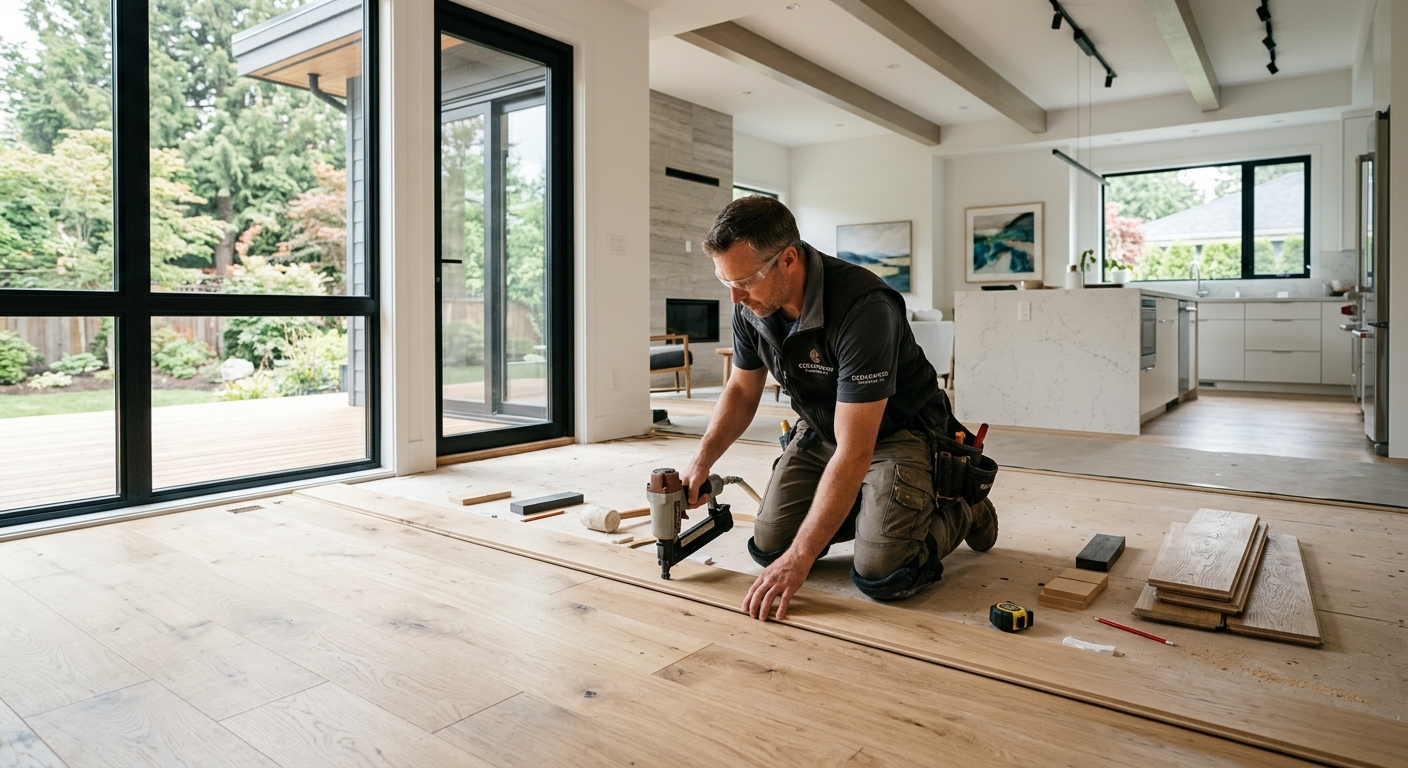
Flooring options and costs in Tweed
Tweed homeowners typically feel the flooring decision first in their budget, then in the day-to-day comfort. In a town of 6,067 people (Statistics Canada, 2021 Census), a lot of homes are older: 61.2% were built before 1981, which usually means the subfloor may need patching, levelling, or moisture checks before any new finish goes down. That early work matters because in Kingston–Pembroke we see real humidity swings and basement moisture risk, and Tweed’s older housing stock can make those effects show up as cupping, gaps, or weak patch areas if the prep is skipped. In practice, that’s why solid hardwood is often limited to above-grade installs, while engineered hardwood and luxury vinyl plank (LVP) are commonly chosen for their stability and easier basement readiness.
Contractor availability and prep requirements also shape pricing across the region (including nearby Kingston–Pembroke communities), so two quotes for “same room, same product” can still land far apart once patching, vapour control, or stair transitions are priced in. If you’re in neighbourhoods around the Tweed area and rural properties along Highway 7, many jobs include entryway transitions and uneven slab/joist adjustments, which pushes labour and materials upward—especially where the existing floor has to come out and be disposed of.
Below is a realistic snapshot of installed pricing ranges you can use to compare options before site-specific prep is confirmed.
| Type |
Best Room |
Moisture Resistance |
Lifespan |
Price per sq ft |
| Solid hardwood (nail-down, above grade only) |
Living / dining |
Low to moderate (humidity sensitive) |
25–40 years |
$11–$25 |
| Engineered hardwood (float or glue, above + on-grade) |
Living / bedrooms (not typical for damp basements) |
Moderate (more tolerant to movement) |
20–35 years |
$11–$22 |
| Laminate (click-lock, above-grade) |
Bedrooms / hallways |
Low to moderate (protect edges) |
10–20 years |
$4–$10 |
| Luxury vinyl plank / LVP (waterproof, any level) |
Kitchen / main floor / finished basement |
High (waterproof core) |
15–25 years |
$6–$15 |
| Porcelain / ceramic tile |
Kitchen / bathrooms |
High (if substrate is sound) |
20–50 years |
$8–$20 |
| Carpet (broadloom or modular tile) |
Master / secondary bedrooms |
Low to moderate (manage spills) |
8–15 years |
$4–$12 |
Prices are estimates only and vary by project scope, site access and material selection.
What affects the price of flooring in Tweed
In Tweed and across the Kingston–Pembroke region, quotes for the “same” flooring can vary by 30–50% because the cost drivers usually aren’t the finish—they’re the prep and the site conditions. Indoor humidity swings in Ontario can move wood fibres and weaken already-marginal subfloors, and below-grade moisture risk is a constant variable in older basements. That’s why solid hardwood expands and contracts with humidity, and it can’t be glued or floated over concrete in the way engineered or LVP can; in basements it typically performs poorly unless moisture is controlled and the assembly is specified correctly. Colder Ontario homes with in-floor heat also influence material selection—radiant-compatible flooring is often preferred, which can rule out some solid hardwood setups and some laminate underlays.
Older homes are frequently the real cost story: pre-1981 builds are common (61.2% in the area profile, Statistics Canada, 2021 Census), and that often means levelling, patching, and subfloor repairs before install. A realistic regional allowance is often around $1–$4 per sq ft for subfloor repair/levelling, which can noticeably narrow the price gap between “cheap” and “mid” materials once everything is added together. For example, laminate priced in the $4–$10 band can become less economical if your contractor has to flatten an uneven subfloor and add moisture mitigation; meanwhile LVP in the $6–$15 range may cost more on paper but saves labour because it tolerates moisture and doesn’t require the same strict wood movement controls.
Two common Tweed examples: (1) a finished basement with damp odours may need vapour mitigation before LVP goes down, while a dry main-floor job can go faster; (2) an entry/foyer replacement where tile-to-wood transitions need stair nosing and custom transitions adds labour per step or per linear foot and often explains why the quote differs even when square footage is similar.
| Price Factor |
Why It Matters |
Cost Impact |
| Room area in sq ft |
Material and labour scale with coverage |
Direct—often the biggest line item |
| Subfloor condition — levelling or repair needed before install |
Uneven surfaces cause gaps, squeaks and premature failures |
Common allowance roughly $1–$4/sq ft |
| Moisture / below-grade install — rules out solid hardwood |
Basements and slab-on-grade need stable assemblies |
Can add $500–$1,500+ depending on mitigation |
| Material choice — solid vs. engineered vs. LVP vs. tile |
Different products tolerate movement and water differently |
Hardwood often $11–$25 vs LVP $6–$15 |
| Removal and disposal of existing flooring |
Demo time, haul-away and subfloor inspection |
Often $1–$3/sq ft equivalent in labour |
| Stair nosing / transitions — charged per step or per linear foot |
Transitions are labour-intensive and require matching profiles |
Can add $300–$1,200+ on typical homes |
| Radiant heat compatibility — limits material options |
Some products and underlays tolerate in-floor heat poorly |
May add premium material costs ($) and prep time |
| Installation method — float vs. glue-down vs. nail-down |
Method changes labour time and tolerances |
Glue-down and tile generally higher labour |
Permits & regulations in Ontario
In Ontario, installing flooring itself usually does not require a building permit. However, related work can trigger permits—especially when you’re changing electrical components or structural conditions. The most common permit-sensitive situations include: (1) electrical permits if you’re working on circuits for in-floor heating (new wiring, thermostat changes, or making modifications to existing heating circuits); and (2) certain circumstances around structural subfloor repair—particularly if you’re addressing damaged framing in a way that affects load paths, which is less common for routine levelling and patching but can happen in older homes with moisture rot.
If you live in a condominium or multi-unit building, the corporation’s rules around sound transmission matter. Even when flooring work doesn’t require a permit, condo bylaws and the declaration often specify required underlay and may restrict hard-floor installs on upper levels due to STC/IIC considerations. Always request written board approval and follow their underlay requirements before installing hardwood or tile above grade in a multi-unit setting.
For homeowners in Tweed, the best protection is contractor verification before anyone starts work. Ask for the Ontario business registration/licence details (where applicable), then request proof of liability insurance and WSIB/WCB coverage. Typically, you can verify these using the contractor’s certificate of insurance (with policy effective dates and limits) and by checking WSIB/WCB clearance/registration status. Then, keep copies of everything—quote, scope, insurance certificates, and any job-specific recommendations for moisture control—so there’s a clear paper trail if something goes wrong.
Best flooring for each room in your Tweed home
Choosing the right flooring in Tweed means matching the material to the room’s moisture exposure, traffic, and comfort needs. In our colder Ontario winters and humid shoulder seasons, homes also “breathe,” so assemblies that tolerate movement tend to last longer without visible gaps. In living and dining areas, engineered hardwood or high-quality laminate is often the sweet spot: you get warmth and a more natural look than vinyl, while avoiding some of the strict humidity limits that come with solid hardwood. For master bedrooms, carpet is still a favourite because it adds comfort, warmth, and sound absorption—useful in older homes where footsteps carry.
Kitchens see water splashes and day-to-day mopping, so luxury vinyl plank (LVP) or large-format porcelain tile is usually the practical choice. Porcelain/ceramic tile is also the correct option for bathrooms because it’s dimensionally stable and easy to clean when installed over a sound substrate. For basements (especially those with any moisture history), LVP is typically the clear winner: it’s waterproof and far more forgiving on below-grade installs than solid wood or most laminate. For rooms over radiant in-floor heat, prioritize radiant-compatible products—this can affect both material and underlay selection, and it’s one reason hardwood and laminate aren’t always “everywhere” choices.
Here’s a simple pricing example: if your living room is 300 sq ft, upgrading from laminate in the $4–$10 band to engineered hardwood in the $11–$22 range might add several hundred dollars, but it can be justified when you want longer wear, better stability in humidity swings, and a more premium finish. If the same room has high risk of uneven subfloor, the extra prep labour may reduce the difference—so confirm subfloor condition first.
| Room |
Best Material |
Why |
Moisture Risk |
Price Band per sq ft |
| Living / dining room |
Engineered hardwood |
Warmth and realistic wood look with better humidity tolerance than solid |
Low (manage winter dryness) |
$11–$22 |
| Master bedroom |
Carpet |
Comfort underfoot, quiet performance and thermal benefits |
Low |
$4–$12 |
| Secondary bedrooms |
Laminate (high-quality) or engineered |
Durable, budget-friendly, easier maintenance than carpet |
Low |
$4–$10 |
| Kitchen |
Luxury vinyl plank (LVP) or porcelain tile |
Handles spills and frequent cleaning; resists water better than wood |
Moderate to high |
$8–$20 (tile) / $6–$15 (LVP) |
| Basement (finished) |
LVP (waterproof) |
Best tolerance for below-grade moisture vapour and temperature swings |
Moderate to high |
$6–$15 |
| Bathroom |
Porcelain / ceramic tile |
Moisture-stable surface and long-term durability with proper underlayment |
High |
$8–$20 |
How to choose a flooring contractor in Tweed
Hiring a flooring contractor in Tweed is mostly about verification and clarity. Start by confirming Ontario credentials: ask whether the business is properly registered for the work they’re doing, then request proof of liability insurance and WSIB/WCB coverage. You should be able to receive current certificates of insurance and (where applicable) WSIB/WCB clearance/registration information. If a contractor can’t provide these documents on request, treat it as a major risk—especially with demo, patching, and any moisture-mitigation steps.
Next, get 2–3 itemised written quotes. You want labour and materials broken out separately, not a single lump-sum figure. Make sure the quote includes what’s excluded: subfloor repair scope, levelling products, underlay type, mouldings, adhesives (if applicable), stair nosing and transitions, and whether disposal is included. If you have in-floor heat, insist on radiant-compatible specs in writing.
Warranty matters too. Ask for both workmanship warranty (how long the installer stands behind installation) and manufacturer warranty (product-related defects). Confirm whether warranties are transferable if you sell the home. Payment schedule should stay reasonable: never pay more than about 10–15% upfront, and keep a holdback until the job is fully complete and cleaned. Finally, get the start date and completion estimate in writing so you have a realistic timeline.
- Provide current insurance certificates and WSIB/WCB coverage documents before scheduling
- Itemise labour vs. materials, including underlayment, adhesives, and trim
- Include removal and disposal (or clearly state “not included”)
- State subfloor responsibility: who checks for moisture and what repair is included
- List the exact flooring product names/SKUs and thickness
- Confirm installation method (nail-down, glue-down, click-lock, or float) in the quote
- Specify transitions/stair nosing pricing per step or per linear foot
- Detail undercutting of door jambs and finishing around vents/fixtures
- Clarify warranty lengths for labour and product, and whether they’re transferable
- Set a payment schedule with 10–15% max upfront and holdback until completion
- Get dust control and protection plan (especially for living areas and stairs)
- Ask for an on-site measurement and verify the square footage assumption
Red flags to watch for in Tweed: quotes that omit subfloor prep details, “we’ll match it later” transition pricing, unwillingness to show insurance/WSIB documents, vague scope language that doesn’t say who handles moisture issues, and start dates that keep changing without written confirmation.
Frequently asked questions — flooring in Tweed
Can I install flooring over existing tile in Tweed?
Sometimes, but it depends on what’s underneath the tile and whether the tile surface is flat and solid. In Tweed, many older homes have tile in kitchens or entryways, and you may be tempted to go over it to save demo labour. However, flooring failure usually starts with unevenness and weak edges: if the tile is cracked or not well bonded, you can get movement and joint issues. For LVP, many installers can go over properly bonded tile if the surface is flat; for laminate, it’s riskier and typically requires a very smooth, stable base. For tile-to-tile, you may still need proper prep (cleaning and sometimes height transitions). Your best approach is to have a contractor check flatness with a straightedge and confirm whether an underlayment or self-levelling patch is required.
What is the best flooring for a high-traffic area in Tweed?
For high-traffic areas in Tweed—like foyers, hallways, and main living routes—LVP or engineered hardwood are usually the strongest practical choices. LVP is particularly forgiving because it’s waterproof and tolerant of moisture vapour, which matters for homes with damp basements or tracked-in slush from winter. If you’re staying budget-conscious, laminate in the $4–$10 band can work, but it’s more sensitive at the edges when moisture gets in. Engineered hardwood, often in the $11–$22 range, offers a more premium look and better movement tolerance than solid hardwood under humidity swings. Whatever you choose, the best “high-traffic” upgrade is still preparation: flat subfloor, clean seams, and correct transitions. In older housing stock (61.2% built before 1981, Statistics Canada, 2021 Census), skipping levelling can make any finish fail earlier.
How do I prepare my subfloor before new flooring?
Subfloor prep is where quality is either won or lost. A good contractor will start by inspecting for moisture, checking flatness, and confirming the type of base (joists vs. concrete slab). In Tweed, below-grade moisture risk means you should expect moisture mitigation steps before installing LVP and especially before any wood-based product. Preparation typically includes removal of loose material, scraping high spots, fixing squeaks, and levelling/patching low areas. If you’re dealing with older subfloors, repair may be needed to deal with water damage or uneven sheathing—commonly budgeted around $1–$4 per sq ft depending on extent. For tile, you’ll also need the right substrate and flatness tolerance before mortar work starts. Don’t accept “we’ll cover it with thicker underlay”—for most systems, underlay can’t correct major unevenness.
Is cork or bamboo flooring a good choice in Tweed?
Cork and bamboo can look great, but they’re not always the most reliable choice for Tweed’s humidity swings and any basement moisture risk. Cork is more dimensionally stable than many woods, and it adds comfort and sound dampening; however, it can still be vulnerable to prolonged moisture, especially around entryways and basements. Bamboo is a wood product in terms of movement and can require conditions similar to other wood flooring—meaning careful humidity control and an appropriate installation method. If you’re choosing cork or bamboo for a main floor above grade with stable indoor humidity, it can be a reasonable option. But if your plan is a finished basement, LVP is typically the safer “waterproof” approach. When homeowners compare costs, wood-look alternatives often start around the $11–$25 hardwood/engineered band, while LVP commonly lands lower, such as $6–$15, with less worry about below-grade moisture movement.
What is the difference between floating and glued-down flooring?
Floating flooring is installed over a prepared subfloor with an underlay, and the planks/tiles “float” because they’re not permanently bonded to the base. Click-lock laminate and many engineered hardwood floors are commonly floating. Glued-down flooring is adhered directly to the subfloor using a specified adhesive, which increases stability in some applications but requires careful subfloor condition and correct product/adhesive matching. In Tweed, the choice often comes down to moisture and subfloor prep: a well-prepped, dry above-grade base may allow floating engineered; a more challenging moisture-prone environment may steer homeowners toward waterproof LVP. Also, floating can handle slight movement better when assemblies are correct, while glue-down systems demand a consistent substrate so the bond line doesn’t fail. If you have radiant heat, the manufacturer requirements for glue and/or underlay compatibility are critical—your installer should quote the correct system, not just the product name.
What flooring holds up best to pets in a Tweed home?
For pets in a Tweed home, durability and cleanability matter as much as scratch resistance. LVP is often the best starting point because it’s waterproof and easier to clean after accidents, and it can better tolerate occasional moisture from paw prints and winter tracking. A lot of homeowners find LVP in the $6–$15 range is a practical balance of performance and cost. Engineered hardwood can also be a solid option if your home maintains stable humidity and you address pet nails quickly, but wood-based floors are less forgiving with water than LVP. Carpet is comfortable and hides minor imperfections, yet it can hold odours or stains if accidents aren’t handled immediately—still, it can work well for low-moisture households. Whatever product you choose, prioritize correct underlayment, strong transitions (so claws/dirt don’t catch), and immediate spill cleanup—especially in older homes where moisture management is part of everyday life (61.2% built before 1981, Statistics Canada, 2021 Census).