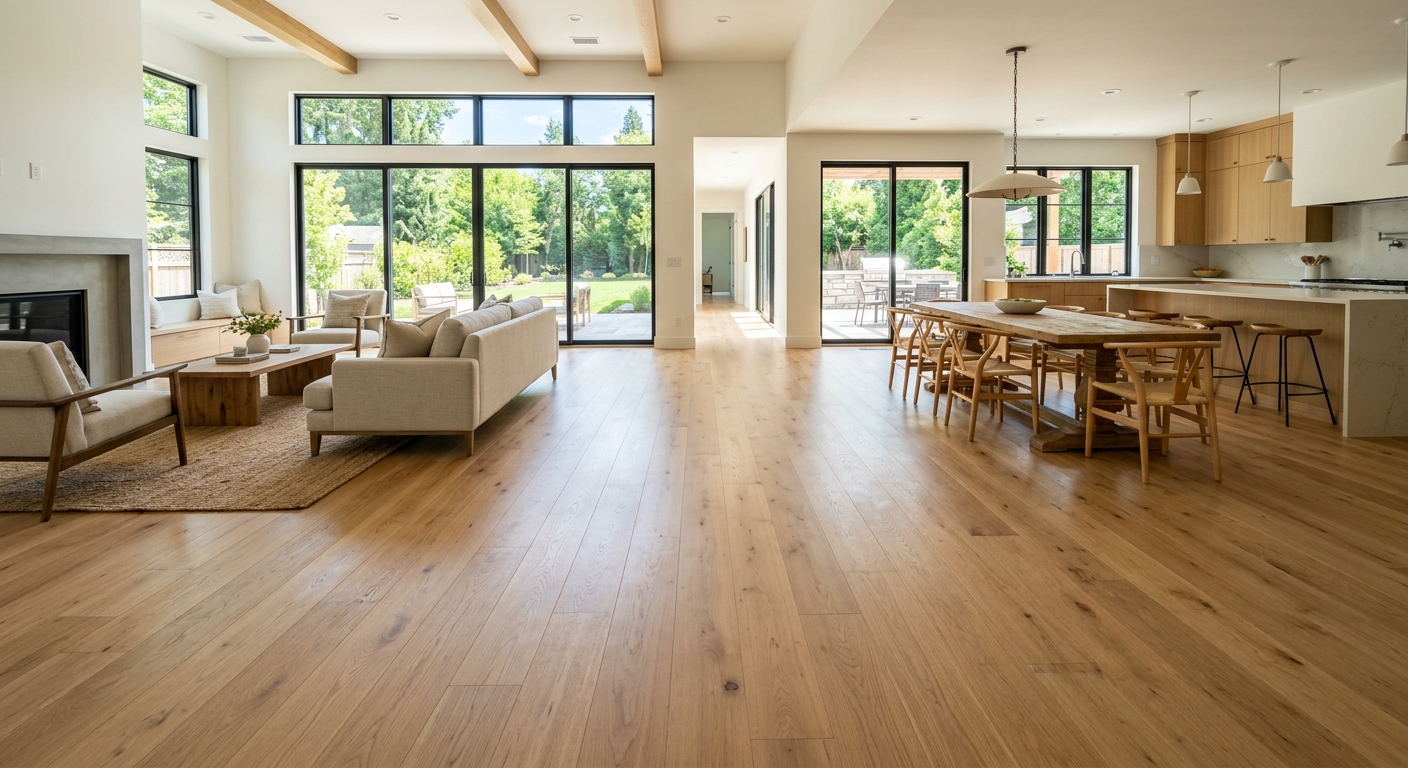
Flooring options and costs in Currie Barracks
Currie Barracks, Alberta sits in the Calgary region’s dry, cold prairie climate—great for outdoor life, but tougher on floors because indoor humidity swings can be dramatic. For homeowners, that climate reality is one reason flooring quotes can shift quickly based on what’s happening below the surface. In the area, the housing mix is heavily weighted toward smaller, established neighbourhoods, and with a local population of 1,275 (Statistics Canada, 2021 Census), contractors tend to see steady demand for makeover jobs in occupied homes. Many of these homes have older subfloors or transitions that need attention before flooring goes in, which can mean levelling and prep added to the budget.
Basements and below-grade slabs also influence costs. In Calgary and surrounding communities, moisture migration through concrete is a common concern, so below-grade installs typically favour engineered wood, LVP, or SPC rather than traditional solid hardwood. That choice alone often drives which product you can use and how much prep labour you’ll need. For example, if tile is on the plan, contractors frequently budget levelling and crack isolation because ceramic and porcelain are sensitive to flatness.
In Currie Barracks, trade demand is especially consistent in the south-facing pockets near neighbourhood shopping and main routes, where homeowners often renovate entryways, living rooms, and stair areas in the same project—especially when they’re also replacing trim and doing stair updates. From there, it’s easy to compare material options side-by-side before you talk to a local installer about your exact scope.
| Type |
Best Room |
Moisture Resistance |
Lifespan |
Price per sq ft |
| Solid hardwood (nail-down, above grade only) |
Living rooms, dining rooms (dry) |
Low (humidity-sensitive) |
25–50 years |
$8–$15 |
| Engineered hardwood (float or glue, above + on-grade) |
Living rooms, bedrooms, hallways |
Medium to high |
20–35 years |
$9–$14 |
| Laminate (click-lock, above-grade) |
Bedrooms, hallways, offices |
Medium (protect seams) |
10–20 years |
$3–$7 |
| Luxury vinyl plank / LVP (waterproof, any level) |
Kitchen, basement (finished) |
High (waterproof core) |
15–25 years |
$4–$8 |
| Porcelain / ceramic tile |
Bathrooms, mudrooms, kitchens |
High (when properly set) |
20–50 years |
$6–$12 |
| Carpet (broadloom or modular tile) |
Master and secondary bedrooms |
Low (not for wet areas) |
7–15 years |
$4–$10 |
Prices are estimates only and vary by project scope, site access and material selection.
What affects the price of flooring in Currie Barracks
In Currie Barracks and across Calgary, two quotes for “the same floor” can differ by 30% to 50% because installers aren’t only pricing the material—they’re pricing what the subfloor and the climate will demand. Indoor humidity swings in Alberta can cause normal seasonal movement, and that’s a major cost driver: solid hardwood expands and contracts with humidity, and it generally can’t be glued or floated over concrete. In practice, basements and slab-adjacent areas are often where budgets jump, because solid wood is usually removed from the short list, and engineered hardwood or waterproof LVP/SPC becomes the sensible choice. In cold-weather homes with radiant heat, some products are also limited, and that can change both labour and material pricing.
Below-grade moisture migration through concrete is another reason costs vary across the region. If the slab is cool or has occasional moisture vapour, contractors may recommend LVP/SPC or require specific underlay systems and prep. Older housing stock in the Calgary area frequently needs subfloor levelling or repair—commonly adding about $1 to $4 per sq ft depending on how uneven it is. Tile projects are particularly sensitive to flatness, so levelling and crack isolation membranes can be budgeted even when the finished look is “standard.”
Concrete examples we see often in Currie Barracks: (1) a main-floor laminate install over older plywood that needs patching can land near the laminate band ($3–$7 per sq ft for material-driven planning), but levelling can push labour-heavy quotes toward the upper end; (2) switching from solid hardwood to engineered hardwood often avoids expensive moisture-related mitigation on slab-adjacent areas, keeping the project closer to the hardwood band ($8–$15) rather than ballooning with failed-attempt troubleshooting. When stairs or trim come into the plan, removal and stair transitions can also add cost in ways homeowners don’t always predict.
| Price Factor |
Why It Matters |
Cost Impact |
| Room area in sq ft |
Directly drives material quantities and labour hours |
Higher area usually lowers cost per sq ft slightly, but total $ increases |
| Subfloor condition |
Levelling or repair is required for flat, stable installation |
Often adds roughly $1–$3 per sq ft; worst cases can be higher |
| Moisture / below-grade install |
Determines whether solid hardwood is even viable |
Typically increases prep and limits product choice; LVP/SPC can reduce risk |
| Material choice |
Solid, engineered, LVP/SPC, laminate, and tile have different prep needs |
Solid hardwood is usually the highest; LVP/SPC balances cost and stability |
| Removal and disposal of existing flooring |
Includes labour, hauling, and sometimes adhesive remediation |
Can add a noticeable line item, especially with glued-down materials |
| Stair nosing / transitions |
Stair work is slower and often charged per step or per linear foot |
Commonly one of the biggest “surprise” costs in renovations |
| Radiant heat compatibility |
Limits which products and underlay are acceptable |
May require specific underlays and installation details |
| Installation method |
Float, glue-down, and nail-down each have different labour and risk profiles |
Glue-down and tile are often labour-intensive; floating can be faster |
Permits & regulations in Alberta
In Alberta, the flooring installation itself typically does not require a building permit. However, associated work can. If your project includes structural subfloor repair (for example, major joist reinforcement), moisture remediation beyond simple surface prep, or modifications tied to in-floor heating circuits, the job can trigger electrical permitting depending on what’s being changed. If you’re adding or altering wiring for radiant heat components, that is the piece to confirm with your electrician and the applicable permit process.
For condominiums in Currie Barracks (and throughout Calgary), the most important “rule” is usually not a permit—it’s the condo corporation’s requirements for sound transmission. Hard flooring on upper floors often affects noise transfer ratings (commonly discussed as STC/IIC), and the board may require specific underlay or limit installation types. Always review the declaration/bylaws and request written approval before you install hardwood or tile on upper-grade units.
Step-by-step verification you can do before signing: (1) ask for the contractor’s Alberta business contact and verify their licence/registration status through the appropriate online government resources; (2) request a current certificate of insurance showing general liability and confirm the effective dates; (3) ask for WSIB/WCB clearance or coverage documentation and confirm they can legally employ installers on your project; (4) request references for similar Alberta climate installs—basement LVP/SPC or tile with levelling are good proof points; and (5) ensure they’ll be responsible for safety practices on demo day (dust control, floor protection, and site clean-up).
Best flooring for each room in your Currie Barracks home
In Currie Barracks, choosing flooring is really about matching material stability to Calgary’s dry-cold seasons and the moisture behaviour of basements and slabs. Living and dining rooms usually stay relatively dry, so engineered hardwood or high-quality laminate can deliver the look you want with fewer humidity-related headaches than solid wood. For bedrooms, comfort and sound matter: carpet is still a top choice for warm underfoot feel and noise reduction, while engineered hardwood is a durable alternative if you prefer a harder surface.
Kitchens and entry areas see frequent water events (mopping, tracked snow melt, spills). That’s where luxury vinyl plank (LVP) or large-format porcelain tile wins: both are easier to maintain and are more forgiving if a puddle lingers for a short time. Basements are the deciding factor. In a Calgary region basement, fully waterproof LVP is often the clear winner because it handles moisture vapour and below-grade conditions far better than traditional solid hardwood and most laminate. Bathrooms should be porcelain or ceramic tile only, with correct grout and proper installation details to reduce risk.
Radiant heat compatibility is also becoming more common in Alberta new construction. When rooms sit over hydronic systems, you’ll want products that explicitly allow radiant heat use—this can rule out some solid hardwood applications and certain laminate/underlay combinations.
To justify price differences: if you’re comparing carpet installation in bedrooms versus LVP in a shared hallway, you might see laminate/basement-ready LVP planning around the $3–$7 and $4–$8 per sq ft ranges, while tile can land higher due to levelling and installation labour—often closer to $6–$12 per sq ft. That higher spend is usually worth it where moisture and cleaning demands are highest.
| Room |
Best Material |
Why |
Moisture Risk |
Price Band per sq ft |
| Living / dining room |
Engineered hardwood |
Warm look with better stability through seasonal humidity swings |
Low to medium (depends on ventilation and season) |
$9–$14 |
| Master bedroom |
Carpet or engineered hardwood |
Carpet adds comfort and sound control; engineered holds up well |
Low |
$4–$10 |
| Secondary bedrooms |
Carpet (broadloom or modular tile) |
Budget-friendly comfort and forgiving feel for daily traffic |
Low |
$4–$10 |
| Kitchen |
LVP or large-format porcelain tile |
Easy cleaning and better tolerance to spills and frequent wet mopping |
Medium to high |
$4–$12 |
| Basement (finished) |
Waterproof LVP (or SPC) |
Dimensionally stable and safer over below-grade moisture exposure |
High (vapour migration through concrete) |
$4–$8 |
| Bathroom |
Porcelain / ceramic tile |
Designed for wet areas with the right substrate and installation system |
High |
$6–$12 |
How to choose a flooring contractor in Currie Barracks
Choosing the right contractor matters as much as the floor you pick—especially in Alberta where humidity swings and below-grade moisture can reveal poor prep fast. Start by verifying Alberta coverage: ask for a current certificate of insurance (general liability) and confirm it covers the scope of your job. Next, request proof of WSIB/WCB coverage (or a clearance letter, where applicable) so you know installers are properly covered. Then verify their business details and standing using Alberta’s online resources (you’re looking for the ability to lawfully operate and take on residential work).
Get 2–3 itemised written quotes, not lump sums. You want separate lines for removal/disposal, subfloor prep and levelling, underlayment (if applicable), installation labour, transitions/stair work, and moulding/trim reinstall. Ask whether permits are included for any related electrical or radiant heat scope (even if flooring itself doesn’t usually require one). Confirm warranty terms: workmanship warranty length and whether it’s tied to the installer, and also the product/manufacturer warranty details—plus whether the warranty is transferable if you sell the home.
Payment schedule should be cautious. Avoid paying more than 10%–15% upfront; hold back part of the balance until the job is complete and defects (like gaps, transitions not flush, or undercut issues) are addressed. Finally, request the start date and the completion estimate in writing so you can plan around a realistic demo and installation sequence.
- Ask for Alberta insurance and confirm the effective dates match your project.
- Request WSIB/WCB clearance or coverage documentation before work starts.
- Get licence/registration details and confirm the contractor is eligible to perform the scope.
- Require an itemised quote: material, labour, prep/levelling, underlay, and disposal separately.
- Confirm exactly what’s included in subfloor prep (patching, levelling compound, skim coats).
- For tile: ask about flatness targets and whether a crack isolation membrane is included.
- For LVP/SPC: confirm moisture limits for slabs and which underlay system is approved.
- Clarify stair work pricing (per step or per linear foot) and whether nosing is supplied.
- Ask who supplies transition strips, reducers, and matching end caps.
- Verify trim and baseboard reinstall is included, or priced separately.
- Review warranty: workmanship duration, product warranty, and transferability.
- Use a payment plan with 10–15% max upfront and holdback after final walkthrough.
Red flags in Currie Barracks include: refusing to provide an itemised scope and only offering a lump sum; guaranteeing hardwood for basements without discussing moisture/vapour risk; asking for large upfront payments beyond 10–15%; missing proof of liability insurance or WSIB/WCB coverage; and avoiding written timelines or not specifying who handles disposal and stair transitions.
Frequently asked questions — flooring in Currie Barracks
How much does flooring cost in Currie Barracks?
In Currie Barracks, most homeowners end up budgeting based on two realities: material choice and what the subfloor needs to look like before installation. As a planning guide, hardwood flooring pricing often lands in the $8–$15 per sq ft band, while laminate and vinyl plank planning is commonly lower—laminate around $3–$7 and LVP/SPC often in the $4–$8 range depending on thickness and wear layer. Tile is typically $6–$12 per sq ft, but flatness prep can push costs upward if levelling or crack isolation is required. Quotes can easily differ by 30% to 50% when removal/disposal and stair work are involved, which is a common scenario in established homes in the Calgary area (Statistics Canada, 2021 Census).
Hardwood vs laminate vs vinyl plank — which is best?
“Best” depends on where you’re installing. For above-grade rooms in Currie Barracks, engineered hardwood is usually a strong balance, while solid hardwood is best kept to dry areas because Alberta humidity swings can cause seasonal movement. Laminate can be a budget-friendly option for bedrooms and low-risk areas, but it still needs careful seam protection and the right underlay. Luxury vinyl plank (LVP) is typically the safest all-around choice when moisture is a concern—especially on-grade-on-slab or finished basements—because it’s waterproof and more dimensionally stable through Calgary’s dry, cold seasons. If you’re deciding between $3–$7 laminate and $4–$8 LVP/SPC, the small material difference is often justified where spills, mop water, or basement vapour exposure are realistic.
What flooring is best for a Currie Barracks basement?
For a Currie Barracks basement, the safer default is waterproof LVP or SPC, installed with the correct underlay system (or directly as the product requires). The Calgary region’s below-grade moisture behaviour—vapour migration through concrete and seasonal humidity swings—makes traditional solid hardwood a risky fit. Laminate can work only if moisture conditions are confirmed suitable, but many homeowners prefer the lower stress approach: LVP/SPC. If your basement slab is uneven, expect levelling prep; levelling needs can add roughly $1–$4 per sq ft depending on how out-of-level it is. If you want the look of wood, engineered hardwood is sometimes viable on grade-appropriate areas, but for basements, waterproof LVP/SPC is still the most common recommendation for long-term stability in Alberta.
Can I install hardwood over concrete?
In most Currie Barracks cases, solid hardwood isn’t the right choice over concrete because it’s humidity-sensitive and is typically installed nail-down on approved above-grade subfloors. You also generally can’t “float” solid oak over concrete in a way that performs reliably long-term. Engineered hardwood is the product that more often works on concrete, but it still has to follow the manufacturer’s instructions for moisture conditions, flatness, and the approved installation method (glue-down or floating, depending on the system). Before you plan the install, ask your contractor to assess slab moisture risk and confirm the correct approach in writing. In Alberta winters and shoulder seasons, moisture conditions can change, so choosing a system designed for concrete reduces the chance of buckling or gaps.
How long does flooring installation take?
Timelines in Currie Barracks depend on room count, subfloor prep, and whether stairs are included. For a single room over reasonably flat subfloor, a straightforward laminate or LVP job may be completed quickly once materials are on site; add days when levelling compounds, patching, or adhesive removal is required. Tile generally takes longer because it’s sensitive to flatness and needs curing time between steps. Stair work and trim reinstalls also add time, even if the total square footage seems small. The best way to plan is to request a start date and completion estimate in writing and to ask the contractor how long prep will take based on their flatness assessment. If moisture checks or extra underlayment steps are needed for basement installs, that can shift the schedule too.
What flooring works with radiant heat?
In Alberta, radiant heat is increasingly common, and it narrows the choices. Materials must be rated as compatible with radiant heat systems, including the right underlay (for floating floors) and correct installation details to manage heat transfer. Generally, engineered hardwood can be compatible when the product is rated for radiant heat and installed within manufacturer limits; many LVP/SPC options are also compatible depending on the core and approved underlay. Some laminate products can work, but only if explicitly approved—otherwise heat can cause separation or excessive expansion. Solid hardwood is more often restricted than engineered because it’s more moisture and movement sensitive. The key is product-specific approval: ask your contractor to confirm radiant-heat compatibility for every layer, and don’t rely on “it should work” assumptions.