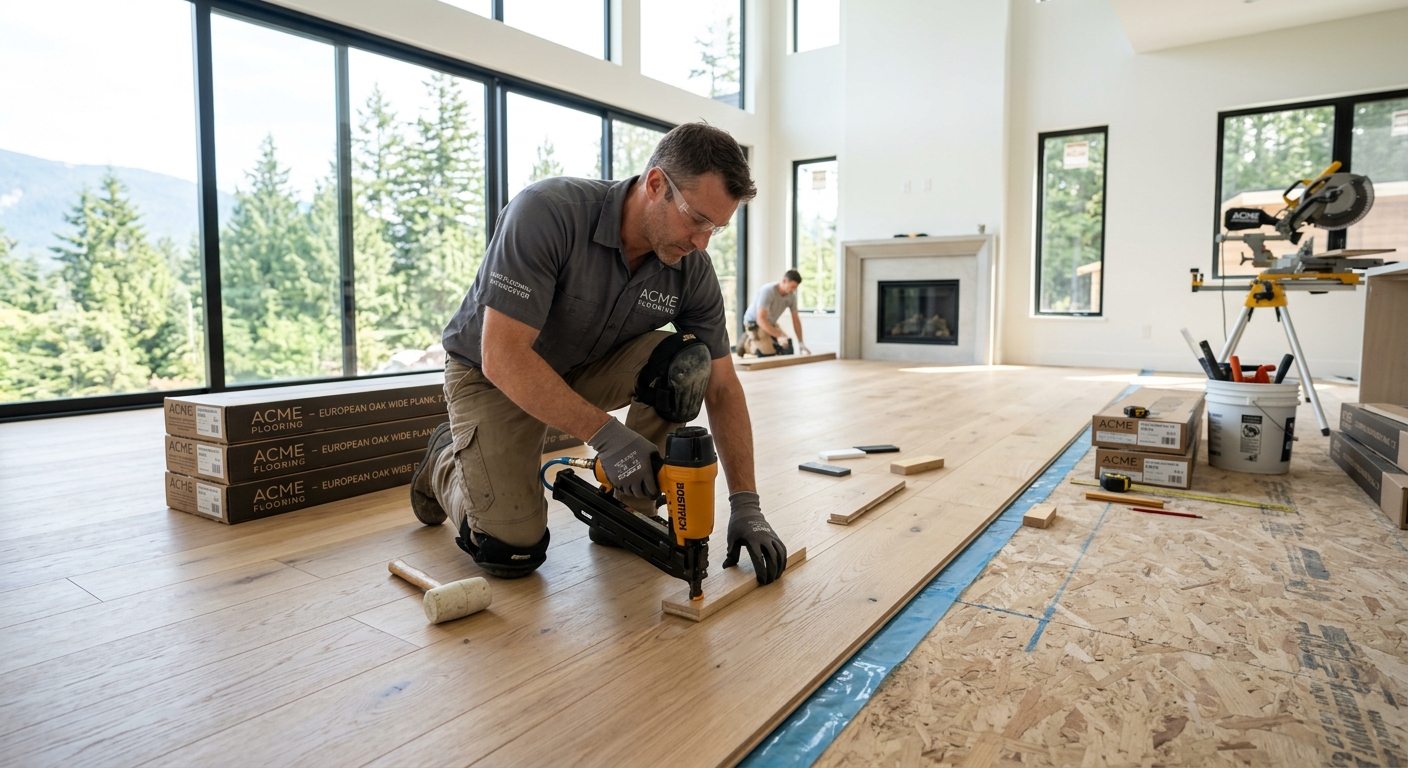
Flooring options and costs in Kilkenny
In Kilkenny, Alberta, your flooring costs start with the realities of our dry, cold prairie climate and the way Calgary-area homes handle seasonal humidity swings. With a population of 5,699 people (Statistics Canada, 2021 Census), demand here tends to be steady, but project complexity varies a lot because of housing age and basement construction. In older regional homes, you’ll often run into out-of-level subfloors (especially on main floors with aged plywood and transitions) and moisture migration through slab. Those conditions can add roughly $1 to $3 per sq ft for levelling, feather-finishing, or targeted repairs, before any “nice” flooring goes down.
That’s why Calgary-area contractors frequently steer basements toward engineered wood, luxury vinyl plank (LVP), or SPC rather than ¾-inch solid hardwood. Solid hardwood moves with humidity and also can’t be installed over concrete; it’s a poor fit for below-grade moisture conditions. Meanwhile, LVP/SPC is dimensionally more stable and waterproof, which matters when Alberta winters tighten indoor air and summers bring larger humidity swings.
In Kilkenny, trade activity is especially noticeable around established residential pockets—typically where homeowners are refreshing older interiors and finishing basements. If you’re planning a living-area upgrade but also want a wet-area and basement plan, budgeting correctly up front helps you avoid surprises once removal, levelling, and transitions begin. Below is a side-by-side look at common material options so you can compare realistic price bands and end results, then we’ll break down what moves those numbers the most.
| Type |
Best Room |
Moisture Resistance |
Lifespan |
Price per sq ft |
| Solid hardwood (nail-down, above grade only) |
Living / dining (above grade) |
Low to moderate (not for basements) |
25–50 years (with proper humidity control) |
$8 – $15 |
| Engineered hardwood (float or glue, above + on-grade) |
Main floor bedrooms / living |
Moderate to high (best for above + on-grade) |
20–40 years (depends on wear layer) |
$9 – $14 |
| Laminate (click-lock, above-grade) |
Bedrooms / living (dry areas) |
Low to moderate (not truly waterproof) |
10–25 years |
$3 – $7 |
| Luxury vinyl plank / LVP (waterproof, any level) |
Kitchen, basement, main floor |
High (waterproof core) |
15–25 years (product dependent) |
$5 – $10 |
| Porcelain / ceramic tile |
Bathrooms, entries, kitchens |
Very high (with correct underlayment) |
25–50 years |
$6 – $12 |
| Carpet (broadloom or modular tile) |
Bedrooms, TV rooms |
Low (needs dry subfloor) |
8–15 years (traffic dependent) |
$4 – $8 |
Prices are estimates only and vary by project scope, site access and material selection.
What affects the price of flooring in Kilkenny
In Kilkenny and across the Calgary economic region, two quotes for the same room size can vary by 30 to 50% because the scope isn’t always identical—especially around subfloors, moisture risk, and how many labour hours it takes to prep for a flat, clean surface. In colder prairie climates, seasonal humidity swings can make tolerances unforgiving: solid hardwood expands and contracts with indoor relative humidity, so it’s usually limited to above-grade installs. Basements and slab-on-grade spaces often perform better with engineered hardwood, LVP, or SPC because these materials are more stable when humidity and vapour conditions change. Colder-region heating practices also matter—if you have radiant heat, most solid hardwood options get restricted, and some laminate types are limited by manufacturer specs.
Older housing stock in this region frequently needs levelling or repair, and that’s where costs jump. For example, if your main floor plywood is uneven, levelling can add $1 to $3 per sq ft; if a contractor finds localized damage at seams or transition areas, it can add another $2 per sq ft or more. Tile is particularly sensitive to flatness—small dips or humps can cause lippage or cracked grout—so crack isolation membranes and additional prep are commonly budgeted.
Concrete examples we see often in Kilkenny: (1) a basement “drying up” season still leaves slab moisture vapour, so solid wood may need to be ruled out in favour of waterproof LVP/SPC; (2) kitchens with multiple doorways and tight clearances can increase labour and stair/transition work; and (3) a change from laminate at $3 to $7 per sq ft to tile at $6 to $12 per sq ft can be justified when you need water resistance and easier cleanup, but only if the subfloor is prepped to the tile flatness standard.
| Price Factor |
Why It Matters |
Cost Impact |
| Room area in sq ft |
Controls material quantity, waste factor, and labour hours |
Typically the biggest variable—cost scales linearly with size |
| Subfloor condition |
Levelling and repairs decide whether the final flooring can be installed flat and stable |
Commonly adds about $1 – $4 per sq ft depending on repairs needed |
| Moisture / below-grade install |
Solid hardwood is generally a poor match over concrete/slabs and vapour movement |
May force a switch to engineered/LVP/SPC, plus extra moisture-safe prep |
| Material choice |
Solid vs. engineered vs. LVP vs. tile have different material and underlayment needs |
Can shift pricing by roughly several dollars per sq ft (e.g., laminate vs tile) |
| Removal and disposal of existing flooring |
Demolition, haul-away, and prep cleaning affect labour time and disposal fees |
Often adds a project-based fee; more if tile/adhesive is involved |
| Stair nosing / transitions |
Steps need separate trim pieces and careful edge finishing |
Usually charged per step or per linear foot, increasing overall cost |
| Radiant heat compatibility |
Cold-prairie radiant systems restrict some product types and installation methods |
May require specific underlay and product selection; can add or reduce labour |
| Installation method |
Floating, glue-down, or nail-down changes prep, adhesives, and time on site |
Glue-down and some tile prep typically cost more than simple click-lock installs |
Permits & regulations in Alberta
In Alberta, installing flooring itself usually does not require a building permit. What often triggers permits is associated work—particularly when you’re altering building systems. For example, if a project involves in-floor heating circuits, electrical modifications, or changes to wiring for thermostats and controls, electrical permits and inspections may be required. Similarly, structural subfloor repair that impacts framing or supporting elements could require permit attention depending on scope.
For condominiums, even when no permit is required, building rules still matter. Many condo corporations restrict or specify underlay for sound transmission (often discussed in terms of STC/IIC performance) when installing hard surface flooring like engineered hardwood, tile, or LVP on upper floors. Before work starts, review the condo declaration and get board approval in writing—especially if you’re installing hardwood or tile where impact sound and vibration are a concern.
Step-by-step, here’s how a Kilkenny homeowner can verify a contractor in Alberta:
- Confirm the contractor’s licensing/registration status through the appropriate provincial registry for their category of work (ask the contractor what trades they’re using and for their registration details).
- Request a clear certificate of insurance (liability) and verify it’s active for your project dates.
- Ask for WSIB/WCB coverage proof (the contractor should provide clearance documentation).
- Get the quote in writing with product specs (underlay, adhesives, warranty terms) tied to your address and scope.
- Verify who does the work (subcontractors should also be insured and compliant).
Best flooring for each room in your Kilkenny home
Choosing flooring in Kilkenny is mostly about matching the material to each room’s moisture, traffic, and comfort needs in a dry-cold prairie climate. Living and dining spaces usually tolerate engineered hardwood or high-quality laminate well, because these areas stay closer to indoor humidity and daily wear is moderate to heavy. In the master bedroom, many homeowners prefer carpet for comfort and sound absorption; if you want a hard surface, engineered hardwood is the common compromise—stable above grade and warmer underfoot than tile.
For kitchens, go with luxury vinyl plank (LVP) or large-format porcelain tile. LVP’s waterproof core handles spills and mopping, and it’s generally more forgiving if the subfloor has minor imperfections. Porcelain tile is extremely durable and water-resistant, but it demands proper underlayment and flatness prep to avoid cracked grout lines.
Basements in the Calgary region often see moisture vapour migration through concrete, so the clearest “best buy” is typically waterproof LVP or SPC for finished basements. Solid hardwood and most laminate can struggle here due to humidity movement and installation restrictions. Bathrooms should be porcelain or ceramic tile only—no compromise—because water exposure is constant.
Radiant heat compatibility also matters. If you have in-floor heating, confirm products are approved for radiant systems before you buy. As a practical example: if LVP is near the $5 to $10 per sq ft band and tile is around $6 to $12 per sq ft, the extra cost is often worth it in bathrooms and heavily used entrances where water exposure is real—while laminate is rarely justified in a basement.
| Room |
Best Material |
Why |
Moisture Risk |
Price Band per sq ft |
| Living / dining room |
Engineered hardwood |
Warm look with better stability than solid in Alberta’s humidity swings |
Low (above grade) |
$9 – $14 |
| Master bedroom |
Carpet |
Comfort and sound absorption for daily living; cozy in cold winters |
Low (dry room) |
$4 – $8 |
| Secondary bedrooms |
High-quality laminate or carpet |
Laminate is durable for kids/pets; carpet softens noise and improves comfort |
Low |
$3 – $7 |
| Kitchen |
LVP |
Waterproof performance for spills and easier cleanup; stable under daily traffic |
Moderate (spills, sink splash) |
$5 – $10 |
| Basement (finished) |
SPC or waterproof LVP |
Best fit for below-grade conditions and vapour movement risks |
High (slab moisture risk) |
$5 – $10 |
| Bathroom |
Porcelain / ceramic tile |
Holds up to water exposure; long-life finish when installed over correct prep |
Very high |
$6 – $12 |
How to choose a flooring contractor in Kilkenny
When you’re hiring a flooring contractor in Kilkenny, the biggest cost risks usually aren’t the product—they’re the install quality, moisture handling, and whether the contractor can legally and safely work on your site. Start by verifying Alberta coverage and compliance. Ask for their proof of liability insurance (certificate of insurance), and request WSIB/WCB clearance documentation before work begins—then confirm the dates line up with your project. A flooring crew should also show they’re insured for their scope and have proper processes for dust control and subfloor prep.
Next, request 2 to 3 itemised written quotes. You want a breakdown that separates labour from materials, and includes prep items like levelling compounds, underlay, adhesives, crack isolation membranes (if tile), and any moisture mitigation steps. Avoid “lump sum” quotes that don’t specify what’s included in removal, edge finishing, stair work, and trim reinstallation.
Read the scope carefully for exclusions: disposal included or not, old flooring removal included or not, and whether stair nosing and transitions are priced per step or per linear foot. Warranty should be specific: ask for the workmanship warranty length, product/manufacturer warranty terms, and whether the warranty is transferable to you if you sell the home. Finally, keep payment controlled—never pay more than about 10 to 15% upfront, and hold back until the job is fully complete and cleaned up. Get the timeline in writing with a start date and completion estimate; Alberta weather and curing times can affect schedules, especially for levelling and tile.
- Ask for a written scope and material list (brand/model and thickness/grade, not just “LVP”).
- Confirm liability insurance with valid project-date coverage.
- Verify WSIB/WCB clearance (or equivalent proof) before the crew arrives.
- Require itemised labour vs materials pricing—no vague totals.
- Check whether levelling/repair is included or treated as an allowance.
- Confirm underlay/moisture barrier included (especially for LVP and tile transitions).
- Ask how transitions and stair nosing are priced (per step/linear foot).
- Clarify disposal and haul-away for old flooring and underlay/adhesive.
- Confirm stairwork and trim reinstallation responsibilities.
- Get warranty details in writing: workmanship duration and product coverage terms.
- Set payment schedule: 10–15% max upfront; hold back until final inspection.
- Require a start date and completion estimate in writing, with dependencies listed.
Common red flags in the Kilkenny market: (1) quotes that don’t mention subfloor prep/flatness or treat it as “optional”; (2) a promise of solid hardwood “in the basement” without moisture-vapour discussion; (3) no proof of liability insurance or WSIB/WCB clearance; (4) unclear warranty wording or refusal to provide it in writing; and (5) lump-sum pricing with no itemisation for removal, stair work, or disposal.
Frequently asked questions — flooring in Kilkenny
What is the difference between floating and glued-down flooring?
Floating floors (like many click-lock laminate and many LVP installations) are not attached to the subfloor. They sit over an underlay and rely on a locking system to stay together, which typically allows faster installs and easy adjustments. Glued-down floors are bonded directly to the subfloor (common with some engineered hardwood or certain LVP products), which can reduce movement and improve feel on uneven substrates—if the subfloor is properly prepped.
In Kilkenny’s dry-cold Alberta climate, subfloor prep matters either way, but glue-down can be more sensitive to moisture conditions when adhesives and substrate contact are involved. For basements or slab-on-grade areas, waterproof LVP/SPC is often the safer choice (typically in the $5 to $10 per sq ft band), while solid hardwood is generally limited to above-grade due to humidity movement and concrete installation restrictions.
What flooring holds up best to pets in a Kilkenny home?
For pets in a Kilkenny home, the best balance of durability and cleanup is usually waterproof LVP/SPC or quality laminate in dry areas. LVP/SPC handles accidents and spills better because the core is water-resistant, and it can stand up to everyday claws better than soft materials like carpet (carpet can work, but it stains and holds odours if moisture gets under the fibres).
Consider the traffic patterns: if your pets use the basement or there’s a moisture-sensitive slab, LVP/SPC is typically the most practical option. In main living areas, engineered hardwood also works well if you choose a strong wear layer and keep humidity stable. As a budget anchor, many laminate options land around the $3 to $7 per sq ft range, while waterproof LVP/SPC often sits around $5 to $10 per sq ft, with the difference usually justified by spill resistance and fewer anxiety moments.
How do I fix squeaky floors in my Kilkenny home?
Squeaks usually come from movement between subfloor layers, joists, or fasteners—not just the top flooring. In many older Calgary-area homes (and Kilkenny addresses often match that pattern), you may find loosened nails/screws in plywood, worn underlayment, or gaps where the subfloor shifts slightly as temperature changes. Dry prairie swings can make those noises more noticeable because materials expand and contract through the season.
The first step is diagnosing: if the squeak is under carpet, it may be easier to identify by pulling a small section or using sound tracking. If you have hardwood or laminate, the squeak can sometimes be reduced by securing the subfloor through the top (only where appropriate) or by addressing the joist/subfloor connection below, depending on access. A contractor should assess before recommending “fixes,” because forcing a patchy approach can create unevenness that later affects tile flatness or causes click-lock gaps.
What is luxury vinyl plank and is it worth it in Kilkenny?
Luxury vinyl plank (LVP) is a layered, vinyl-based flooring with a wear layer on top and typically a waterproof core. In Kilkenny and the wider Calgary region, it’s often worth it because below-grade and spill-prone scenarios are common—especially where basements have concrete slabs and moisture vapour movement. Unlike solid hardwood, LVP can be installed in higher-moisture zones, and it tolerates humidity swings better than materials that rely on stable wood expansion behaviour.
Whether it’s “worth it” depends on your room. In basements, it’s frequently the best match for cost and performance. In main areas, it can look excellent, but you’ll want quality thickness and a solid wear layer to handle traffic. Price-wise, LVP commonly falls around the $5 to $10 per sq ft band, while laminate is often lower (about $3 to $7 per sq ft) but can be less forgiving if water reaches seams. For many homeowners, the small jump is justified by easier cleanup and fewer moisture-related failures.
How much does flooring cost in Kilkenny?
Flooring costs in Kilkenny generally follow the same pricing bands you’d see across the Calgary market, but your final total changes once you add prep, removal, and transitions. Material-only bands can be a helpful starting point: hardwood is often roughly $8 to $15 per sq ft, laminate or vinyl plank material is commonly $3 to $7 per sq ft for budget tiers, while tile is typically $6 to $12 per sq ft. Carpet installation is commonly budgeted around $3 to $5 per sq ft for labour, with material varying by grade.
Prep is where projects diverge. If your subfloor needs levelling or repair—common in older regional homes—that can add roughly $1 to $4 per sq ft depending on how out-of-level the surface is. Also, basement moisture risk can steer you toward engineered hardwood or waterproof LVP/SPC rather than solid hardwood, and that choice affects the budget quickly.
Hardwood vs laminate vs vinyl plank — which is best?
There isn’t one “best” choice; the best option depends on room moisture and how much seasonal change your home experiences. Solid hardwood (nail-down) is beautiful, but it’s generally best for above-grade areas only because wood moves with indoor humidity and it’s not suited to concrete installs or basement moisture conditions. Engineered hardwood can bridge the gap above grade, offering a more stable build.
Laminate is usually the budget-friendly route (often $3 to $7 per sq ft), and it’s fine for dry bedrooms and living spaces. However, laminate isn’t truly waterproof, so spills that seep at seams can cause swelling. Vinyl plank is often the practical winner for kitchens and basements: quality LVP/SPC is waterproof and better aligned to Calgary-area moisture realities (commonly $5 to $10 per sq ft). If you’re choosing for a basement in Kilkenny, vinyl plank is typically the safest performance call, while hardwood is best reserved for rooms that stay dry and stable year-round.