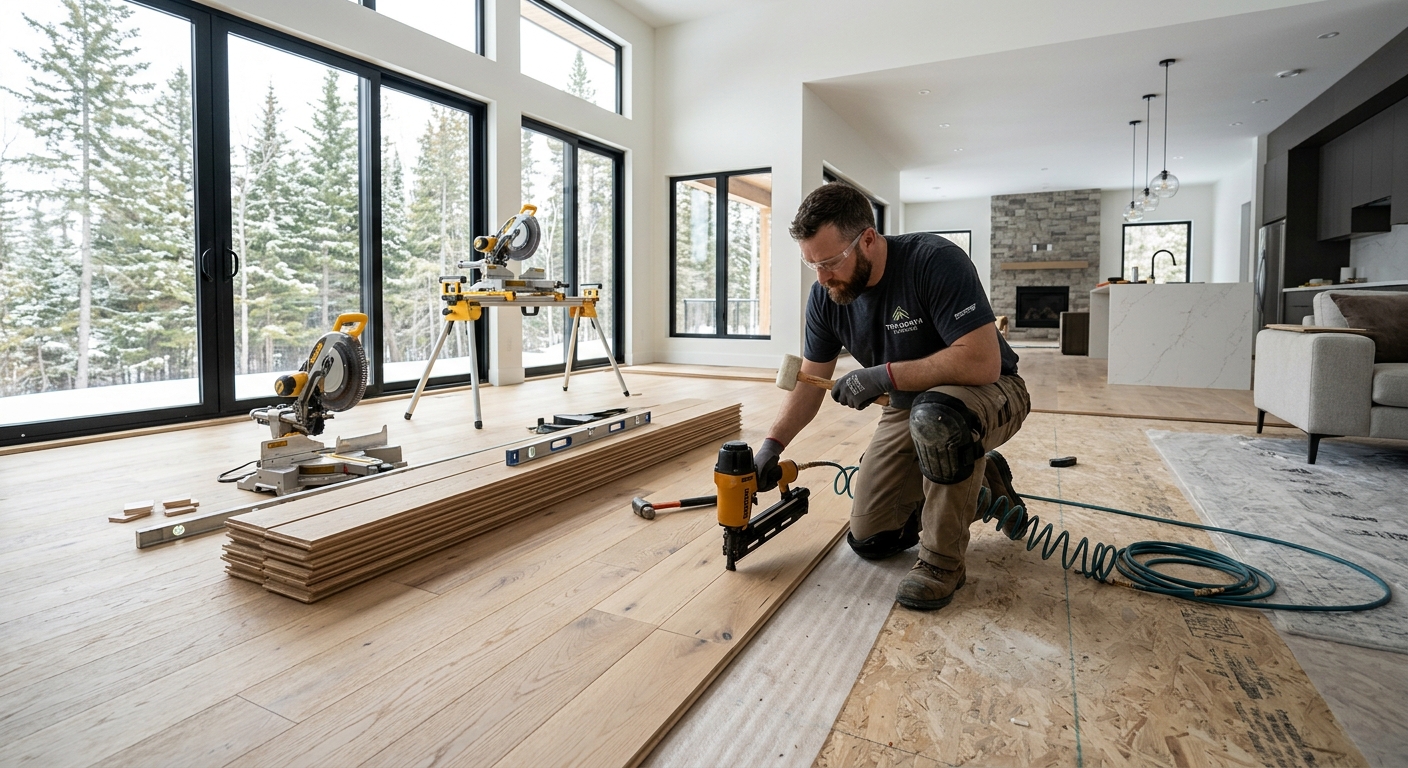
Flooring options and costs in Dovercourt
Dovercourt, Alberta is a small community with a big range of home ages—population is 2,030 (Statistics Canada, 2021 Census), and a lot of that housing stock was built long before today’s moisture-management best practices. In older homes around the Dovercourt neighbourhood core, it’s common to find surfaces that need flattening before new flooring goes in, especially where worn plywood meets patchwork transitions. That prep work (levelling, skim-coat, or localized repair) is one reason “the same” install can price differently from one quote to the next.
In Calgary’s dry, cold prairie climate, seasonal humidity swings can be dramatic. Above-grade materials still expand and contract, but below-grade areas (basements and in-slab concrete) face added risk from moisture migration. That’s why Calgary-area contractors usually steer homeowners toward engineered hardwood, luxury vinyl plank (LVP) or SPC over traditional solid hardwood for basements. If you’re adding flooring in a heated area with in-floor radiant, you also need products that tolerate the heat cycle without gapping.
Because Dovercourt is close to Calgary’s labour market, trades availability is generally good, but the cost drivers are still site-specific: room size, how much existing flooring must be removed, and how much subfloor work is required. For many projects, the “real” cost ranges land near mid-band pricing—hardwood often runs roughly $8–$15 per sq ft, while vinyl plank or laminate may start closer to $3–$7 per sq ft—depending on what the substrate demands.
Below is a practical comparison to help you budget before you request itemized quotes.
| Type |
Best Room |
Moisture Resistance |
Lifespan |
Price per sq ft |
| Solid hardwood (nail-down, above grade only) |
Living room, dining room (main floors) |
Low (humidity-sensitive; not for basements) |
20–50 years |
$8 – $15 |
| Engineered hardwood (float or glue, above + on-grade) |
Main floors, hallways, bedrooms |
Medium–high (better with humidity swings) |
15–30 years |
$9 – $14 |
| Laminate (click-lock, above-grade) |
Secondary bedrooms, living areas |
Medium (protect from standing water) |
10–20 years |
$4 – $7 |
| Luxury vinyl plank / LVP (waterproof, any level) |
Kitchen, main floor, finished basement |
High (waterproof core; good over concrete) |
15–25 years |
$4 – $8 |
| Porcelain / ceramic tile |
Bathrooms, entries, kitchens |
High (with correct grout and waterproofing where needed) |
25–50 years |
$6 – $12 |
| Carpet (broadloom or modular tile) |
Bedrooms, stairs (comfort) |
Low–medium (needs good ventilation and stain control) |
8–15 years |
$3 – $5 |
Prices are estimates only and vary by project scope, site access and material selection.
What affects the price of flooring in Dovercourt
In Dovercourt and the broader Calgary market, homeowners often see the same flooring “type” priced 30–50% apart. The gap usually isn’t the product—it’s the prep and the site conditions. Calgary’s dry, cold prairie swings mean hardwood can move with indoor humidity, and below-grade installs can see moisture migration through concrete. In practice, that pushes many basement projects toward LVP/SPC or engineered hardwood, and it also influences labour intensity (vapour control, crack isolation, levelling, and transition detailing).
Solid hardwood is typically limited to above-grade, nail-down installs. Because it expands and contracts with humidity, it generally can’t be glued or floated directly over concrete and performs poorly in basements. Engineered hardwood and luxury vinyl plank tolerate humidity and below-grade conditions far better. Cold-climate households that use (or are adding) radiant heat also see product restrictions; most contractors price radiant-compatible materials differently or adjust underlayment and spacing to maintain performance.
Older local housing stock commonly needs subfloor levelling or repair. In Dovercourt, it’s not unusual for levelling to add about $1–$4 per sq ft depending on how out-of-flat the surface is and whether patchwork transitions must be feathered. For example, a basement where crack repairs and vapour strategy are required can increase overall cost enough that choosing tile at the $6–$12 per sq ft band becomes less attractive than LVP at the $3–$7 per sq ft band—unless the room needs the tile’s splash resistance. Conversely, if your subfloor is already flat, upgrading from laminate to LVP may only be a modest jump because labour stays similar.
When you’re comparing quotes, ask specifically what the contractor is doing for the substrate and the moisture conditions—not just what finish you’re buying.
| Price Factor |
Why It Matters |
Cost Impact |
| Room area in sq ft |
Material quantity and labour hours scale with square footage |
Direct—often the biggest driver overall |
| Subfloor condition |
Levelling, patching, or replacing aged plywood/underlay affects readiness |
Commonly adds $1 – $4 per sq ft |
| Moisture / below-grade install |
Concrete moisture and vapour migration rule out solid hardwood for basements |
May add moisture control steps: $0.75 – $3.00 per sq ft |
| Material choice |
Solid vs engineered vs LVP vs tile changes tolerances and install method |
Hardwood/tile typically higher than laminate/LVP |
| Removal and disposal of existing flooring |
Demolition, haul-away, and patching after removal add labour |
Often adds noticeable per-sq-ft or per-room charges |
| Stair nosing / transitions |
Stairs require extra fabrication, nose moulding, and precise fitting |
Charged per step or per linear foot; can add several hundred dollars |
| Radiant heat compatibility |
Heat cycles can stress some materials and require correct underlayment |
May require specific products/underlayment: moderate increase |
| Installation method |
Float vs glue-down vs nail-down affects labour time and materials |
Glue-down often higher than click-lock; varies by substrate |
Permits & regulations in Alberta
In Alberta, a typical flooring installation does not require a building permit by itself. That said, certain related work can trigger permit requirements—especially when electrical systems are touched. For example, if you are modifying or installing circuits for in-floor radiant heat, that electrical work may require an electrical permit and inspections. Similarly, if the project involves significant structural repairs to the subfloor (for instance, replacing structural framing beyond simple patching), your contractor may need to coordinate approvals depending on the scope and how it’s classified.
In condominiums, the bigger “rule” is often the building’s sound-transmission requirements. Even when no municipal permit is needed, the condo corporation’s policies may restrict which underlay you can use under hard flooring on upper floors to meet STC/IIC expectations. Before you install hardwood or tile above grade in a multi-unit setting, request written board approval (or confirmation) and keep it on file.
To verify your Dovercourt/area contractor is compliant, take a simple step-by-step approach: (1) confirm their Alberta business details and credentials through the appropriate online listings for flooring contractors where applicable; (2) request a certificate of liability insurance and verify the coverage dates match your project; (3) ask for proof of WSIB/WCB coverage (or a letter of clearance if they’re exempt/registered appropriately). Finally, require the contractor to provide their plan for substrate prep, underlay/vapour control (where needed), and disposal—so there are no surprises that could delay the schedule.
Best flooring for each room in your Dovercourt home
Choosing flooring in Dovercourt is mostly about matching each room to its moisture exposure, traffic level, and comfort needs—while respecting Calgary’s climate swings. Living and dining spaces take daily wear but typically aren’t wet, so engineered hardwood or a high-quality laminate is a common sweet spot: it gives warmth underfoot without the stricter basement limitations of solid wood. For a master bedroom, carpet is hard to beat for comfort and sound absorption, especially on cold mornings; engineered hardwood is also a solid choice if you want a cleaner, longer-wear surface.
Kitchens usually benefit from luxury vinyl plank (LVP) or large-format porcelain tile. In a dry-but-cold prairie winter, spills and wet mopping still happen—LVP’s waterproof core tolerates everyday splashes, while tile is ideal if you prefer a wipe-clean surface and don’t mind grout care. Basements (finished) are where Calgary homeowners typically “stop negotiating with moisture”: LVP (or SPC) is the clear winner because it’s waterproof and dimensionally stable over concrete. Bathrooms should be porcelain or ceramic tile only, installed with the correct membrane strategy where required.
If your room sits over in-floor radiant heat, talk to your contractor before finalizing any product. Radiant-compatible installation helps prevent premature gapping and protects your warranty. For perspective, upgrading from laminate at about $4–$7 per sq ft to engineered hardwood around the $9–$14 band is often worth it in main living areas, but spending tile-level dollars ($6–$12 per sq ft) in a dry bedroom usually isn’t justified unless you need it for specific cleaning or design goals.
| Room |
Best Material |
Why |
Moisture Risk |
Price Band per sq ft |
| Living / dining room |
Engineered hardwood |
Looks like hardwood, handles Alberta humidity swings better than solid |
Low |
$9 – $14 |
| Master bedroom |
Carpet (or engineered hardwood if you prefer hard surface) |
Carpet improves comfort and reduces noise; engineered offers easier cleaning |
Low |
$3 – $14 |
| Secondary bedrooms |
Laminate (click-lock) or carpet |
Laminate is cost-effective and durable; carpet adds warmth for kids or guests |
Low |
$4 – $7 |
| Kitchen |
Luxury vinyl plank (LVP) or porcelain tile |
Water resistance for spills and easy daily cleaning |
Medium |
$4 – $12 |
| Basement (finished) |
LVP / SPC (waterproof) |
Works with below-grade moisture risk; avoids solid wood failures |
High |
$4 – $8 |
| Bathroom |
Porcelain / ceramic tile |
Best long-term performance with correct sealing and substrate prep |
High |
$6 – $12 |
How to choose a flooring contractor in Dovercourt
For Dovercourt homeowners, the safest way to choose a flooring contractor is to verify compliance and then match the quote to the actual site conditions. Start by confirming Alberta licensing/registration where applicable for the trade, and ask for current liability insurance documents before anything begins. For coverage, request proof of WSIB/WCB (workers’ compensation) status—many reputable contractors can provide either a clearance letter or evidence of active registration. If a contractor can’t produce paperwork quickly, that’s a practical risk you don’t want to absorb.
Next, get 2–3 itemized written quotes. You want a breakdown that separates labour, subfloor prep/levelling, underlay/vapour control, trim work, stair labour, and disposal/haul-away—not just a single lump sum. Read the exclusions carefully: what happens if the subfloor is worse than expected, who supplies patch materials, and is the permit-related electrical work scope mentioned if radiant heat is involved? Also confirm whether product and workmanship warranties are clearly stated, and whether the warranty is transferable if you sell your home.
Set a sensible payment schedule—never pay more than about 10–15% upfront, and hold back a portion until the job is fully complete, cleaned, and touch-ups are done. Require a start date and a completion estimate in writing so schedule changes don’t become budget surprises. In Calgary’s climate, good contractors also specify acclimation time for products and describe how they’ll manage humidity conditions during installation.
- Ask for certificate of liability insurance and verify coverage dates and project address.
- Request WSIB/WCB clearance/registration proof (or applicable documentation).
- Confirm who is responsible for substrate evaluation (flatness checks) before pricing changes.
- Get itemized labour vs materials pricing (including underlay/vapour barrier).
- Ensure disposal/haul-away is explicitly included or listed as an add-on.
- Confirm stair work and transition mouldings are priced per step/linear foot.
- Ask about acclimation requirements for hardwood/LVP before install.
- Require a description of levelling method (skim coat, patching, feathering).
- Verify moisture steps for basements (vapour control, crack isolation if needed).
- Check warranty details: workmanship length and how it’s handled for defects.
- Confirm warranty exclusions (product misuse, standing water, inadequate ventilation).
- Use a written payment schedule with a holdback until punch-list completion.
Red flags I commonly see in Dovercourt-area jobs include: (1) quotes that don’t mention subfloor prep or moisture steps for basements; (2) “no need to level” claims on tile installs where flatness matters; (3) refusing to itemize labour and exclusions; (4) asking for large upfront payments without a written schedule; and (5) vague warranty wording that doesn’t separate manufacturer coverage from workmanship.
Frequently asked questions — flooring in Dovercourt
What is the best flooring for a high-traffic area in Dovercourt?
For high-traffic areas in Dovercourt (entries, hallways, and main living zones), LVP/SPC and engineered hardwood are usually the most practical choices in Calgary’s dry, cold prairie climate. LVP is waterproof, handles humidity swings better than solid hardwood, and stands up well to scuffs and frequent vacuuming; many homeowners compare it to laminate at roughly $3–$7 per sq ft. Engineered hardwood is also durable, but it’s most reliable on main floors where humidity is controlled. In basements, I typically steer people away from solid hardwood because vapour migration through concrete plus humidity changes can lead to gapping. If your entry sees salty snow tracks, choose a tough wear layer and plan for mats—no floor material likes constant grit.
How do I prepare my subfloor before new flooring?
Subfloor prep in Alberta is where projects succeed or fail, especially with Calgary’s moisture behaviour. For Dovercourt homes, the first step is flattening: flooring manufacturers and installers expect a certain level of flatness, and older plywood or patched concrete often needs levelling. You’ll usually need to remove old adhesive residue, clean dust and debris, and replace any soft, wet, or delaminating sections. For basements and in-slab areas, contractors commonly add vapour control and address cracks (sometimes with crack isolation) before installing waterproof LVP/SPC. If you’re installing tile, flatness requirements are stricter, so levelling compound and a proper membrane strategy are often budgeted. Ask your contractor to describe the exact prep method and confirm it in writing.
Is cork or bamboo flooring a good choice in Dovercourt?
Cork and bamboo can be appealing for comfort, but in Dovercourt (and across Alberta), they’re not always the safest pick for high-moisture conditions. Cork is naturally resilient and warm, yet it can still be sensitive to prolonged moisture exposure and humidity swings—so it’s typically best on main floors where you can keep indoor conditions stable. Bamboo behaves differently depending on the product type, but many bamboo options are still engineered/surface-layered and should be installed with the right underlayment and acclimation. If you’re considering cork or bamboo for a basement, ask specifically about below-grade suitability and vapour control requirements; many traditional solid-wood-like products aren’t recommended over concrete. For a basement, most homeowners get better risk control with waterproof LVP/SPC, often around $4–$8 per sq ft.
What is the difference between floating and glued-down flooring?
Floating flooring “locks together” and rests on an underlayment, meaning it isn’t bonded to the subfloor. Click-lock laminate and many engineered products are common floating installs. The advantage is faster installation and that small subfloor imperfections can be handled better—within reason—by a proper underlayment. Glued-down flooring is bonded directly to the subfloor using adhesive (often with engineered hardwood or specific products), which can improve stability on certain substrates. In Dovercourt and Calgary, glued-down installs can be a good choice when the subfloor is flat and properly prepared, but they’re less forgiving if moisture is present or if the concrete isn’t addressed. For basements where moisture migration is common, waterproof LVP/SPC floating installs are often the practical approach because they tolerate conditions that make other methods riskier.
What flooring holds up best to pets in a Dovercourt home?
For pets in Dovercourt, look for scratch resistance, easy cleaning, and a surface that tolerates accidents. Waterproof LVP/SPC usually performs best because it’s stain-resistant and the core won’t degrade when spills happen. In pricing terms, LVP often falls near the $4–$8 per sq ft range, which tends to be less than many engineered hardwood upgrades while still giving durability. Engineered hardwood can work well for pets too, but you must clean up water quickly and avoid repeated wetting—humidity swings can amplify movement in wood floors if moisture is prolonged. Carpet offers comfort, but it can trap odours and stains unless you choose pet-focused fibres and stain-protect treatments. For tile, grout maintenance matters; it can be great for claws and wear, but it requires care around cleaning products and sealed grout.
How do I fix squeaky floors in my Dovercourt home?
Squeaks typically come from movement between subfloor layers or between boards and joists. The fix depends on what’s above the squeak—some floors are plywood over joists, others include older underlay or nails that have loosened. In Dovercourt homes (including older main floors), squeaks are often solved by locating the squeaky spot, then tightening or adding fasteners to reduce flex. If the floor is over a concrete slab, squeaks may come from a problematic underlayment or unevenness. Before you replace flooring, ask a contractor to inspect from underneath where accessible, or check by walking the area and listening for consistent spots. If you’re planning a new floor install, we can sometimes reduce squeaks by flattening and reinstalling with correct fasteners or by using the right underlayment—however, waterproof basement systems like LVP should always follow proper prep first.