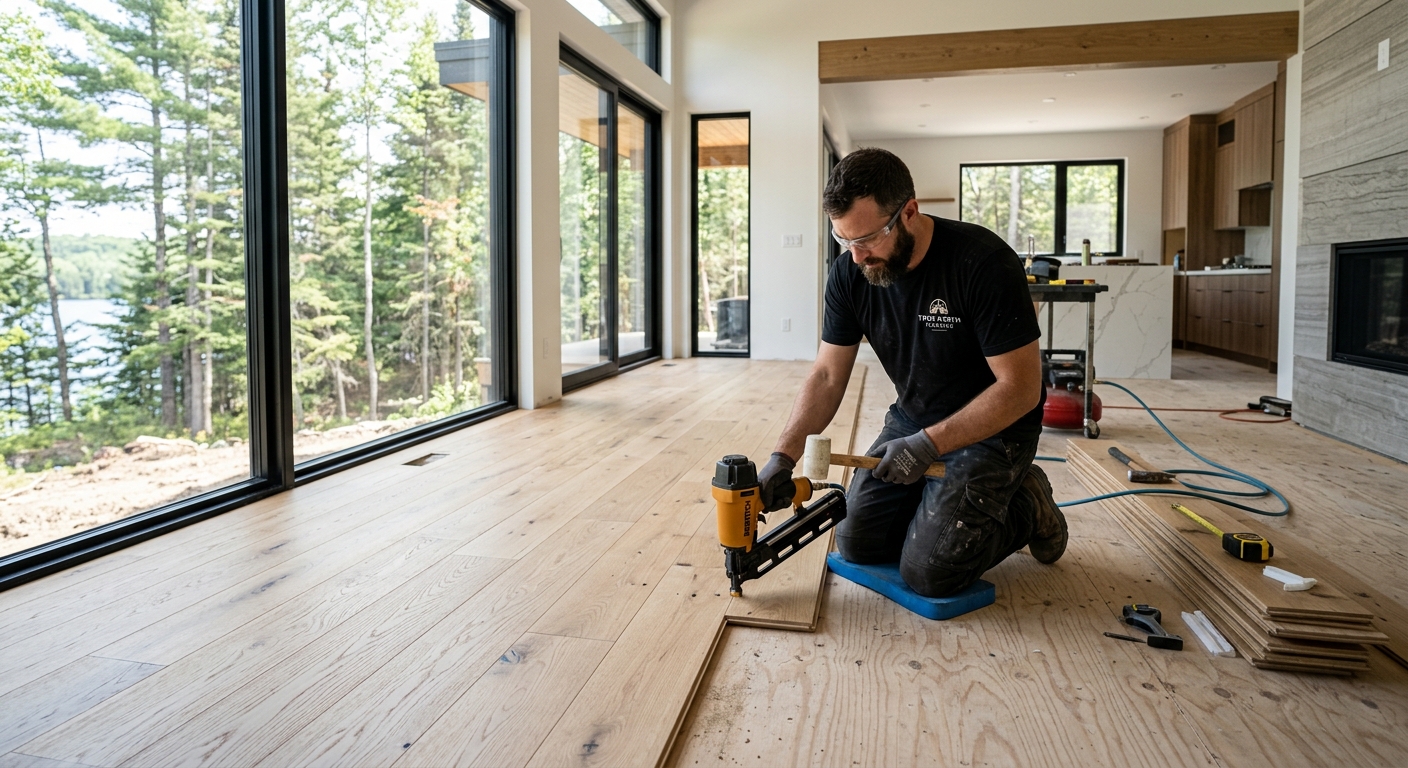
Flooring options and costs in Scarboro
Scarboro, Alberta homeowners usually start with the same question: “What will it cost, and what will hold up here?” With a population of 1,010 (Statistics Canada, 2021 Census), Scarboro is small enough that contractors often prioritize nearby Calgary-area projects first, which can tighten scheduling during busy seasons. Your home’s age also matters—older prairie housing stock across the Calgary region commonly shows wear in subfloors (wavy plywood, patchy concrete, or transitions between rooms), and levelling is one of the biggest drivers of price jumps. In practical terms, that prep work can add roughly $1–$4 per sq ft depending on how out-of-level the base is.
Cost is also shaped by Calgary’s dry, cold conditions and large seasonal humidity swings. Solid hardwood expands and contracts with indoor moisture and generally isn’t recommended over concrete or for below-grade basements. That’s why many Scarboro families favour engineered hardwood and waterproof luxury vinyl plank (LVP/SPC) when there’s a basement or any below-grade component. For tile, contractors typically budget for extra attention to flatness and crack isolation membranes, because ceramic and porcelain are less forgiving on uneven slabs.
In Scarboro, trade demand is often strongest around established residential pockets where homeowners renovate kitchens, main-floor living areas, and basements—particularly where people want a warmer feel than hard concrete. Next, compare the typical materials and price ranges that show up in real Scarboro-Calgary bids across these options.
| Type |
Best Room |
Moisture Resistance |
Lifespan |
Price per sq ft |
| Solid hardwood (nail-down, above grade only) |
Living/dining where the base stays dry |
Low to moderate (humidity sensitive; not for basements) |
25–50 years |
$8 – $15 |
| Engineered hardwood (float or glue, above + on-grade) |
Main floor and hallways |
Moderate to high (handles swings better than solid) |
20–40 years |
$9 – $14 |
| Laminate (click-lock, above-grade) |
Bedrooms and hallways |
Low to moderate (protect from standing water) |
10–25 years |
$3 – $7 |
| Luxury vinyl plank / LVP (waterproof, any level) |
Basements, kitchens, entry foyers |
High (waterproof construction) |
15–25 years |
$4 – $10 |
| Porcelain / ceramic tile |
Bathrooms and kitchens |
Very high (tile resists moisture; grout and substrate matter) |
25–50 years |
$6 – $12 |
| Carpet (broadloom or modular tile) |
Bedrooms and media rooms |
Low (moisture can lead to odour/mould risks) |
8–15 years |
$5 – $10 |
Prices are estimates only and vary by project scope, site access and material selection.
What affects the price of flooring in Scarboro
In Scarboro and the wider Calgary region, two homeowners can receive very different quotes for what looks like the “same flooring” on the same day—often by 30–50%. The gap usually comes from hidden scope: base condition, flatness requirements, moisture testing/mitigation, removal and disposal, and how much stair/transition work is involved. Even when material selection sits in the same bands, labour complexity can move the total quickly.
Technically, the big driver is Calgary’s humidity swings layered on top of cold winters. Solid hardwood expands and contracts with indoor moisture and generally shouldn’t be installed over concrete or in basements, where moisture vapour migration is common. That typically rules out traditional ¾-inch solid hardwood for below-grade projects and many on-slab scenarios. Engineered hardwood and waterproof LVP/SPC are more dimensionally stable, so they cost less in the long run because you’re less likely to face cupping or gapping and less likely to pay for repeated remedial work.
Colder-area design choices also affect costs. If your home has radiant heat, many solid hardwood options become limited, and contractors may need specific underlay systems or flooring thickness/stability specs. On top of climate, older housing stock in the Calgary region frequently needs subfloor levelling or repair—commonly adding $1–$4 per sq ft. For example, a 400 sq ft basement finish can move from a mid-band LVP install to a higher-ticket plan if levelling is required; meanwhile, tile in wet areas may start near the $6–$12 per sq ft range but can increase if crack isolation membranes and deeper prep are required.
Concrete examples we see in Scarboro: (1) a main floor with aged plywood and transitions between rooms often needs patching and smoothing before tile—adding labour and flatness materials; (2) below-grade concrete with moisture migration typically pushes budgets toward waterproof LVP/SPC instead of carpet; (3) stair re-staining/re-nosing and matching transitions can add noticeable cost even when the flooring material itself stays mid-range.
| Price Factor |
Why It Matters |
Cost Impact |
| Room area in sq ft |
Directly affects material quantities and labour hours |
Often the biggest driver; larger areas reduce per-sq-ft labour rate |
| Subfloor condition |
Levelling, patching, and repair must be done before flooring |
Can add roughly $1–$4 per sq ft depending on correction needed |
| Moisture / below-grade install |
Moisture vapour can damage solid wood and some laminates |
May increase costs by switching to engineered hardwood or waterproof LVP/SPC |
| Material choice |
Solid vs. engineered vs. LVP vs. tile have different install methods |
Solid hardwood typically costs more upfront than laminate; tile prep can add cost |
| Removal and disposal of existing flooring |
Old flooring teardown and hauling add time and equipment |
Can raise total project cost substantially on multi-room jobs |
| Stair nosing / transitions |
Stairs and transitions are custom-cut and measured carefully |
Charged per step or per linear foot; can add hundreds of dollars |
| Radiant heat compatibility |
Limits which materials can be installed and how underlay is set |
May require specific products and installation details |
| Installation method |
Float vs. glue-down vs. nail-down changes labour and prep |
Glue-down and tile often require more labour-intensive prep |
Permits & regulations in Alberta
In Alberta, installing flooring itself typically does not require a building permit. Where permits can come into play is the associated work around the flooring system—especially anything that touches electrical circuits or structural elements. For example, if you’re upgrading or adding radiant in-floor heating wiring, that electrical work can require electrical permits. If there’s subfloor structural repair that goes beyond simple patching (or involves engineering considerations), permits may be required depending on scope and building requirements. For most straightforward installations—carpet, laminate, engineered hardwood on an existing flat base, or waterproof LVP/SPC—homeowners usually do not need a permit.
Condos are a different practical reality. Even when permits aren’t required for flooring, condominium bylaws and the board’s sound rules often matter. Many corporations specify underlay requirements to help with sound transmission and may require approval before hard-surface floors (like hardwood or tile) are installed on upper floors. Before you book Scarboro-area work, request board approval in writing and keep the underlay/product specs handy.
To verify your contractor in Scarboro, start by confirming they’re licensed where applicable (trade licensing depends on the business type), and then focus on three proof points: liability insurance, WSIB/WCB coverage, and their written scope. Ask for a certificate of insurance that lists you as an interested party or provides job-site coverage details. For WSIB/WCB, request a clearance letter or current account confirmation. Finally, confirm the contractor’s trade registration/credentials via official online registries when available, and keep copies of their insurance and clearance documents for your records.
Best flooring for each room in your Scarboro home
Choosing the right flooring for your Scarboro home is less about “best overall” and more about matching each room’s moisture exposure, traffic level, and comfort needs to a product that fits Calgary’s dry-cold prairie swings. In living and dining areas, you usually want a warm surface, dependable wear resistance, and a stable installation—engineered hardwood or a quality laminate often hits the sweet spot. For bedrooms, comfort matters: carpet provides cushioning and sound absorption, which is helpful in family homes where footsteps carry.
Kitchens are the turning point. Spills happen, wet mopping is common, and the floor takes impacts from carts and appliances. That’s why luxury vinyl plank (LVP) is a strong choice, and why large-format porcelain tile remains popular in Alberta kitchens where easy cleaning matters. Basements are where climate logic becomes non-negotiable: waterproof LVP/SPC is the clear winner for most finished basements because it tolerates below-grade moisture vapour and won’t suffer the same cupping risks as solid wood. For bathrooms, porcelain or ceramic tile is the safer standard because it’s built for ongoing wet environments.
Radiant heat is increasingly common over new builds and remodels in the Calgary area. If you have in-floor heating, your best option is the flooring system that’s rated for radiant—many solid hardwood installs are more restricted, while engineered hardwood and certain laminates/LVP systems are typically more compatible when installed correctly with approved underlay and protocols.
As a dollar example: swapping from carpet (carpet installation typically comes with a labour band around $3–$5 per sq ft) to waterproof LVP in a 300 sq ft basement often costs more upfront than carpet, but it can prevent moisture-related replacement later—especially in homes where concrete moisture migration shows up seasonally.
| Room |
Best Material |
Why |
Moisture Risk |
Price Band per sq ft |
| Living / dining room |
Engineered hardwood |
Looks like real wood, stays more stable through humidity swings |
Low to moderate |
$9 – $14 |
| Master bedroom |
Carpet or engineered hardwood |
Carpet adds comfort and sound control; engineered keeps warm, cleanable surfaces |
Low |
$5 – $10 |
| Secondary bedrooms |
Laminate or carpet |
Laminate is durable for kids and pets; carpet improves comfort and acoustics |
Low |
$3 – $7 |
| Kitchen |
LVP or large-format porcelain tile |
Handles spills and easy cleaning; tile resists moisture and heat |
Moderate |
$4 – $12 |
| Basement (finished) |
Waterproof LVP/SPC |
Dimensionally stable over below-grade moisture vapour; safer than solid wood/most laminate |
High (below-grade) |
$4 – $10 |
| Bathroom |
Porcelain / ceramic tile |
Built for wet areas and long-term wear |
High |
$6 – $12 |
How to choose a flooring contractor in Scarboro
Picking the right contractor in Scarboro comes down to verifying credentials, getting comparable quotes, and reading the scope closely. Start with Alberta job safety documentation: ask for proof of liability insurance (so you’re covered if there’s property damage), and request WSIB/WCB clearance or current coverage confirmation so you’re not left responsible if a worker is injured on site. When you receive their paperwork, check the policy is current, and confirm it covers flooring installation activities. If a contractor can’t provide clear certificates or clearance letters, that’s a major warning sign in any Alberta neighbourhood.
Next, get 2–3 itemised written quotes. The best quotes break costs into materials and labour—often showing flooring, underlay (if applicable), levelling/patch compounds, stair work, removal/disposal, and transitions—rather than one lump sum. Ask whether permits are required for any connected electrical or structural scope and confirm if the contractor includes disposal and any prep work. For warranties, separate the workmanship warranty from the product warranty, confirm the length, and ask whether the warranty is transferable to future owners if you sell your home.
Finally, align payment with progress. In practice, avoid paying more than 10–15% upfront. Use a holdback until the job is complete and you’ve confirmed transitions, stair nosing, and cleanup are done to spec. Timing matters in a small market: request the start date and completion estimate in writing so you know when you’ll regain full use of your rooms.
- Verify liability insurance is current and includes job-site coverage details.
- Request WSIB/WCB clearance or written confirmation of coverage.
- Get 2–3 itemised quotes (labour + materials + prep) instead of a single total.
- Confirm removal and disposal costs are included (or clearly excluded).
- Ask who levels/repairs the subfloor and how flatness will be achieved.
- For tile, ask about crack isolation membrane and substrate prep requirements.
- Check stair scope: nosing style, edge details, and whether trims are reinstalled.
- Confirm underlay/vapour barrier details for your specific product and subfloor type.
- Ask how they handle transitions between rooms (T-mould, reducer, flush edges).
- Clarify radiant heat compatibility: which products are approved for your system.
- Review warranty terms: workmanship length, product coverage, exclusions, transferability.
- Use a payment schedule with a holdback; avoid large upfront payments.
In Scarboro, red flags we watch for include: vague scope language (“as needed”) with no line items, contractors who refuse to share insurance/WSIB/WCB documents, quotes that omit levelling when your subfloor is aged or uneven, and payment requests that ask for most of the total upfront. Another common issue is not addressing moisture strategy for basements—if they try to install solid hardwood in a below-grade space without a moisture plan, that’s a risk.
Frequently asked questions — flooring in Scarboro
What flooring is best for a Scarboro basement?
For most Scarboro basements, waterproof LVP or LVP/SPC is the safest all-around choice. Calgary-area basements often experience seasonal moisture vapour movement through concrete, and that’s exactly where solid hardwood and most laminates struggle—humidity swings can lead to gapping or cupping in wood, and laminate can be damaged by moisture at seams. LVP’s waterproof construction helps the floor tolerate the conditions better, and it’s also easier to live with if you get occasional dampness after spring thaw. If you’re comparing options, it’s common to see LVP positioned around the $4–$10 per sq ft band, while tile often starts in the $6–$12 per sq ft band but may require more subfloor prep. (Statistics Canada, 2021 Census) data remind us Scarboro is a small community—so scheduling and basements often get tackled during prime contractor availability windows.
Can I install hardwood over concrete?
Sometimes, but not in the way most homeowners expect. Traditional nail-down solid hardwood is not recommended over concrete, and it’s especially problematic if the concrete is below grade or isn’t effectively sealed/managed for moisture. If you want a wood look over concrete, engineered hardwood is generally the more workable option because it’s more dimensionally stable and can be installed using a method approved for slab conditions (often float or glue-down depending on the product and manufacturer requirements). In Scarboro and the Calgary region, we typically avoid solid hardwood for basements and treat on-slab installs seriously—flatness, moisture, and product compatibility all matter. If you have radiant heat, that can also restrict which hardwood options are approved. A knowledgeable quote should explain the install method and whether moisture mitigation and levelling are included.
How long does flooring installation take?
Timing depends on room count, subfloor prep, and whether stairs and transitions are involved. In the Calgary area, a straightforward single-room laminate install can be fairly quick, but most Scarboro projects include at least some prep—especially levelling over aged plywood or smoothing transitions—so expect more time than a showroom demo suggests. Tile and complicated stair work usually take longer because layout, underlayment/thinset work, and curing times can slow progress. For planning, ask your contractor for a start date and a completion estimate in writing, and confirm whether levelling materials are included in the timeline. Also ask if they need to protect nearby finishes while adhesive cures (for example, glue-down systems) and whether they’ll return for final transitions and baseboard/trim touch-ups.
What flooring works with radiant heat?
Radiant heat compatibility mostly comes down to product approvals and installation details. In Alberta (including Scarboro), radiant in-floor heating is common enough that contractors should ask about your system type and temperature controls before choosing materials. Engineered hardwood can work when it’s rated for radiant heat and installed with the manufacturer’s approved method and moisture/expansion tolerances. Waterproof LVP/SPC can also be a strong option, and some laminate products are rated for radiant as well, provided the underlay and flooring specs meet the requirements. Solid hardwood options can be more limited due to expansion and temperature cycling. A good contractor will reference the product’s radiant guidelines and specify the correct underlay/thickness so you don’t end up with warranty issues.
Engineered vs solid hardwood — what's the difference?
Solid hardwood is a single piece of wood (typically ¾-inch) that relies on stable indoor conditions; it’s usually installed nail-down and is best kept above grade. Engineered hardwood is made of multiple wood layers with a real wood veneer on top, which helps it resist humidity-driven movement. In Calgary’s dry, cold prairie climate with strong seasonal humidity swings, engineered generally performs more consistently in conditions that aren’t perfectly controlled. Over basements or on concrete slabs, engineered is usually the more practical route, while solid hardwood is commonly avoided because of moisture and dimensional change risks. Pricing can vary widely, but hardwood flooring in the region is often quoted in the higher bands (for example, solid hardwood may land around $8–$15 per sq ft, while engineered often sits close to the same general bracket depending on grade and thickness).
Do I need to level my subfloor first?
Often, yes—and it depends on what you’re installing. In Scarboro and the Calgary area, older homes frequently have uneven subfloors due to aged plywood, patch repairs, or inconsistent concrete surfaces. If you’re installing tile, levelling (and sometimes crack isolation) is especially important because flatness affects how the tile sets and how grout joints perform over time. For LVP, minor imperfections may be tolerated, but excessive dips or high spots can create joint failures or clicks in floating systems. For hardwood, flatness and stability are crucial so the boards sit correctly and don’t develop stress points. A realistic quote should include levelling/repair when your base requires it—often around $1–$4 per sq ft when prep is needed. If your contractor doesn’t mention flatness or prep, ask directly how they’ll check the subfloor and what’s included.