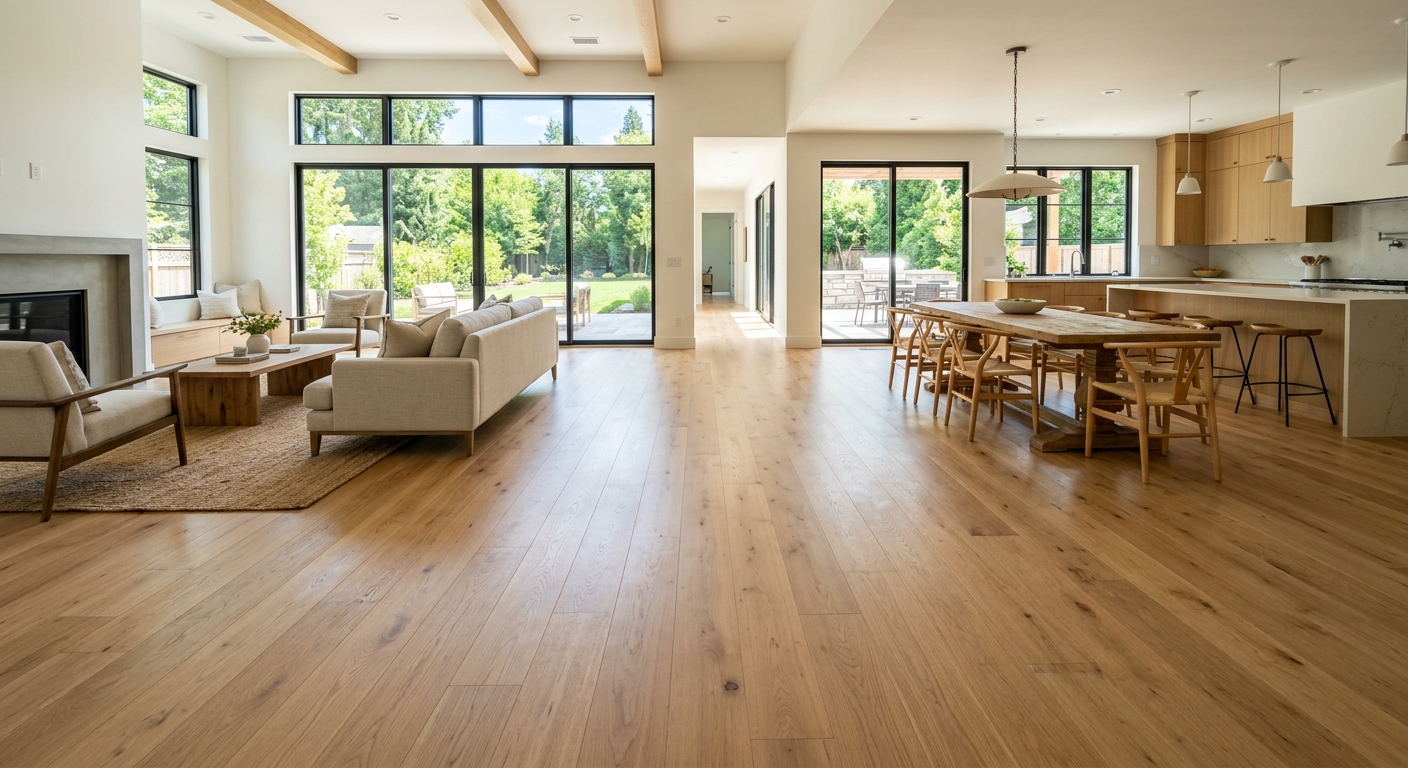
Flooring options and costs in Langford
Langford is a great place to think carefully about flooring because the region’s coastal conditions are hard on materials that don’t tolerate movement. With 46,584 people in the area (Statistics Canada, 2021 Census) and 64.8% of households owning their homes, most upgrades are done to last—yet many houses are also older. Homes built before 1981 account for 19.4% of the housing stock (Statistics Canada, 2021 Census), and that matters: it’s common to find dated subfloors, wavy plywood, or uneven concrete that need levelling/repair before any new floor can be installed. Those prep steps are one of the main reasons two “similar” quotes can land far apart.
On Vancouver Island and the Coast, indoor relative humidity can swing outside the ideal 35–55% range, especially in shoulder seasons when outdoor moisture loads up. That’s why we typically steer homeowners toward engineered hardwood and waterproof LVP in rooms where moisture management matters, including basements and bathrooms. In older areas of Langford—especially around the West Langford growth corridor—flooring work is in steady demand because many renovators are updating main floors while also dealing with subfloor irregularities. Availability of installers can also tighten around renovation season, which affects labour rates and scheduling.
Below is a practical side-by-side of popular flooring types we see in Langford, along with realistic installed price ranges so you can compare quotes confidently before we talk about your specific layout and prep requirements.
| Type |
Best Room |
Moisture Resistance |
Lifespan |
Price per sq ft |
| Solid hardwood (nail-down, above grade only) |
Main floors (above grade) |
Low to moderate; sensitive to humidity swings |
25–60 years |
$9 – $18 |
| Engineered hardwood (float or glue, above + on-grade) |
Living, dining, hallways; some bedrooms |
Moderate; better dimensional stability |
20–50 years |
$10 – $18 |
| Laminate (click-lock, above-grade) |
Bedrooms, living areas (dry rooms) |
Moderate; avoid chronic dampness |
10–25 years |
$5 – $10 |
| Luxury vinyl plank / LVP (waterproof, any level) |
Kitchen, basement (finished), main baths |
High; waterproof core with proper flashing/vapor plan |
15–30 years |
$6 – $12 |
| Porcelain / ceramic tile |
Bathrooms, kitchens, entries |
High; durable under normal wet use |
30–60 years (with proper grout/maintenance) |
$12 – $25 |
| Carpet (broadloom or modular tile) |
Bedrooms, stairs (comfort first) |
Low to moderate; avoid damp basements |
8–15 years |
$4 – $9 |
Prices are estimates only and vary by project scope, site access and material selection.
What affects the price of flooring in Langford
If you’re seeing quotes for the “same floor” that differ by 30–50% across Vancouver Island and Coast, it usually comes down to what’s included (prep, subfloor work, underlayment, transitions) and what the contractor is dealing with on-site. Flooring is a lot more than material plus snap-together boards: on older Vancouver Island homes—19.4% built before 1981 (Statistics Canada, 2021 Census)—we often run into wavy plywood, patchy concrete, or moisture-vapour concerns that require extra time and correct assemblies.
Technically, indoor humidity swings and below-grade moisture are the key drivers in Langford. Solid hardwood expands and contracts with humidity; it can also be damaged by chronic dampness and it generally can’t be glued or floated on concrete, which is why basements are typically excluded for solid. Engineered hardwood and luxury vinyl plank (LVP) handle humidity and below-grade installs far better because their construction is more dimensionally stable and easier to design around moisture management systems.
Radiant heating compatibility also matters. Because colder pockets and more electrically heated homes are common, many homeowners choose radiant-compatible options like engineered hardwood, LVP, many laminates, and tile. Those constraints can rule out some solid products and some laminate lines, changing both material and labour costs.
Concrete examples we see in Langford: if your subfloor needs levelling/repair, budget for added labour and materials often in the $1–$4 per sq ft range. If you’re moving from carpet to a hard surface, removal and disposal can add cost quickly, and stairs or transitions can bump the total. It’s also common to see that a carpet install in the $4–$9 band feels economical until you include underlay, subfloor smoothing, and stair work—at which point LVP in the $6–$12 range can become a better “all-in” comparison for the whole project.
| Price Factor |
Why It Matters |
Cost Impact |
| Room area in sq ft |
Material quantity and labour hours scale with square footage |
Direct; larger rooms typically lower cost per sq ft |
| Subfloor condition |
Levelling/patching affects prep time and waste rate |
Often adds $1–$4 per sq ft on older homes |
| Moisture / below-grade install |
Determines whether you can use solid wood and what vapor plan is required |
Can shift you to engineered/LVP; increases prep for moisture |
| Material choice |
Solid vs engineered vs LVP vs tile changes both product price and install method |
May swing total by $3–$10 per sq ft depending on spec |
| Removal and disposal of existing flooring |
Tearing out and hauling adds labour and tipping fees |
Common hidden cost; can be a noticeable part of the quote |
| Stair nosing / transitions |
Stairs are labour-intensive and need proper edge protection |
Charged per step or per linear foot; adds quickly |
| Radiant heat compatibility |
Only certain products can handle temperature cycling correctly |
May require specific underlayment/installation method |
| Installation method |
Float vs glue-down vs nail-down changes labour, adhesives, and time |
Glue-down and nail-down typically cost more than click-float |
Permits & regulations in British Columbia
In British Columbia, a typical floor replacement generally does not require a building permit. Installing new flooring over an existing substrate is usually considered a finishing trade. However, some associated work can trigger permit requirements—so it’s smart to confirm scope up front. For example, structural changes to the building (like significant subfloor framing repairs, load-bearing adjustments, or structural levelling) may require permitting. Moisture remediation can also involve additional steps, and in-floor heating projects may require electrical permits if you’re adding or altering circuits, thermostats, or connections.
If you’re in a condominium in Langford, you also need to check the corporation’s rules. Sound transmission requirements (commonly discussed in terms of STC/IIC performance) often restrict what underlay you can use on upper floors, and the strata may require board approval for hard-surface installs like hardwood or tile.
To verify your contractor in Langford and across BC: (1) check their business licence status and credentials using the appropriate provincial resources and public listings; (2) request a certificate of insurance—confirm they carry liability coverage for your project; (3) for coverage related to workers, ask for proof of WCB/WSIB clearance or equivalent coverage documentation; (4) keep copies of these documents with your contract and any written scope approvals.
Finally, if you’re in a multi-unit building, request board approval in writing before work begins, especially when installing hardwood or tile on an above-grade unit floor.
Best flooring for each room in your Langford home
Choosing the right flooring for each room in your Langford home is about matching the material to moisture exposure, foot traffic, and comfort. In living and dining areas, engineered hardwood is a top choice because it delivers the look of wood while better handling Langford’s humidity swings than solid hardwood. High-quality laminate is also common for cost-sensitive renos, but it should stay in genuinely dry rooms. Bedrooms usually do well with carpet for comfort and sound absorption, or engineered hardwood if you want a cleaner, low-maintenance feel.
For kitchens, LVP is often the practical winner: it resists spills and everyday water drips, and it tolerates minor subfloor imperfections better than many rigid materials. If you want the longest-wear option, large-format porcelain tile is excellent for heavy traffic and wet cleanups, though it’s typically costlier and can be colder unless you add radiant heating. In basements (especially finished ones), LVP is usually the clear choice on Vancouver Island and the Coast because it’s waterproof and designed to work with vapor barrier strategies where solid wood and most laminate struggle.
Bathrooms should be porcelain or ceramic tile only—properly installed with correct underlayment and grout practices. For radiant heat compatibility, many engineered woods, LVP, laminate lines, and tile can be installed successfully over hydronic or electric radiant systems, as long as the product is rated for it and you follow temperature controls.
As a budgeting example: if your living/dining area is in the same $/sq ft comparison, carpet might start around the $4–$9 band, but switching to engineered hardwood can be justified when you factor in longer lifespan and reduced maintenance, particularly in homes built before 1981 where subfloor prep and unevenness can otherwise chew up carpet longevity.
| Room |
Best Material |
Why |
Moisture Risk |
Price Band per sq ft |
| Living / dining room |
Engineered hardwood |
Warm look with improved dimensional stability for coastal humidity |
Low to moderate (manage indoor humidity) |
$10 – $18 |
| Master bedroom |
Carpet or engineered hardwood |
Carpet adds comfort and quiet; engineered keeps a clean finish |
Low (keep moisture sources controlled) |
$4 – $18 |
| Secondary bedrooms |
Laminate or carpet |
Laminate is budget-friendly; carpet improves acoustics |
Low (avoid chronic dampness) |
$5 – $12 |
| Kitchen |
Luxury vinyl plank (LVP) |
Resists spills and wet messes; tolerates normal kitchen accidents |
Moderate (daily water exposure) |
$6 – $12 |
| Basement (finished) |
Luxury vinyl plank (LVP) |
Waterproof surface and more stable in below-grade conditions |
Higher (vapor/moisture management matters) |
$7 – $13 |
| Bathroom |
Porcelain / ceramic tile |
Best resistance to wet use and long wear with correct installation |
High (standing water risk) |
$12 – $25 |
How to choose a flooring contractor in Langford
To choose a flooring contractor in Langford, start by verifying three things: licensing/business standing, liability insurance, and WCB/WCB-equivalent coverage documentation for workers. Ask the contractor directly for their liability insurance certificate—your quote should reference that they’re insured for work at your address. For coverage, request clearance documentation for WCB/WSIB (depending on their setup) and keep it on file; this is especially important if your project involves subfloor repair or removal of older materials.
Next, get 2–3 itemised written quotes. The best quotes break out labour and materials separately (including underlayment/vapor barrier where needed), and they specify what’s included for subfloor prep, removal, and disposal. Avoid “lump sum” pricing that doesn’t show how stairs, transitions, and underlayment are handled—those are common sources of budget surprises on Vancouver Island renos.
Read the scope line by line: is subfloor levelling included, or treated as a separate charge? Is permit pull included if in-floor heating electrical work is involved? Is demolition and hauling included? Also clarify warranties: you want both workmanship warranty terms and manufacturer product warranties, and you should ask whether the warranty is transferable to you if you sell the home.
For payment, never pay more than about 10–15% upfront. Hold back the remainder until the job is complete and you’ve reviewed transitions, stair edges, and clean-up. Finally, get the start date and completion estimate in writing so you can plan around Langford renovation schedules.
- Ask for insurance certificate and confirm the named insured matches the contractor’s business.
- Request proof of WCB/WSIB clearance or equivalent coverage.
- Verify licence/business registration status before deposits are paid.
- Get an itemised quote: materials, labour, underlayment/vapor barrier, and disposal.
- Confirm what subfloor repairs are included and what triggers extra charges.
- Ask how they handle humidity—do they recommend acclimation and moisture checks?
- Ensure transitions and stair nosing are listed (per step or per linear foot).
- Clarify whether they move appliances/furniture and how protection is handled.
- Check warranty details: workmanship duration and product warranty conditions.
- Confirm payment schedule: max 10–15% upfront; holdback until complete.
- Get a written timeline with start date and realistic completion estimate.
- Request references from similar Langford projects (older homes, basements, radiant floors).
Red flags to watch for in Langford: (1) quotes that ignore subfloor prep despite obvious unevenness; (2) no written scope for stairs/transitions; (3) refusal to provide insurance and WCB/WCB documentation; (4) asking for a large deposit before any measurement or material selection is confirmed; (5) vague warranty language that doesn’t separate workmanship from manufacturer coverage.
Frequently asked questions — flooring in Langford
How do I prepare my subfloor before new flooring?
In Langford (and across the Vancouver Island and Coast region), subfloor prep is the difference between a floor that stays flat and one that opens up at seams. The contractor should start with inspection: checking for loose nails/screws, measuring flatness, and identifying high spots, low areas, and any soft or damp sections. If you’re installing engineered hardwood, laminate, or LVP, unevenness can still transfer and create squeaks or gaps—so levelling/repair is often required in older homes built before 1981. For basement or below-grade work, preparation may also include moisture/vapour management with the correct underlayment and sealing approach. Expect more labour and materials when levelling is needed—commonly adding roughly $1–$4 per sq ft. Don’t let a contractor skip moisture checks and still guarantee “no gaps.”
Is cork or bamboo flooring a good choice in Langford?
Cork and bamboo can work well in British Columbia, but they’re not our first pick for the highest-moisture areas in Langford. Cork is naturally resilient and can feel warmer underfoot, which is nice in homes with radiant heating, but it still needs a stable, dry substrate—humidity swings can affect any wood-based product. Bamboo may be more dimensionally stable than some solid woods depending on construction, yet it still performs best when installed on appropriate subfloors and with the correct expansion allowances. In a typical Langford renovation, cork or bamboo is best kept to main living spaces with controlled indoor humidity (not chronic damp basements). If you’re aiming for waterproof performance and easier moisture tolerance, LVP is usually the safer choice. Budget-wise, if you’re comparing to laminate or vinyl bands, remember LVP commonly lands around $6–$12 per sq ft, while cork/bamboo pricing can climb quickly once you factor in underlay and installation requirements.
What is the difference between floating and glued-down flooring?
Floating flooring “rests” on an underlayment and locks together without being firmly attached to the subfloor. This is common with click-lock laminate and many LVP products; it allows the planks to move slightly with temperature and humidity. Glued-down flooring is adhered directly to the subfloor (more common with certain engineered hardwood systems and specific products), which can reduce movement and improve stability on properly prepared surfaces. In Langford’s coastal humidity swings, floating systems often tolerate normal movement better, but they still require a flat, sound base. Glued-down installations require the right adhesive and subfloor moisture/porosity conditions—especially important if you have older concrete. If you’re dealing with a wavy plywood subfloor, levelling can be non-negotiable either way. A good contractor will specify which method matches your product and your subfloor conditions rather than using one method for every home.
What flooring holds up best to pets in a Langford home?
For pets, the best long-term choice in Langford is usually waterproof LVP or a durable laminate with a proper wear layer, because accidents and frequent cleaning are common. LVP’s waterproof core helps it resist spills and reduces damage from minor wet events—this matters in a region where indoor humidity can swing and basements can be part of the risk picture. If you have lots of claws, focus on thickness and wear layer; avoid thin, soft-core products. For main floors, engineered hardwood can still work if the finish is strong, but you’ll want to manage moisture and promptly clean spills to avoid prolonged exposure. Carpet can be comfortable but can stain and hold odours if moisture or urine accidents occur; it’s also less ideal in damp basements. If you’re budgeting, LVP commonly fits the $6–$12 per sq ft band, while laminate often starts around $5–$10 per sq ft. Either way, plan for felt pads, regular trimming, and prompt wipe-ups to maximize lifespan.
How do I fix squeaky floors in my Langford home?
Squeaks are usually a subfloor movement or fastening problem, not a “flooring problem.” In a Langford home—especially older properties built before 1981—squeaks often come from loose subfloor panels, nails that have backed out, or joists shifting slightly with foot traffic and humidity changes. The correct fix is to identify where movement occurs and re-secure materials: re-screwing subfloor panels, adding appropriate fasteners where allowed, and addressing any damaged sections. In many cases, the squeak is best corrected before new flooring is installed, because once a finished floor goes down, you can’t easily access the problem without damaging the new surface. If you already have a finished floor, some contractors may recommend patching and selective repair, but that’s not guaranteed. If you’re planning a full replacement, ask your contractor to do a quick “walk test” and report squeak points before you commit—this may add labour, but it prevents a recurring issue.
What is luxury vinyl plank and is it worth it in Langford?
Luxury vinyl plank (LVP) is a synthetic flooring with a wear layer and, in many products, a waterproof core designed to handle spills and moisture better than wood-based options. In Langford and the broader Vancouver Island and Coast region, where humidity swings and below-grade moisture are common considerations, LVP is often worth it because it’s durable, easier to maintain, and forgiving on subfloor imperfections when installed correctly. For basements, it’s usually the top choice because it’s waterproof, unlike solid hardwood and most laminate. It’s also radiant-compatible for many products, which matters as more homes add electric or hydronic heat. Cost-wise, LVP typically lands around the $6–$12 per sq ft range installed depending on product quality and prep needs. If your quote for LVP is close to the $9–$18 range for solid hardwood, it’s a strong sign you should compare what’s included—especially levelling and moisture/vapour work—because those details drive long-term performance.