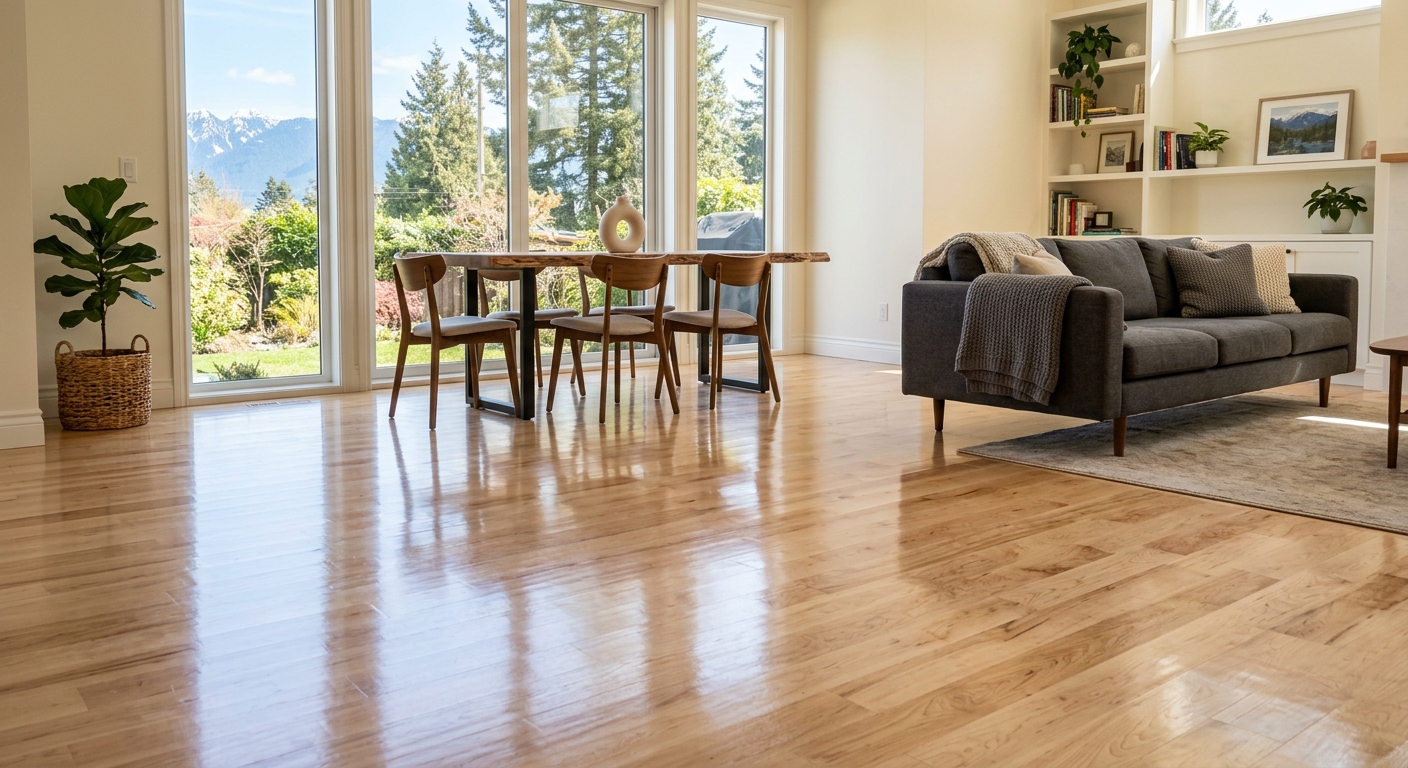
Flooring options and costs in Saanich
Saanich homeowners have plenty of choice, but costs and performance on Vancouver Island are shaped by our coastal humidity swings and the large share of older housing. With 56.3% of homes in the area built before 1981 (Statistics Canada, 2021 Census), many projects start with subfloor grading, patching, or levelling—especially when you’re replacing carpet over older plywood or addressing wavy sections near exterior walls. On top of that, it’s common to find older basements with intermittent dampness, which changes the “best” floor type and the underlayment/vapour-barrier system.
In Saanich, contractor availability also matters. When there’s heavy demand around peak renovation months, you may see higher labour rates for scheduling and for time spent prepping uneven substrates. The good news: engineered hardwood and luxury vinyl plank (LVP) are widely stocked and typically more forgiving when humidity moves outside the ideal indoor range.
We see especially strong demand in neighbourhoods such as Tillicum and North Saanich-style areas where older houses are being updated room-by-room. If you’re aiming to keep costs predictable, the key is matching each material to the moisture conditions of that room—rather than choosing based on appearance alone.
Use the table below to compare typical all-in installed pricing ranges for common flooring types in Saanich, then we’ll break down what drives differences in quotes.
| Type |
Best Room |
Moisture Resistance |
Lifespan |
Price per sq ft |
| Solid hardwood (nail-down, above grade only) |
Main living areas with stable humidity |
Low to moderate (not for basements or damp slabs) |
30–60 years |
$9 – $18 |
| Engineered hardwood (float or glue, above + on-grade) |
Living rooms, hallways, bedrooms |
Moderate to high (better stability) |
20–40 years |
$9 – $16 |
| Laminate (click-lock, above-grade) |
Bedrooms, living areas |
Moderate (avoid chronic moisture) |
10–25 years |
$5 – $10 |
| Luxury vinyl plank / LVP (waterproof, any level) |
Kitchen, basement (finished) |
High to waterproof (when installed with correct system) |
15–25 years |
$6 – $12 |
| Porcelain / ceramic tile |
Bathrooms, entries, kitchens |
High (with proper underlayment/grout) |
25–50 years |
$12 – $25 |
| Carpet (broadloom or modular tile) |
Bedrooms, stairs (where comfort matters) |
Low (can hold odours/moisture if damp) |
7–15 years |
$4 – $9 |
Prices are estimates only and vary by project scope, site access and material selection.
What affects the price of flooring in Saanich
In Saanich and across Vancouver Island and the Coast, two “similar” flooring jobs can land 30–50% apart depending on substrate condition, moisture management requirements, and labour scheduling. The same product can also cost differently when one installer builds in more levelling, better vapour barriers, or more labour for detailed transitions and stair work. That’s why it’s smart to compare itemized quotes—materials plus labour—rather than relying on a single lump sum.
The biggest technical driver here is moisture. Indoor relative humidity on the coast often moves outside the ideal 35–55% band, and below-grade spaces can add vapour pressure from older foundations. Solid hardwood expands and contracts with humidity; it also can’t be installed over concrete or in damp basements, which makes it a poor fit for many on-grade and below-grade rooms. Engineered hardwood and LVP handle humidity and below-grade applications far better when paired with the right underlayment and a proper moisture/vapour-barrier plan. In colder stretches of the region—and with electrically heated homes—radiant-compatibility also matters, and that often favours LVP, many laminates, tile, and engineered woods over most solid hardwood systems.
Older housing stock contributes to higher prep costs. With 56.3% of homes built before 1981 (Statistics Canada, 2021 Census), it’s common to find wavy plywood, nail pops, and patchwork. Levelling or repair commonly adds about $1–$4 per sq ft before flooring goes down; in extreme cases, it can push higher. For budgeting, most all-in pricing lines up with the region’s bands: LVP typically falls around $6 – $12 per sq ft installed, while tile commonly lands around $12 – $25 per sq ft installed—largely driven by substrate prep, underlayment choice, and finish work.
| Price Factor |
Why It Matters |
Cost Impact |
| Room area in sq ft |
More square footage increases both materials and labour time (demo, layout, pattern cuts) |
Direct proportional increase; small rooms hit higher minimum charges |
| Subfloor condition |
Levelling, sistering joists, patching, or plywood repairs are labour-heavy but protect the finished floor |
Often adds $1–$4 per sq ft before materials |
| Moisture / below-grade install |
Moisture remediation and vapour barriers change the system—rules out solid hardwood on slabs and in damp zones |
Can add $2–$6 per sq ft depending on existing moisture issues |
| Material choice |
Solid, engineered, LVP, laminate, and tile vary in unit cost and complexity of install |
Shifts you across typical bands (e.g., LVP vs tile) |
| Removal and disposal of existing flooring |
Carpet and underpad removal is fast; tile, glue-down residue, and thick adhesives take longer |
Often $1–$3 per sq ft equivalent (varies by type and waste load) |
| Stair nosing / transitions |
Steps require precise nosing profiles, extra cutting and finishing, and sometimes moulding fabrication |
Charged per step or per linear foot; can materially change total |
| Radiant heat compatibility |
Not every product is approved for radiant; underlayment and temperature limits affect warranty |
May require approved systems (small add, but can prevent costly callbacks) |
| Installation method |
Float-down, glue-down, and nail-down each require different prep, adhesives, and tolerances |
Can swing labour intensity by 10–25% for the same surface area |
Permits & regulations in British Columbia
In British Columbia, a typical flooring replacement usually does not require a building permit. The floor covering itself (carpet, laminate, engineered hardwood, LVP, and tile) generally falls under finishing work. However, associated tasks can trigger requirements.
Work that may require permits: structural subfloor repair when it affects load-bearing components; any moisture remediation that involves altering or sealing building assemblies beyond normal patching; and in-floor heating changes or electrical work related to radiant systems (these commonly require an electrical permit and work must be performed by the appropriate licensed trades). In multi-unit buildings, there are also condominium rules rather than municipal permits—especially around noise control.
What typically does not require a permit: removing existing flooring, installing a new floor covering, installing an approved underlayment, and standard patching/levelling that doesn’t change structural load paths.
To verify a contractor in Saanich, start with their British Columbia licence status (where applicable to their trade category) and insist on documentation. Next, request a current certificate of liability insurance naming you and showing coverage effective dates. For clearance related to site safety and labour standards, ask for WSIB/WCB coverage details (or proof of compliant coverage status). Finally, for condos, request board approval in writing and confirm the underlay and installation method meet the corporation’s sound transmission requirements (STC/IIC).
Best flooring for each room in your Saanich home
Choosing the right flooring in Saanich is less about trends and more about how each room handles moisture, traffic, and comfort. In living and dining areas, engineered hardwood is a popular sweet spot: it brings the warmth of wood while coping better with coastal humidity than solid hardwood. For master bedrooms, carpet remains hard to beat for comfort and sound absorption; it also reduces echoes in older homes where subfloors can be a touch less rigid.
In kitchens, we usually steer homeowners toward luxury vinyl plank (LVP) or large-format porcelain tile. LVP handles splashes and frequent wipe-downs, while tile is unmatched for wet-zone durability when installed with the correct underlayment and grout system. Basements (finished or not) are the clearest “buy right the first time” zone: LVP is often the winner because it’s waterproof and can be installed with the right vapour barrier approach—where solid wood and many laminates struggle with chronic moisture risk. Bathrooms should be porcelain or ceramic tile only.
Radiant heat compatibility is also increasingly common across British Columbia. In rooms over electric or hydronic radiant systems, many laminates, engineered hardwood, tile, and LVP can perform well when installed with approved underlayment and temperature controls; most solid hardwood installs over radiant are far more restricted.
As a budgeting example: if you’re comparing carpet to LVP in a similar-sized bedroom, carpet may land closer to the $4 – $9 band, while LVP typically sits around $6 – $12 installed. The extra cost is often justified if you expect higher spill risk, want easier cleaning, or are dealing with a damp or older floor assembly.
| Room |
Best Material |
Why |
Moisture Risk |
Price Band per sq ft |
| Living / dining room |
Engineered hardwood |
Wood look with better dimensional stability for coastal humidity swings |
Low to moderate (mostly controlled indoor humidity) |
$9 – $16 |
| Master bedroom |
Carpet or engineered hardwood |
Carpet adds comfort and sound reduction; engineered wood keeps a cleaner look |
Low (if moisture is controlled) |
$4 – $16 |
| Secondary bedrooms |
Laminate (click-lock) or LVP |
Laminate is budget-friendly; LVP is easier to maintain if kids/trafficked |
Low to moderate (depends on home humidity and spills) |
$5 – $12 |
| Kitchen |
Luxury vinyl plank (LVP) or porcelain tile |
Handles spills, easy cleaning, and frequent foot traffic |
Moderate (water events and higher cleaning frequency) |
$6 – $25 |
| Basement (finished) |
LVP (waterproof) with correct vapour barrier |
Best resilience in older assemblies and below-grade moisture conditions |
High (vapour pressure and occasional dampness) |
$6 – $12 |
| Bathroom |
Porcelain / ceramic tile |
Designed for wet zones; durable and repairable |
Very high (direct water exposure) |
$12 – $25 |
How to choose a flooring contractor in Saanich
Choosing the right flooring contractor in Saanich is mainly about proof, process, and accountability. Start with British Columbia compliance: ask whether the company is properly licensed for their trade category where applicable, and request a certificate of liability insurance (with effective dates) before work begins. Next, confirm workers are covered—ask for WSIB/WCB coverage details or clearance that demonstrates they’re compliant for employees and jobsite work.
Then, get 2–3 itemised written quotes. Itemized means you can see a breakdown for labour and materials, including underlayment/vapour barrier, adhesives (if glue-down), levelling/patching, removal and disposal, and any transition work for doorways and stairs. Avoid quotes that only state “labour and materials included” without listing quantities or assumptions.
Read the scope carefully: what’s excluded (baseboards, floor flattening beyond a certain amount, subfloor replacement)? Is permit pulling included if required for electrical radiant work? Is disposal included or billed separately? A good warranty protects workmanship and product performance—ask for the workmanship warranty length, whether it covers click-lock floating issues or only defects, and whether the manufacturer warranty is transferable if you sell your home.
For payment, keep it controlled: never pay more than 10–15% upfront. Hold back the remainder until the job is complete and you’ve inspected the final flooring and transitions. Finally, insist on a written start date and realistic completion estimate that reflects curing/conditioning and substrate prep.
- Confirm they provide a written contract with itemized labour/materials scope.
- Request a current certificate of liability insurance.
- Verify WSIB/WCB coverage or compliant clearance documentation for workers.
- Ask how they’ll check subfloor flatness and moisture conditions before install.
- Ensure vapour barrier/underlayment is specified for each product and location.
- Get removal and disposal details in writing (what’s included and what isn’t).
- Clarify levelling/repair allowances (and the rate if extra prep is needed).
- Confirm transition details for doorways, stairs, and where flooring meets tile.
- Ask who installs baseboards/trim and whether you’ll be responsible for touch-ups.
- Verify the warranty: workmanship term, product warranty, and transferability.
- Payment schedule: limit deposit to 10–15% and hold back until completion.
- Get a start date, completion timeline, and schedule changes in writing.
Red flags in the Saanich market include: refusing to provide insurance/coverage proof, quoting only a lump sum without itemization, skipping subfloor moisture/flatness checks, promising “no underlayment needed” for LVP or engineered systems, and starting before confirming radiant heat compatibility or condo sound requirements (STC/IIC) where applicable.
Frequently asked questions — flooring in Saanich
How do I fix squeaky floors in my Saanich home?
Squeaks are usually a sign of movement between subfloor layers, loose fasteners, or nails/straps that have loosened over time—common in older Vancouver Island homes. Before choosing new flooring, it helps to identify the squeak source: walk the area with a helper and tap along joists or plywood seams to find where movement happens. Often, the fix is adding screws, re-nailing, or repairing the subfloor—not just “covering it up.” If your plan is to install LVP or engineered hardwood, we can correct squeaks during prep so the new floor doesn’t fail from trapped bounce or deflection. In Saanich, where 56.3% of homes are older than 1981 (Statistics Canada, 2021 Census), expect that prep may add labour cost; it’s not unusual for levelling/repair to affect your total by a few dollars per sq ft.
What is luxury vinyl plank and is it worth it in Saanich?
Luxury vinyl plank (LVP) is a layered synthetic floor with a wear layer on top. The “worth it” part in Saanich comes down to our coastal moisture and older basements: LVP is typically waterproof and can tolerate humidity better than solid hardwood, especially when installed with the correct underlayment/vapour-barrier system. It’s also fast to maintain—big plus in kitchens and for families. If you’re comparing costs, LVP installed often lands around $6 – $12 per sq ft, while tile can be $12 – $25 per sq ft (depending on layout complexity). You’d generally choose tile for bathrooms and shower-adjacent wet zones, but for finished basements and kitchens, LVP is usually the best balance of durability and budget. For radiant heat homes, many LVP products are approved when the installer follows temperature limits and uses recommended underlay.
How much does flooring cost in Saanich?
In Saanich, flooring prices vary mainly by material type, subfloor prep, and the amount of trim/transition work. As a baseline for homeowners budgeting, LVP/Laminate type projects often fall in the $5 – $12 per sq ft range all-in installed, while hardwood and tile typically cost more. For example, solid hardwood is commonly priced around $9 – $18 per sq ft installed (above grade only), and porcelain/ceramic tile is often $12 – $25 per sq ft installed once you include proper underlayment and labour. If you have an older house, plan for levelling or repairs: with 56.3% of homes built before 1981 (Statistics Canada, 2021 Census), it’s common to add $1–$4 per sq ft for prep. The only reliable way to confirm your number is an itemized quote.
Hardwood vs laminate vs vinyl plank — which is best?
“Best” depends on the room and moisture risk. Solid hardwood looks great and can last decades, but in British Columbia—especially on concrete slabs or in any space with damp basements—it’s usually not the right call because solid wood expands/contracts with humidity and can’t be installed where moisture is chronic. Engineered hardwood is a better hardwood compromise for most above- and on-grade rooms. Laminate is budget-friendly and stable enough for many living areas, but it still doesn’t like prolonged moisture. Luxury vinyl plank (LVP) is often the most forgiving option for Saanich: it’s waterproof, handles coastal humidity swings well, and performs in basements when installed as a complete system. Pricing is also a practical tie-breaker: laminate can be around $5 – $10 per sq ft, while LVP commonly sits around $6 – $12. If you want one “safe” choice across the home, LVP tends to win—then switch to tile in bathrooms.
What flooring is best for a Saanich basement?
For most finished basements in Saanich, LVP is the go-to. The reason is Vancouver Island’s moisture reality and the fact that older homes often have below-grade vapour pressure and intermittent dampness. LVP is waterproof, and when installed with the right vapour barrier and flat subfloor, it’s far more forgiving than laminate or solid hardwood. If you’re currently seeing odours, musty smells, or signs of moisture, the most important step is to address moisture before flooring goes down—otherwise any “waterproof” top layer can fail due to trapped moisture and odour issues. Carpet is usually not ideal for basements in this region unless the space is extremely dry. Budget-wise, many basement installs land near $6 – $12 per sq ft all-in with proper prep; if levelling or subfloor repair is needed, that can add a few dollars per sq ft.
Can I install hardwood over concrete?
In most cases, solid hardwood should not be installed over concrete. The issue is moisture transmission and how solid wood responds to humidity movement; with Saanich’s coastal conditions and older foundations, concrete can be a persistent moisture source even when the slab “looks dry.” If you want a hardwood look on concrete, engineered hardwood is usually the correct choice because it’s more dimensionally stable and can be paired with appropriate moisture mitigation systems and an approved installation method. For radiant heat, ensure the engineered hardwood and underlayment are explicitly approved for that application. If your quote is for solid hardwood over a slab, ask for the specific moisture testing plan and the warranty terms—good installers build their method around the slab conditions, not just the flooring brand’s general brochure. In general, budget accordingly: solid hardwood pricing around $9 – $18 per sq ft installed is typically reserved for above-grade applications where humidity is controlled.