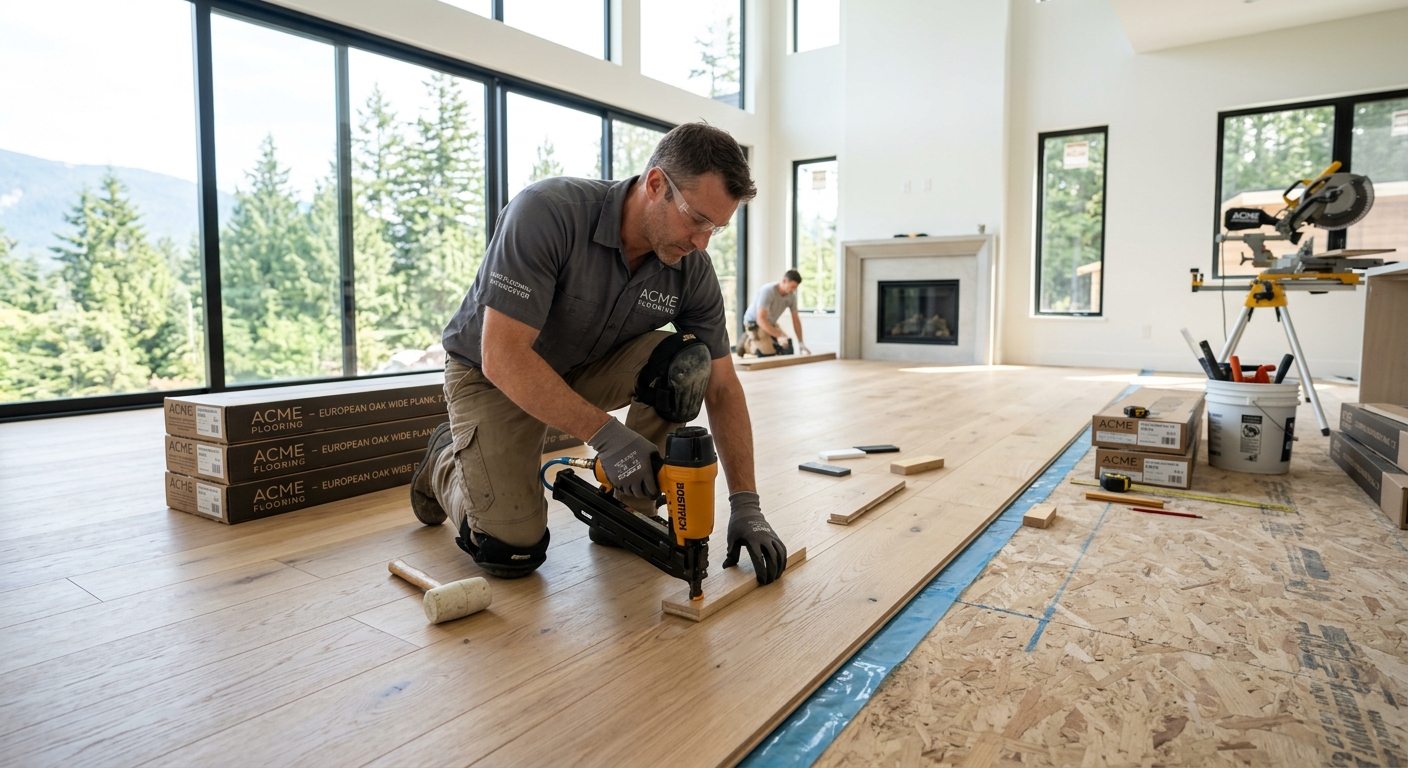
Flooring options and costs in Alpine
In Alpine, Ontario, the right flooring choice usually comes down to balancing comfort, durability, and moisture performance—especially because Toronto-area homes can see wide indoor humidity swings across the seasons. With a local population of 3,203 (Statistics Canada, 2021 Census), Alpine homeowners often renovate single-family and townhouse properties close together, and that steady demand affects scheduling and pricing for installers. In many Toronto-area pockets (including older neighbourhoods developed in earlier decades), many homes have subfloor irregularities that can add prep time before the “real” install starts—levelling and repairs are common and can push budgets up even when you pick a mid-range product. If your home has older finishes to remove, that’s another cost driver that varies job to job.
In practice, the region’s building stock and climate make engineered hardwood and luxury vinyl plank the most forgiving options for most above-grade rooms, while tile and carpet take over where they’re best suited. Solid hardwood looks classic, but it’s more moisture-reactive, isn’t recommended over concrete or for most basement builds, and radiant heat compatibility can limit choices in newer Alpine homes with in-floor systems. Contractors are also busier in Toronto-area renovations, which can increase labour rates compared with many other parts of Ontario.
To help you estimate your project in Alpine, use the table below as a starting point, then we’ll break down why quotes can differ so much and what you can do to control costs.
| Type |
Best Room |
Moisture Resistance |
Lifespan |
Price per sq ft |
| Solid hardwood (nail-down, above grade only) |
Main floor living spaces |
Low to moderate (sensitive to humidity) |
25–60 years |
$10 – $18 |
| Engineered hardwood (float or glue, above + on-grade) |
Main floor living + hallways |
Moderate to high (more stable) |
15–40 years |
$9 – $16 |
| Laminate (click-lock, above-grade) |
Secondary bedrooms |
Moderate (protect against standing water) |
10–25 years |
$4 – $9 |
| Luxury vinyl plank / LVP (waterproof, any level) |
Kitchen, entry, finished basement |
High to waterproof (good for humidity) |
15–30 years |
$5 – $12 |
| Porcelain / ceramic tile |
Kitchen, bathrooms, entry |
High (impervious surface) |
30+ years |
$12 – $25 |
| Carpet (broadloom or modular tile) |
Bedrooms, family rooms |
Low (needs good moisture control) |
7–15 years |
$5 – $11 |
Prices are estimates only and vary by project scope, site access and material selection.
What affects the price of flooring in Alpine
In Alpine and across the Toronto economic region, quotes for the same “room and material” can land 30–50% apart because the biggest cost drivers aren’t just the finish—they’re what’s happening underneath and around the edges. Indoor humidity swings matter: solid hardwood expands and contracts more with moisture and temperature, so it can’t be glued or floated over concrete reliably, and it performs poorly in basements where moisture vapour is more common. Engineered hardwood and luxury vinyl plank are typically more dimensionally stable and are designed for above-grade installs with far better tolerance for real-life humidity. In colder stretches of the region and in newer builds where radiant floor heating is added, owners often need products that can handle heat cycles—this can rule out some solid hardwood and certain laminate systems.
Local housing stock adds another layer. Many homes built decades ago often require subfloor levelling or plywood/OSB repair before the new floor goes down. That prep work can add roughly $1–$4 per sq ft, even before you consider moisture mitigation. For example, a main-floor engineered hardwood project that includes subfloor self-levelling, seam repair, and floor flatness checks will commonly cost materially more than the same square footage on a perfectly flat surface. Conversely, if your existing underlay and subfloor are already in great shape, laminate or LVP can come in closer to the lower end of the $4–$9 and $5–$12 bands.
Finally, labour pricing in the Toronto area runs higher due to strong renovation demand and higher general construction wages. That’s why two bids with the same “LVP” line item can still differ—one contractor may include deeper prep, longer acclimation, and more transitions work (which you’ll feel in the final finish quality).
| Price Factor |
Why It Matters |
Cost Impact |
| Room area in sq ft |
Materials scale with square footage; labour is partly time-based |
Low to moderate variance by size (often 5–20%) |
| Subfloor condition — levelling or repair needed |
Older Toronto-area floors often need patching, plywood replacement, or levelling compounds |
Commonly +$1 – $4 per sq ft |
| Moisture / below-grade install — rules out solid hardwood |
Basements and on-grade slabs require moisture-tolerant systems |
Can add $2 – $6 per sq ft depending on mitigation |
| Material choice — solid vs. engineered vs. LVP vs. tile |
Different products carry different labour complexity and accessory needs |
Can shift total by $4,000+ on typical homes |
| Removal and disposal of existing flooring |
Demo, hauling, and dust control time vary widely |
Often +$500 – $2,500 |
| Stair nosing / transitions — charged per step or per linear foot |
Transitions, reducers, and stair work add materials and detailed cutting |
Commonly +$200 – $1,500 |
| Radiant heat compatibility — limits material options |
Heat cycles require specific installation methods and product ratings |
May add +$1 – $3 per sq ft |
| Installation method — float vs. glue-down vs. nail-down |
Glue-down and nail-down require different prep and tooling |
Often +10–25% over basic float installs |
Permits & regulations in Ontario
In Ontario, installing new flooring itself generally does not require a building permit. That said, related work can trigger permit or approval requirements—especially when you’re touching electrical systems or making structural changes. For example, if your project includes radiant in-floor heating circuit work, thermostat upgrades, or any electrical modifications, you’ll typically need the electrical permitting process to be followed by a licensed electrician. If you’re doing structural subfloor repair that involves significant joist modification or other structural changes, permits can become relevant depending on the scope.
In condominiums, permits are not the only issue. The condo corporation’s rules on sound transmission can affect your flooring underlay choice and the installation details. Even on upper floors, many buildings require specific underlay products and proper installation methods to meet STC/IIC expectations. Always review your condo declaration, ask for board approval in writing if required, and confirm what underlay and installation method you’re allowed to use—especially for hard surfaces like hardwood and tile.
To verify an Ontario contractor in Alpine, check three things step-by-step: (1) Ontario licensing/registration status where applicable (start with the contractor’s own registration claims and confirm via relevant provincial channels), (2) liability insurance—request a current certificate of insurance listing your address as a job site, and (3) WSIB/WCB coverage—ask for proof of coverage and verify it matches the contractor’s legal business name. If they cannot provide these documents up front, that’s a major red flag before you sign.
Best flooring for each room in your Alpine home
In Alpine, Ontario, the most successful floor plans are the ones that match the room’s moisture exposure, foot traffic, and comfort needs to a material that can handle Toronto-area humidity swings. In living and dining spaces, engineered hardwood is usually the sweet spot: it delivers the look homeowners want while staying more dimensionally stable than solid hardwood when indoor humidity shifts through the seasons. For bedrooms, carpet remains popular in Alpine because it feels warm underfoot, absorbs sound, and is comfortable for everyday use—particularly in older homes where the subfloor can be slightly uneven.
Kitchens and entries take the most abuse, so luxury vinyl plank (LVP) is often the easiest win: it’s waterproof, resists spills, and handles the day-to-day moisture that comes with wet shoes and cleaning. If you prefer a “permanent” surface that stands up to water and long-term wear, large-format porcelain tile is a great alternative, though it typically costs more and needs proper subfloor prep for best performance. Basements are where we’re most strict: LVP is the clear winner for finished basements because it’s designed for high humidity and below-grade installs; solid hardwood and most laminate systems are risky over concrete and in moisture-prone conditions.
For radiant floor heating, engineered wood, tile, and certain vinyl products pair well because they’re installed to accommodate heat cycling. A solid hardwood install over radiant systems is often limited by manufacturer guidance.
On pricing, if you compare options: switching from laminate around $4 – $9 per sq ft to engineered hardwood around $9 – $16 per sq ft can be justified in main living areas when you want a longer lifespan and higher resale appeal—provided your subfloor prep is done right.
| Room |
Best Material |
Why |
Moisture Risk |
Price Band per sq ft |
| Living / dining room |
Engineered hardwood |
Warm look with better stability during humidity swings |
Low to moderate (above-grade control) |
$9 – $16 |
| Master bedroom |
Carpet or engineered hardwood |
Comfort and quiet; engineered keeps moisture tolerance better |
Low (but protect against spills) |
$5 – $16 |
| Secondary bedrooms |
High-quality laminate or engineered hardwood |
Good value and durability with easier maintenance |
Low to moderate |
$4 – $14 |
| Kitchen |
Luxury vinyl plank (LVP) or porcelain tile |
Water/spill tolerant and easier cleanup |
Moderate to high |
$5 – $25 |
| Basement (finished) |
Luxury vinyl plank (waterproof) |
Designed for below-grade moisture conditions |
High (moisture vapour risk) |
$5 – $12 |
| Bathroom |
Porcelain or ceramic tile |
Impervious surface and excellent water resistance |
High |
$12 – $25 |
How to choose a flooring contractor in Alpine
Choosing the right flooring contractor in Alpine is mostly about verifying coverage and reading the scope closely—because the “extra” details are where costs and outcomes are won or lost. Start with Ontario compliance basics: ask for proof of liability insurance (a current certificate of insurance for the job), then ask for WSIB/WCB coverage proof, and confirm it’s tied to the contractor’s legal company name. If you’re getting radiant heat or any electrical-adjacent work, confirm the appropriate trades are licensed for what they do—don’t let a flooring crew assume electrical responsibilities. You can also ask the contractor for their Ontario business details and match them to insurance documents.
Next, request 2–3 itemised written quotes. You want the breakdown to show labour and materials separately, plus line items for removal/disposal, underlayment, stair nosing/transitions, and subfloor prep. Avoid “all-in lump sums” unless the scope is extremely detailed. Also clarify what’s excluded: for instance, whether moisture mitigation is included if tests show elevated moisture, or whether disposal is included for old flooring and underlay.
For warranty, confirm both workmanship and product coverage. Ask: how many years is the installer’s warranty, is it transferable to a new homeowner, and do they document acclimation and installation steps? Payment schedule matters: never pay more than 10–15% upfront; hold back the remainder until the job is complete and you’ve confirmed clean transitions, proper finishing, and any punch-list items are done. Finally, get the start date and a completion estimate in writing so you can plan around your family’s routine and protect your home from extended dust exposure.
- Provide WSIB/WCB proof and confirm the insured legal name matches the invoice.
- Provide liability insurance certificate (ask for job-site address details if available).
- Give a written scope: prep, underlayment, transitions, and finish details.
- Itemise material and labour—avoid a single “lump sum” line.
- Confirm disposal/hauling is included (or priced separately).
- Ask how they handle moisture mitigation if subfloor tests show elevated readings.
- Confirm installation method (float vs glue-down vs nail-down) matches the product warranty.
- Ask about acclimation time for hardwood/vinyl products in Ontario humidity swings.
- Request the exact warranty lengths and whether the workmanship warranty is transferable.
- Discuss stair nosing and transitions: per step or per linear foot pricing.
- Clarify payment schedule and holdback amount before work starts.
- Provide a written start date, duration estimate, and who to contact for changes.
Red flags I see in Alpine: contractors who won’t show insurance/WSIB documents; quotes that omit subfloor prep and transitions (then “find” them later); pushy pressure for large upfront payments; vague warranty terms like “we stand behind it” with no written duration; and installers who won’t discuss moisture testing or acclimation for your specific room conditions.
Frequently asked questions — flooring in Alpine
How do I compare flooring quotes?
To compare flooring quotes in Alpine, focus on scope and inclusions—not just the final number. Ask each contractor for the same line-item breakdown: materials (product name, grade, and thickness if applicable), labour, subfloor prep/levelling, underlayment, stair nosing/transitions, removal and disposal, and any moulding/trim adjustments. Make sure moisture mitigation and subfloor flatness prep are covered in writing; Toronto-area humidity swings can make “minor” prep necessary once the existing floor is removed. Also confirm the installation method matches the product warranty (e.g., engineered hardwood glue-down vs float). If one quote uses a different product level, you may be comparing different realities even if both fall within the $9 – $16 engineered band.
Can I install flooring over existing tile in Alpine?
Often yes, but it depends on the condition of the tile and what you’re installing over it in Ontario. For vinyl plank, you can sometimes install over tile if the surface is stable, properly level, and well prepared (no loose grout, no rocking tiles). For floating floors, the main requirement is flatness within the manufacturer’s tolerance. If you’re planning laminate or engineered hardwood, you need to confirm that the manufacturer allows tile over tile and that an appropriate underlayment system is used. If the tile surface is uneven, you may need grinding or patching first—otherwise you risk movement and joint separation. If your tile is cracked or loose, fixing it typically costs less than repairing a failed new floor later. A reputable contractor should identify this before quoting.
What is the best flooring for a high-traffic area in Alpine?
For high-traffic areas in Alpine—entries, main halls, and open living spaces—I typically steer homeowners toward engineered hardwood or luxury vinyl plank. Engineered hardwood is a strong choice when you want a premium look and better stability than solid wood during seasonal humidity changes. If you expect frequent spills, wet shoes, or you’re working around a foyer where water can track in, waterproof LVP is often the safest bet because it handles moisture far better than hardwood or laminate. Carpet can work in bedrooms or lower-traffic zones, but in busy corridors it can wear faster and trap dirt in pile. Budget-wise, you’ll usually compare products across the $5 – $12 LVP band or the $9 – $16 engineered band; the “best” pick is the one that matches your day-to-day moisture and cleaning reality.
How do I prepare my subfloor before new flooring?
Subfloor preparation is where most flooring failures are prevented in Ontario, especially in older Toronto-area homes. After removal, contractors should check flatness, inspect for soft spots, and identify any plywood/OSB damage. If levelling is needed, they’ll typically use patching and/or levelling compound to bring the surface within the manufacturer’s tolerance. They should also address squeaks and fix hollow areas so nailed or glued systems don’t fail. For below-grade projects, moisture testing and moisture mitigation are critical—solid hardwood is not recommended for basements, and most laminate is risky where vapour is present. If you’re installing engineered hardwood above grade, good prep still matters for long-term seam integrity. Ask your contractor what they will do specifically for your subfloor condition, and whether those steps are included in the quote.
Is cork or bamboo flooring a good choice in Alpine?
Cork can be comfortable and can help with sound, but it still needs careful installation and moisture control in Alpine. If your home has strong humidity swings or you’re considering installation near exterior doors, bathrooms, or basements, cork’s performance can vary depending on the product’s finish and construction. Bamboo’s main concerns are structural stability and how it reacts to moisture; it’s not as forgiving as engineered hardwood in below-grade or high-humidity scenarios. In Toronto-area conditions—where moisture vapour in basements is a real issue—I usually recommend sticking to engineered hardwood or waterproof LVP for the broad majority of homes. If you’re strongly considering cork or bamboo, ask for the manufacturer’s moisture rating, installation requirements, and whether they explicitly allow your intended location in Ontario (especially basements and on-grade slabs). If they won’t, it’s a sign to pivot.
What is the difference between floating and glued-down flooring?
Floating flooring is installed so it isn’t rigidly attached to the subfloor; typically, the planks click together and the system “floats” over an underlayment. This method is common for laminate and some vinyl plank products. Glued-down flooring is fixed to the subfloor using adhesive, creating a more rigid bond that can help with stability—particularly when the subfloor is properly prepared. In Alpine’s humidity swings, both methods can work, but the key is matching the installation method to the product and warranty requirements. For example, if you’re dealing with concrete or a moisture-prone slab, glued systems still need correct adhesives and conditions, and solid hardwood is often limited. Ask your contractor which method they’re proposing and confirm it’s consistent with the manufacturer’s instructions—this can affect long-term performance and your ability to claim warranty coverage.